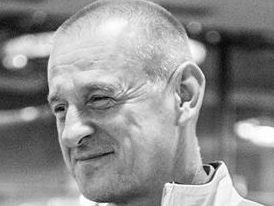
Yuriy Solomko

Not finished version, filling up
Biography
1962.05.11

was born in Bakhchisarai (Ukrainian SSR)

1986

graduated from the Krasnodar Art College (Krasnodar, RSFSR)

1986–1992

graduated from the monumental painting workshop of the Kyiv State Art Institute (now — National Academy of Fine Arts and Architecture) (Kyiv, Ukraine)

1990–1994

participant of the squat «On Lenina» (at the corner of Franko Street and the current Bohdan Khmelnytsky Street). Worked in the squat on Paris Commune Street.

1993

CulturalContact Scholarship (Vienna, Austria)

1995

CulturalContact Scholarship (Vienna, Austria)

1995

ArtKomuna Scholarship (Galichnik, Macedonia)

1996

scholarship holder of the CEC ArtsLink program (New York, USA), Cleveland Institute of Art (Cleveland, USA)

1998

participation in the summer academy «KulturEks» (Slovakia)

2000

participation in the summer academy «KulturEks» (Slovakia)

2001

participation in the summer academy «КультурЕкс» (Hungary)

2002

participation in the summer academy «КультурЕкс» (Hungary)

2003

participation in the summer academy «KulturEks» (Poland)

Overview of artistic practice

Yuriy Solomko. Resume. Researcher — Tetyana Zhmurko. 2016. Yuriy Solomko

The beginning of Yuriy Solomko’s artistic career dates back to the late 1980s. From 1986 to 1992, he studied at the Kyiv State Art Institute in the monumental painting workshop of Mykola Storozhenko. He began his exhibition activity in 1988. In 1990, Solomko, then still a student, became a member of the squat on Paris Commune Street, whose creative atmosphere largely defined his path. His early work, like that of most Parkomuna artists, is characterized by the search for a new visual language. Remaining faithful to painting, the artist created large-format works in which characteristic features of postmodernism (quotation and ironic reinterpretation of the past) are combined with the typical baroque style of Ukrainian art, expressed in dynamic visual language, metaphorical imagery, and frequent use of the shell as a symbol of sensuality and vitality.

In the early 1990s, Solomko found his original visual language related to geographical maps, which he has been developing and transforming throughout his life. The first work was created by the artist a few months before the collapse of the USSR, when the air was filled with a sense of freedom and radical irreversible changes, when the geographical map underwent huge changes, and along with it, self-awareness and awareness of the surrounding reality were transformed.

For Solomko, “the map is one of the strongest symbols created by civilization. It combines so much that when working with one of the layers, something new inevitably appears beneath it. The only thing missing from the map is immaterial, non-visual concepts. For example, the concept of time. There is no map of emotions or experiences. But for this, there is a painting. I tend to think that any painting is a map of feelings”[1].

The first work created based on maps is “Morning Toilet.” The idea was born accidentally. Traveling through Crimea, the artist wanted to buy a local map, but on the bookstore shelves, as was usual in the early 1990s, there were only school political maps of the world. The author took these as a basis. At the same time, bookstores began to stock “Justine” by Marquis de Sade (erotic literature of this kind was banned during Soviet times) with reproductions of 18th-century engravings, which the artist also borrowed for his compositions. He himself calls this group of works “Projections” because technically, to create the image on the map, he used an epidiascope.

Later, Yuriy Solomko transformed the creative method he invented of painting projections on maps into the field of media art and began experimenting with photography. His fascination with photography is connected with a scholarship stay in Cleveland (USA). He created works by overlaying two shots: the human body and a geographical map. Remaining devoted to the symbols and signs of geographical maps and images from art history, the artist created new series of photographs where heroes from art history fit well into the surface of continents, whose images repeat the outlines of land and oceans.

A powerful series by Solomko, “Planet of People,” combines the symbolism of the map with the human body as an embodiment of the Earth’s body. For the project, the artist invited people with disabilities and other physical defects resulting from accidents or natural disasters. Through their mutilated bodies, the artist showed the Earth’s body suffering from ecological catastrophes and wars. The transformed bodies are placed on maps of the planet’s hot spots and visualize the processes occurring in specific regions, while the personal tragedy of the depicted person takes on a planetary scale. For example, in the work “Aral Sea,” the naked body of a woman with a removed breast symbolizes the tragedy of the Aral Sea, which has almost disappeared — turned into a desert due to an ecological disaster.

Continuing to work with the human body, Yuriy Solomko created a series of staged studio photographs in 2003. In his project “Regeneration,” the model was a girl with physical disabilities, whom the artist involves in a masquerade game and dressing up. Unlike the “Planet of People” project, which focused on physical losses and suffering on a global scale, the “Regeneration” project showed the beauty of the human body, but through the beauty of the tragic, which is usually hidden in a society intolerant of difference.

In the projects “Natural Product” (2007) and “GMO-Free” (2010–2014), Yuriy Solomko returns to traditional painting. By meticulously depicting green vegetables, fruits, and numerous jars of preserves, the artist gives them a bright, even “glossy” sound and thus raises the question of whether anything “natural” or “organic” exists today.

If Yuriy Solomko’s first maps were rather formal searches, experiments with new material, the latest ones openly appeal to the geopolitical context and raise complex contemporary issues. The artist increasingly turns to the theme of Ukraine, analyzing geopolitical and local contexts, and ironically commenting on myths and legends deeply rooted in Ukrainian history. One can recall his work “The Last Barricade,” created in 2008 together with Crimean Tatar artist Ismet Sheykh-Zade. Against the backdrop of the map of Ukraine are portraits of the artists themselves, holding long spears that cross the map’s space and intersect on the territory of the Crimean Peninsula. This work, prophetic in many ways, appeals to the complex history of Crimea, where the political interests of several states intersect.

[1] Desiateryk, Dmytro. Cartography of feelings: interview with Yuriy Solomko // Den. — 2000. — October 19 (No. 190): http://www.day.kiev.ua/uk/article/kultura/kartografiya-pochuttiv


Exhibitions
2018.03.01
FLASHBACK. Ukrainian media art of the 1990s.
2016.10.21
Parkomuna. Place. Community. Phenomenon
2015
Old news
2014.07.08
Ukrainian file. Exhibition of Ukrainian artists
2014.04.29
The Show Within The Show
2014.01.23
Non-GMO
2014
Premonition: Ukrainian Art Today
2014
Blinded by beauty
2013.10.18
Exhibition of Contemporary Ukrainian Art as part of the Ukraine Days Festival in the United Kingdom
2013.08.04
August Agenda
2013.05.15
Orientation on the terrain
2013
Race against time. Art of the 1960s – early 2000s
2012
Titans
2012.06.02
Contemporary Ukrainian artists, within the framework of the parallel program ARSENALE 2012
2011.08.23
20 years of presence
2011.08.23
Independent
2011.04.05
International Week of Contemporary Art "Space Odyssey — 2011"
2010
Gazing. Rorschach
2010
Restriction
2010
LeaderLenin
2009.12.25
DO NOT HIDE!
2009.09.18
Ukrainian New Wave. Art of the second half of the 1980s — early 1990s
2009.06.25
Bloomsday ’09. The perfect age
2009.06.23
Persistently
2009
Over The Wall
2009
Between Heaven and Earth: A New Ukrainian Landscape
2009
Above the wall
2008.05.14
Art Moscow — 2008, 13th International Fair
2008.04.29
G8
2008.04.11
New Ukrainian Art
2007.10.11
Sex. Boxing. Jazz
2007
Natural product
2007
Just a dream
2006.12.21
Artists are drawing. A4, ballpoint pen, 2006–2007
2006.05.04
Ukraine and around
2004.12.09
Outskirts
2004.10.01
Farewell, weapon!
2003.11.22
First collection
2003.05.08
Hyperspace
2003.01.17
Regeneration
2003
Start
2002.10.23
Blue clay
2002.04.23
Beyond the threshold, within the Art-Moscow festival
2002
Office
2002
Poetry of the Wind. International Flag Festival
2001
Art versus Geography
2001
Motherland
2001
The first Ukrainian project, the 49th Venice Biennale
2000.05.16
Intervals. Cosmism in Ukrainian Art in the 20th Century
2000
Intervals. Cosmism in Ukrainian Art in the 20th Century
2000
Result 2000
2000
Intervals. Cosmism in Ukrainian Art in the 20th Century
2000
Untitled
2000
Yalta — 2000
1999
Preventive measures
1999
Pinacotheca. Special project "New Figurativeness"
1998
Cartographers
1998
Cartographers
1998.11.07
Crimean Project II
1998
Depth and height scale
1998
Cartographers
1997
Love story
1997.05.24
Kyiv—Odense—Toulouse — A Love Story
1997.03.[?]
Photo…synthesis
1997
Cartographers
1997
Peer Gynt
1996
Borders
1996
Contemporary Russian art, the collection of Lys Janstrup and Jens Gregengesen
1996
Borders
1996
Parts of the world
1996
Cartography
1995
5 years of Marat Gelman Gallery
1995
Top secret
1995
Black and white
1994
Transit
1994
Cold-hot orientation
1994.05.26
Space of Cultural Revolution
1994.02.18
Artistic impressions
1993
Event-93. III Biennale
1992.03.06
Calm
1992
New works of Kyiv artists
1992
Start
1992
[?]
1991.11.12
Artists of the Paris Commune
1991
Republican Spring Art Exhibition
1990
Group-90
1990
New figurations, 1990, Odessa, Ukraine
1990
Three generations of Ukrainian painting, 1990, Kyiv, Ukraine
1990
Ukrainian smallART of the 60s-80s
1990
Exhibition of Ukrainian Artists
1990
Three generations of Ukrainian painting, 1990, Odense, Denmark
1989
21 погляд
1988
Любов — 1988
Bibliography
  1. Соловйов О. Турбулентні шлюзи: Зб. статей / Олександр Соловйов // Ін-т проблем сучасного мист-ва АМУ. – К.: Інтертехнологія, 2006. – 192 ст.: іл. – Режим доступу до ресурсу: http://www.mari.kiev.ua/PDF/solovev.pdf
  2. Solovyov A. About Yuri Solomko's project ”Regeneration” [Electronic resource] / Alexander Solovyov // Guelman Gallery in Kyiv. – 2301. – Access mode to the resource: http://kiev.guelman.ru/rus/articles/3e3003a3a8ac1/.
  3. Sakharuk V. Artistic Impressions. Painting, Graphics, Sculpture, Installation / V. Sakharuk. – Kyiv: Center "Ukrainian House" Gallery "Alipiy", 1994. – 159 p.
  4. Yuriy Solomko: symbols of modernity are rarely worthy of being depicted on the map / [Conversation with Halyna Klyuchkovska] // ART Ukraine. – 2010. – No. 3 (16), May-June. – pp. 30-37
  5. Conversation of Anatoliy Zvizhynskyi with Yuriy Solomko // In the End. Almanac on Contemporary Art. – 2009. – pp. 127 – 129.
  6. Yuriy Solomko: Mystical Cartography / Ihor Bondar-Tereschenko // Fine Arts. – 2007. – No. 2 (26). – pp. 110-111
  7. 21st View: Young Contemporary Ukrainian Artists [catalog]: 1989 – 98 p.
  8. History of Ukrainian Art: in 5 vols. / NAS of Ukraine. M.T. Rylsky Institute of Art Studies, Folklore and Ethnology; chief ed. H. Skrypnyk, scientific ed. T. Kara-Vasylieva. – Kyiv, 2007. – Vol. 5: Art of the 20th Century. – 1048 p.: ill.
  9. The Myth of "Ukrainian Baroque" / Exhibition Catalog // Article authors: Halyna Sklyarenko, Oksana Barshinova. – Kyiv: 2012. – 192 p.: ill.
  10. Intervals. Cosmism in Ukrainian Art. Part I /book-catalog, concept: Valentin Rayevsky. – Kyiv, 2000. – 262 p.: ill.
  11. Ukrainian New Wave. Late 1980s – early 1990s: exhibition catalog // Compiled by: Oksana Barshynova. Article authors: Anatoliy Melnyk, Halyna Sklyarenko, Oksana Barshynova. – Kyiv: Oranta, 2009. – 224 p.: ill.
  12. Independent. New art of the new country. 1991-2011/ Exhibition catalog – Kyiv, 2011. – 252 p.
  13. The Time of Patrons / Booklet of the public collection of contemporary art of the National Art Museum of Ukraine – Kyiv: Institute of Contemporary Culture, 2004. – 48 p.
  14. Cartography of Feelings / Interview of D. Desyaterik with Yu. Solomko. [Electronic resource] / Dmytro Desyaterik // Newspaper "Den". – 2000. – Access mode to the resource: http://day.kyiv.ua/uk/article/kultura/kartografiya-pochuttiv.
  15. 20 years of presence / Exhibition catalog – Kyiv: Institute of Contemporary Art Problems, 2011.
  16. Sklyarenko Halyna. On the Shores. Notes on Ukrainian Art of the 20th Century. Collection of Articles / Foreword by M. Selivachov. – Kyiv: Sofia, 2007. – 336 p.
  17. Staged Photography in Contemporary Ukrainian Art / Oleksandr Solovyov // Fine Art. – 2009. – № 1 (6). – 32-35
  18. Sklyarenko H.Ya. Contemporary Art of Ukraine. Portraits of Artists. Second edition, in Ukrainian. Supplemented. // Halyna Sklyarenko – Kyiv: Huss, 2016. – 376 p.: ill.
  19. Uspensky A. Painting in the Context of Postmodernism. The South Russian Wave from the GRM Collection (a gift from Marat Gelman) [Electronic resource] / Anton Uspensky // http://uspensky.narod.ru/. – 2008. – Access mode to the resource: http://uspensky.narod.ru/sud-wall.html.
  20. Desyaterik D. Where Time Thickens. On the Tenth Anniversary of the Closure of the Squat "Paris Commune" / Dmytro Desyaterik. // Den. – 2004. – No. 133. – Access mode to the resource: https://day.kyiv.ua/uk/article/kultura/tam-de-zgushchuietsya-chas.
  21. ПАРКОМУНА. Місце. Спільнота. Явище / автор-упорядник Тетяна Кочубінська. – Київ: Victor Pinchuk Fondation, PinchukArtCentre, 2017. – 207 с.