From Reaction to Thought. Part 3. What Are Thoughts About?
Imagine an embroidered textile butterfly with the portrait features of the artist Myroslav Yahoda, or another one resembling a math notebook, or yet another dedicated to the confident step of the artist Vova Vorotnyov. Suddenly, what seems significant and mundane alike resemble each other, and the division into important and insignificant disappears.
In the autumn of 2019, artists Stas Turina and Katya Libkind took over the baton of textile butterfly embroidery from the Lviv hippie — Yan Metelyk (Ivan Lyashkevych, 1961–2010). Since 1982, he traveled to music festivals, called himself a thread master, and embroidered over 3,000 butterflies during his lifetime. Yan Metelyk was neither a folk master nor a professional artist; his embroidery practice is difficult to classify in the usual way. However, visually and metaphorically, it contains a humble and humane form of artistic reflection on reality. The ornamental and decorative butterflies of Ivan Lyashkevych, as executed by Stanislav Turina and Katya Libkind, began to acquire anthropomorphic features, figurative embodiments, and new symbolic meanings. Among the butterflies are those dedicated to Katya Libkind’s exclamations, the year 2019, 30 seconds of our life, violent body deformations, brands, Ukrzaliznytsia, DJs, and many other everyday phenomena. It is everyday life, along with those elusive and insignificant fragments, that artists embody through routine work. They embroider insignificant images, thereby reducing the meditativeness of handicrafts to a diary form: this is evident both in the themes and in the systematic nature of the work. As for the image of the butterfly, it contains a metaphor of transition, the process of transformation of a living being, its natural metamorphosis. An image and state that resonate with the current stage of moving away from entrenched historical and artistic paradigms and pseudo-traditions.
This text is the third and final in a series of articles by the Research Platform on Ukrainian art of the independence era. We will attempt to comprehend the changes that have occurred recently and have become a certain trend. There are no clear temporal or generational boundaries here, as the outlined processes began before the specified historical period. However, in recent years they have become visible, such that one can speak of them as a set of certain qualities and characteristics of contemporary Ukrainian art. The list of projects included in the article, as well as the characteristics described below, are not exhaustive and do not claim unequivocal judgment. Rather, it is a desire to rethink the progress of independent Ukrainian art differently. Also, an attempt to outline the main directions of movement in 21st-century Ukrainian art.
The 20th century, among other things, was an era of power: physical, emotional, psychological violence increasingly became a means of controlling the discipline of social and individual bodies. The pursuit of increasing power was a principle for survival. But a small effort still became resistance to great power. Anticipating the circumstances of the total destruction of World War II, in her pre-war diaries, French philosopher Simone Weil (1909–1943) wrote: “Art is a symbol of two noble human efforts: to build and to refrain from destruction” [1]. Weil gave effort prevailing significance over power and saw in this a manifestation of the humanity of the future. Weil also coined another phrase — “In recent years we have had much freedom of thought, but no thought.” Weil’s philosophical views resonate with our present: we entered the 21st century with a struggle for our rights and freedoms — two Maidans and the war testify that society repeatedly fought for freedoms, but what thought did it offer along with that?
The 21st century has not yet created a single narrative by which one could move in the darkness of history, unerringly taking the side of “truth.” Belgian art sociologist Pascal Gielen called the current situation “artistic multiplicity” [2], characterized by the individualization of participants but on the path to forming communities. The introduction to the special issue of Obieg journal Euphoria and Fatigue: Ukrainian Art and Society after 2014 states that the questions provoked by the post-2014 situation about responsibility, the integrity of state borders, the fragmentary worldview, post-truth, and information manipulation have established an awareness of the impossibility of a single normativity [3].
This does not deny the existence of various circles and currents, but it seems important to us to reveal what has begun to acquire a certain systematization in recent years. The following will discuss a number of features characterizing the art of the new era.
SLOWING DOWN
If the 1990s and early 2000s were a time of reactive projects, and quick reaction defined the creative method of artists, the current situation could be called slowing down, paradoxical as it may be in times of frantic pursuit of success, hyper-productivity, and permanent acceleration of technological changes. Slowing down is expressed in concentration, emphasis on the creative process, on the search for oneself, or in “hesitant contemplation that breeds doubt” [4]. Here processuality becomes one of the tendencies in the practice of many young Ukrainian artists. For this circle, the process is more significant than the form it takes. In the words of Katya Buchatska, such art does not need a theme [5]; it is intuitive, following emotions and contemplation. It can begin with a pencil stroke or some other insignificant experience. The insignificant becomes important because if it is small, undefined, unnoticed, or everyday, it does not mean it is apolitical. This political dimension lies in another, individual dimension and resembles the archaeology of everyday life. Therefore, such art cannot have a fixed form — it uses all the tools it can master, both artistic and life-related.
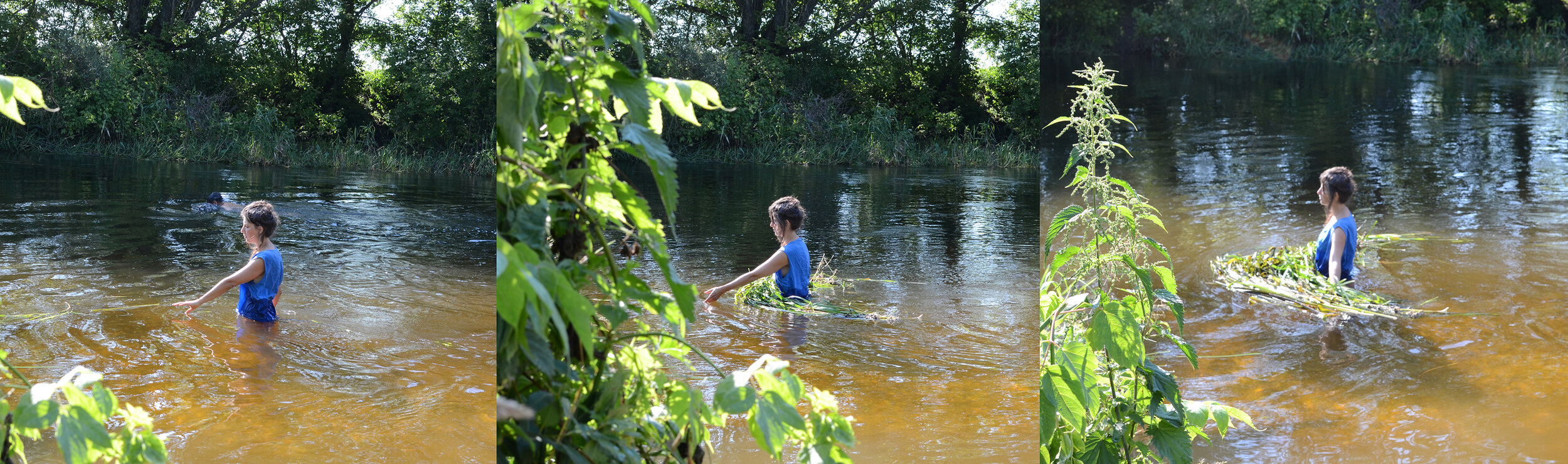
Katya Buchatska. Practices of Lazy Land Art. During the Mogrytsia Land Art Symposium. 2016. Photos provided by the author
Meditativeness in artistic practice is given by the repetition of actions, immersion in the process, and following its flow, beyond the final goal of creating an artwork. Thoughtfulness and processuality do not become the opposite of reactions, i.e., actions. Rather, it is a natural change of state — from activity to slowing down, reflection, sometimes even routine.
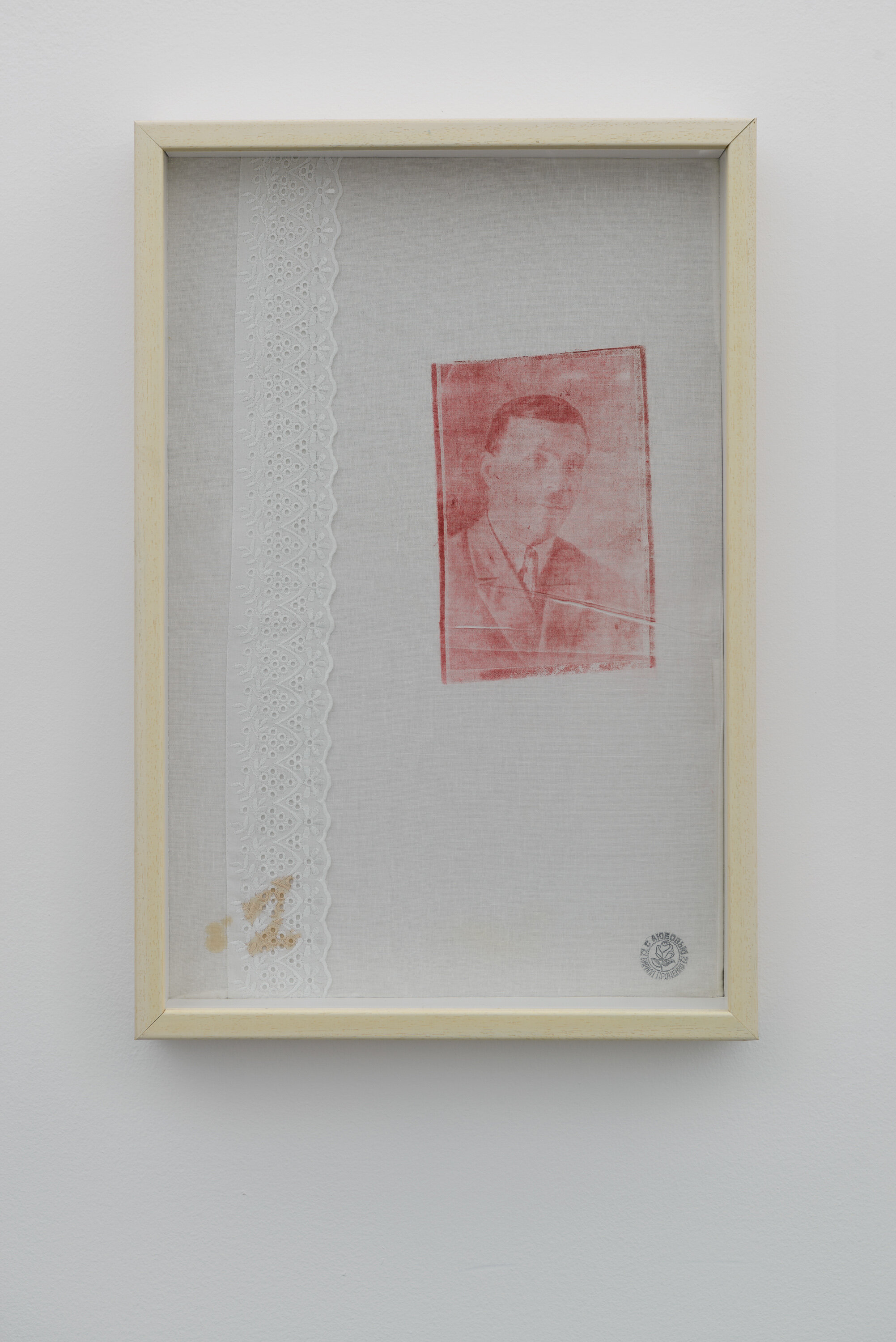
Kyrylo Protsenko. White Spots. 2005. Fabric, high print. Provided by the artist’s family. Photo from the exhibition “Anonymous Society.” Provided by PinchukArtCentre © 2017. Photographer: Maksym Bilousov
Or vice versa. For example, among the works of Volodymyr Kuznetsov, besides large-scale monumental murals with sharp social, political, and anti-clerical subtexts, there is another type of artistic expression — sensitive and personal practices of “stitching experience” [6]. Kuznetsov worked with textiles and sewing for a long time, skills he inherited from his grandmother Ulyana Kuznetsova and deepened at the Department of Artistic Textiles at the Lviv National Academy of Arts. By embroidering pages of his diary transferred onto fabric, with random sketches or thoughts torn from context, the artist invites the viewer into a private territory. The stereotypically female technique of embroidery in the hands of a man levels the gender quality of the material and becomes, though fragile, a way to immortalize such a form of artistic practice. Another example is Kyrylo Protsenko’s series “White Spots” (2005), based on childhood memories related to important moments of personal life. Intimacy and the child’s world are expressed here through starched family sheets that serve as a background for the print — memories of that time. Such personality and empiricism beyond social criticism during the wave of active political transformations and social activism after the 2004 Orange Revolution were little understood in the mid-2000s and early 2010s.

Dmytro Krasnyi. From the series “Under the Glass Dome.” 2020. Paper, lens, porcelain. Photo provided by the author
In contrast to the processes of technologization of art, its virtualization, artists return to art as craft — handmade, mechanical, tactile. To sewing, painting, analog means of photography and printing, working with ceramics, fabric, and other applied practices. In graphics, these are subtly thin and emotionally ephemeral drawings and collages by Misha Buksha, Katya Libkind, Dmytro Krasnyi, and others.
“I worked for other artists — painted pictures for them and got paid (authorship, of course, remained with them). I came to the realization that I was a worker, and what I was doing was craft. Using the term ‘artist-craftsman’ was an attempt to unify my practice in art and life. Now I am returning to drawing and painting — having reflected and understood my practice and the specifics of the work” [7], noted artist Anna Shcherbina in an interview.
Undoubtedly, such practices still yield in quantity to the video genre or digital art, which contemporary Ukrainian artists actively develop today.

Misha Buksha. Broken, from the project “Primitive People.” 2018. Paper, monotype. Photo provided by the author
EMPATHIC COMMUNITIES
The uniqueness of the new era is often described through excessive emotionality — emotions become a significant tool of geopolitical games, hybrid wars, and new economic relations as never before, and “like” and “dislike” are equivalents of currency. The beginning of the 20th century shifted the perspective, and the figure of the observer became central, while attention became an important practice that allows understanding one’s own emotions and desires, as Jonathan Crary writes in his article “Visual Technologies and Depression” [8]. In the 21st century, “our corporeality limits us,” notes Olena Chervonyk in the text “Micropolitics of Another Sensitivity” [9]. It seems most exhibitions and artists’ works either tell about corporeality or manifest it. However, is everything depicting the body truly a bodily and sensory experience, or does it rely on someone else’s acquired experience, previously described or reproduced by another?
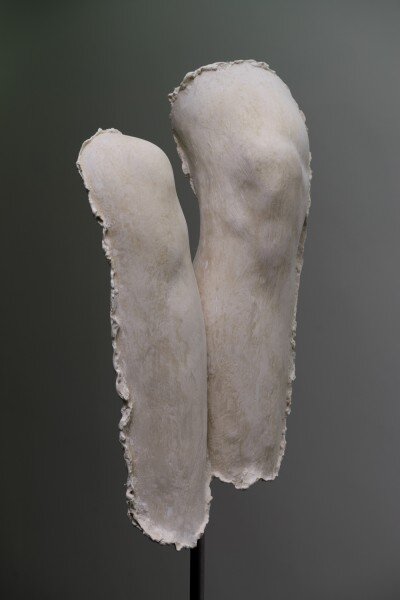
Anna Zvyagintseva. Inappropriate Touches. Fragment. 2017. Photos provided by PinchukArtCentre © 2017. Photographer: Maksym Bilousov
In search of answers, the artist becomes like a child who sees themselves in the mirror for the first time and begins to explore the surrounding world and themselves. This happens, for example, in Oksana Kazmina’s work “Secret. Girl and Boy” (2017), where her characters literally study their own and others’ bodies and the environment. Another example is the practice of Anna Zvyagintseva, who has been working with ceramics for several years, creating thin and delicate sculptures. The formative element in her works is the space created by intervention in the personal zone (exhibition “Inappropriate Touches”) or, conversely, the approximation of people to each other (exhibition “The Emptiness of Doors and Windows Allows the Room to Be Lived In”) [10].
As we see, these searches concern not only one’s own physical body but also the social body — the city, family, community, nature. The observer returns. Only now he (she) watches not history or the global world but themselves, their own reactions, everyday life, and the environment. Artists abandon global forecasting, acts of visionary art, aiming instead for intimate reflection on states, emotions, and processes they are part of. For example, commenting on her work “Record of Pain” (2020), Katya Buchatska noted: “I was interested in marking the place of a person, shifting anthropocentrism, proposing to look differently: we are much less than we are used to thinking about ourselves” [11].
Most artists work with their own experience, social context, personal problems, and preferences. However, today’s art differs from previous years by attempting to reconsider the origin of its experience — is it yours or borrowed (imposed)? To feel by touch whether surfaces, structures, tastes, textures are real, whether your body resonates with circumstances and time? Or is it a reflection on knowledge? After all, our knowledge about art has to some extent atrophied how we feel. Thus, the right to corporeality, previously fought for by feminists, must now be fought for by everyone. Likewise, the right to one’s own sensitivity and emotionality, the right to sentimentality, the right to not be serious, the right to empathy and mutual understanding. The right to healthy communication. Hence the need arose to create communities working on the principle of friendly circles, close surroundings. This is no longer a party or a squat where passions, struggles for primacy, the desire to assert oneself through another, or imitation may rage. It is a more empathic format of communities formed from comrades and friends or students and teachers.
ROOTING
As the aforementioned Simone Weil noted, “a person who can say something new can initially be heard only by those who love them” [12]. It is precisely about the formation of such communities built on mutual trust and respect that Anton Karyuk, Oksana Kazmina, Tymofiy Maksymenko, Yaroslav Futimsky, Elias Parvulesco, Yarema Malashchuk, Roman Khimey, and others speak through their practices. The group “Montage,” the workshop of Stas Turina and Katya Libkind “Atelier Normal,” or the “Luhansk Contemporary Diaspora” — a musical-art project initiated to popularize Donbas art — those who stayed and those who left the war zone — work on this principle.

Oksana Kazmina. Secret. Girl and Boy. 2017. Photos provided by PinchukArtCentre © 2018. Photographer: Maksym Bilousov
An example of activity built on the principle of such horizontal communication is the practice of the Open Group. In particular, works that include a participatory element. Gallery spaces such as “Detenpula” in Lviv, “Koridor” gallery and “Sorry, No Rooms” residency in Uzhhorod, NOCH in Odesa, “Shukhlyada” in virtual space, PVS in Lutsk, Kherson Museum of Contemporary Art, “Garages” in Kharkiv, and others are also built on horizontal principles. All these institutions were organized at different times — indicating that the demand for such a format of interaction existed earlier, but now we observe a growing need for such institutions and formations.
Rejection of the practice of knowledge transmission was a manifestation of the reactivity of new art in independent Ukraine and arose as resistance to tradition, which was identified with Soviet dogmas and structure. However, tradition itself was not always what limited the development and transformation of art. Speculation on tradition and the need to regulate the progress of art for political or personal reasons form prejudices against the practice of imitation and transmission of empirical knowledge from teacher to student.
The situation of constant erasure of memory, which has permanently existed in Ukrainian cultural history, requires artists to reconstruct the artistic environment. Each conducts this practice locally, changing their own guidelines in rethinking the present. Nowadays, artists increasingly turn to projects trying to restore the imitative methods, find a connection with tradition. Here it is worth mentioning the project “Rethinking,” initiated by PinchukArtCentre, aimed at finding connections between young artists and the creativity of the older generation. For example, the Open Group invited Lviv artist Yuriy Sokolov, whose work resonated with their own practice. Although Sokolov cannot be called a direct teacher of the Open Group in the literal sense, the artists sought a certain affinity of ideas.
There is also a noticeable trend of organizing their own art schools, a desire beyond mentorship positions to share personal experience and create a community with similar views and interests. Teaching activities of Ivan Svitlychnyi and the art group Sviter, and their students Yevhen Svystun and Taira Umarova, who continue working with technological art, developing this type of artistic practice, come to mind. Also, the work of Lesia Khomenko, who has been teaching at Kyiv Academy of Media Arts for several years. Recently, the Voloshyn Gallery [13] hosted the exhibition “Lesia Khomenko and Her School,” described as “This exhibition is about trust, self-irony, and problematization of contemporary Ukrainian education” [14]. Another example is the activity and developments of the Method Foundation and, in particular, Lada Nakonechna and Kateryna Badianova, who develop artistic practice and environment, their interests lying between scientific research and recontextualization of history.
CONTEMPLATION
The current form of escapism allows one to observe oneself without resorting to global historical and political contexts. Such individualistic mechanisms are further strengthened by the absence of extensive cultural systems, lack of social elevators in culture, an active community, and lively criticism. Also, by permanent disappointment: in that same community, in the system of art criticism, and to some extent — in oneself as a participant in the professional community.
If earlier Duchamp drew attention to the object by bringing it into the gallery space — everything in that space is an art object — now everything outside the gallery space is also art. Entering an institutional structure like the white cube, contemporary art sometimes seems to lose its vitality because the gallery cube turns such ephemeral art into a decorative object.
In contrast to art based on the reactivity of artistic expressiveness, for the described art, the audience is not so important — it can even be a single person. In this context, it is apt to recall the phrase of Lviv artist and poet Lyubomyr Tymkiv: “If only flies saw the exhibition, does it mean it took place?” Today, this thought receives reflections from contemporary artists. For example, the 2014 project at Berlin’s another vacant space, where artists and curators reflect on “informal spaces and artistic practices among bodies, workshops, conversations, actions, and memories” [15].
Other authors unintentionally reveal the stated problem in their chosen themes. For example, Katya Buchatska, who works with the theme of museification and the place of the object in art, or the aforementioned Open Group or Stas Turina’s practice.
All this progress from hierarchical dominant structures to horizontal institutions and democratizing ideas proves that today it is not the gallery that calls art art, but the artist themselves or even a random viewer who defines it.
Being “on the edge” — between gallery and participation, between painting and installation, between cinema and video art, on the edge of interdisciplinarity and intermediality — is another feature of contemporary artists’ practice. The culture of sharing economy here transforms into sharing arts in the broadest sense: from involving other people to broadcasting one’s art in unexpected spaces. An example is the video work “Live Broadcast” (2020) by Yarema Malashchuk and Roman Khimey, who emphasize that it was built on intuitive feeling and, despite a set scenario, developed on its own. The corridor where the action takes place in the video and through which passersby walk is also not a random place from this perspective, as it corresponds to the concept of “on the edge/between.” “Live Broadcast” is something between a stream plot, a film, video art, or what can be called part of the broad concept of moving image.
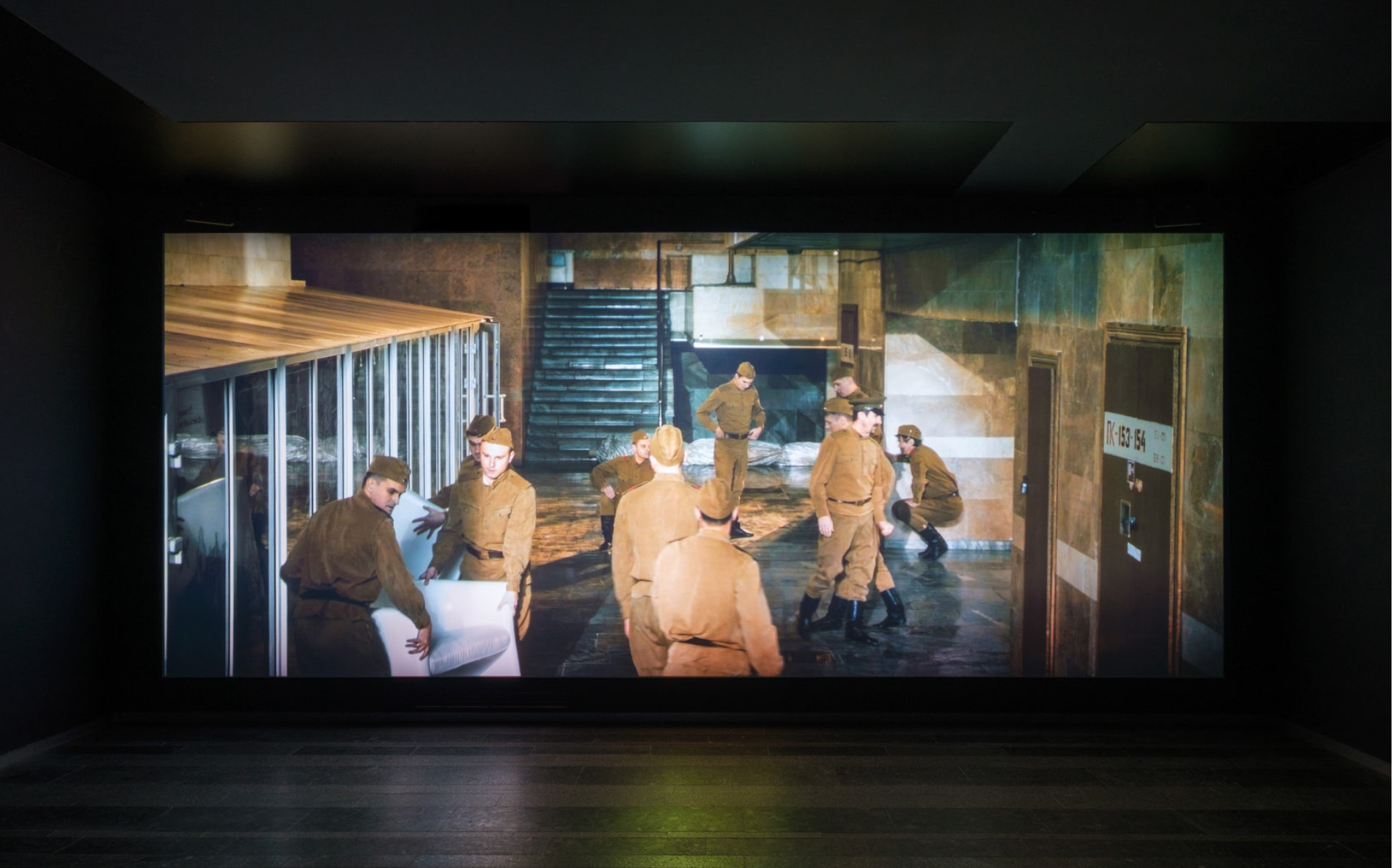
Yarema Malashchuk and Roman Khimey. Live Broadcast. 2020. Photo from the exhibition of 20 nominees for the PinchukArtCentre Prize 2020. Photos provided by PinchukArtCentre © 2017. Photographer: Maksym Bilousov
An example of being on the edge of intermediality is the project “Kiptyava” (2018) by Daniil Revkovsky and Andriy Rachynskyi, which combines research mechanisms, intervention in public space, and installation. Or the project Liya Dostlieva’s “I Love It When Canaries Sing” (2019) for the Second Biennale of Young Art in Kharkiv, where the author turned to the installation format, combining sewing and sound.
Also, the practice of Oleksandra Kadzyevich, which developed as a result of transforming the private space of her own NOCH gallery. Here the idea of sharing economy and arts is embodied in organizing a gallery in the space of her own workshop. The artist literally shared the space for exhibitions with her colleagues. As Kadzyevich herself notes, her view of her own works changed, the works themselves changed, becoming more intimate, delicate, fragile, and subtle, and the plots more intuitive.

Liya Dostlieva. I Love It When Canaries Sing. 2019. View of the II National Biennale of Young Contemporary Art (location: Kharkiv Hotel). Photo provided by the author. Photographer: Yevhen Nikiforov
LANDSCAPE SETS THE FORM
Landscape has always been an important theme for Ukrainian art, through which artists highlighted social and political contexts. This landscape became a metaphor for change, decline, violence, or freedom. The transformation of the landscape was shown in the work “Machine and Garden” (2016–2018) by Larion Lozovyi during the Second Biennale of Young Art in Kharkiv. But what is landscape today, what has changed in the perception of what once seemed familiar?
First of all, the possibility to touch the landscape, to feel part of it. No longer to dominate it, not to position oneself as an integral element of the chain, but to realize oneself as a variable unit in the system of the natural cycle.
As Katya Buchatska noted, “landscape is fate, and when you see such an environment, you want to turn into a stone” [16]. This phrase contains an attempt at an artistic gesture: not to separate oneself from nature but truly become it, to submit to its power. Because the power of nature is greater and more significant than the power of ideologies that became central to the 20th century. Here Ukrainian art fits into the international context of philosophical thought about attributing objectivity to everything that does not possess it — wind, water, plants, sun, etc. An example is the work of Yaroslav Futimsky, created during the Performance Days in Lviv 2015 [17]. For Futimsky, landscape is always political. However, he works with it not for depiction but rather reflecting on the everyday, voicing the personal. His medium is speech, a story he shares with all viewers as if they were his close friends.
Describing the context of Odessa art, artist Yuriy Leiderman expressed the opinion that nature became decisive for the formation of the city’s artistic environment, where “…the immanent extent of the coast, […] fractal line, joke, surf” set the tone for poetic wandering, looping, the possibility of crossing out what has already been done [18]. However, today this metaphor of fundamental nature is also decisive for other artists. Petro Ryaska relies on landscape, understanding it as a kind of horizon of events, connecting man-made elements with the landscape line, remaining faithful to his Zakarpattia environment. The landscape of Gurzuf has special significance throughout the work of artist Volodymyr Budnikov — “ideal because so familiar that it paradoxically turns every time into a mystery, a white spot” [19].
In the project by Liya Dostlieva and Andriy Dostliev “I’m Still Ashamed to Throw Away Food. Grandma Told Me About the Holodomor” (2018), the artists made prints of food they discarded over two months and combined them with landscapes of the Ukrainian countryside, recognizing them as places of memory that preserve traces of collective trauma the longest.
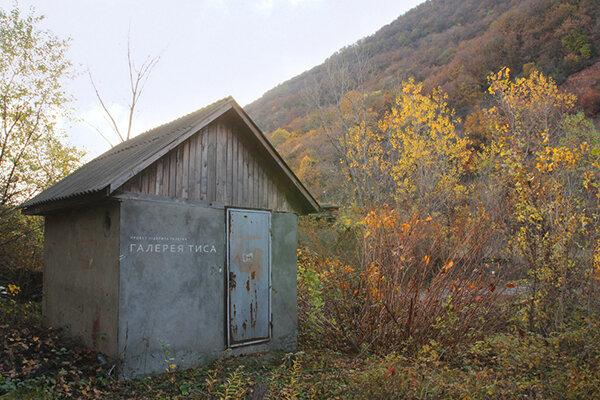
Open Group. Tysa Gallery. From the project “Open Gallery.” Realized on 21.08.2012 as part of the local contemporary art festival “Credence 2012.” © Open Group
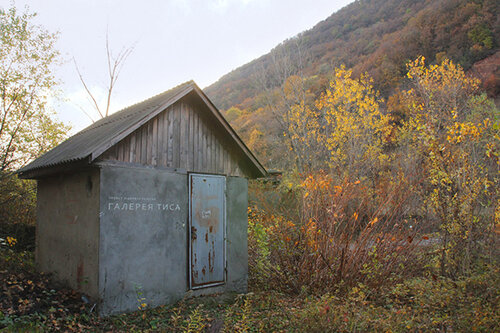
The delineation of spaces, real and imaginary, was the subject of the long-term project of the Open Group “Open Gallery” (starting in 2012). Artists created temporary territories for exhibiting works, places that became self-sufficient works, outlining them only by conditional borders or their own presence [20]. This idea is also not new in Ukrainian art; for example, Kherson artist Vyacheslav Mashnytskyi together with Ihor Platonov in 2003 outlined by boat the Kherson floodplains along the Dnipro to the Black Sea as the project “In Search of Civilization,” whose goal was “to search for what is impossible to find” [21]. These “open galleries” continued to exist in their own environment without further control, turning into natural interventions and overcoming institutional dependence.
The image of the butterfly has various interpretations in symbolic systems. In particular, in Daoist parables, it often appears as a symbol of lightness and fragility. One of these parables tells of philosopher Zhuangzi, who dreamed he was a butterfly. Upon waking, he could not understand: did Zhuangzi dream he was a butterfly, or is the butterfly now dreaming it is Zhuangzi? The butterfly metaphor describes the state and aspirations currently existing in Ukrainian art.
Referring to the analysis of artists’ works, we do not intend to undermine other types of practices. As noted above, the search for coexistence methods is one of the important characteristics of the current era. Instead, it was important for us to outline the changes that have occurred or continue to arise. The desire for empathy, safe spaces, processuality, contemplation, cognition, awareness, being in-between — these are the characteristics and aspirations that, in our opinion, are actualized in the new era. Both from the side of artists and viewers.
[1] Simone Weil, The Pre-War Notebook (1933—1939), published in First and Last Notebooks (1970) edited by Richard Rees
[2] See: Gielen P. Murmuring of Artistic Multiplicity. Global Art, Politics and Post-Fordism / Pascal Gielen. — Moscow: Garage. Ad Marginem, 2015. — 288 p. — (Garage Pro)
[3] Kateryna Iakovlenko, Tatiana Kochubinska. Introduction | Euphoria and Fatigue: Ukrainian Art and Society after 2014. Obieg. 2020. — URL: https://obieg.u-jazdowski.pl/en/numery/euphoria-fatigue/introduction
[4] Ledenev V. The Language of the New Generation of Artists — Hesitant Contemplation. Bjorn Geldhof on PinchukArtCentre, Fear, Hope and Theater [Electronic resource] / Valeriy Ledenev // COLTA. — 2020. — Access mode: https://www.colta.ru/articles/art/24164-v-rubrike-kurator-u-mikrofona-art-direktor-pinchukartcentre-byorn-geldhof.
[5] From a personal conversation with Kateryna Iakovlenko. April 20, 2020
[6] From the title of the exhibition of the same name in 2014. Read more: Lysun, Tetyana. The Bright Future Remained in the Past [Electronic resource]/ Tetyana Lysun // LB. — 2013. — Access mode: https://lb.ua/culture/2013/12/20/248916_svetloe_budushchee_ostalos_proshlom.html
[7] Artist Anna Shcherbina: “I decided to exploit my shame.” — Bird in Flight — URL: https://birdinflight.com/ru/vdohnovenie/opyt/20190212-20190212-anna-scherbyna.html
[8] Along the Edge: Francesc Torres, Ann Hamilton, Bruce Nauman, Bill Viola [publication for the exhibition of American artists “Along the Edge,” (Kyiv, 22.03-18.05.1997)]. — p. 14. — URL: https://issuu.com/ukrmediaartarchive/docs/uzdovzh_mezhi_opt_r
[9] Chervonyk, Olena. Micropolitics of Another Sensitivity. — Korydor— December 20, 2011 — URL: http://old.korydor.in.ua/blogs/860-mikropolitika-inshoji-chutlivosti
[10] The Emptiness of Routine: Artist Anna Zvyagintseva on Her Exhibition at The Naked Room Gallery. — Vogue UA — URL: https://vogue.ua/article/culture/art/pustota-rutiny-hudozhnica-anna-zvyaginceva-o-svoey-novoy-vystavke.html
[11] Katya Buchatska on “Record of Pain,” collective work, and artistic method — Your Art — URL: https://supportyourart.com/conversations/katya-buchatska
[12] Weil S. Rooting. Letter to a Cleric / S. Weil. – Kyiv: Dukh i Litera, 1998.
[13] Lesia Khomenko and Her School. September 6 — October 7, 2018 — URL: http://voloshyngallery.art/exhibitions/lecja-khomenko-i-ejo-shkola.html
[14] Ibid.
[15] If Only Flies Saw the Exhibition. — May 31 — June 13, 2014. — URL: http://openarchive.com.ua/event/if-only-flies/
[16] From a personal conversation with Kateryna Iakovlenko. April 20, 2020
[17] URL: https://www.youtube.com/watch?v=9m8ZC-dEm10
[18] Leiderman Yu. Washed Up in the Surf [Electronic resource] / Yuriy Leiderman // Prostory. – 2017. – Access mode: https://prostory.net.ua/ua/krytyka/254-shliavshyesia-v-pryboe.
[19] Budnikov V. Questions to the Visible. — Kaniv: ChervoneChorne, 2017, — p. 157.
[20] Read more about the project on the Open Archive website. — URL: http://openarchive.com.ua/vidkrita-grupa/#practice161
[21] Vyacheslav Mashnytskyi, Ihor Platonov. Action “In Search of Civilization.” 2003. — URL: https://archive.pinchukartcentre.org/works/aktsiya-v-poiskah-in-kov-2003
Prepared based on materials from the PinchukArtCentre Research Platform
Halyna Hleba, Tetyana Zhmurko, Kateryna Iakovlenko
Comment type: Publications of the Research Platform
Author: Halyna Hleba, Tetyana Zhmurko, Kateryna Iakovlenko
Sources: Hleba H. From Reaction to Thought. Part 3. What Are Thoughts About? [Electronic resource] / H. Hleba, T. Zhmurko, K. Iakovlenko // Your Art. – 2020. – Access mode: https://supportyourart.com/researchplatform/from-reaction-to-thought-part-3.