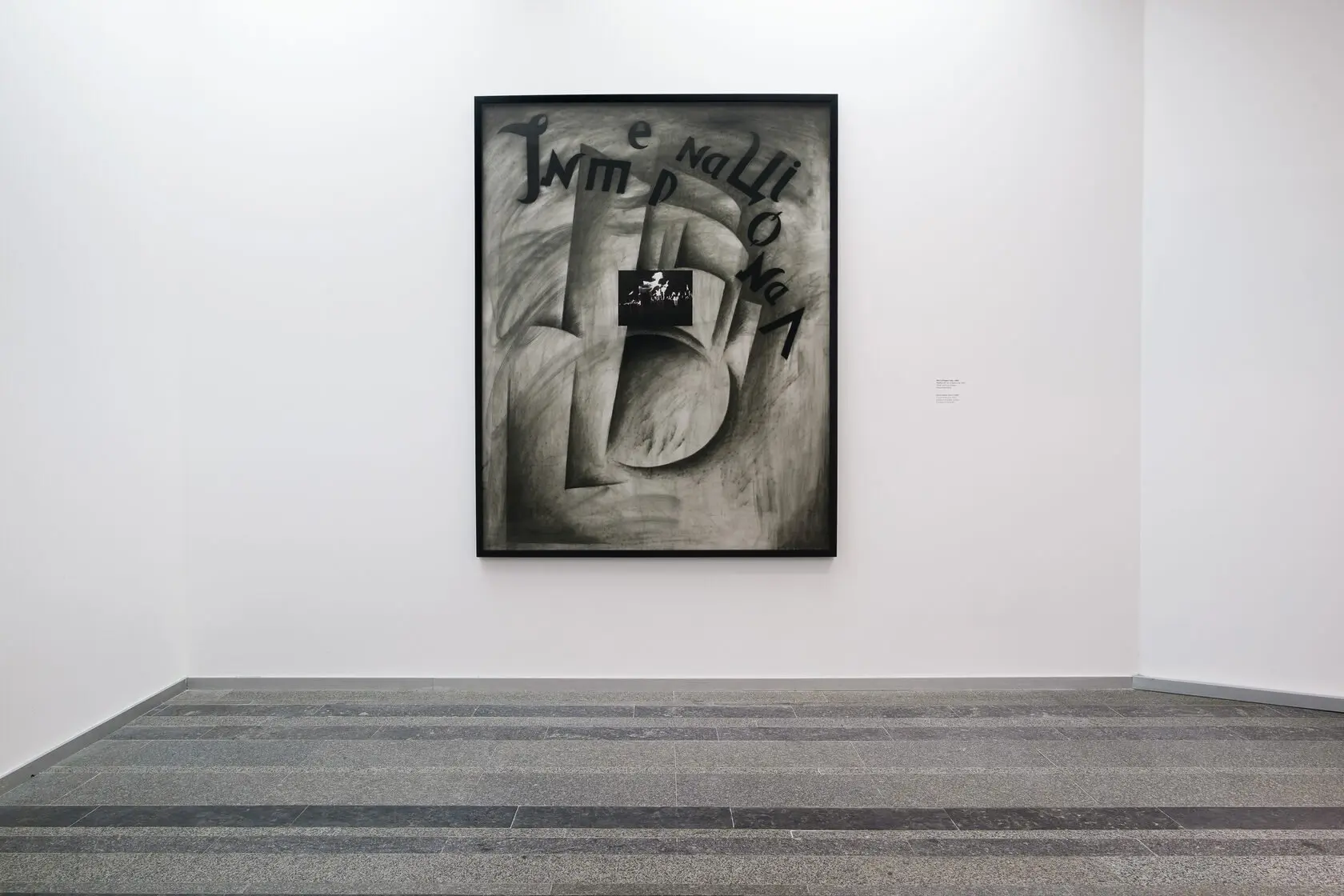
Nikita Kadan. Tiger’s Leap. 2018

Work Description
The sculpture displays iron replicas of improvised weapons fashioned from tools used in industrial metallurgy during the early 20th century, in what was then the Russian Empire. Such weapons were used by factory workers in a failed uprising in 1905 in Horlivka, an industrial city in the Donetsk region. The revolt was violently subdued by the military, but this act of resistance was one of many that laid the groundwork for not only the successful revolution of 1917 and the start of the Soviet empire, but also the enthusiastic belief in a Soviet utopia that would be vividly expressed by the artists of the Avant-Garde.

Tiger’s Leap, is one of Walter Benjamin’s most well known concepts. Applied to the work of Kadan, Xin Feng & Kiera Chapman’s reading of a tiger’s leap comes to mind: “a ‘tiger’s leap’ into the past rejects the idea of time as linear and sequential in favor of a creative use of past example that breaks with the temporal continuum. The ‘tiger’s leap’ allows people to seize on the past as a source of difference and thus to draw attention to new possibilities for change in the present.” Kadan, throughout the exhibition, makes a series of ‘tiger’s leaps’ by appropriating historical events, objects and designs, and reinterpreting them with a contemporary urgency—an urgency to resist geo-political failures, extreme right ideologies and neo-liberal forces.
- Geldhof, B. Nikita Kadan: Stone Hits Stone. The Past as an Urgent Now // Kadan, N. Stone Hits Stone. — Kyiv: PinchukArtCentre Research Platform, 2021. — 80 p.