The term “transavantgarde” comes from the Italian trans-avanguardia, which literally means “beyond the avant-garde” or “after the avant-garde.” This word was first used by the Italian critic and curator Achille Bonito Oliva in the programmatic article “Italian Transavantgarde,” published in 1979 in the magazine Flash Art [1]. In this article, Oliva named painters Marco Bagnoli, Sandro Chia, Francesco Clemente, Enzo Cucchi, Nicola De Maria, Mimmo Paladino, and Remo Salvadori as representatives of transavantgarde art. At the Venice Biennale in 1980, Oliva curated the exhibition “Aperto ’80,” after which the concept of transavantgarde entered the circulation of global art criticism.
Throughout the 1980s, Achille Bonito Oliva wrote a series of works on the history of Italian and world art of the 20th century, consistently developing the concept of transavantgarde as a stage in the development of art characterized by a rejection of the linear perception of history and belief in progress inherent in the avant-garde, as well as the actualization of the past through quotation, irony, and myth creation. In a 1996 lecture organized by the Soros Center for Contemporary Art in Kyiv, Oliva defined the term he invented as follows: “Transavantgardism is a term that means transition, nomadism, temporariness, and at the same time entails the concept of the avant-garde. ‘Transavantgardism’ is a term used to denote a creative strategy that coexists with the impossibility of predicting the future, which tries to live in the hell of the present time, in the vitality of the present being, including the impossibility of predicting the future, and in this impossibility uses the past” [2]. The rejection of the future, the turn to the past, and the denial of the progressive interpretation of history, according to Oliva, were caused by the post-catastrophic situation humanity found itself in after the collapse of ideologies — it was then that the artist “stops creating new forms and instead quotes the grandeur of the past through his memory” [3].
In both the early work “Italian Transavantgarde” and the later “International Transavantgarde,” Oliva uses the concept he invented to denote the originality of European art in the global art market, where — primarily for economic reasons — directions of contemporary American art (pop art and conceptualism) dominate. Oliva emphasizes: “…transavantgardism also reproduces what I call genius loci, that is, the territorial identity of the artist, and not in a regressive tribal sense, returning not to a static root but to a root capable of exploring its own territory, revealing within itself a dialectical … play between the very strong sensitivity of the artist and the universality of the artistic language” [4].
Ukrainian artists learned about transavantgarde just a few years after the emergence and spread of this term, but for a long time, knowledge about it remained superficial. Here is how Oleksandr Roitburd, called the father [5] and patriarch [6] of Ukrainian transavantgarde, recalls it: “I heard this term back in the early 1980s, in 1982 or 1983. After the Italian art theorist and curator Achille Bonito Oliva showed the works of transavantgarde artists at the 1980 Biennale, an article “Transavantgarde at the Venice Biennale” appeared in the magazine ‘Tvorchestvo’ [7]. The article was extremely compromising: it contained no reproductions of Italian artists, but it said that many Soviet authors were close to transavantgarde. … As an ideology, it began to form in 1987 when art critic Oleksandr Solovyov gave everyone a Russian-language brochure with a torn cover and no title page, which contained criticism of Achille Bonito Oliva’s ideas with extensive quotes from his texts. Everyone memorized it. … But notably, we never saw the actual works of the transavantgarde artists. Only once did Arsen Savadov pull out from under his coat a torn-out magazine picture smaller than a cigarette pack with a reproduction of Mimmo Paladino: that was the first transavantgarde artist’s work I saw. … I expected more, but I liked it. And it was no longer something we wanted to imitate because by then we had all already established ourselves as artists” [8].
Recalling the difficulties of choosing between the conceptualist direction, in which Odessa artists were moving and which dominated Moscow at the time, and the painterly one associated with transavantgarde, Roitburd emphasizes Arsen Savadov’s role in resolving his internal conflict: “On the one hand, I knew and loved to paint; on the other, I was friends in Odessa with Serhiy Anufriyev, Yura Leiderman, Lyonya Voitsehov, and other members of the ‘Odessa Group.’ Their ideology was much closer to me than that in which my painting was. But I could not give up the painterly drive, the expressiveness. Arsen Savadov helped me reconcile these sides” [9].
Indeed, Arsen Savadov had a great influence on the artists who, together with Oleksandr Roitburd, are most often called Ukrainian transavantgarde at various stages of their work. These were artists associated with the squat on Paris Commune Street: primarily Oleksandr Hnylytsky, Oleg Holosiy, Valeriya Trubina, Dmytro Kavsan, as well as Serhiy Panych. All of them in the late 1980s engaged in dynamic expressive figurative painting, creating large canvases filled with mythical and fantasy motifs and quotations from classical painting. A model of this manner of painting was the work by Arsen Savadov and Heorhiy Senchenko “The Sadness of Cleopatra,” presented at the All-Union Exhibition of Young Artists “Youth of the Country” in Moscow in 1987 — one of the key exhibitions for young Ukrainian art at the time.
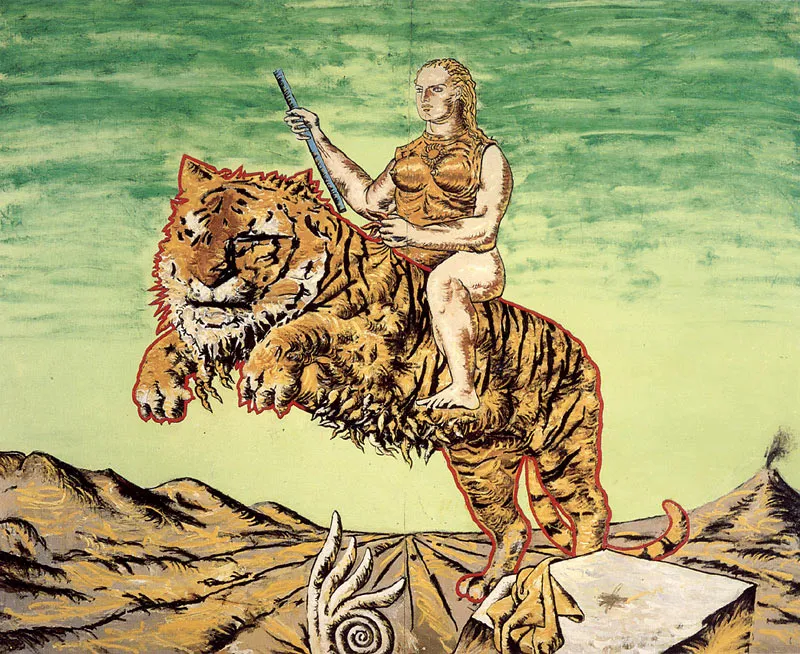
The painting depicts a woman sitting astride a tiger galloping through a deserted desert. The surreal landscape and the tiger in the style of Salvador Dalí’s dreams, combined with a direct reference to Velázquez’s “Equestrian Portrait of the Infante Baltasar Carlos” [10], distorted proportions, unexpected details such as the red outline around the tiger and strange strands of fur on its belly — all this caused a wave of discussion and even outrage among critics [11], but so captivated the young generation of artists that for some time they were called post-Savadists [12].
The 1988 All-Union Youth Exhibition in the Manege in Moscow was an important moment in representing the works of the young generation of Ukrainian artists, who radically differed from official late Soviet art [13]. The pavilions of this exhibition were divided on a national basis, and the Ukrainian pavilion received many favorable reviews [14]. The exhibition featured Arsen Savadov with the work “Melancholy,” Heorhiy Senchenko with “Sacred Landscape of Pieter Bruegel,” Oleksandr Hnylytsky with “Discussion on the Mystery” [15], Oleksandr Roitburd, Valentyn Rayevskyi, Vasyl Ryabchenko, Serhiy Lykov, Pavlo Kerestey, Serhiy Panych, Valeriya Trubina, Dmytro Kavsan, Oleg Holosiy, Kostyantyn Reunov, Roman Zhuk, and others [16]. After this exhibition, the famous Moscow critic Leonid Bazhanov described Ukrainian art as “neo-Baroque of the transavantgarde type” [17].
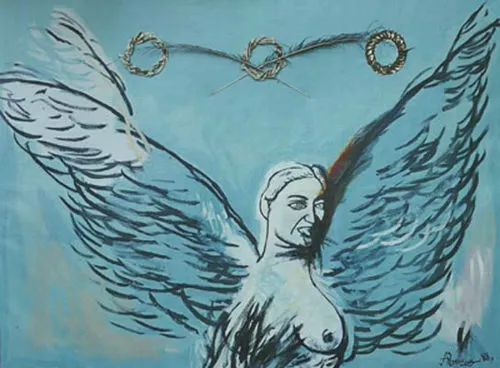
At the end of 1989, in the magazine “Decorative Art of the USSR” in the special section “Rakurs–12,” a selection of texts about young Ukrainian art appeared, in the editorial foreword to which the “new Ukrainian wave” was called an extraordinarily original variant of European transavantgarde [18]. The selection included articles by critics and texts by the artists themselves. “Apocrypha” by Arsen Savadov and Heorhiy Senchenko, “Oliva’s Family” by Oleksandr Hnylytsky, “On the Spiritual in Art” by Oleksandr Roitburd and Mykhailo Rashkovetsky became programmatic statements later dissected into quotes by critics and art historians. It was here that Roitburd and Rashkovetsky, polemicizing with Moscow conceptualism, opposed it with artistic Ukraine — tender, vital, and excessive, Ukraine called the illusory Heavenly Italy [19].
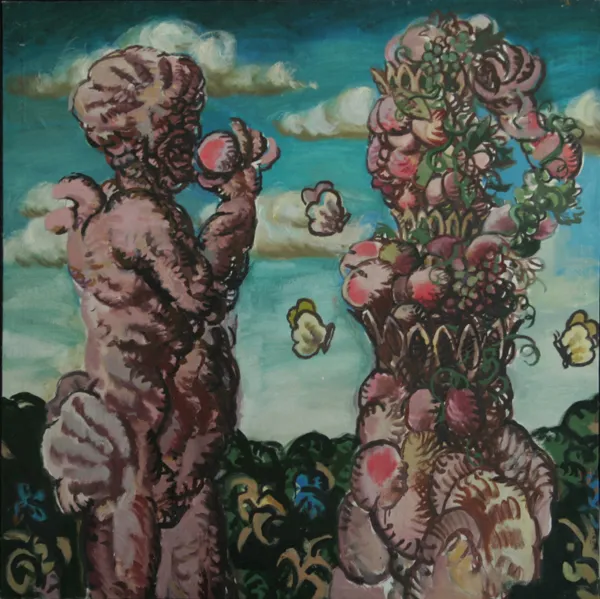
Serhiy Anufriyev in the article “Kyiv as a Cultural Model” developed this metaphor and created another popular trope, speaking of the “meaty manifestations of Kyiv mentality” [20]. Alongside almost poetic texts by artists, critics Kostyantyn Akynsha, Oleksandr Solovyov, and Volodymyr Levashov pondered what distinguishes the Kyiv artistic situation from Moscow’s, what preceded the emergence of “hot postmodernism” in Kyiv, and how it would develop further [21].
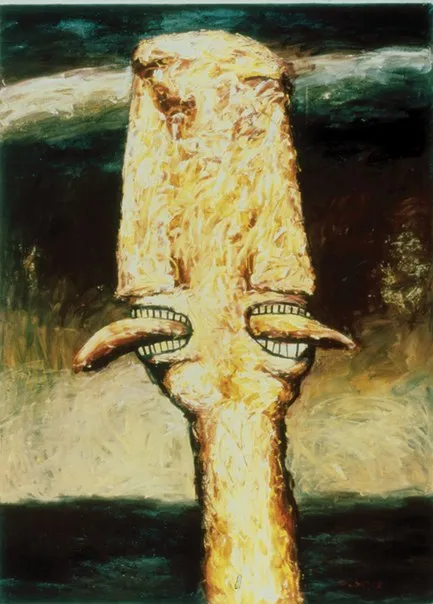
Through Roitburd, Kyiv ideas found followers in Odessa. Here is how Roitburd himself recalls it: “I brought the brochure [about transavantgarde] to Odessa for a week and gave it to Vasyl Ryabchenko and Serhiy Lykov to read. After that, we went to curator Mykhailo Rashkovetsky and said we needed an ideologist. We gave him this article, then long convinced him that we all needed to become transavantgardists” [22]. Already in 1989, the exhibition “After Modernism I” took place in Odessa, followed a year later by “After Modernism II,” which presented works by Serhiy Lykov, Yevhen Nekrasov, Oleksandr Roitburd, and Vasyl Ryabchenko, united by characteristic transavantgarde features [23]. Serhiy Kuskov, describing the works of the Odessites, spoke of their “Dionysian indecency in communication with agitated archetypes, orgiastic aggressiveness when entering the loose, turbulent essence of sculptural-pictorial flesh into the collective ‘mythothyl'” [24]. The very language of this description most accurately illustrates the radical difference of the mentioned artists’ work from the conceptualism already recognized in Odessa at that time.
Despite its sensational nature and further rapid development, transavantgarde as an ideology, that is, as a programmatic guideline for artists, existed in the Ukrainian context for a short time. Already in 1991, Kostyantyn Akynsha in one of the often-quoted later texts “A Wreath on the Grave of Ukrainian Postmodernism” summed up what Ukrainian artists had done after the success of the 1988 Manege exhibition. Akynsha began with the obvious fact: Ukrainian artists’ ideas about transavantgarde and postmodernism were very superficial. This, as well as the prolonged orientation towards Savadov, who kept away from neophytes, became the cause of “sins” that led Ukrainian postmodernists into a dead end. Akynsha spoke of the “sin of prettiness” in Vasyl Ryabchenko’s decorative works, the “sin of naivety” of Holosiy, who never outgrew the childlike spontaneous manner of painting, the “sin of seriousness” of Serhiy Panych, Serhiy Lykov, and Valeriya Trubina, who try to philosophize and write “thoughtful” works, and the “sin of intellectualism” of Roitburd, who seems afraid that “he might be suspected of simplicity” and therefore overloads his works with quotes from all the philosophers he knows. Concluding this list, the critic noted the end of the collective wave and the beginning of individual paths for its participants [25].
The motives for even a very superficial appeal of young Ukrainian painters to Western ideas are aptly explained by Marta Kuzma in the foreword to the catalog of the exhibition “Angels over Ukraine” in 1993: “These artists did not so much define themselves by Achille Bonito Oliva’s theory of transavantgardism, which included Chia, Cucchi, Clemente, but rather turned to it for its visual language and the possibility it provided to step back from the creaky dogmatism imposed at the Art Institute. Thus, they perceived the sublime and irony” [26].
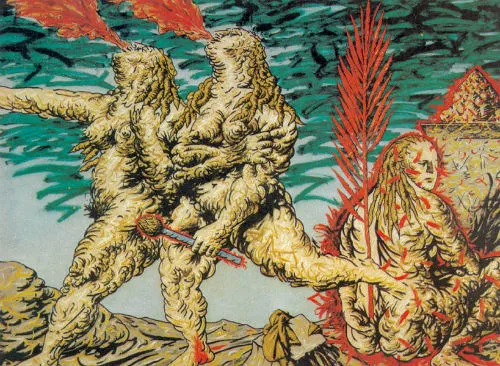
When Achille Bonito Oliva came to Kyiv in 1996, “only memories of transavantgarde remained” [27]. As Roitburd recalls, he “came to Ukraine in the nineties when Ukrainian transavantgarde had already ended. He was told that it had existed here; he was very surprised. … no one wanted to join this movement willingly. But Ukrainian artists joined its ranks voluntarily, although not fully understanding what they were doing — and this was a shock for him” [28]. Even Solovyov, who was once a proponent of transavantgarde painting ideas among young Ukrainian artists, called the orientation towards representatives of this art direction a “recent semi-conscious attraction” in a 1999 article [29].
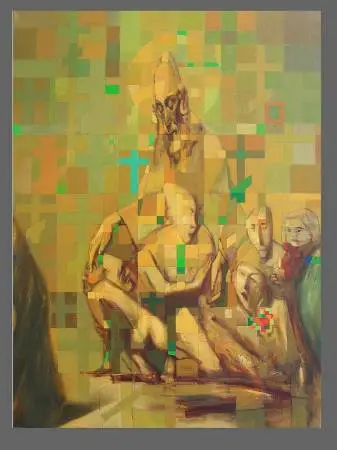
Transavantgarde “revived” for the last time in 2010–2011 when the M17 Center for Contemporary Art hosted the exhibitions “Oliva’s Family” and “Italian Transavantgarde,” the latter curated by Oliva himself. The first was a colorful collection of works by Ukrainian artists, the second presented the same Italian transavantgarde artists whose works the former self-proclaimed Ukrainian transavantgardists had only heard about.
Since the late 2000s, the term “transavantgarde” has rarely been used in art criticism and curatorial texts to denote the work of artists who once identified themselves with this movement. Moreover, these artists themselves have long stopped calling themselves transavantgardists. Instead, in academic art history, this term is becoming established, and terms like “Ukrainian new wave” and “Ukrainian neo-Baroque” have become common concepts used to describe the work of a wide range of artists from Kyiv and Odessa from the late 1980s to the early 1990s.
Another sphere of the term “transavantgarde” usage is auction publications [30]: transavantgarde, as Solovyov noted, has turned into a brand. Roitburd, who was one of the first inspired by the Italians’ ideas, confirms the same: “Time passed, and what initially seemed a breakthrough in the system turned simply into a commodity, and now it is also turning into a good antique. This is the fate of any rebellion that consumer society engages…” [31].