
When the canvases are not enough: the artistic borders of Polina Raiko and Oleg Mitasov

Reproduction of the paintings of Polina Raiko’s house (1928–2004) Photo: Semen Khramtsov. Digital print: provided by the Polina Raiko Charitable Foundation
The stories of Polina Raiko and Oleg Mitasov unfold roughly at the same time — at the intersection of the 1980s and 1990s. However, they are connected not only by the time in which they lived. For both, their private space was important, which they filled with their own symbolic system.
Polina Raiko and Oleg Mitasov were not artists. Their lives consisted of needs, habits, and rituals traditional for a Ukrainian Soviet person. Raiko’s life was focused on family, Mitasov’s — on work and scientific activity. A fundamental change in their everyday life occurred as a result of personal traumas they experienced, which released the creative energy of both authors, marking the next period with a striving for art that on one hand freed them from inner pain and longing, and on the other — created a safe space and gave strength.
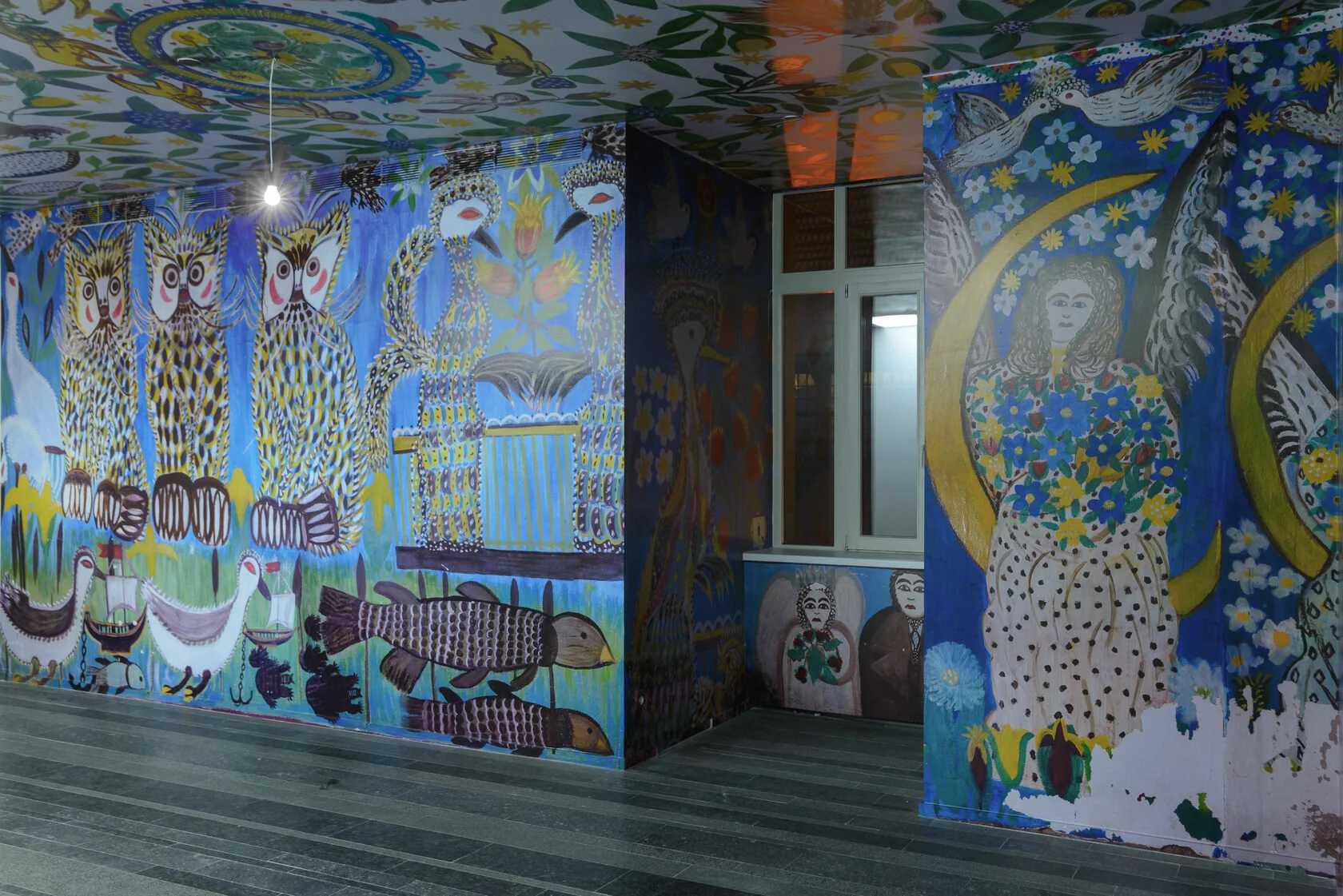
Reproduction of the paintings of Polina Raiko’s house (1928–2004) Photo: Semen Khramtsov. Digital print: provided by the Polina Raiko Charitable Foundation

Reproduction of the paintings of Polina Raiko’s house (1928–2004) Photo: Semen Khramtsov. Digital print: provided by the Polina Raiko Charitable Foundation
Raiko’s space was her own house in the village of Oleshky in Kherson region, which she covered with her paintings; Mitasov’s space was an apartment in a Kharkiv high-rise and the territory where the artist moved and spent time. Despite the similarity in practice, Raiko and Mitasov used different artistic tools: Raiko chose painting on walls, what we can now call murals; Mitasov — text, in fact, he is one of the first original Ukrainian graffiti writers.
The work of both Mitasov and Raiko is deeply symbolic. Raiko painted her own house with animals, plants, quirky characters, and her own portraits. Describing Raiko’s work, art historian and curator Tetyana Kochubinska compared the domestic scenes the artist recreated from her own memories to “lives” of saints. “Having never studied painting anywhere, Raiko created her own ‘iconography.’ The placement of certain scenes was related to the location of rooms in the house. For example, from the bedroom door you can see a painting depicting her wedding; the entrance to the bedroom is covered by leopard-birds — guardians and protectors; a small black dog is painted on the stove, and above the hearth — a belligerent kite. Almost every composition in the rooms has a peculiar talisman in the form of pairs of storks, swans, doves,” notes the researcher [1].
Private space (whether a house or an apartment) is usually perceived as a place of safety and comfort, where intimate and frank life unfolds without embellishments. The desire for even greater protection of one’s home and personal life, the creation of endless talismans and totems — all this marks the fragility of perception, the need for protection, coziness, and peace. However, not only images and symbols acted as talismans, it was art itself that acquired totemic and sacred significance here.
A kind of talisman for Mitasov was the word. It is known that the author often wrote his name and surname (this is one of the greatest common traits with graffiti writers), as well as words related to scientific activity. According to legend, Mitasov was unable to defend his scientific dissertation, which caused his mental disorder. Most often, the artist wrote words and phrases like “ВЕК.ВАК”, “на земле” and others. The inscriptions he left are often unrelated to each other, these are detached words that at first glance seem like absurd messages. However, in their joint placement with each other, they formed a certain philosophical and existential meaning:
Immediately. Narrowing. Of mind.
Indestructible union. Of free republics. On earth there is none.
Lenin. Made. Everyone. An injection. In. The head.
Do not. Lose. Faith. In. People. Everyone. Everything. Living. Not. Living.
Stars. From. The sky. Do not. Tear off.
Study. Russian. Language. And. Do not. Appropriate.
You. Vit. Have never. Been. Land. And never. Can be.
People. Immediately. Lenin.
Where. On earth.

Photographer unknown. Provided by Kateryna Yakovlenko
The urge to create can also be explained by the fact that both authors spent all their money on paints and brushes. Raiko bought tools with a small pension, and Mitasov was provided with paint and tools by artists from the Kharkiv art institute.
The work of Raiko and Mitasov can be attributed to art brut — an artistic movement that includes practices of creators without formal art education and executed in a “rough,” “raw,” and often expressive manner. The term, proposed by French artist Jean Dubuffet in the mid-20th century, originally generalized the artistic practices of people with mental disorders, children, prisoners, and representatives of other communities marginalized by society. Today, there are certain reservations about this term, as well as about another term used as an alternative generalizing marker — outsider art.
The emotional, expressive, intimate, and frank creativity of the artists is related to the works of many other artists who at certain moments found themselves alone with their own experiences and released inner energy, pain, and trauma in artistic practices. Artists belonging to this phenomenon mostly create tangible art — painting, graphics, sculpture. When examining the works, one can notice how these inner impulses begin to require much more, and canvases or paper become insufficient: then the surrounding space becomes the surface for creativity, the works become volumetric and all-encompassing. Such art is more vulnerable as it requires more attention and care, which creates certain difficulties in archiving and museification of such experience.
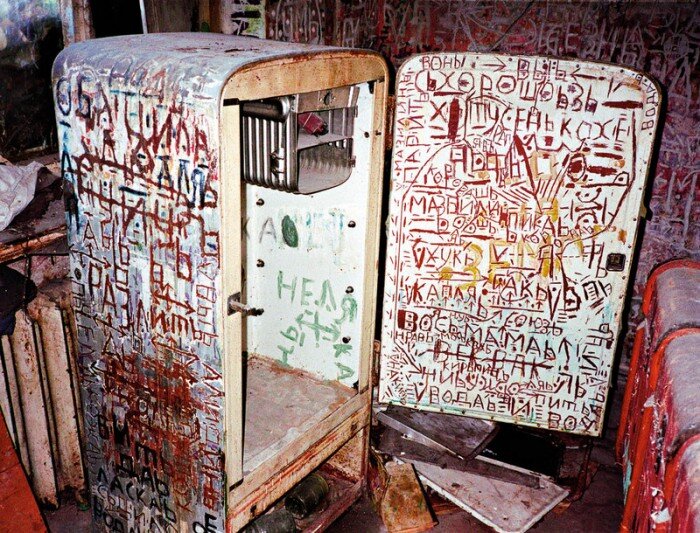
Oleg Mitasov. Provided by Kateryna Yakovlenko
Similar to Raiko and Mitasov was the American industrial photographer, sculptor, and artist Sidney “Sid” Edward Boyum. Boyum became known for his own sculptures placed in the public space of Madison, Wisconsin. Some of the artist’s works are now neglected. To save these works, the local community initiated a project to preserve Boyum’s house and sculptures, created a website for him, and organized the relocation of the works to safer spaces.
A similar initiative is the project of Polina Raiko’s house. The Museum of Contemporary Art of Kherson and the Center for Cultural Development “Totem” created the Polina Raiko Foundation, which is engaged in preserving the artist’s heritage.
However, while Raiko’s biography is more or less known, Mitasov’s figure today consists only of myths and legends. Artist Pavlo Makov wrote in his note in the magazine “NASH”: “We know little about his life. Apparently, he was married, had higher education, was an economist, worked as a store director. Until illness turned him into a living testimony of our madness, a diary unmatched in authenticity, in which the entire hopelessness of our mentality is recorded with terrifying detail. Time and place of action are unimportant — it creates the impression that it has always been so, is so, and always will be where we are.” In the 1990s, Mitasov’s inscriptions covered the apartment, entrance hall, walls of the house, and walls of other houses located nearby. Today, almost none of these texts remain — the artist’s apartment was sold, and the rest of the drawings could not survive repairs and painting.
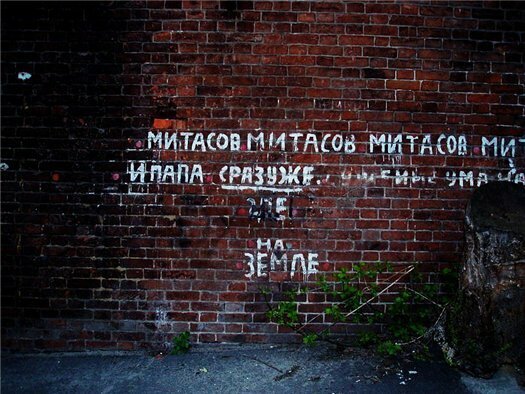
Provided by Kateryna Yakovlenko
In 2001, Pavlo Makov warned: “I am far from the idea of possible interpretation of the ‘Mitasov heritage’ and would like to warn against any attempt to use this material as a source of creative inspiration. Mitasov is a phenomenon of nature. His ‘creativity’ is not art. It is a document. The absolute unconscious of our life. And this is its meaning.” Today, photographs of Mitasov’s textual works become part of contemporary art exhibitions, including “Ha” (National Art Museum of Ukraine, 2017-2018) and “Crossing the Border” (PinchukArtCentre, 2019). And despite the fact that the art of both authors was hermetic and each developed their own mythology and symbolic system, difficult for the other to understand, both Mitasov and Raiko influenced other artists. Raiko inspired authors from Kherson and is now an important figure of the Kherson art scene, and Mitasov’s texts have in some way reflected in the practices of both Kharkiv graphic artists and musicians.
[1] Kochubinska Tetyana. Polina Raiko: The house she painted // BirdinFlight. — URL: https://birdinflight.com/ru/pochemu_eto_shedevr/polina-rajko-dom-kotoryj-narisovala-ona.html
[2] Lecture by Pavlo Makov. “Oleg Mitasov and art brut” // PinchukArtCentre. — URL: https://www.youtube.com/watch?v=RWZCggfkF20&vl=ru
[3] Design coalition. — URL: http://www.designcoalition.org/community/Boyum%20/boyum2.htm
[4] Makov Pavlo. Oleg Mitasov // NASH. — May, 2001.
[5] Makov Pavlo. Oleg Mitasov // NASH. — May, 2001.
[6] Modern Van Gogh and genius. The story of Kharkiv legend Oleg Mitasov // Mediaport. — URL: https://www.mediaport.ua/news/city/70905/sovremennyiy_van_gog_i_geniy_istoriya_harkovskoy_legendyi_olega_mitasova
Prepared based on materials from the Research Platform PinchukArtCentre
Kateryna Yakovlenko