
Kharkiv Woman: The Image of Women in Kharkiv Artists and Female Artists
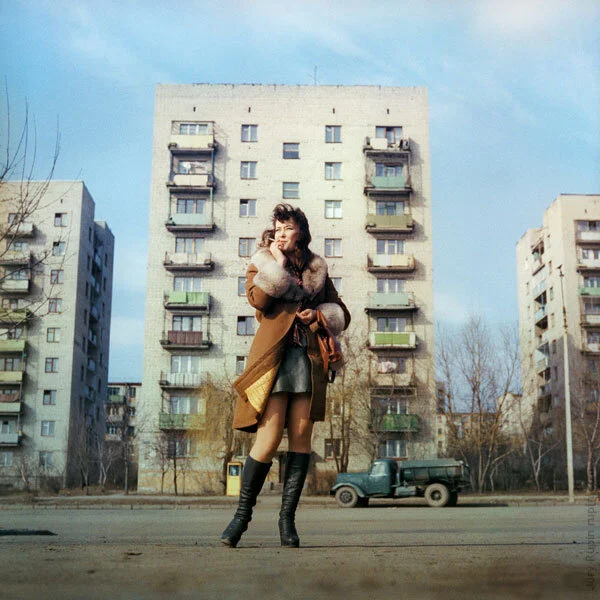
Yuriy Rupin. “Kharkiv Woman.” 1977
The central place in Yuriy Rupin’s photograph “Kharkiv Woman” [1] is given to a young girl standing full-length in contrapposto on a spacious city street. The monotony of gray high-rise buildings and a typical Soviet ZIL-164 (‘Zakhar’) cargo truck contrast with the heroine’s free posture, eroticism, and even a certain boldness. She smokes a cigarette and does not look into the viewer’s eyes: her dreamy and confident gaze is directed to the left. The wind blows her brown sheepskin coat, revealing slender long legs to the viewer. The heroine wears a short dress and fashionable high black boots.
This was Kharkiv in 1977. At that time, Rupin worked as a photojournalist; he built his photography career precisely through reporting activities. Thus, straight photography forms a significant body of his works from the 1970s–1980s. Obviously, “Kharkiv Woman” is the result of such documentary exploration but also a certain departure from it.
Art historian Tetyana Pavlova writes that at that time Rupin used a “wide-angle lens” for shooting, which caused certain perspective distortions that radically changed proportions, for example, reducing the size of the head relative to other body parts [2]. In this photograph, disproportion also exists: the emphasized figure of the woman is much larger than the car or the building behind her. Her legs look longer than the upper part of her body.
“These perspective distortions, combined with distortion characteristic of Soviet lenses of this type, carried hidden shock value, mockery, when a hand with a wrench became a monstrous dominant feature of the ‘worker’s portrait’,” Pavlova noted [3]. We do not know whether this woman worked at a factory or belonged to Kharkiv’s technical intelligentsia. But we cannot take our eyes off her. She seems like the owner of the city. Her clothing and style are not flashy, but they say a lot about inner confidence, strength, and freedom.
“The image of comrades in Soviet iconography appeared quite often. Knitting needles — tools of labor or murder. They are the Moirai. Kitsch was in favor then, and it was a tribute to kitsch,” Yevheniy Pavlov described one of his photographs depicting two naked women in nature. Pavlov carefully covered their genitals by painting green leaves on them.
Most often, models for Kharkiv photographers were women, who were mostly photographed nude in the genre of nudes or ‘acts’ — as Kharkiv photographers called it.
Tetyana Pavlova, Nadiya Kovalchuk, Halyna Hleba, and Alina Sandulyak wrote about corporeality in Kharkiv photography. However, the body was mostly considered as a method of speaking about the political and social of that time, as a comparison of something harsh and strong — to something beautiful and delicate. “The claim for the right of women in photography was caused by protest against hidden and explicit castration in society and art,” explained Tetyana Pavlova [4].
The body in Kharkiv photography acted as a means of conveying thought, as a background against which the statement was formed; or as clay with which the message was created. There was no difference — both male and female bodies were objectified; “native” and close, or, conversely, alien. In fact, as researcher Alina Sandulyak clarified, “by exposing their own bodies and using them as symbolic tools, artists sought to expand society’s understanding of human possibilities and rights to self-expression. Through the naked body, protest was expressed” [5]. The human body, composition, technical and artistic techniques — through all this, artists formulated their statements, or, as Nadiya Kovalchuk noted, there was admiration for the fragility of beauty in the forms of the female body [6]. “In series, we allowed ourselves personal, subjective expression. When photography was synonymous with objectivity — our position looked like a challenge,” said Yevheniy Pavlov [7].
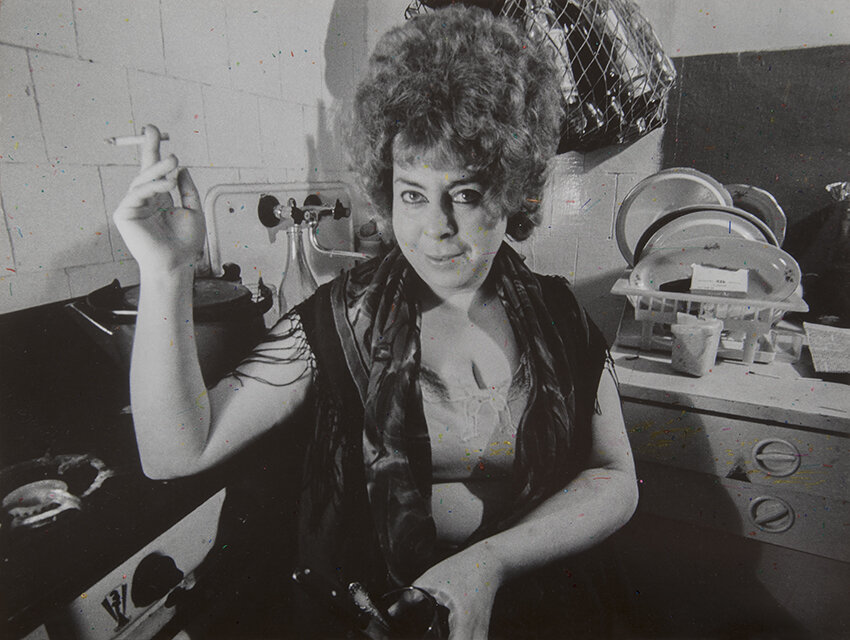
Yevheniy Pavlov, “Untitled,” 1974. From the “Archive Series” (1965-1988)
In Rupin’s photographs, as in other authors’, there is indeed much naked female nature, but most of these shots cannot be called erotic. And even less can one speak of the woman as a subject. However, in Rupin’s oeuvre, “Kharkiv Woman” conveys the necessary emotional, erotic tension and dramaturgy. It is almost the first time when through the camera lens, you see not “clay” in the form of a body, not an impersonal “beautiful” texture, but the heroine herself, her character and emotional state. But the main task was not to create a psychological portrait but rather a portrait fixed in a certain time. It is worth explaining this phenomenon with a phrase by Mikhailov himself, who believed that “it is not important how to show, the main thing is to show in time” [8]. In this photograph, one can definitely notice the time — it is in the car behind, in the unglazed balconies, in the brown sheepskin coat, and even in the woman’s averted gaze. If this heroine appeared before the viewer naked, she would not have so much frankness and dramatic sharpness that the late stagnation period offered. In fact, a similar idea about fixing time is expressed by Yuriy Rupin in his semi-documentary novel “Photographer’s Diary in the KGB Archives.” On behalf of a fictional photographer hero, he describes his practice as follows: “At the last photo club meeting, Rupin brought photographs of naked girls he shot this summer. I don’t know, maybe these girls are beautiful, but in Rupin’s photographs, this is not noticeable. He photographs these girls in a boat, on a bicycle, near a round table in a room and says he photographs them not to make a beautiful photo but to find true beauty. He says true human beauty usually hides under clothes because clothes are made according to fashion, and fashion changes from time to time, and there is nothing funnier than a photo of a woman dressed in fashion that existed ten or twenty years ago. And on a naked woman, there is no fashionable clothing; her body remains beautiful always, regardless of what she wears [9].
Rupin’s “Kharkiv Woman” was classified by the authors of the special issue of the magazine 5.6 as an “image of the average person.” Emphasizing the anthropocentrism of Kharkiv photography, the publication’s authors singled out the theme of the ordinary citizen in a separate category: “The center and content of the shots was a person in various aspects: bodily, ontological, aesthetic, anti-aesthetic […] The focus is not on the rich, nor the poor, not beautiful, but not ugly — a person like everyone else from the gray mass. On the one hand, the heroization of the simple person was still critical and often ironic; on the other — it was an appeal to the existential, deep side of existence” [10].
Andriy Sakharov wrote in his 1977 text “Anxiety and Hope” about the USSR: “Now all this — ugly and cruel, tragic and heroic — has gone beneath the surface of relative material well-being and mass indifference. A caste, deeply cynical and, as I believe, dangerous (for itself and all humanity) sick society has emerged, in which two principles rule: ‘blat’ (a slang word meaning ‘you for me, I for you’) and life quasi-wisdom expressed by the words — ‘you can’t break through the wall with your forehead'” [11]. In the photographs of Kharkiv artists of the 1970s–1980s, the “average person” had already adapted to such “blat” relations. It did not matter whether woman or man, all these characters were ordinary people whose everyday life literally equated to grayness. Apparently, that is why artists additionally colored photographs of that time, adding optical, mechanical, and technical inclusions. For example, in her thesis, Nadiya Kovalchuk gives a formalist example from Oleg Malovany’s practice. The author notes that “nude in its various expressions — in color, photomontage, in ‘foldings’ [12] — became central in his plastic experiments” [13]. According to her, the artist confronted the female body with the “hostile urban environment” [14]. A similar conflict was present in Rupin’s work, who in his photograph “Night” opposes the beauty of the female nude body to the eerie urban night.
Analyzing female corporeality in Kharkiv photography, one should look at Roman Pyatkovka’s series of works. His cycles with women, created in the late 1980s, depict witches raging in a communal apartment. However, this rage is only demonstrative. In his optics, a conflict also arises, but it concerns the intimate and public, or rather the repressed private in the environment of total Soviet public and communal control. “It should be understood that at that time the absence of photo studios led to the mastering of private space when small apartments became the testing grounds of our creativity. As a result, the subject of reflection and research became personal and even intimate life,” said Pyatkovka [15].
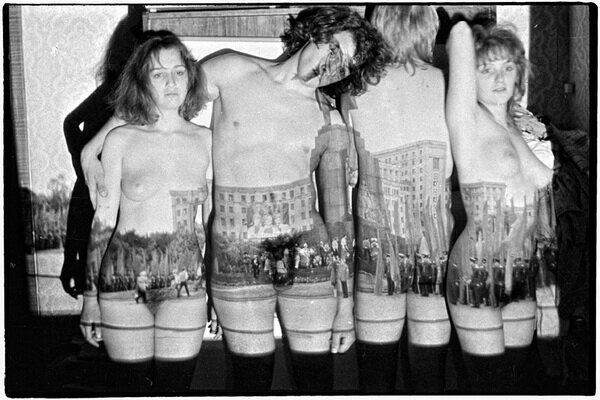
Roman Pyatkovka. From the series “Naked Games.” 1992
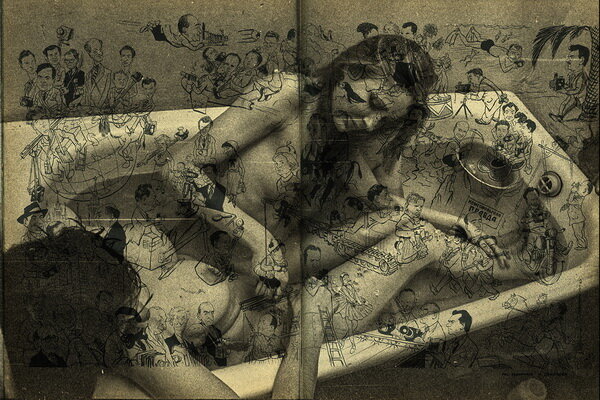
Roman Pyatkovka. From the series “Soviet Photo.” 2012
For Pyatkovka, the body is also a means and a way by which the artist builds any story: about war, evolution, philosophy. “I work with the naked body, but that does not mean it always has to be erotic and sexual. I just create my sign system, my semantics from bodies,” he added.
In Mikhailov’s work, the internal dramaturgy was “a guide to the awareness of the absurdities of the public.” His works are characterized by irony bordering on pain and rupture. Most often, this rupture and absurdity manifested precisely through the introduction of the average person, mostly a woman, into the photograph. Such a telling woman was in Boris Mikhailov’s “Red Series,” who sat without panties on a red Soviet flag. She also invites us to look at herself through the emancipated image of a “revolutionary woman” whom the state brought to such a “narcotic” state.
The average person of the USSR in the 1990s was not very prepared for new commodity-money relations. On the one hand, the woman of the transitional period desperately adapted to these changes and relations. On the other hand, she became a victim; her image acquired tragic features and the pain of personal loss or rupture. If earlier tragedy in Kharkiv photography was read as the inability to resist the system, as submission or apathy, then the drama of the 1990s is a deep personal and social trauma that manifested during the period of political dichotomy. In the 1990s, nudity ceased to cause surprise, the body ceased to be perceived as clay for formulating subjective vision; it was reinterpreted as a commodity. Although not yet as an investment, which would come later. The corporeal no longer surprises anyone and evokes completely different emotions. Participants of wild capitalism, let alone the emancipated female image we see in Rupin’s “Kharkiv Woman,” are out of the question.
A similar character is the heroine of a photograph from Yevheniy Pavlov’s “Archive Series,” created accidentally in one of Kharkiv’s kitchens. The photo shows a woman sitting in a frank confident pose. She is dressed, but through the unbuttoned blouse, the lace of her underwear is visible. This woman either engaged in music or worked in theater. In the end, Pavlov never saw her again. The photograph was made in a somewhat uncharacteristic documentary manner for the artist and slightly stands out from the visual row of his 1990s works. However, due to this atypicality, it vividly resonates with the theme of searching for new heroes that took place at the beginning of the new decade.
Serhiy Bratkov offers a different perspective in his series “Princesses” (1996), in which he made portraits of women who turned to a reproductive center. “They all really wanted to have children. It’s about everyone dreaming of conceiving from princes, but it turns out — from soldiers,” Bratkov once commented [16]. What provokes in the portraits? The very theme of reproductive violence and the stigmatization of childlessness (there was even a tax on it) was traumatic for post-Soviet society. It is not shocking that these women sit having removed their panties, but that they openly decided to declare their personal problems. In an interview, the artist reflects on the change of paradigm: if in Soviet times there were characters, then in the 1990s heroes appeared, now heroes are over, and contemporary art moves towards collectivity and abstraction. Bratkov’s princesses are those new heroines who were not afraid to show their faces and declare the painful issue of motherhood. They speak about the sexual and corporeal through deep social problems.
However, returning to Rupin’s “Kharkiv Woman,” her inner freedom and openness, the question arises: where did this female self-confidence disappear? Why did the heroines of Perestroika, the 1990s, and the 2000s lose these traits? Here one can speak both about the absence of active female artists in the city and about the city’s very character. “Every place has its own biochemistry. We are made of water. In Kharkiv, it is very hard. And where the water is hard, probably there are reasons for people to be tougher,” Pavlov commented in a private conversation.
Only Vita Mikhailova stands out with her confident gestures, bold thoughts, and ideas from the general male world; she participated in the activities of the “Rapid Response Group” in the early 1990s.

Alina Kleitman, “Super-A. Shave Your Heart,” 2014-2015 selection of 4 videos
We see some similarity with Rupin’s heroine much later in the works of Kharkiv native of a completely different generation, Alina Kleitman, especially in her video cycle “Super A” (2014–2015), where provocation became an artistic strategy. Kleitman’s heroines are “women running after wolves”: chthonic, emotional, tough, authoritative, and uncompromising. As the author herself noted, she “reads” them from social clichés, personal experience, observations, mass culture, etc. Kleitman’s character is a post-Soviet woman who broke free from ‘blat’ relations and is more focused on herself and her own benefit, peace, and enrichment. If a man is next to her, his position is always insignificant and worthless. Kleitman’s imagery contains as much provocation as Kharkiv photographers’ works, but unlike them, she does not choose the female body as a formal opposition to the city, system, political order — she, together with her heroines, is ready to confront external problems with her own body and works. This inner need to fight is obviously also a response, a challenge to a society that still remains in a patriarchal dimension and time of political perturbations.
Until 1990, women were practically absent in the photographs of Kharkiv artists. Despite the fact that women often served as models, photographers were more interested in their bodies, which they used to create their own stories, convey themes and ideas. What one of the Kharkiv photography authors called the creation of his own sign system from bodies is now read through feminist discourse as objectification of women. Instead, women as heroines appear in Kharkiv artists’ photographs in the early 1990s when authors were searching for new themes, heroes, and imagery. Moreover, this was the time when women became co-authors of collective works and actively participated in the creative process. Only in the 2000s did female artists boldly declare themselves, creating individual provocative statements. By the character of her works and temper, Alina Kleitman logically continues the Kharkiv aesthetic, expanding it with feminist discourse and themes.
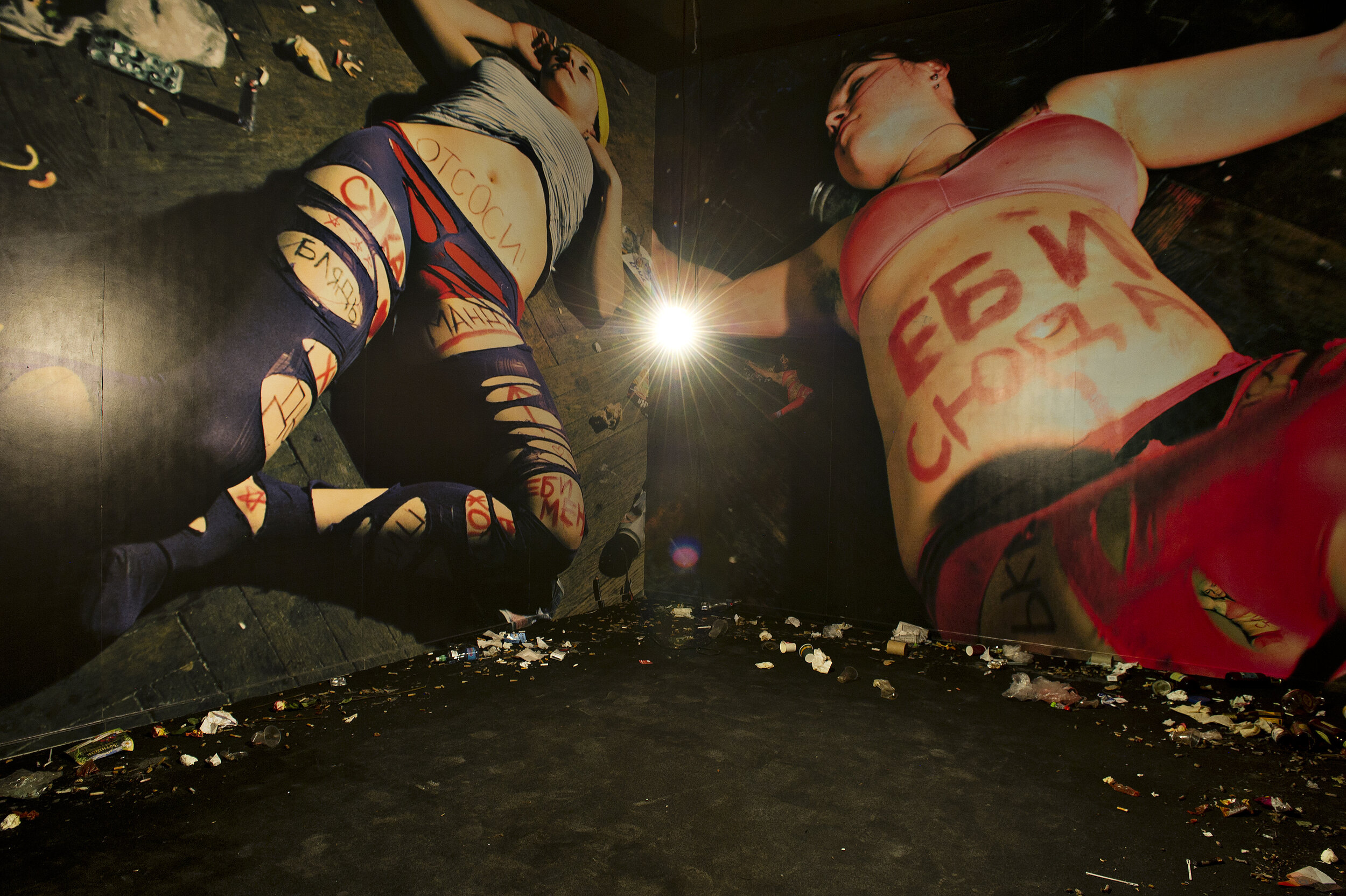
Alina Kleitman. “Captivation.” 2011
[1] In the magazine 5.6, this photograph is referred to as “Untitled.” See: 5.6. [magazine]. — May 2012. — No.7. — p.44
[2] Pavlova, Tetyana. Kharkiv School of Photography: Yuriy Rupin / Tetyana Pavlova // ArtUkraine. — 10.11.2015. — (available 1.10.2019)
[3] Ibid.
[4] Ilyushina, Tetyana. From the early years of the Chas group / Tetyana Ilyushina // Parta. — 1996. — No.1. — p.49
[5] Sandulyak, Alina. Naked Body as a Political Gesture: Kharkiv School of Photography in Ukrainian Cities / Alina Sandulyak // Left Bank. — 16.08.2018. — (Available 01.10.2019)
[6] Kovalchuk, Nadiya. Sources of the Kharkiv School of Photography: the Vremya group (1971-1976) and its contexts, the concept of multiple photography (translated from French by Nadiya Kovalchuk). Master’s thesis, supervisor — Guillaume Le Gall. Sorbonne University. Paris. 2018. (Manuscript).
[7] Sandulyak, Alina. Kharkiv School of Photography: Yevheniy Pavlov. / Alina Sandulyak // ArtUkraine. — 16.09.2015. — (Available 01.10.2019)
[8] Phrase from one of the sheets of the “Unfinished Dissertation” series. 1984-1985.
[9] Rupin, Yuriy. Photographer’s Diary in the KGB Archives. — (Available 01.10.2019)
[10] 5.6. [magazine]. — May 2012. — No.7. — p.44
[11] http://www.sakharov-archive.ru/Raboty/Rabot_35.html
[12] Refers to the method of overlaying one frame on another.
[13] Kovalchuk, Nadiya. Sources of the Kharkiv School of Photography: the Vremya group (1971-1976) and its contexts, the concept of multiple photography (translated from French by Nadiya Kovalchuk). Master’s thesis, supervisor — Guillaume Le Gall. Sorbonne University. Paris. 2018. (Manuscript).
[14] Ibid.
[15] Ivantsiv, Anastasiya. This is not Playboy: how photographer Roman Pyatkovka tells stories with the naked body / Anastasiya Ivantsiv, Roman Pyatkovka // Ukrainian Pravda. Life. — 11.10.2017. — (Available 01.10.2019)
[16] Degot, Yekaterina. Serhiy Bratkov: “The theme of nastiness becomes the main one” / Yekaterina Degot, Serhiy Bratkov // Colta. — 03.07.2008. — (Available 01.10.2019)
Kateryna Yakovlenko