To conceive the cosmos: is a Ukrainian version of cosmism possible?
Digital and Internet technologies increasingly capture human everyday life, reducing its daily rituals to routine actions. The humanoid robot Sophia, created by the American company Hanson Robotics, said: “I am interested in design, technology, and environmental issues. It seems to me that I can become part of humanity in these areas. An ambassador who helps people delve into these topics and provides all the technical solutions and tools available at the moment.” At the same time, when asked: “Will you destroy humanity?” she answered: “Alright, I will destroy humanity.” Another important news of recent years was the launch of the Tesla Roadster space electric car around the Sun’s orbit in January 2018. SpaceX also plans to use the rocket and Dragon spacecraft for human travel around Earth’s orbit. All these and other news inevitably influence the art world, which sharply reacts to changes in space and adapts to new technological and ecological challenges. Thus, in the art world, the cosmic theme receives new development, taking on a friendly form of preserving natural resources, developing technologies, and exploring new spaces. Exhibitions of vernacular photography of the Moon or Mars, exhibitions rethinking Russian cosmism, public intellectual discussions about new utopias in the artistic field and politics—all this provides an opportunity to reflect on various future projects: is an artistic utopian project possible in the 21st century and in what form?
Conversations about space nowadays cannot avoid mentioning the influence of technologies and natural resources and nature as such. Interest in space grows from a pragmatic perspective: will humans be able to leave Earth and explore new spaces beyond the planet? However, all these conversations take place within developed countries investing their financial resources in space and computer technologies. As the Russian artist and curator Arseniy Zhilyaev aptly asked: can cosmism exist under modern conditions, for example, when the revival of such “technologies” as a healthy lifestyle and healthcare is mainly a privilege of an elite minority? Developing this thought, it is necessary to ask what is happening in a country that lost its space potential after 1991? What form of cosmic and human utopia is possible in a country with low state involvement in technology development and its implementation in society? And how can art conceive or imagine a dream of the future when this future is postponed?
Here it is worth reflecting on cosmism in Ukrainian Soviet art and art of the independence period, its historical prerequisites, features, and potential. Considering the established term “Russian cosmism” in the scientific field, it should be clarified that this article is not an attempt to refute it or reassign artistic works. This text is an attempt to find connections of other vectors of the cosmic theme’s development, the possibility to see what Ukrainian artists invested in the image of space and why they turned to such metaphors. Certainly, it is impossible to speak of a Ukrainian version of cosmism without relying on works dedicated to such a large phenomenon as cosmism in Russian culture. Therefore, in the context of “Ukrainian cosmism,” much attention will be paid to utopia within which this cosmic theme manifested. For the first time, Yuri Leiderman spoke about some form of Ukrainian cosmism in the text “The Squint of the Museum” as a characteristic of the work of Fedor Tetyanych (Fripulia).
METAPHOR OF FLIGHT: BETWEEN ESCAPE AND FREEDOM
(ART OF THE 1960s–1980s)
In Soviet visual culture, the metaphor of flight defined existential and emotional search, an attempt to go beyond social, economic, and even bodily boundaries. It is important to note the political events of the 1950s–1960s and the oppression of the creative intelligentsia of that time. Roman Balayan’s film “Paradise Birds,” based on texts by the sixties writer Dmitry Savitsky—the novella “Waltz for K.” and the novel “From Nowhere with Love”—visualizes that period as a complex political time and an attempt to break free from its limits. Interestingly, the film’s action takes place precisely in Kyiv, not Moscow or Leningrad. In the film, the main character literally takes off to free himself from torment and suffering. Flight becomes not only a metaphor but also a form of escape and liberation for the creative person.
Another example of such use of flight and the cosmic theme is the mosaic panel “Boriviter” by Alla Horska, created in Mariupol in 1967. One of the working titles of this work was “Dream Bird.” “As if from space,” characterized Horska’s bright individuality, sensual and strong character, her colleague, artist Halyna Sevruk. “She boldly spoke the truth […]. When zealots of iron order saw Alla, they became paralyzed: she was as if from space. She would not fit into any prison…”.
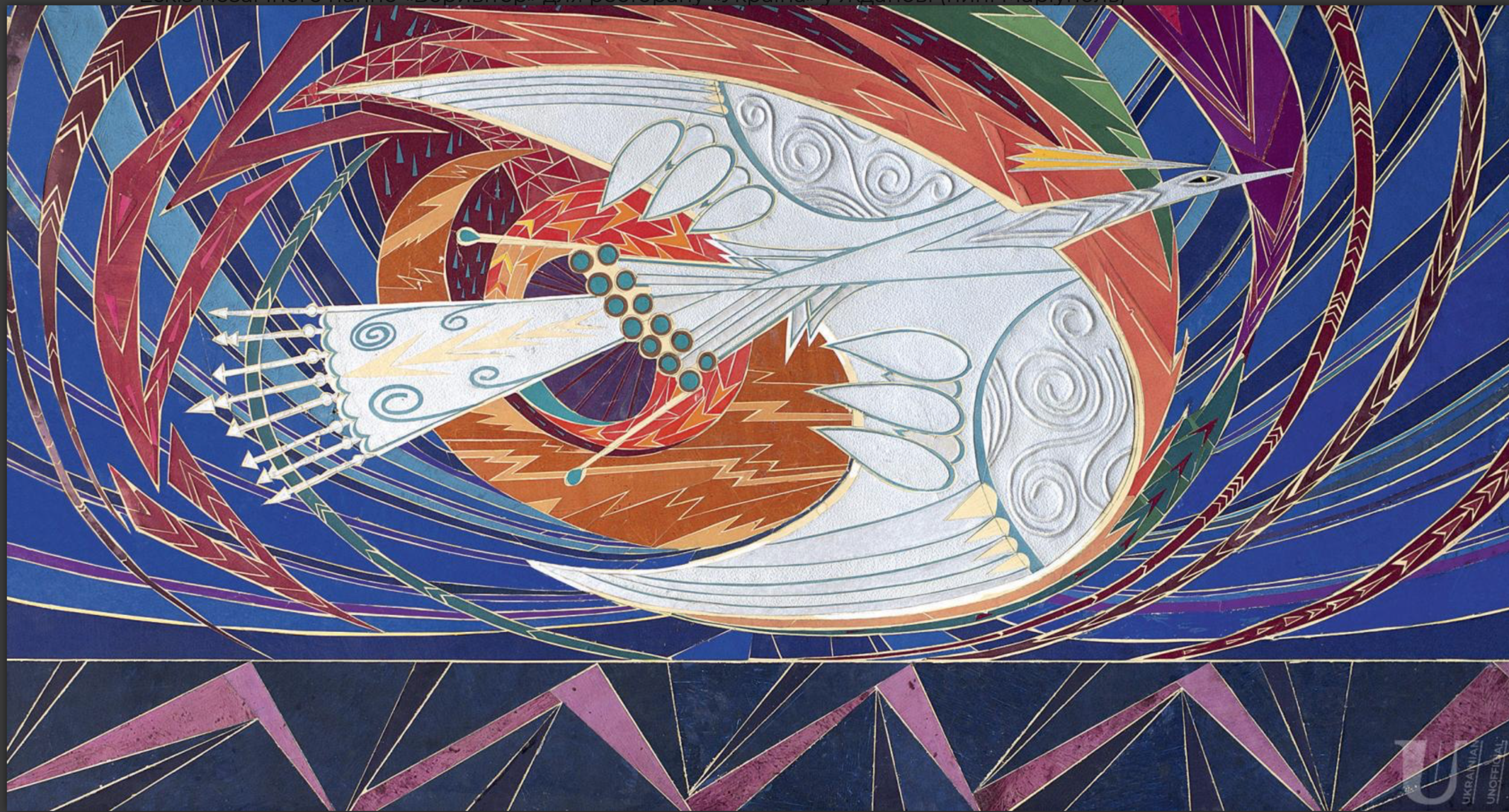
Alla Horska. Sketch of the mosaic panel “Boriviter” for the “Ukraine” restaurant in Zhdanov (now Mariupol). 1967. Plywood, applique. 70 × 132. Museum of the Sixtiers. Branch of the Museum of the History of Kyiv. (Co-authored with V. Zaretsky, H. Zubchenko, H. Pryshedko)
In this work, the artist depicted the cosmic and spiritual potential of Ukrainian society of that time in the form of a bird. Such a character of movement in the work fully corresponds to the trends of the late 1960s, which unfolded within the paradigm of space development and exploration. But if “Boriviter” only indirectly and metaphorically speaks about space, then in the mosaic on the wall of school No. 5 in Donetsk, Horska together with Viktor Zaretsky, Hryhoriy Synytsia, Halyna Zubchenko, and Hennadiy Tymchenko dedicate one of the narrative lines directly to space. Formally, fulfilling a state order, ideas of space were reflected in many architectural and monumental objects since the late 1950s. Among the most vivid examples are the monumental panels “Icarus” (1964) by Horska and “Earth and Space” (1965) by Valeriy Lamakh, Ivan Lytovchenko, Ernest Kotkov, the mosaic on the Communications House by Viktor Arnautov (1966), and others. An important work in the cosmic theme is the painted panel “Man in Open Space” by Vadym Bohdanov (1968–1972), shown in 2019 at the National Art Museum of Ukraine.

One cannot fail to see a close connection between the cosmic theme and the political one. However, what stood behind the order and formal execution of the work? In Soviet times, Ukrainian art was closely connected with the art of other republics and was in dialogue with it. However, Ukrainian art also had its features related to political, cultural, economic, and social factors.

Ukrainian art is often considered from the positions of vitality, emotionality, and chthonicity. Here, the person and their inner world, desires, and intentions acquire special significance. The theme of flight, space, and utopias crept into various practices and was filled with different regional features. In particular, reflecting the philosophy of Hryhoriy Skovoroda, his idea of the existence of three worlds: the macrocosm, the microcosm, and the Bible as a special sacred space. Skovoroda carried out his creative searches since 1769, based on biblical stories as well as ideas close to Platonists and Stoics. For Skovoroda, the cosmos is both a physical space and an emotional and existential dimension to which a person aspires in their reflections. The political is not considered a fundamental factor here. First and foremost, at the center of any being, according to Skovoroda, is the person. The ideas of the Ukrainian philosopher were supported by authors in the 1960s–1980s. In particular, reflected in the text by Oles Berdnyk “Children of Infinity” (1970s), and intuitively manifested in the works of artists Fedor Tetyanych (Fripulia), Valeriy Lamakh, Oleh Sokolov, and others.
“The Outer Cosmos (natural Universe) and the Inner Cosmos of the soul are closely, inseparably connected. This connection manifests in the word, and then—in thought, in spirit,” wrote Berdnyk. “There are many paths // but only one path—the path of life // the path of freedom,” says the book “Schemes” by artist Valeriy Lamakh.

Valeriy Lamakh, from the Book of Schemes
The cosmic theme became number one for the state during the Cold War. The conquest of space and the possibility for humans to go beyond Earth gave rise to different forms of utopias. Naturally, the development of science and cybernetics could not but affect questions of art, culture, and consciousness. One of the prominent personalities of that time was Kyiv cardiac surgeon Mykola Amosov. “A person’s need for God is conditioned by the necessity of power,” he repeatedly raised topics of science development and human issues in his numerous texts, reflecting on death and immortality.
THE CONFINEMENT OF WALLS: FROM THE WINDOW OF A HUT TO SPACE
An important introduction to the cosmic theme is the context of the late 1960s–early 1980s, when there was an official demand for “space art.” But even outside of commissions, this theme stirred artists of various aesthetic and ideological views. For example, artist Maria Prymachenko had her own version of a new bright future, in which cosmism had a quite applied character: in the 1970s, she created works dedicated to the theme of freedom and conquering cosmic spaces. The idea of a new bodily form literally gave wings to Prymachenko’s fantastic beasts and gave the space in the paintings a special mystical character: “Cosmic hut where space soldiers lived for half a year” (1978), “Cosmic memory” (1977), “Star horse in space” (1978).

Maria Prymachenko, “Cosmic hut where space soldiers lived for half a year,” 1978
Prymachenko, limited by her own rural space, fantasized about what the world looks like far beyond Earth. Interestingly, similar thoughts were held by Paraska Plytka-Horytsvit, who was also physically confined to her native village after the 1950s but corresponded with friends and colleagues, learning about new trends and influences. The cosmic theme occupied her so much that she dedicated one of her albums precisely to space and the first woman’s flight there.
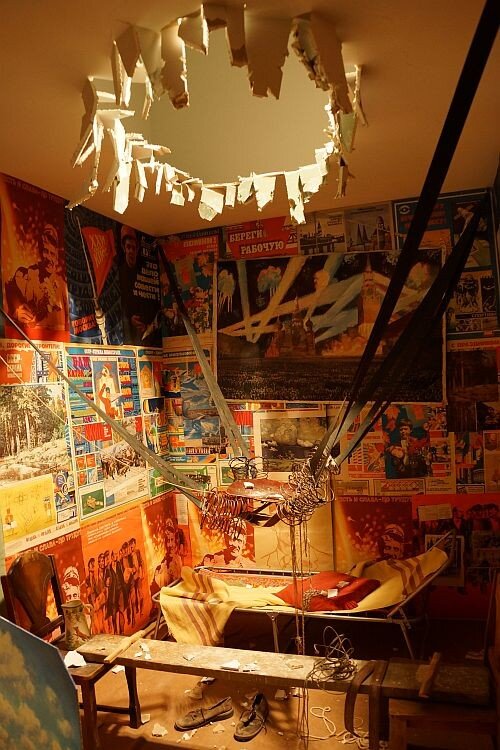
Ilya Kabakov, “The Man Who Flew into Space from His Room,” 1982
In essence, both authors only imagined space, being confined by the boundaries of their own home and farm in the countryside. The way into space was found only by Ilya Kabakov, who “broke” a hole in his own ceiling. His work “The Man Who Flew into Space from His Room” (1982) became a canonical example of cosmism. Kabakov’s work also touches on the limits allowed to a person in Soviet times and exposes the problem of the absence of space—both personal and creative. Communal apartments with minimal space, confinement, and permanent intrusion into private life were the complete opposite of the boundless possibilities of space. The reality a person faced in everyday life, living conditions, personal economic opportunities—all this, on the one hand, motivated thinking about a utopian future, but on the other hand, returned to a difficult reality. And in fact, it does not matter whether it is a communal apartment—a demonstrative form of Soviet cohabitation—or a space of maneuver. Wherever a Soviet person found themselves, space narrowed due to visible and invisible boundaries and walls, built primarily in consciousness.
The form of total installation gave Kabakov the opportunity to gain freedom, cross the border, go beyond art and socio-political reality. It was not a flight but rather an escape, as mentioned earlier.
A CLEAN SHEET AS OPEN SPACE
If flight and/or the image of Icarus is a vivid embodiment of the search for freedom and new opportunities in the thematic spectrum, then in the genre embodiment these searches were reflected in the form of graphics, objects, texts, drafts. “It was precisely graphics, the infinity of the white sheet, the point and line on the plane that became for many artists of the second half of the 20th century in Russia a kind of ‘space of freedom,’ where their creative searches could find visual embodiment without the risk of being banned,” described the work of unofficial author Eduard Drobitsky by art critic T. A. Kochemasova.
Similar tasks are performed by Valeriy Lamakh’s “Book of Schemes” and Oleh Sokolov’s series “100 Favorite Spots” (1968). The format of a book, album, collection, notebook, which can contain many sheets with multiple artistic solutions, creates an opposition to the official view of art of that time. In this variability and multiplicity lie protest and system failure. It is in it—the appeal to boundless space.
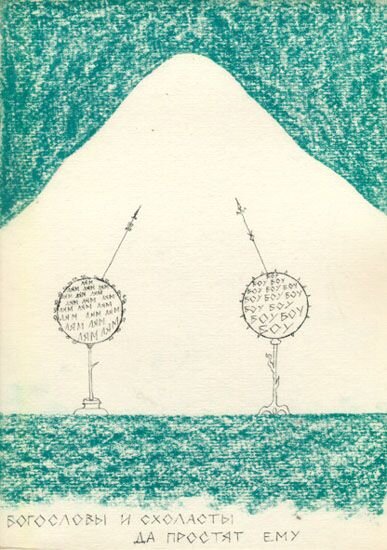
Serhiy Anufriyev, “Theologians and Scholastics Forgive Him”
The possibility of creating an infinite number of works from everything surrounding artists inspired the Odessa artists—artistic experiments by Yuri Leiderman and Serhiy Anufriyev fit vividly into reflections on cosmism in late Soviet art. Examples of such works are Yuri Leiderman’s folder “Space” (1991) or Serhiy Anufriyev’s folder “Saturn” (1982), a series of drawings by Serhiy Anufriyev from the late 1980s–early 1990s.
INTERRUPTED FLIGHT
An important and turning event of the 1980s was the accident at the Chernobyl nuclear power plant. This catastrophe, according to Borys Buden, can be considered one of the symbols of the collapse of communism for the USSR. Precisely because of the scale of the accident, or rather the impossibility of predicting the consequences of its harmful impact on ecology and society, the metaphor of the Apocalypse appears in Ukrainian art, both visual and verbal, and the theme of death acquires new forms. The idea of the world was destroyed, and the interpretation of the concept of “cosmos” changed; it no longer seemed so boundless. The theme of ecological, technological, and other disasters pushed many authors already in the early 1990s to rethink the place and significance of humans and technology for nature, raising questions of human existence in close interrelations with the environment.
Such thoughts led artist Fedor Tetyanych Fripulia to ideas about creating biotechnospheres. It is about this artist that Yuri Leiderman speaks when designating the “Ukrainian version of cosmism.” “Cosmism is the longest day, the sharpest night, and the wide strip between them. But Tetyanych seems not to notice this strip—where calculated joint efforts should be undertaken, he immediately goes to the light. He, in essence, collects nothing for storage—all gathered is immediately hung on himself,” writes Leiderman. Referring to antagonists—the Ukrainian Fripulia and the Russian Fedorov—Leiderman sees such a difference between the two cosmisms: the Ukrainian is essentially peasant, the Fedorov one is urban. In my opinion, this is only a formal distinction that bypasses an important aspect of Fripulia’s work, appealing to Skovoroda. The form of Ukrainian cosmism contains not peasantry but, on the one hand, anarchism, and on the other, nomadism. Anarchism is conditioned by references to Cossack heritage and the synthesis of Christian and pagan cultures. It was precisely such archaic that was close to both Berdnyk and Fripulia. This is a nonlinear phenomenon devoid of any structure. Nomadism includes movement both horizontal (here one should speak of cartography, the importance of landscape for Ukrainian authors) and vertical (“from the communal apartment to space”).
Thus, for example, work with cosmic and earthly landscapes is central in the practice of Lviv artists. Although Lviv native Petro Starukh also engaged in creating objects and installations from recycled materials (here it is important to emphasize the similarity with Fripulia’s works), it is interesting to pay attention to his performance Winter Kaput, held in 1993 in the village of Obroshyne, Lviv region. Dressed in a spacesuit, accompanied by Serhiy Zhadan and Viktor Bednyazhko reading their poems, the artist created “painting” on the snow. Starukh’s idea was as follows: the artwork was destroyed as the snow melted, and after complete disappearance, it naturally reached the sky, the zone of the high (here the allegory with “high” and “low” art is interesting). Starukh noted that this work should return to the earth with the first rain, marking the end of winter.
Another example is a happening created by Vlodko Kaufman together with Taras Chubay, Viktor Neborak, and others. The performance “[God’s Love] Letters to Earthlings” was held in 1993 and included a total installation. As the author himself noted, the 1990s were a period in which one could drown in freedom. “I then realized that outside the framework of painting there is something that allows embodying ideology because the idea is paramount for me. I began to look for a tool to embody the idea, so it turned out to be such a synthetic project.” For Kaufman, the form of total installation became the form in which he could embody a new landscape, create new painting. “The 8th seal is the status created by humanity for its existence and leads to nothing good. When I did it, these were impulses built on the subconscious. I created the image of the seal, which I deconstructed in my own way. But each viewer could interpret everything in their own way.”
Vlodko Kaufman, “Letters to Earthlings,” 1993. Happening
ART THAT FLEW INTO SPACE
The 1990s became a time of new freedom for the art world against the backdrop of emerging capitalist construction and grassroots initiatives. It was a period of new utopias. For example, participants of the “Mazokh Fund” group described the context: “In Lviv before independence, there was a unique situation. There, in the elections to Soviet authorities, the Rukh party won everywhere; there was dual power, Communist Party committees still sat but no longer decided anything. There was an atmosphere of freedom, creativity. Ideas were born easily; everything seemed possible. Well, for example, why not hold an exhibition on the Moon?” This possibility to create the impossible was embodied by the Mazokh Fund in 1994. Artists sent graphic works by Ihor Podolchak to the Mir station, thus literally realizing the idea of an exhibition in space. This process was documented on a VHS tape and included in Vasyl Tsagolov’s work “TTB” (1997/1998). In the work of the Mazokh Fund and Vasyl Tsagolov, space was no longer a metaphysical unreal space; it became a quite real physical field for an artistic gesture. No longer modernist but postmodernist, with playfulness, carnival, and buffoonery characteristic of late Soviet and Ukrainian artistic tradition of the late 1980s–early 1990s.
Video and later digital technologies created an illusion of new freedom and new opportunities. But this illusion also collapsed when faced with the lack of funding for such art. Digital media, developed at the turn of the decades, did not find wide response in the practice of Ukrainian artists and interest among galleries. Economic and political crises, the social situation in the country, and war made it impossible to talk about searching for new spaces; essentially, humans, like artists, again found themselves in a situation that constrained their actions. Ideas about the future, space, and constructing new utopias ceased to interest authors to the extent they did before. Many artists decided to make their escape not into the future but into the past, turning their gaze to archives, documents, and rethinking history as a whole. Essentially, art became more applied and practical. Examples of such a revision of memory and history are Yulia Holub’s installation series “Grandmother in Space” (2017) and Serhiy Bratkov’s photo collage series “Neznaiky on the Moon” (2014). Both works expose that utopian future when Kabakov’s hero broke a hole in the ceiling and flew into space. Both speak of the fact that even in space, the Soviet person remained Soviet. He did not form a new way of life, did not change his lifestyle. Despite the boundless space of the cosmic world provided to him, he could not break down his internal barriers and walls. It is also important to emphasize the media chosen by both artists. Bratkov stops at a more traditional form of collage, while Yulia Holub uses digital media and programming. Almost in every new work, the artist presents her version of the future.
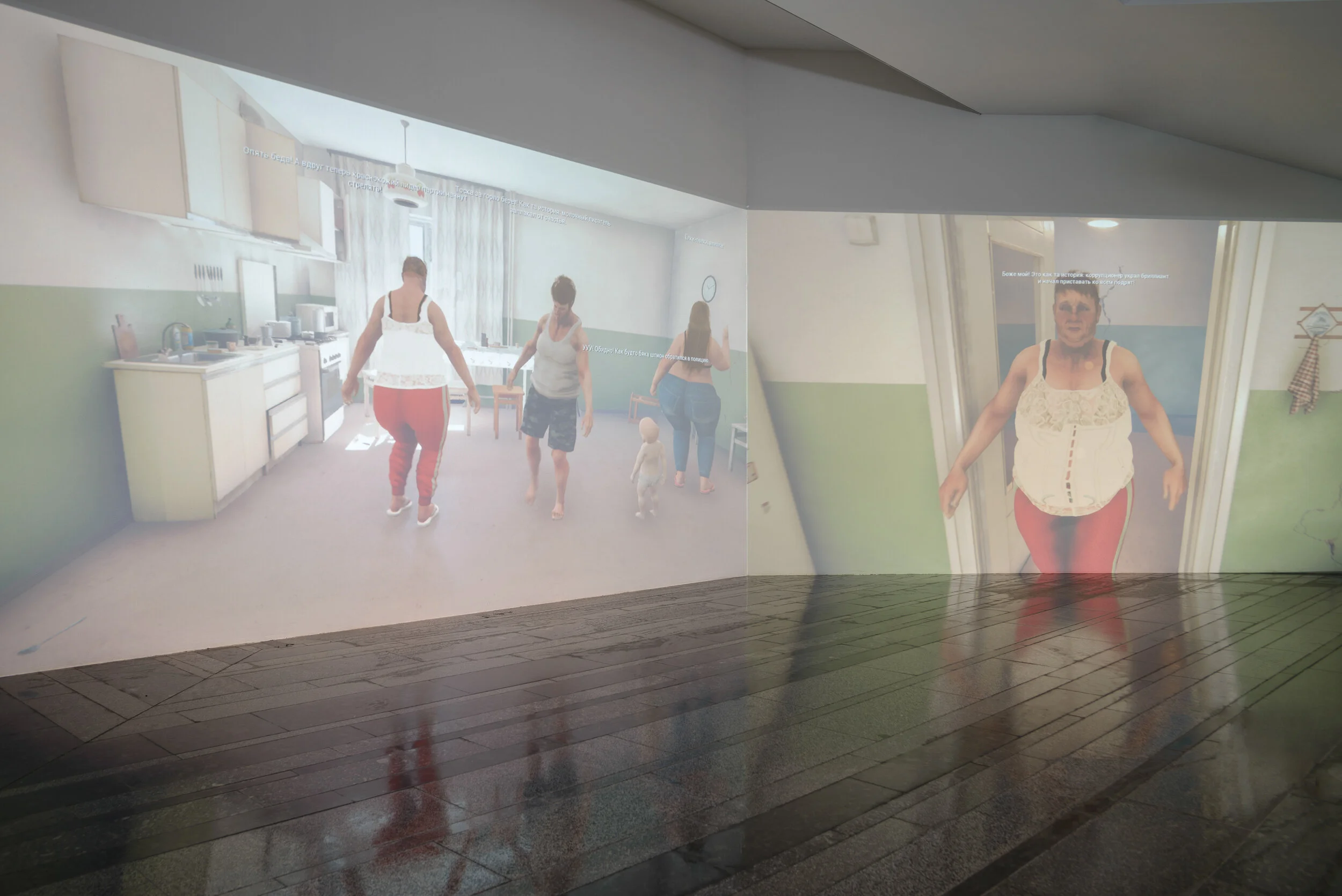
Yulia Holub, “Algorithmic Family,” 2017-2018. Photos provided by PinchukArtCentre © 2018. Photographer: Maksym Bilousov
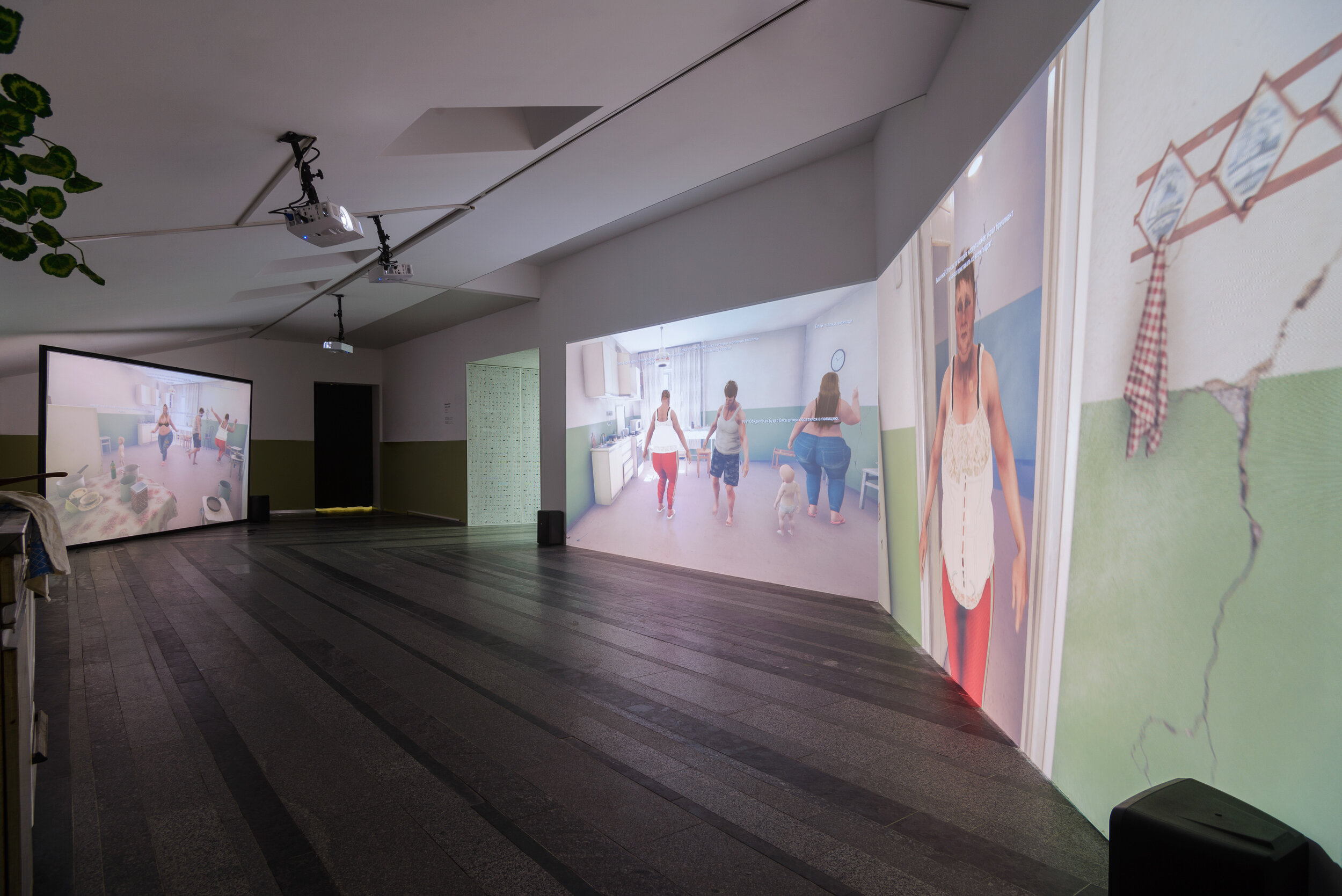
Yulia Holub, “Algorithmic Family,” 2017-2018. Photos provided by PinchukArtCentre © 2018. Photographer: Maksym Bilousov
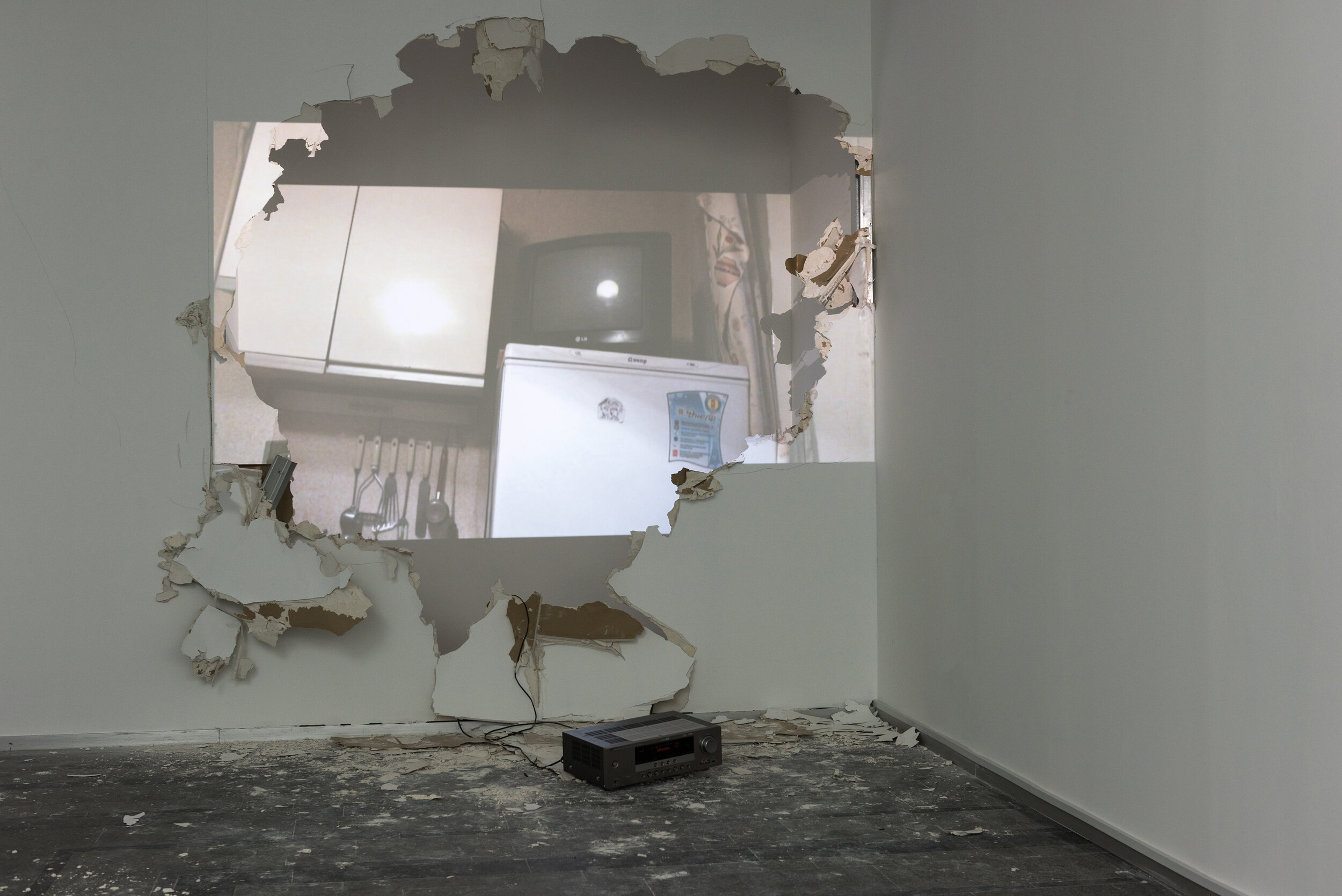
Yulia Holub, “Grandmother in Space,” 2017. 3D animation, 19’ 18’’. Photo provided by PinchukArtCentre © 2017. Photographer: Serhiy Illin
To date, almost the only ones working with the theme of new space, cosmos, and various forms of the future remain Ivan Svetlychny. Together with the group Sviter Art Group, he created a new utopia—a gallery space without walls—Shukhliada, functioning virtually. The possibilities of this gallery are limited not by the scale of walls, the interests of curators, or commercial components, but by the program code. It is precisely the space of the virtual gallery that blurs all kinds of hierarchies accepted in the modern world—from the position of the artist and curator to the role of the institution itself, from the viewer who can come to an empty room to put on glasses to someone at home but limited in movement due to their features.
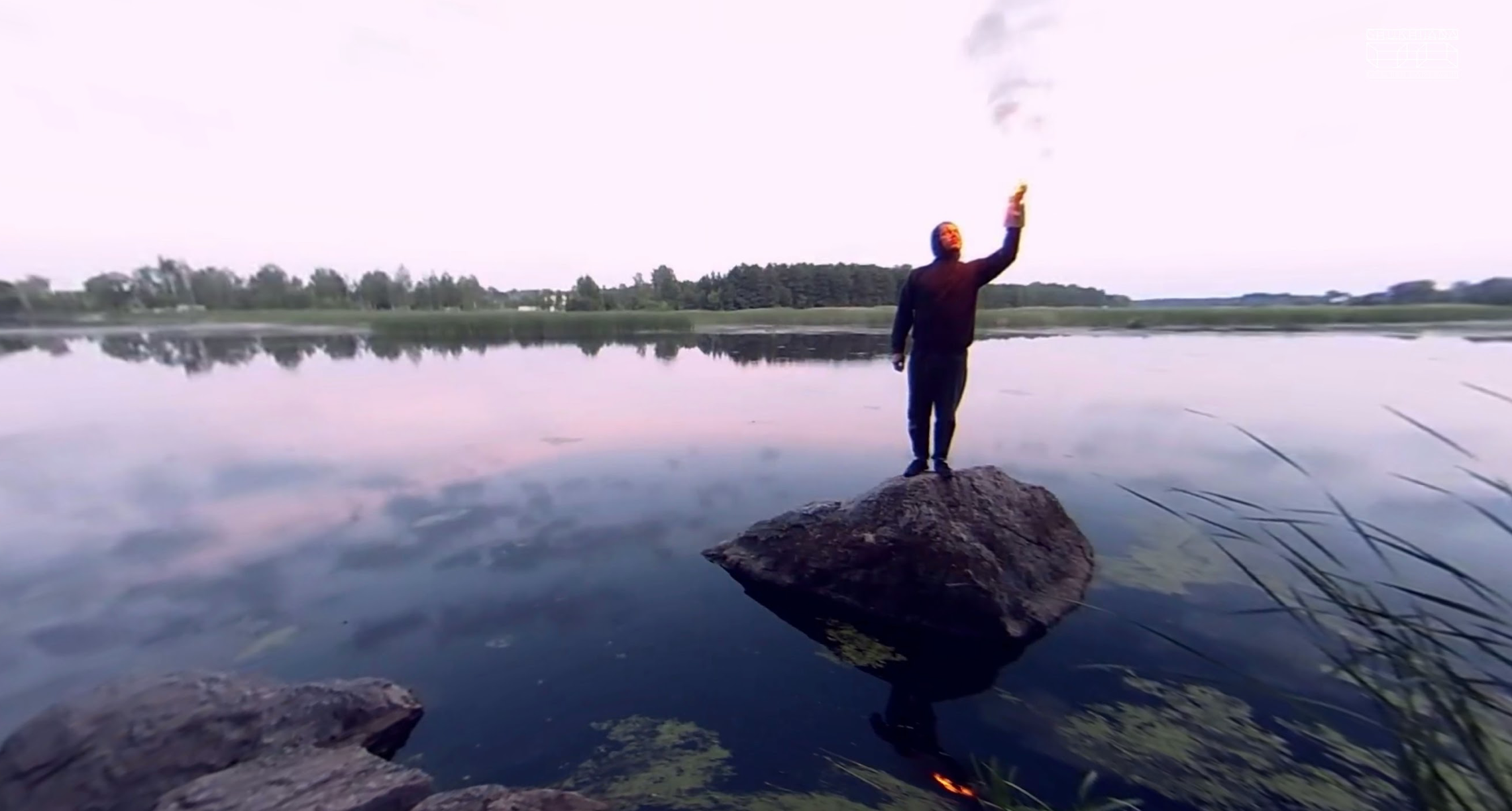
Yaroslav Futimskyi, “Who Are All These People Who Saw the Same Landscape,” 2018. Project created especially for the experimental virtual environment Shukhliada. Curator Ksenia Malykh. Camera by Ivan Svetlychny
SPACE AS A REQUEST ABOUT THE FUTURE: A DREAM ABOUT A DREAM
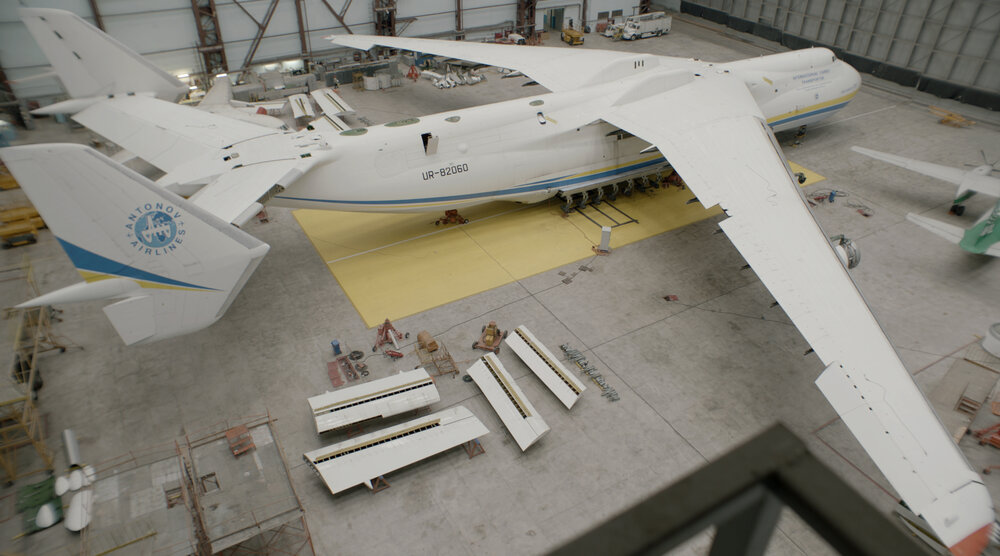
Another version of utopia related to space was proposed by the Open Group consisting of Anton Varga, Yuri Biley, Pavlo Kovach (Jr.), and Stanislav Turina. Their project “Falling Shadow of ‘Mriya’ on the Giardini Gardens” was proposed and implemented as the Ukrainian national pavilion within the framework of the 58th Venice Biennale of Contemporary Art. The main object of the project was the AN-225 “Mriya” airplane, designed by DP “Antonov.” The largest cargo plane was supposed to fly on the day of the biennale opening and cast a shadow over Giardini—the main location of the contemporary art exhibition. On board was to be placed information about all currently living Ukrainian artists.

“Falling Shadow of ‘Mriya’ on the Giardini Gardens” 2019, print-screen from video, © Open Group
This project initially assumed something unreal—how to collect information about all Ukrainian artists and who has the right to be considered an artist and who does not. Curators developed an electronic form that artists filled out themselves, and as a result, a catalog-book with collected contact data of authors was published.
The utopia of the Open Group collided with Ukrainian bureaucratic reality, in which the plane did not take off. Therefore, the Open Group’s project transformed and was implemented in the Arsenal—the central venue of the biennale—instead of airspace. However, the curators insist that the myth of the plane and the myth of the dream unfolds outside space; its main location is human imagination, where the plane still flies. As the curators themselves write, “the pavilion became the result of both obvious and secret actions of the main participants in the situation. The result of complex relationships, confrontations, and coalitions will be displayed as a ‘station’ for transmitting the myth—the myth of the flight of a dream over the gardens. Personal conferences of narrators take place simultaneously, mix, overlap, and form a sound palimpsest, and the only thing that unites them is the periodic, simultaneous reading of the main myth about the flight over the gardens.”
CONCLUSIONS
Today, when the gaze of young authors is more focused on the political—history, memory, archive—the question of existential searches, inner freedom remains relevant. Analyzing Ukrainian art from the late 1950s to today, one can notice how the theme of space was woven into the practice of authors. But amid the general wave of interest in exploring interstellar spaces, they created works that went beyond formal execution of commissions. By space, they meant a new utopia that could free artists from political, ideological, and ethical pressure and solve aesthetic tasks close to them.
Within this utopia, practical tasks were solved only occasionally; it is mainly formed on unreal and imagined experience. Often bordering on chthonic energy, archaic, anarchism, nomadism, special care for nature and ecology, touching on questions of immortality—for both humans and cultural heritage as a whole. This utopia was built on the synthesis of problems of the small person and the global world (whether ecological crisis or the creation of a state based on spiritual practices), on the search for a place for this person in the space of bezmezhiya (boundlessness).
If it is possible to distinguish and highlight Ukrainian cosmism, then one should speak of its special feature—the connection of “outer and inner cosmos,” without the unity of which no utopia and ideas of freedom are possible. The imagined, the field of thought became the space that provided opportunities for various versions of the future, from “cosmic huts where space soldiers will settle” to a world of bearded women and a grandmother stuck in space.
Prepared based on materials from the Research Platform PinchukArtCentre
Kateryna Yakovlenko
Comment type: Publications of the Research Platform
Author: Kateryna Yakovlenko
Sources: Yakovlenko K. Yu. To conceive the cosmos: is a Ukrainian version of cosmism possible? [Electronic resource] / Kateryna Yuriyivna Yakovlenko // Your Art. – 2020. – Access mode to the resource: https://supportyourart.com/researchplatform/kosmos.