The Tormented Body of Ukraine in the Works of Oksana Chepelik
Kyiv native Oksana Chepelik works worldwide: in New York, she turns statistics into a gesture of hope, and helps residents of the slums in Rio to “find” their city. But she is driven by Ukrainian themes — thus the film “Chronicles of Fortinbras” becomes a metaphor for Ukrainians’ relationship with their past and themselves.
Artist of the World
Oksana Chepelik began her artistic career as an actress and dancer in the experimental theater “AAA” in the late 1980s. Chepelik’s parents are architects and architectural historians, so art surrounded her from childhood. Now she works with painting, performance, video, and installation.
Chepelik lived in Kyiv, but her creative interest from the very beginning lay far from the mainstream of the local art scene of the 1990s. She was interested in themes of gender, power and governance, the internet — that is, topics resonant with international artistic processes.

Photo from the filming of the movie “Chronicles of Fortinbras”
Chepelik creates complex multimedia projects “Genesis” and “Collider” about how today’s world was formed. In the 2006 work “The Beginning”, the artist launched a dirigible near the ruins of the World Trade Center. Data on birth rates, collected in real time, were projected onto it. This gesture symbolized the beginning of new life despite violence and terror.
Visually similar was the work “Virtual Sea Tower,” created in 2000 in the Jacarezinho favela in Rio de Janeiro. The artist collected many interviews from favela residents who, although formally living in the “City of God,” were completely cut off from the ocean and the beauties of Rio. Discovering that the slum dwellers were desperate about life in the “reservation,” Chepelik offered them at least symbolically, for one evening, to become part of the city’s common life. They raised a balloon into the sky, onto which interviews with residents and images of the ocean were broadcast. Thus, the people from the favela seemed to dissolve into the ocean, absorbing a life unknown to them, erasing the boundaries in which they were forced to live.
She is interested in themes of gender, power and governance, the internet.
Timelessness
Chepelik actively used the potential of international residencies, traveled a lot, and was a guest lecturer. These trips gave her the opportunity to implement technologically complex ideas; in residencies, “A Piece of Shit” and “Favorite Toys of Leaders” were created — performative works in which the artist reflects on mechanisms of power through mass media, the internet, or analysis of sexual experience.
Although Chepelik claims that all works in residencies are created “through the prism of Ukrainian experience,” she has not many works that directly refer to Ukrainian history and culture. Such is her film “Chronicles of Fortinbras” (2001), which somehow sums up a “decade of tectonic shifts in history.” In an era when “suffering became everyday,” the invisible wanderer — the rider Fortinbras becomes the chronicler. This film reflects the turmoil of a person living on the ruins of a reshaped Europe after the fall of the Berlin Wall, the collapse of the Soviet Union, and the civil war in Yugoslavia.
In this film — the turmoil of a person living on the ruins of a reshaped Europe.
Based on Oksana Zabuzhko’s essay, the film is a nonlinear journey interspersed with chronicles of the past and present: it includes Yuri Gagarin’s flight into space and the “Granite Revolution” — and there are “Bloody Sunday,” “Money Laundering in New York,” “The Prosecutor General Arrested Yulia Tymoshenko,” “Putin’s Embrace.” The film captures the asynchrony inherent even today in Ukrainian society, when “the pre-industrial and post-industrial eras, childhood and old age of civilization have merged into one.”

Frame from the film “Chronicles of Fortinbras”

Frame from the film “Chronicles of Fortinbras”

Frame from the film “Chronicles of Fortinbras”

Frame from the film “Chronicles of Fortinbras”
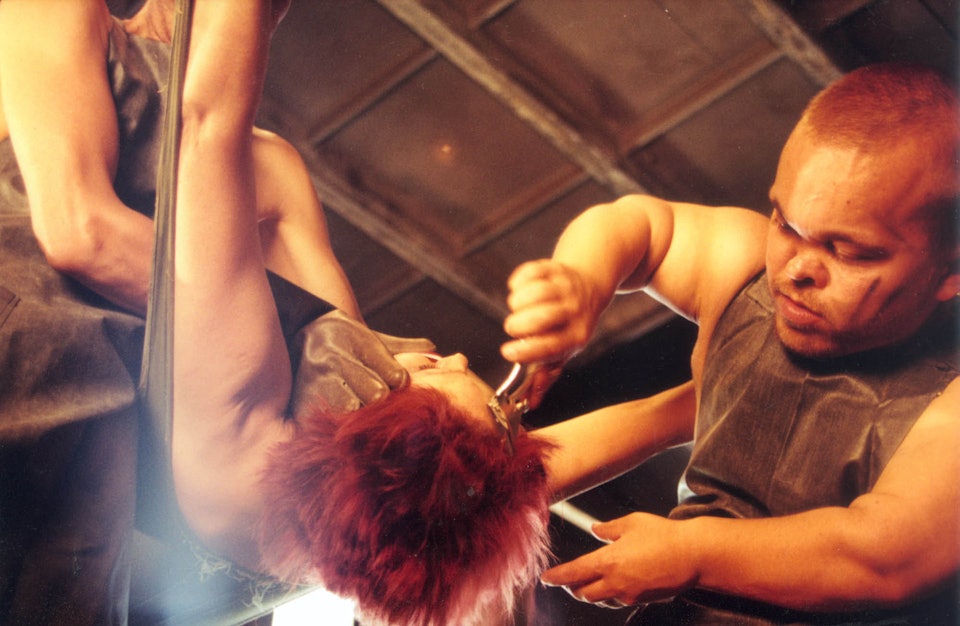
Frame from the film “Chronicles of Fortinbras”
Oblivion
One of the leitmotifs of the film is the search for oneself, the comprehension of lost time, attempts to restore or at least feel out historical connections, the intention to think about the past, no matter how traumatic it was. One of Zabuzhko’s theses is the phenomenon of forgetting inherent to Ukraine: “Ukrainian culture does not know its own time flow,” says the writer. In her collection, Zabuzhko writes that instead of becoming “masters of time, we became its prisoners.”
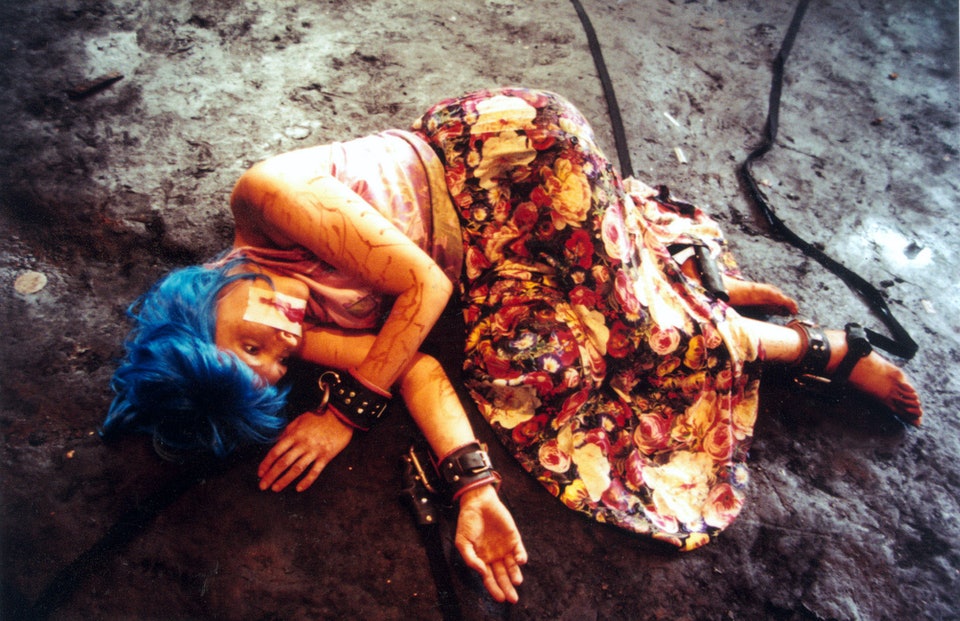
The metaphor of forgetting trauma is also expressed in the main image of the film — a woman raped by two ugly men embodying the totalitarian principle.
In the film, the heroine — a young woman in a pantsuit — ends up in some hangar, after which she loses her subjectivity: her body is torn apart, undressed, painted, and cut; it literally becomes a battlefield in the “cards” made from news of the newspapers of that time. It is painted over with black spray paint, then washed off. What does the ritual of washing carry — cleansing from an inconvenient past or a prerequisite for a new stumble?
Instead of becoming masters of time, we became its prisoners.

Frame from the film “Chronicles of Fortinbras”

Frame from the film “Chronicles of Fortinbras”

Frame from the film “Chronicles of Fortinbras”

Frame from the film “Chronicles of Fortinbras”

Frame from the film “Chronicles of Fortinbras”
Throughout the film, the image of the heroine transforms — from an emancipated woman to a tormented something in Malvina’s wig, and then to the image of the Madonna nursing a baby in the final scenes of the film. The image of the Madonna is interspersed with the depiction of the Oranta mosaic from St. Sophia’s Cathedral in Kyiv — a harbinger of hope and a protector promising that “the sun around you will not be shaken.”
Echoing Zabuzhko’s texts, Chepelik raises the question of responsibility and acceptance of one’s choice, gratitude for the life given to us. “Life without gratitude is a damn nasty thing,” says Zabuzhko.
“Chronicles of Fortinbras” is the finale of the endless “post” of Ukrainian history: “postcolonial, postindustrial, postsoviet.” All these “posts,” according to Oksana Zabuzhko, create precisely this “parallel time” — that “only thing that ultimately matters: human time — in all that is so vaguely called his life.”
Comment type: Publications of the Research Platform
Author: Tetyana Kochubinska
Sources: Kochubinska T. A. The Tormented Body of Ukraine in the Works of Oksana Chepelik [Electronic resource] / Tetyana Anatoliivna Kochubinska // BIRD IN FLIGHT. – 2019. – Access mode to the resource: https://birdinflight.com/ru/pochemu_eto_shedevr/20190208-chepelik.html.