Stas Volyazlovskyi. Appropriation of Inclusivity
Combining primitive ornaments, the stylistics of works by people with psychiatric diagnoses, and the aesthetics of prison creativity in one’s practice is only possible when the artist’s understanding of art is not shaped by academic tradition and canon. Such an author does not think in terms of the history of world culture, clear boundaries of periods, or specific methods of artistic representation. Everything that fascinated and inspired Stas Volyazlovskyi was an embodiment of outsider art. And although it is incorrect to consider Volyazlovskyi as a representative of this art because he had initial artistic education, actively engaged in self-education, and was generally one of the most prominent and successful representatives of the Ukrainian art scene of the 2000s–2010s, his aesthetics is built precisely on visual codes that the author observed and borrowed from the global tradition of art brut, while introducing Ukrainian images into his own practice.

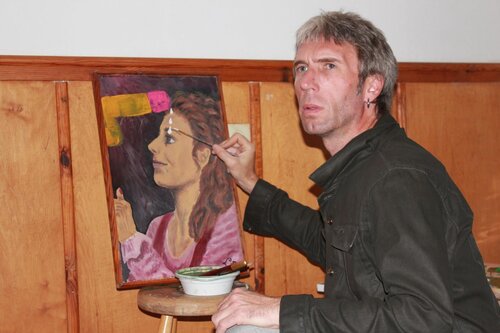
Volyazlovskyi in residence. Photo by Alina Yakubenko. Provided by the Polina Rayko Charitable Foundation

Volyazlovskyi in residence. Photo by Alina Yakubenko. Provided by the Polina Rayko Charitable Foundation
Literal, pornographic, sarcastic, and even autoerotic works of Volyazlovskyi found lively interest and admiration among viewers — simple Kherson workers and former inmates of Kherson colonies. His works did not provoke aggressive resistance, were understandable to the audience, although the author often depicted not only gender-normative but also homoerotic plots, which usually trigger provincial homophobic sentiments. Instead, Volyazlovskyi’s art received rejection from the capital’s audience [1]. There were those who saw an offense to religious and moral feelings in Stas Volyazlovskyi’s works.
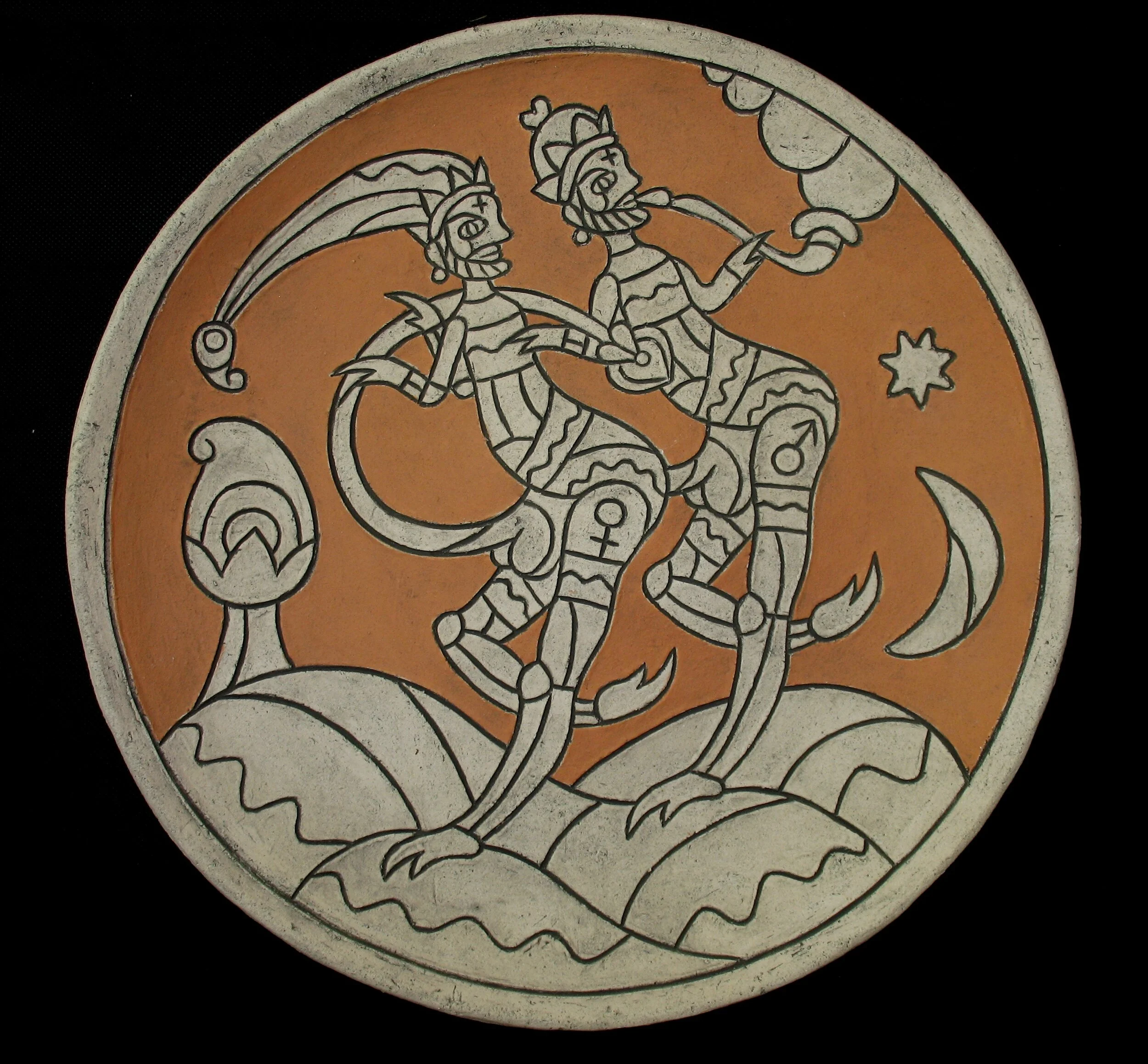
Stas Volyazlovskyi. Decorative plate. 2002. Chamotte. Glaze
Each life period in Volyazlovskyi’s life is associated with a certain fascination in art that shaped him not only as an artist but also as a personality. For example, while teaching ceramics to teenagers in the 1990s, Volyazlovskyi carefully studied the ornamentation of primitive ceramics and created decorative plates, vases, and sculptural compositions in its style. He was attracted to the idea of introducing into the ornament what social morality usually censors — sexual acts or accentuated genitals. Thanks to stylization, such an image loses its literalness and turns into ornamental lace. Ethnographic and folk elements seem to define a zone of permission for tabooed depiction in the artwork, and the utilitarian perception of decorative and applied art objects nullifies possible artistic manifestation. Volyazlovskyi proposed such decorative plates for display at the dull reporting exhibitions of the Kherson artists’ union to see if he could bypass the narrow-minded provincial censorship. This small and hooligan artistic provocation was a form of entertainment for the author.
When ceramics became boring, Volyazlovskyi focused on graphics — ornamental scenes moved from clay to paper and acquired more everyday and social forms. He invented characters, wrote stories for them, and actively combined text with illustrations. The author constructed his works as a kind of comic where text and images complemented each other. Cheap art materials, bright images and ideas “from the people,” as well as a concise and expressive style gradually shaped Volyazlovskyi’s artistic practice into “poor art,” arte povera of Kherson. This simplicity of materials later became one of the defining features of the Kherson artistic phenomenon — Kher-art.
Another feature of Kher-art was the influence of folk and amateur art. Thus, the phenomenon of Polina Rayko, her practices of drawing as self-therapy and self-liberation, preserved by a set of murals in the artist’s house near Kherson, from the early 2000s to today have a noticeable echo in the practice of Kherson artists. Stas Volyazlovskyi was one of those who, through personal acquaintance with Polina Rayko and in visual dialogue with her art, adopted an interest in folk irrational drawing as a story to oneself about oneself.

Stas Volyazlovskyi. “Avtarska Manatypiya KHUI”. 2011. Paper. Gouache. Ballpoint pen. Applique
Several events contributed to the search for an author’s artistic method in Volyazlovskyi’s life. First of all, participation in the activities of the youth initiative center “Totem,” where Volyazlovskyi, alongside Maks Afanasiev and Olena Afanasieva, created bold, experimental, and sometimes crazy video art works in the style of “liquid television” [2]. This practice later naturally continued — independently, together with artist Serhii Bratkov, as well as part of the musical hop-glem band “Rapany” in collaboration with artist Semen Khramtsov, Volyazlovskyi created a gallery of metaphorical stories on the theme of provinciality and the absurdity of life in Kherson and beyond.

Stas Volyazlovskyi. “V€StNIK SP€RMADONORA”. 2008. Paper. Ballpoint pen
The precondition for the emergence of the artist’s most recognizable style — ballpoint pen drawings on old used textiles, i.e., author’s “rags” — Volyazlovskyi identified in numerous interviews as a conversation with artist Yurii Solomko in the early 2000s. Solomko then pointed out to Volyazlovskyi the similarity of his works to schizophrenic writing, which became the starting point of a new self-awareness — “In my work, I am constantly afraid of something, always leaving something unsaid. And if indeed my drawings are like those of schizophrenics, then you can actually relax. Because it’s like in Ilf and Petrov — ‘one comrade got himself admitted to a psychiatric hospital to boldly criticize the Soviet government'” [3].
In fact, Volyazlovskyi emancipated the right to complex and ambiguous images and themes, effectively giving his art signs of inclusivity. That is, he acknowledged that it does not try to be traditional or conventional, taking the right to speak about the most unpleasant social topics — homophobia, pseudo-veterans and the cultivation of false heroes, philistinism and provincial kitsch, late Soviet and post-Soviet everyday racism, polyamory and perversity, depression and borderline emotional states. Volyazlovskyi consciously and voluntarily appropriated the stigma of outsider status in art, which Western artistic practice has tried to neutralize since the 1970s, while post-Soviet Ukrainian art did not even consider outsider works as part of the artistic tradition.

Rapany band. Rapany Live. Poster for the concert 07.11.2011. Photo by Vyacheslav Polyakov. Provided by the Polina Rayko Charitable Foundation
Volyazlovskyi called his attraction to post-Soviet provincial aesthetics and kitsch chanson art. He also defined himself as a penis-art artist, because a stylized or decorated image of the phallus was an inseparable element of most images in his works. As for mood, themes, and Kherson origin, Volyazlovskyi was evidently a representative and remained the embodiment of Kher-art. He turned all this into a fusion of a new visual language and a recognizable authorial style. And although in his practice and personal life Stas Volyazlovskyi simultaneously ironically and tragically experienced the conflict of individuality and the masses, i.e., the untalented society and the talented artist, throughout his life he nevertheless did not leave his native Kherson, on the streets of which he found prototypes and themes for his art.
[1] The catalog of Stas Volyazlovskyi’s exhibition “Libertinage” became one of the grounds for a lawsuit against “Karas Gallery” in 2017. More information at the link
[2] More about Kherson video art and “liquid television” at the link on the website of the Open Archive of Ukrainian Media Art
[3] Halyina Hleba. Thanks for penis art, Stas Volyazlovskyi. 2018 — UPD
More about Stas Volyazlovskyi and his works can be found in the archive of Ukrainian contemporary art from the PinchukArtCentre Research Platform.
Prepared based on materials from the PinchukArtCentre Research Platform
Halyna Hleba
Comment type: Publications of the Research Platform
Author: Halyna Hleba
Sources: Hleba H. Yu. Stas Volyazlovskyi. Appropriation of Inclusivity [Electronic resource] / Halyna Yuriyivna Hleba // Your Art. – 2020. – Access mode to the resource: https://supportyourart.com/researchplatform/stas-volyazlovskij-pryvlasnennya-inluzyvnosti.