At PinchukArtCentre, a research platform was launched with the aim of creating a living archive of Ukrainian art from the early 1980s to the present day. The platform’s team visits artists’ studios, researches their biographies, past and present. The research results can already be seen in the PinchukArtCentre library.
Within this project, Vogue.ua and the art center publish articles about the most interesting Ukrainian artists. The project’s heroes have already included Oleksandr Hnylytskyi, Maksym Mamsikov, Illia Isupov, Oleh Tistol, and Kyrylo Protsenko. The next hero is Oleh Holosiy.
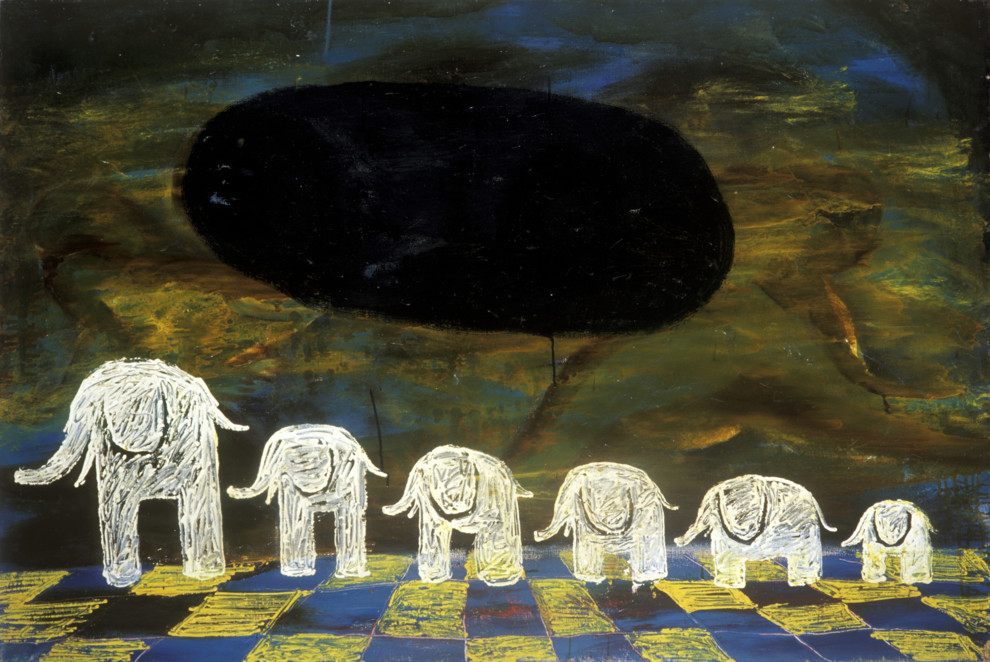
Oleh Holosiy is one of the brightest figures in Ukrainian art of the late 1980s – early 1990s. His life and work are largely connected with the history of the artistic squat on Parizka Koomuna Street in Kyiv.
Many were impressed by Holosiy’s unstoppable productivity, bordering on madness, and the incredible speed with which he worked. Many people recall that he could create several huge paintings in one night.
Christoph Wiedemann, a German journalist and curator of the “Postanesthesia” exhibition (Munich, 1992), said that during the art residency preceding the exhibition, Holosiy initially did nothing — he observed and watched. Then, over three weeks, he created a huge number of works.
As a curator, Wiedemann wanted to show this extraordinary productivity: “I wanted to make them [the canvases — editor’s note] fly.” This idea was realized in a spatial installation consisting of paintings that hovered in the air.
Holosiy’s speed of work and extraordinary productivity were noted a year earlier by Oleh Kulyk, who was responsible for the exhibition of the artist’s solo show “Independent Art” at the Central House of Artists in Moscow. Then, Holosiy’s large-format paintings were placed on moving structures operated by small boys. The paintings moved like a solid wall toward the viewer, creating an endless flow.
During a short period of active creativity, Holosiy created about 300 paintings. Perhaps such speed of painting reflected his desire to live life as intensely as possible.
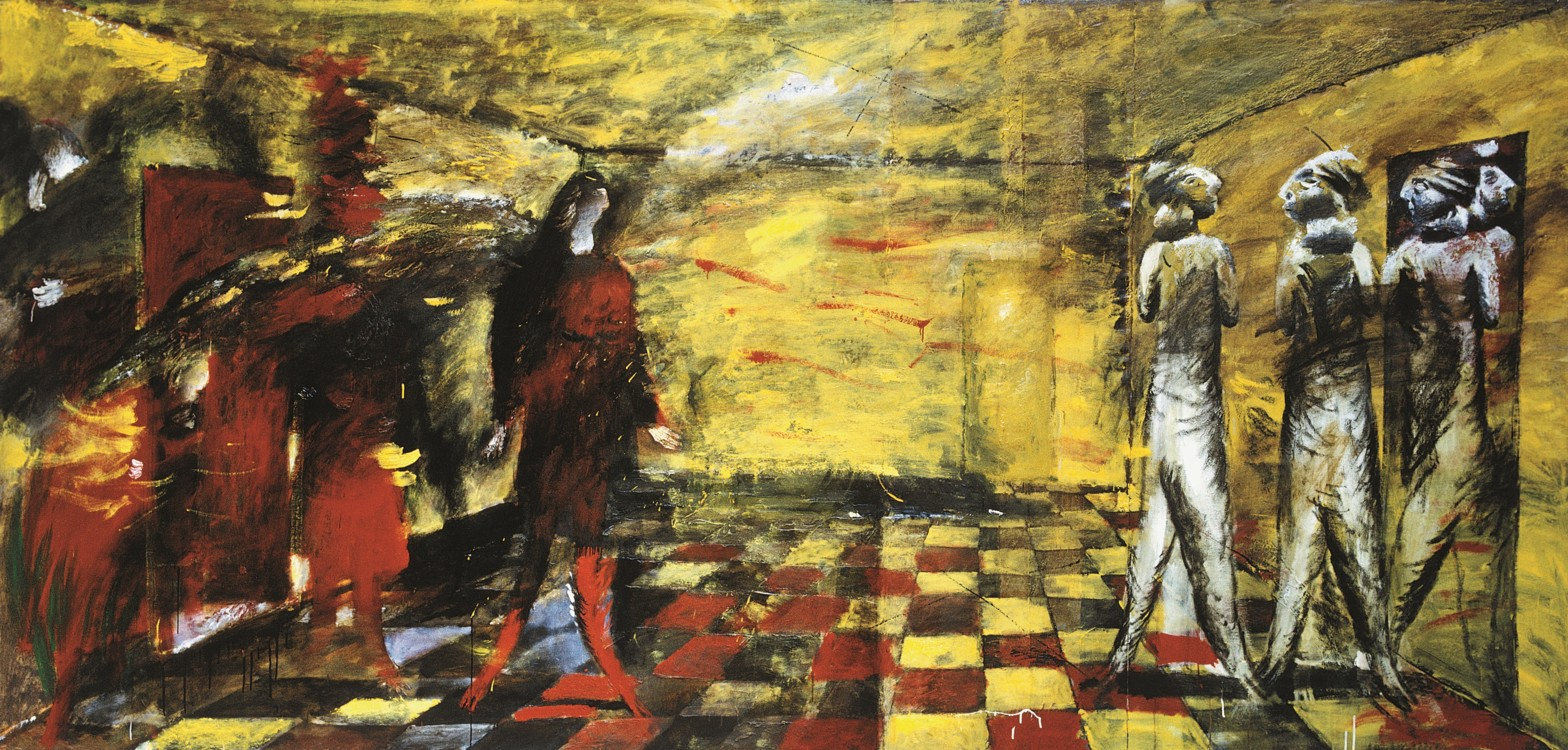
Holosiy’s early creative period (1989–1990) is marked by expressive, dynamic works with tense coloring. The monumental canvas “Yellow Room” (200 × 420 cm) evokes associations with Francisco Goya’s painting “The Third of May 1808.”
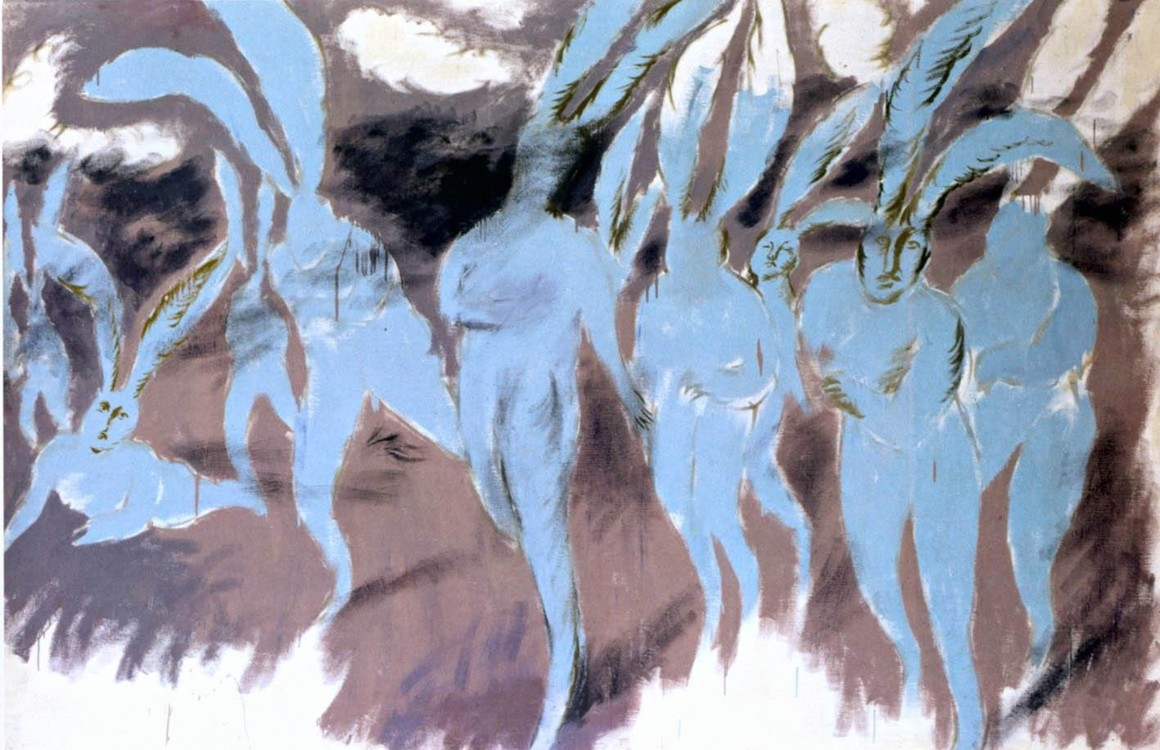
The painting depicts a strange space into which bizarre creatures enter from both sides, as if freezing before the unknown, not understanding what is happening. It is precisely the interest in the unexplored, incomprehensible, unstudied, and mystical — and thus what simultaneously frightens and wildly attracts — that permeates all of Holosiy’s work.
This majestic, almost metaphysical dimension of his art is not irony at all. Unlike many artists of Parkomuna, Holosiy did not make irony an end in itself. Probably, he was one of the least ironic artists of his generation. His works convey incredible strength, serious reflection, and a search for the profound meaning of existence.
Loneliness, death, the unknown, and the search for oneself are key themes in Holosiy’s work. At an early stage, like Valeriya Trubina, the artist and Holosiy’s beloved, he was interested in questions of faith. In many works, he turned to biblical subjects, seeking answers to deeply personal questions and reflecting on his own experiences. Among such works are “Sleeping in the Garden of Gethsemane” (1989), “Execution” (1988), which resembles the iconography of the “Crucifixion of Christ,” and “Annunciation” (1989).
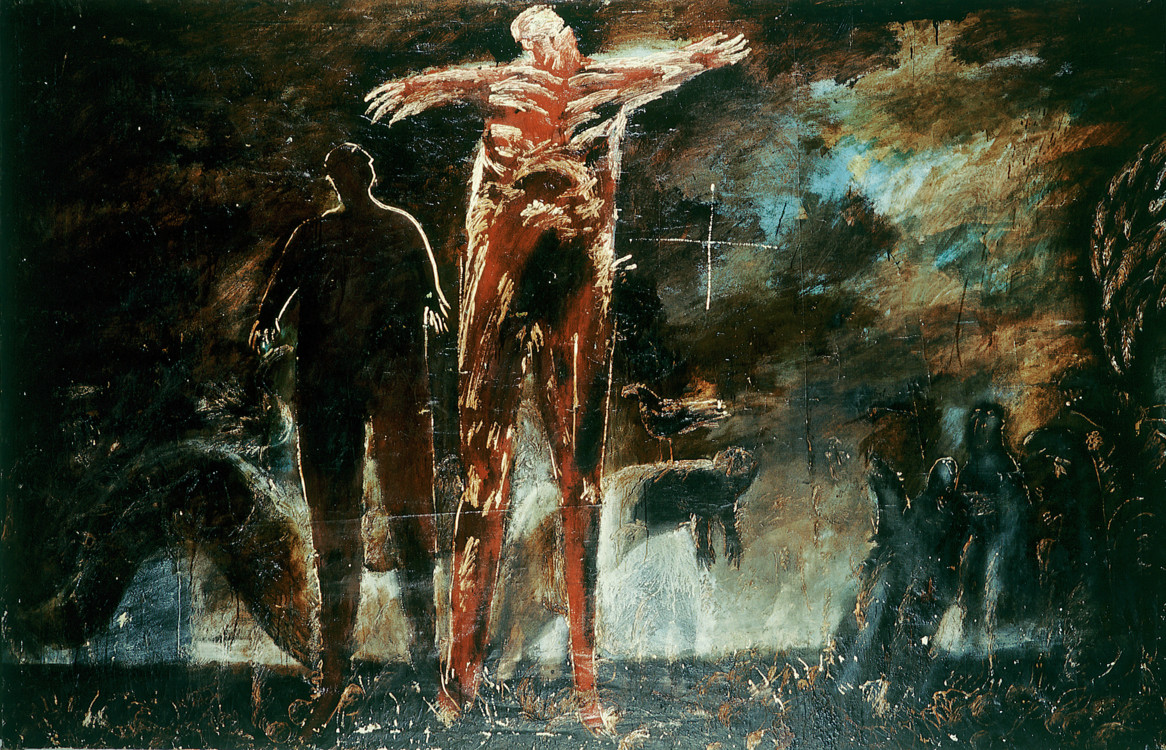
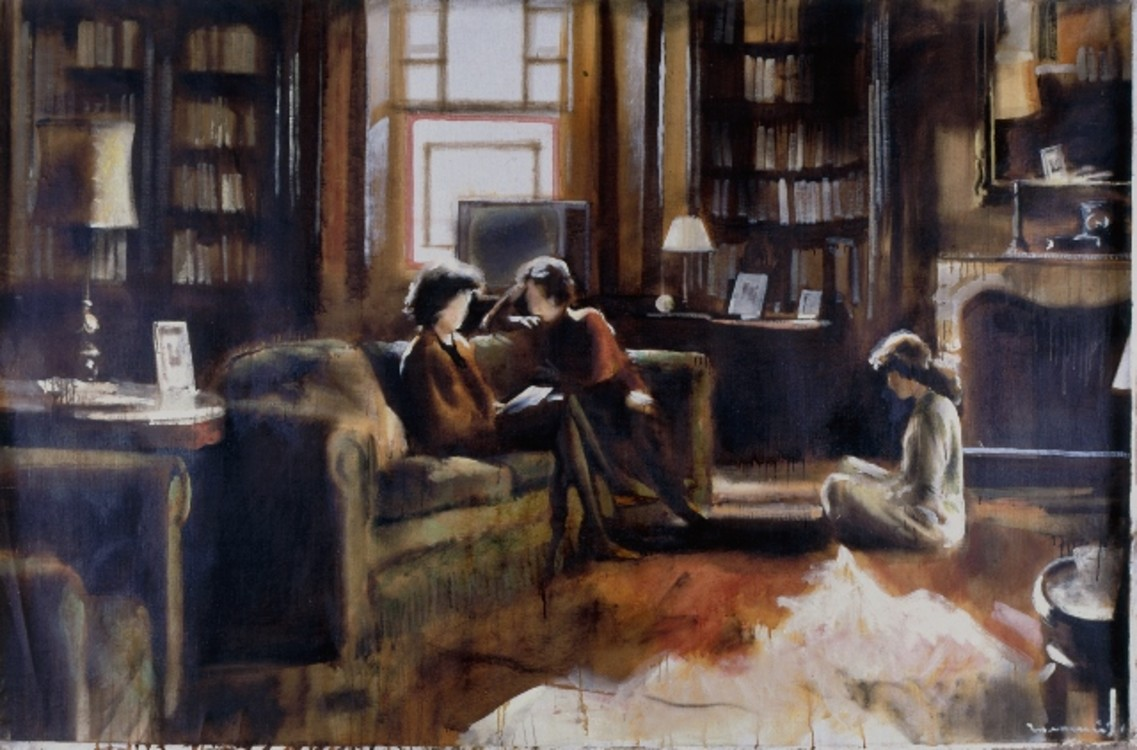
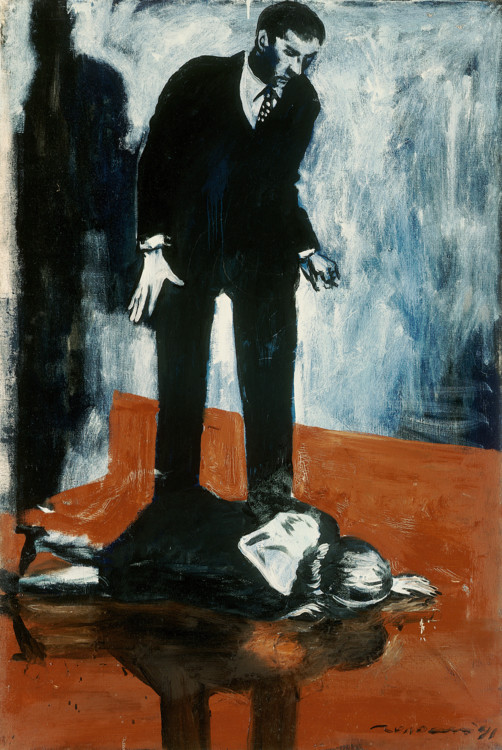
In an early self-portrait painted shortly after returning from the army in 1987, a young man is depicted as if trapped within the confines of the painting.
Acquaintances remembered Holosiy as sensitive but at the same time withdrawn, silent, and detached. There was a certain alienation in him, as if he stood apart from the everyday hustle and bustle. There was something otherworldly about him: with his bleached hair in everyday Kyiv, he seemed like an alien from another planet.
In this self-portrait, the artist seems to observe the surrounding reality, spying on it from the side. The hero’s confrontation with the outside world is a motif that often recurs in Holosiy’s work. His works convey the anxiety a person feels when left alone with the unknown.
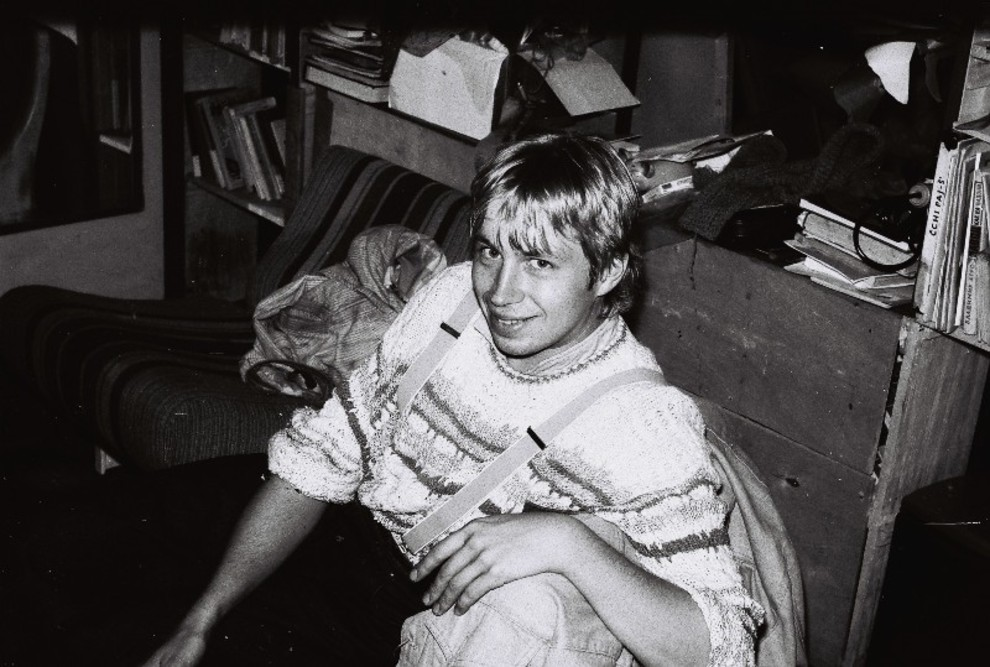
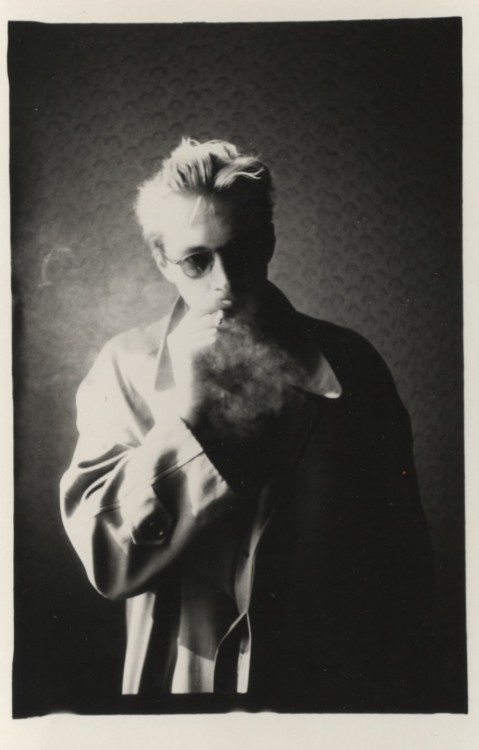
Holosiy’s works are very personal, full of reflections on the search for deep meaning and the discovery of one’s own “I.” They can be anxious and carefree, conflicted and extremely elegiac, but always marked by a sense of melancholy.
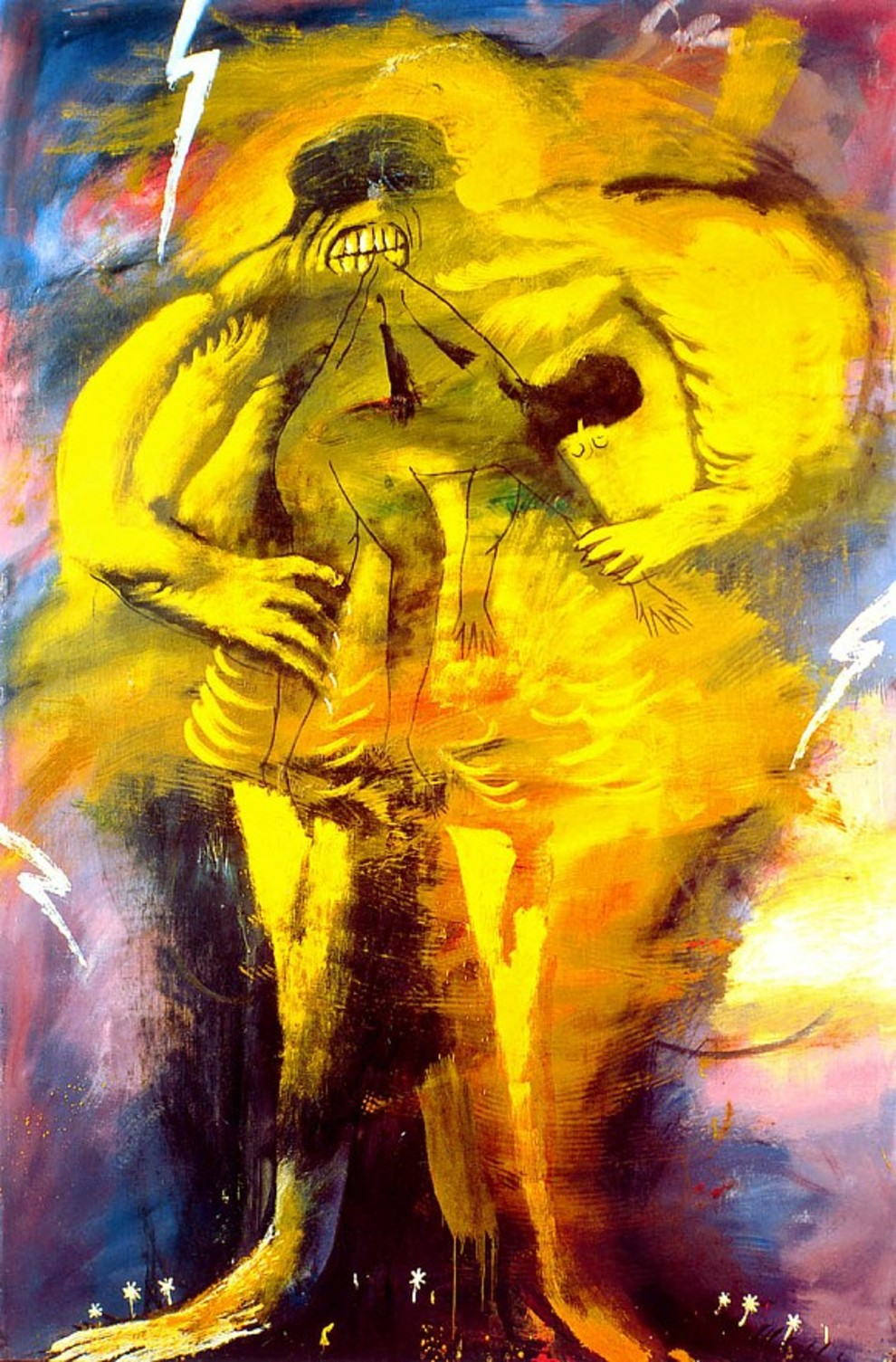
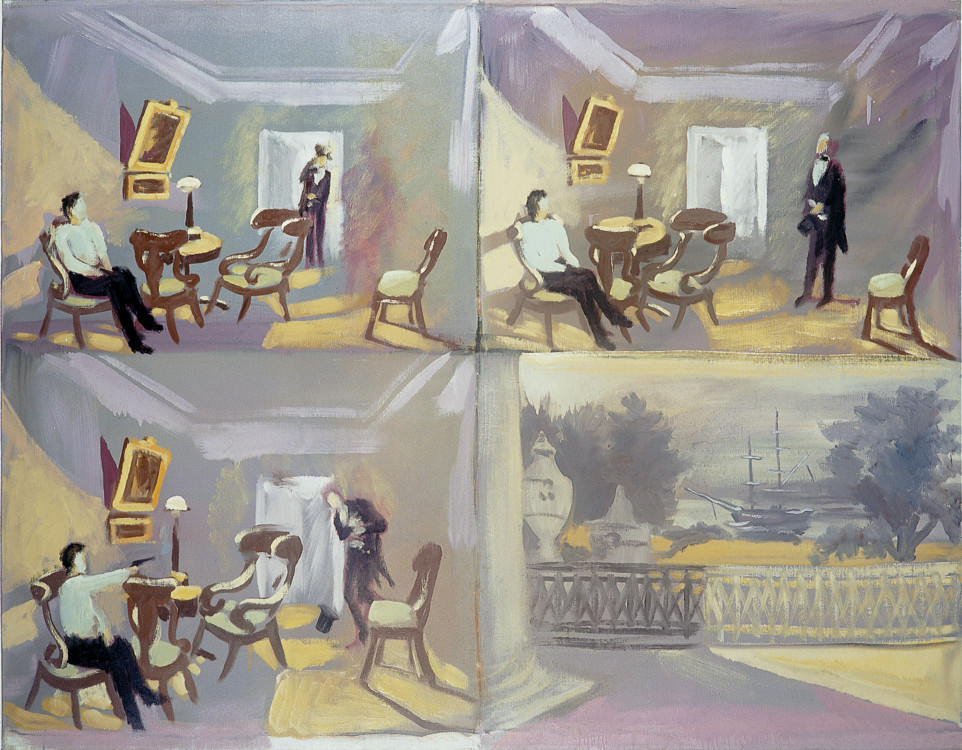
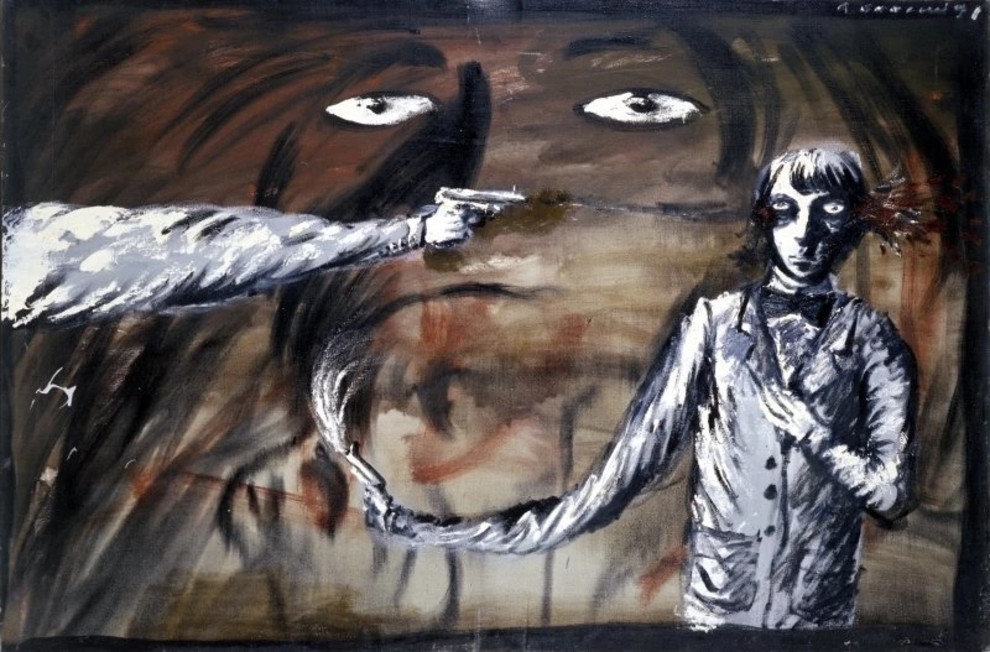
“The Third Wheel” (1991) is one of the most expressive examples of the artist’s reflections on death and the search for his own “I.” On the left side of the painting, a hand with a gun is shown shooting a person who simultaneously fires back. The latter’s gaze is directed at the viewer, but someone else is watching behind them — a figure whose features dissolve into the background of the painting.
The scene creates a feeling of inner trembling, while evoking confusion, mental turmoil, and a sense of searching — states in which the artist himself probably often found himself.
“I am everything, but I — am not me.
The torture of each of my “I” is the torture of attachments. Doubt forces me to look at the sky.”
Speaking about Oleh Holosiy’s work, it is impossible to overlook his tragic death at the age of 27. The circumstances of his death, which have not yet been fully clarified, cemented his image as a romantic hero who left life too early and contributed to the further mythologizing of his personality.
However, the artistic legacy he left behind testifies that Holosiy was one of the most talented and sincere artists of his complex, pivotal time.