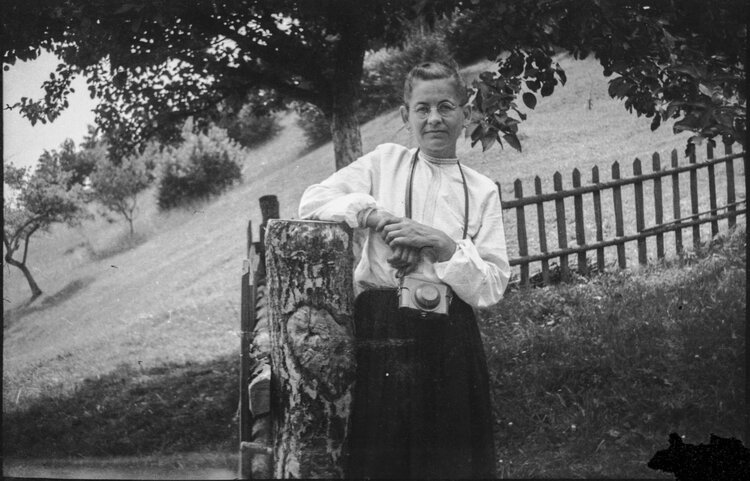
Off-screen. Ukrainian Women Photographers of the 20th Century
Research into Ukrainian art history of the 20th century leads to unexpected perspectives on already known periods, facts, and names. This is how the topic of the lecture about Ukrainian women photographers of the 20th century arose, followed by this text. It continues to describe the work of Ukrainian female artists by the Research Platform of PinchukArtCentre.
WHERE THE STIGMA IS HIDDEN
The preparation of the thematic exhibition “Own Space” [1], dedicated to the status of women in Ukrainian society and the contribution of female artists to Ukrainian art, as well as subsequent work on the publication “Why There Are Great Female Artists in Ukrainian Art” [2], showed that even researchers unintentionally overlook this topic. Women photographers in the history of Ukrainian art of the 20th century — who were they: models, wives, amateurs, or still artists?
As a result of conversations with experts in the 21st century, we note several methods of stigmatizing this topic. First of all, the professional feminine form photographers [3] provokes waves of ridicule and mockery [4], although the term artists does not evoke such a reaction. Probably because the latter was legitimized by Soviet linguistics and thus is familiar to the post-Soviet ear. This, in turn, indicates a Soviet stigma regarding women with cameras and their exclusion from the ranks of professionals. Despite prejudices, language embodies social moods, is a living structure that changes and, if necessary, acquires new linguistic forms. And the still prevalent mockery of words in Ukrainian society is nothing but hidden patriarchal consciousness and a form of linguistic tyranny. Therefore, even at the level of formal conversation, we encountered difficulties with this thematic study, because historically it happened that Ukrainian photography, by analogy with Soviet photography, has a male name. A higher level of stigmatization of the topic arose in rhetorical reflections such as: “If there were talented Ukrainian women photographers, we would definitely know about them.” Here we move to the subject of our research, reflections on talent, artistic value, and originality, which are defined not only by a gender framework.

Boris Gradov. Portrait of Iryna Pap. 1962. Image provided by descendants of Iryna Pap
We really know a few Ukrainian women photographers of the past century. Among them, the first mentioned is Iryna Pap (1917–1985) — an outstanding photojournalist of Soviet Ukraine, a significant figure in the history of Ukrainian photography. Also recently, thanks to the efforts of artists Inga Levi and Kateryna Buchatska, as well as cinematographer Maksym Rudenko, the photographic legacy of the Carpathian artist, writer, and folklorist Paraska Plytka-Horytsvit (1927–1998) was revealed to us. She is a phenomenon of Ukrainian naive art and literature, and she independently mastered the camera and documented the life and everyday life of the mountain village Kryvorivnia for several decades. And even earlier, in the interwar years, inspired by the thirst for modern emancipation spreading through Ukrainian intellectual circles, the Galician journalist, operator, and photographer Sofia Yablonska-Uden (1907–1971) traveled the world and photographed the most remote corners of Asia, Africa, and Oceania.
It is worth noting that Yablonska-Uden was able to establish herself only outside Ukraine, because even such prominent protectors as Volodymyr Vynnychenko [5] mocked her daring journeys to wild lands and her desire to be a photographer [6]. In fact, the world fame of the native Kyiv filmmaker Maya Deren (1917–1961), who moved to the USA as a child with her parents, can also be partly explained by the fact that she grew up and professionally established herself not in Soviet Ukraine. Thus, throughout the 20th century, Ukrainian women took up the camera and created original works, not only appearing in the frame as heroines of photographs and models for photographers [7]. However, only rarely could they professionally realize themselves in this field in their homeland.
The history of Soviet photography of the 20th century is written with male names such as Oleksandr Rodchenko, Yevhen Khaldei, Borys Ihnatovych, Maks Penson, Antanas Sutkus, Maks Alpert, Aleksandras Maciiauskas, Borys Mykhailov, Heorhiy Pinkhasov, Valeriy Plotnikov, and others. Women among the notable names are rarely encountered here, or they are mentioned in tandem with men, for example Halyna Lukyanova (born 1943) — together with photographer and collector Mykhailo Holosovskyi, and Nina Svyrydova (1933–2008) — with photo reporter Dmytro Vozdvizhenskyi.

Portrait of Paraska Plytka-Horytsvit. Author unknown. Second half of the 20th century. Photo archive of Paraska Plytka-Horytsvit
In conversations with Ukrainian photographers Roman Pyatkovka, Andriy Avdienko, and other members of the Kharkiv photo community, we try to identify the reasons for the lack of women’s involvement in the photography process in the late Soviet period. In their opinion, there were two significant reasons: the process of creating photographs at that time seemed complicated, the equipment was bulky, and the technology of film development and photo printing was toxic and harmful; the entire late Soviet system dictated an unofficial division into female and male types of activities, that is, no one forbade women to photograph, but it was not tolerated either.
Obviously, the political framework, not actual technological difficulties for women working with cameras, was the reason for such division. And the talks that there were no Ukrainian women who could become prominent photographers are rhetorical and obscure objective reasons preserved in political will and social consciousness for such internal professional stratification.
ABOUT HISTORY
Photography as a form of activity from its appearance in the early 1830s was gender-neutral but not widely accessible to the general population. The pioneers of the profession were scientists and researchers Constance Fox Talbot, Anna Atkins, Viscountess Clementina Hawarden, Julia Margaret Cameron, and others. However, Frances Benjamin Johnston became the photographer of five American presidents, known for theoretical works on photography and, in particular, a detailed article “What a Woman Can Do with a Camera” [8] for Ladies’ Home Journal in 1897. The text was timely because with the appearance of the portable Kodak camera in 1888, the percentage of women involved in photography increased unprecedentedly. Commercial photography began to have considerable demand, a woman could open her own photo studio and realize herself in the profession without a special diploma in technical or artistic education. Since the 1890s, Kodak advertisers addressed their campaigns to a new clientele — women photographers [9]. Embodying the popular image of the “new woman” at the turn of the century, the icon of the advertising campaign became the “Kodak Girl” [10] — a fashionista with a camera symbolizing a generation of women striving for economic independence, sexual autonomy, and social weight. The camera gradually became an attribute of the emancipated woman, alongside the bicycle, short haircut, cigarettes, trousers, and “leather” perfumes.

General meeting of the Odessa Photographic Society on the 20th anniversary of its founding, 1912. Primary source “Vestnik Odesskogo Fotograficheskogo Obshchestva” No. 1–2, 1913. Image borrowed from public sources wikipedia.org
The emancipation process in the Russian Empire was much slower, but despite this, among the archival photos of members of the Odessa Photographic Society (founded in 1891 — ed.) for 1911, we count 22 women and 26 men. With the advent of Soviet power in 1917, the new government officially equalized women and men in professions — women were actively involved in work. This was related to the needs of the post-war period [11], rapid industrialization, and ideology [12]. In the early years, specially organized campaigns were conducted to popularize women mastering “non-feminine” professions. Among these, besides heavy metallurgy and mining, was film production, including camera operation, since “among all arts, the most important for us [the Soviet people] is cinema,” Vladimir Lenin noted in 1922 [13]. During the first Soviet decade, women had the opportunity to acquire professional skills in film and photo production. Also, the network of amateur photo clubs actively involved women, but archival data shows that in early 1930s Soviet Kyiv, the ratio of women to men in clubs was much lower, fluctuating around 1/6. For example, the Ukrainian Photographic Society (also the union of photo amateurs of Western Ukraine), which existed in Lviv from 1930 to 1939, had among its 24 members two women — Mechyslava Hanytska and Yaroslava (Yarka) Protsiv [14].
After the end of World War II, the Soviet Union began a political rollback to the traditional image of a woman within the new unofficial patriarchal course of the state — worker, mother, and caring wife. The involvement of broad population groups in technical activities in amateur clubs resumed from the 1960s. The Union was covered by a network of photo clubs and a new Soviet hobby — photography. This was facilitated by the powerful work of the photo industry and the political course to organize photo leisure for Soviet citizens. However, there were few women among the participants of photo clubs. And at this time, one of the most common objects and themes for amateur and professional photography in the Soviet Union became women and children.
In the times of Ukraine’s independence, the situation has not fundamentally changed. According to the International Federation of Photographic Art (FIAP), during 1990–2007, the honorary title AFIAP (Artist of the International Federation of Photographic Art) was awarded to only 4 women among 76 nominees — Odessa natives Olena Martyniuk in 1996 and Valentyna Opolska-Fedorovska in 1999, Mykolaiv native Liubov Savelyeva and Kyiv native Nataliya Kompantseva in 2007. And the title EFIAP (higher mastery of the International Federation of Photographic Art) for merits in photography was awarded to 2 women among 23 nominees — Odessa natives Olena Martyniuk in 1999 and Valentyna Opolska-Fedorovska in 2003 [15]. Although it is fair to note that the criteria for evaluating photographic practice by the FIAP council in the 1990s–2000s in Ukraine were hardly exemplary, these archival indicators prove that internal industry gender imbalance existed even at the turn of the 20th–21st centuries.
WHO DO WE FORGET?
Ukrainian women photographers and intellectuals of the interwar and postwar periods. It seems appropriate to speak about them not from the position of a minority in certain historical periods, but from the position of their concealment, minority status — as aptly defined by the head of the Center for Urban History in Lviv, Sofia Djak, in a story about art historian and poet Deborah Fogel [16]. “This concealment can be due to gender, poverty, physical peculiarity, or sexual orientation,” notes the scholar.
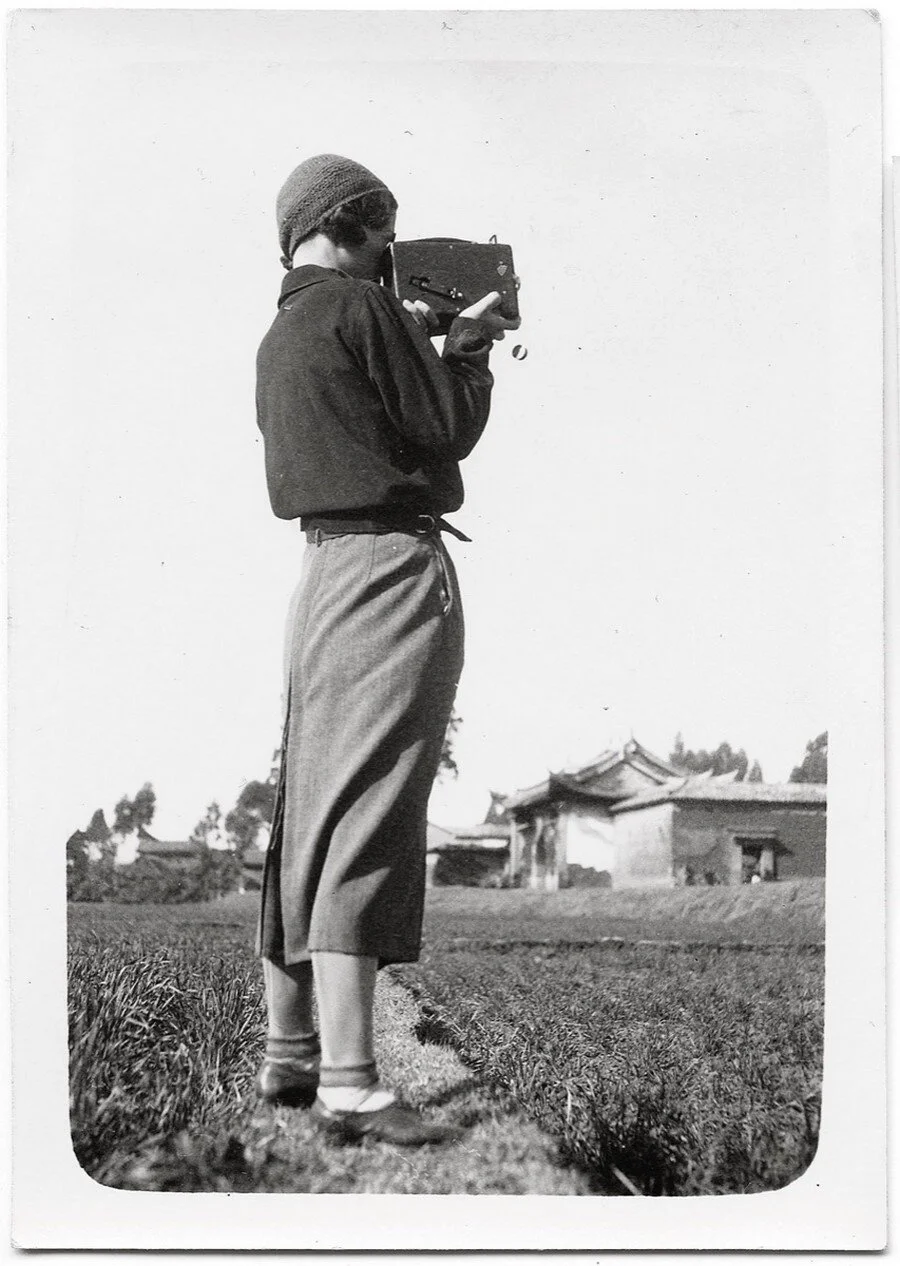
Portrait of Sofia Yablonska-Uden with a camera. Author unknown. Image provided by Rodovid publishing house
For example, it is important to speak about the author of travelogues, journalist, photo reporter, and traveler Sofia Yablonska-Uden (1907–1971) [17] precisely as a representative of emancipated Ukrainian photography. A native of Lviv region, Yablonska-Uden moved in 1927 to study film in Paris, from where she traveled on her first photo hunt to Morocco. She wrote travelogues, sent them to Galician periodicals along with documentary photos of her own authorship as illustrations. She was a successful columnist. Then she made her second journey “beyond the distant horizons” [18] from Marseille through Egypt to Sri Lanka, then to Thailand, China, Vietnam, Laos, through Indonesia, Australia, New Zealand to the USA and back to France.
Yablonska-Uden’s courage is worth learning from, as traveling through Muslim countries and Asian provinces in the 1930s–1940s was very dangerous. She was poisoned by orchid juice, died from a banana viper bite, hunted tigers, was pelted with stones for photographing, and even took opium in China to assimilate with the local population. The desperate Yablonska deliberately fled as far as possible from Europeanized Chinese territories deep into the continent, closer to the indigenous population, to become part of the oriental color.
In the interwar period of strict world division by colonial principle, she stood out with a unique perspective as a photo reporter who deliberately exposed herself to danger to get closer to natives, did not disdain their everyday life, and admired the magical thinking of indigenous peoples. Yablonska deeply respected their otherness. In her shooting of oriental heroines, there is no distance or fear in the frame, because both the photographer and the models were women — intuitively perceiving each other with greater interest and trust. This defines not only the historical but also the artistic value of Yablonska-Uden’s travel photo chronicles and outlines her special emancipated and feminist view through the camera lens on the inhabitants of the “distant horizons.”
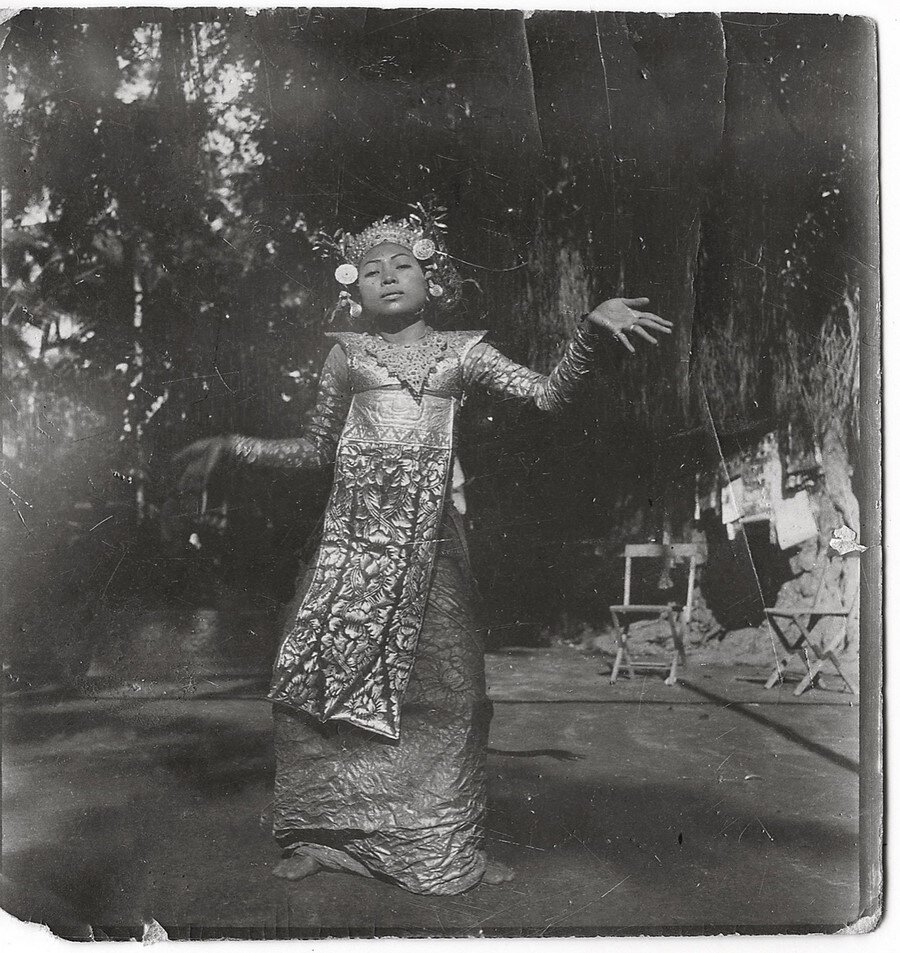
Sofia Yablonska-Uden. Young dancer of Balinese Legong dance. 1930s. Image provided by Rodovid publishing house
Sofia Yablonska-Uden is sometimes compared to Lee Miller for adventurousness and scale of talent, to Dorothea Lange for the ability to shoot depressive hinterlands, and even to Leni Riefenstahl for her Nubian photo poems. As art researcher Kateryna Yakovlenko notes, Yablonska-Uden’s photos are especially valuable to us today also because the originality of many tribes and peoples is gradually disappearing, and “the damage adds special symbolism to her photos. They seem scraped exactly where voids appeared in the memory of civilization” [19].
It is precisely through the voids of memory and erasure of the originality of ethnic groups of the Ukrainian Carpathians that it is important to speak about the photographic heritage of Paraska Plytka-Horytsvit (1927–1998) [20]. In the depths of the Carpathians, she photographed peasants and their families for decades, capturing in her own photos the everyday life of mountain residents, their customs, and rituals. And she created a documentary portrait of the Carpathians of the 1960s–1980s.
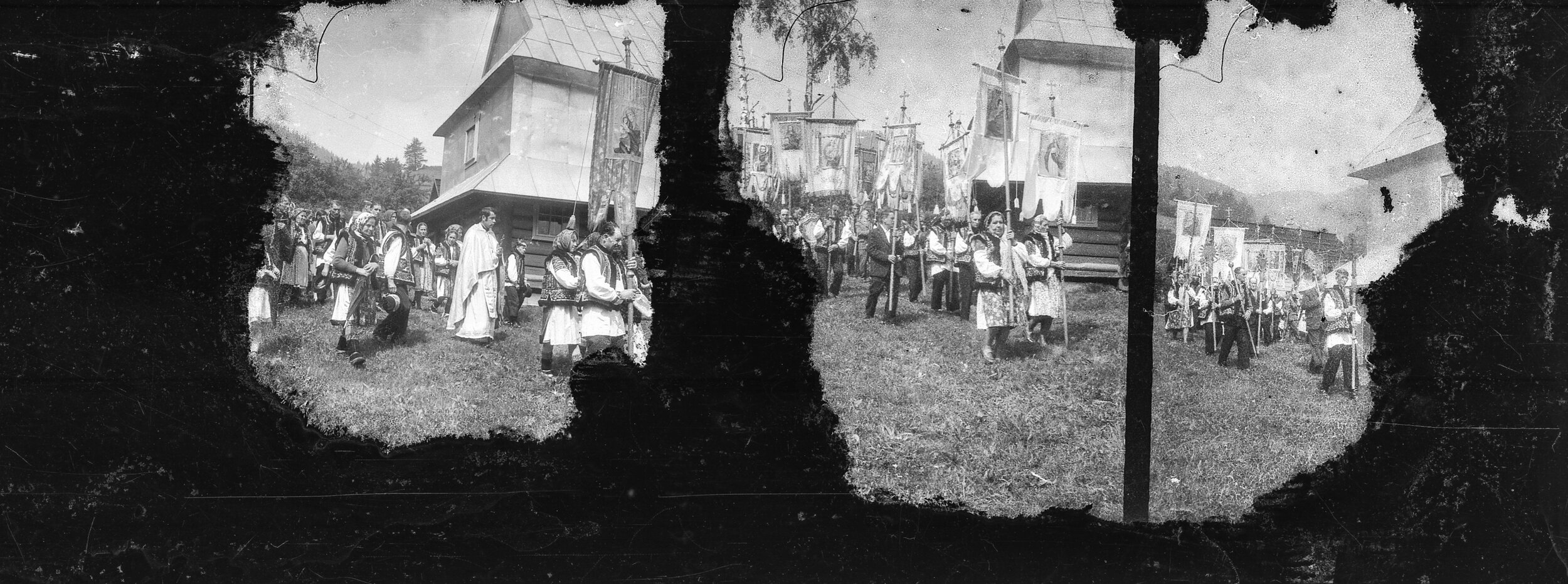
Paraska Plytka-Horytsvit. Religious procession. Second half of the 20th century. Photos from damaged film. Photo archive of Paraska Plytka-Horytsvit
Paraska Plytka-Horytsvit is a phenomenon in Ukrainian folk culture and is interesting not only for her multidisciplinary approach to creativity, where making author’s books bordered on painting, writing, and ethnographic research. Regarding photography, it is important to look at Plytka-Horytsvit not to find a precedent of a unique folk photographic genius and formalize her photo chronicle with artistic categories. Because her photography is ethnographic and lies in the field of social anthropology. Plytka-Horytsvit herself hardly aimed for any conscious artistic photography, rather she was guided by an internal sense of the frame based on her painting experience. It is more interesting to consider her practice in the context of the mass fascination with photo leisure in the Soviet 1960s, the availability of equipment, the appearance of specialized books and magazines, as well as the desire and enthusiasm of a particular author to master a new technology and visual medium. Referring to one of the possible reasons mentioned above for the lack of women’s involvement in photography, it is worth emphasizing that Plytka-Horytsvit was not deterred by technological complexity. She independently mastered the procedure, developed and printed photos for the whole village by candlelight flicker.
Plytka-Horytsvit’s practice is also worth considering through the theoretical reflections on photography by Susan Sontag, who was also interested in peripheral photographic, non-obvious, and what does not get into the frame [21]. Sontag’s identification of the camera with a weapon causing instant death is very similar to the circumstances of Yablonska-Uden’s shooting, who was beaten by natives frightened by the camera. In opposition to this idea, Plytka-Horytsvit’s practice testifies to the opposite — the camera was her medium of communication with peasants. Photography became a social crutch for her — a tool of communication with the inhabitants of the Carpathian village, who shunned the convict after her return from Stalin’s camps. By enticing peasants with the possibility of receiving a photo card as a gift, Plytka-Horytsvit brought them closer to herself, again becoming part of their everyday life. And gradually ceased to be associated locally with fear.

Paraska Plytka-Horytsvit. Portraiture of peasants. Second half of the 20th century. Photo archive of Paraska Plytka-Horytsvit
About official photography in Soviet Ukraine, more Iryna Pap (1917–1985) [22] probably only her colleague, like-minded person, and at the same time husband — Borys Gradov — could know. They are often spoken of as a bright creative tandem of the Ukrainian SSR, compared with artists Ada Rybachuk and Volodymyr Melnychenko, Alla Horska and Viktor Zaretsky, Lyudmyla Yastreb and Viktor Marynyuk, Pavlo Bedzir and Yelyzaveta Kremnytska, Tetiana Yablonska and Serhiy Otroshchenko; this list can be continued for a long time. The 1960s abound with notable family tandems in the history of Ukrainian Soviet culture — a literal embodiment of the idea of “a cell of society,” professional self-realization, and gender equality within a traditional family.

Iryna Pap. Group portrait. 1961. Image provided by descendants of Iryna Pap
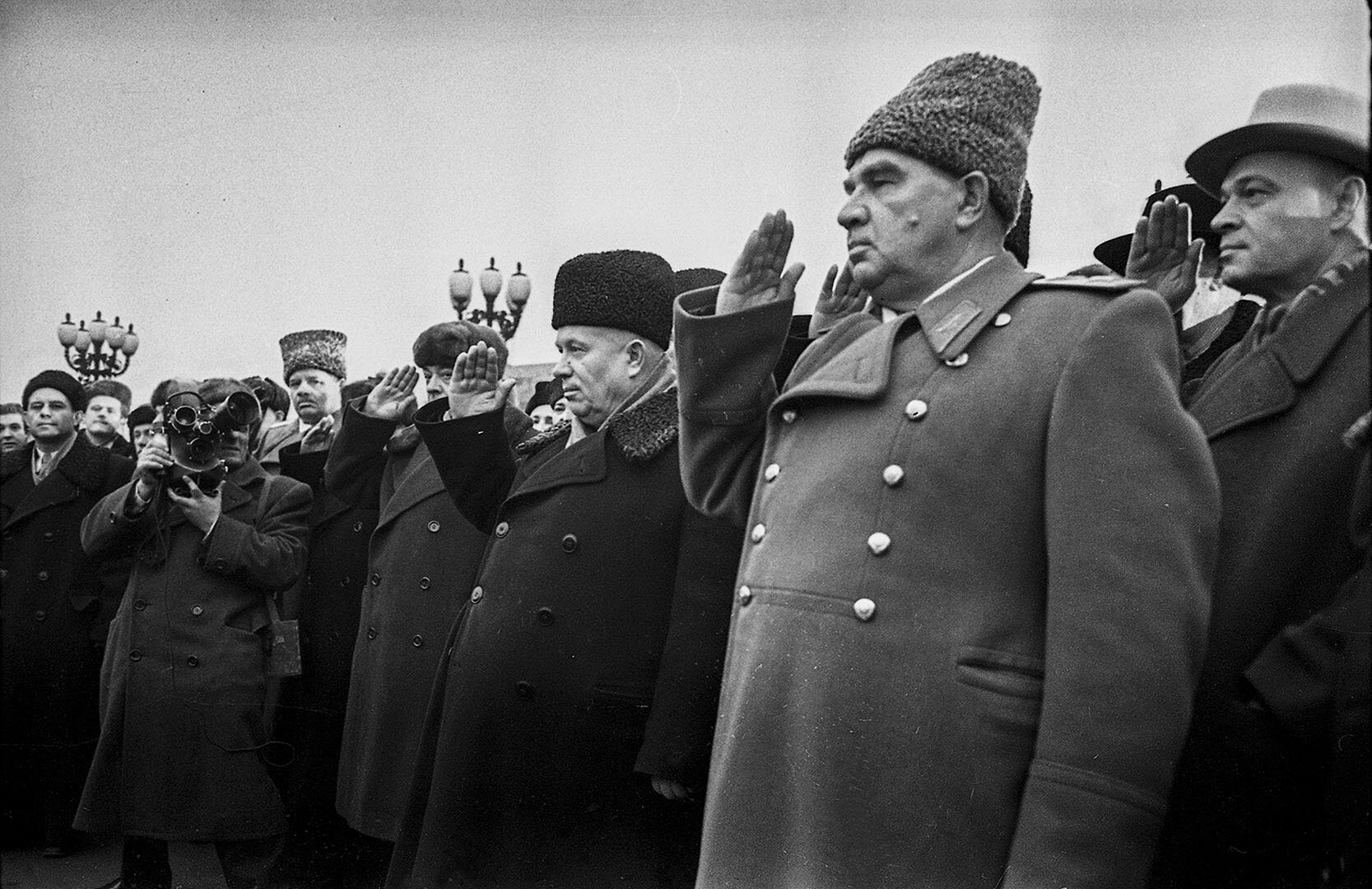
Unlike her Russian colleagues Nina Svyrydova and Halyna Lukyanova, Iryna Pap was not in the shadow of her husband’s folk fame. Pap became the author of the official portrait of Soviet Ukraine within the USSR. She was a leading photojournalist who worked for the newspaper “Izvestia” and documented the era without excessive gloss and pseudo-optimism. The 1950s–1970s in her photos capture the times of the “thaw” and space flights, the reconstruction of Khreshchatyk destroyed in the war, the launch of the capital’s metro, and Kyiv from a bird’s-eye view. She boldly photographed inside mines, turbines, helicopters, and even nuclear reactors [23], tirelessly traveled the country with a bunch of cameras on her. And each time she subtly felt the boundary of the permissible and the balance between ideological censorship and quality reportage photography, without going into the realm of flat propaganda.
Ukrainian photographer Valeriy Miloserdov rightly noted Iryna Pap’s method: “…this is direct Soviet reportage photography without artistic tricks such as, say, superimposing details from another negative into the plot, etc. This photo can be trusted, such was Soviet life, its ceremonial side. But the other side of that life — the Holodomor, war, GULAG — in fact, no one documented” [24]. Progressive and Western-oriented Pap understood that education in the profession and the ability to see the frame at the shooting stage more broadly in the context of history is a strong tool for a photographer. And already in 1971, she initiated the first photo school at the Institute of Photojournalism of the Union of Journalists of Ukraine. A whole generation of prominent photojournalists graduated from her school, who in the 1980s–2000s took over the baton from Pap and Gradov and focused not only on the official but also on the revolutionary portrait of Ukraine at that time.
Iryna Pap. Political portrait. 1957. Image provided by descendants of Iryna Pap
The view of Soviet Ukraine from inside the system differed from the view of Ukraine “under the Soviets” from outside. One of the first American women to receive a visa for independent travel in the Ukrainian SSR in the 1970s was Tetiana Mykhailyshyn-D’Avignon (born 1942) — photographer, journalist, educator, traveler, Plast member, and social activist. She later became the first foreigner invited by the Soviet Ukrainian government in 1989 with a photo exhibition to Kyiv.
Born in Lviv occupied by German troops, Tetiana fled with her parents from Western Ukraine through Germany to the USA in 1944. American education and the diaspora community determined the aesthetic and intellectual coordinates of the photographer. As is typical for those who left their homeland not by their own will, Mykhailyshyn-D’Avignon tends to idealize Ukraine through landscape and portrait genres in photography. Longing for the homeland is embodied in sentimental series for annual Ukrainian-American calendars. During 1986–1993, the photographer worked with National Geographic Journal journalists in Ukraine, and in 1999 received an award for the photo album “Simply Ukraine — Просто Україна” and became a semifinalist of the Shevchenko Prize in journalism.
However, one of Mykhailyshyn-D’Avignon’s most significant series is a photo study of the impact on Ukrainian women of the transition from the USSR system to independent statehood, which the photographer began to develop at the turn of the 1980s–1990s. Her feminist study has not yet received due attention, despite becoming almost the only documentary archive of the transformation of the image of womanhood in Ukraine and continuing in a project dedicated to the first generation of Ukrainian migrant women and the circumstances of their departure.
Using the example of Rita Ostrovska (born 1953), it is worth considering the practice of women photographers of the 1990s. Several of her series form a lyrical portrait of an emigrant through the autobiographical story of her own family. Contrary to excessive extravagance in Ukrainian photography of the 1990s, a tendency was also the personality and intimacy of the depicted, sensitive self-reflection of the authors.
An important project for the photographer was the “Jewish Album” 1987–2002, which she began in 1978 and continues to shoot to this day. The cycle consists of three extensive sections: “Family Album,” “Jews in Ukraine,” and “Emigrants.” Personal history is the very minority that deepens the topic and expands the author’s photographic expressiveness with the presumption of truth.
The first section, which she has been shooting since 1978, Ostrovska tried to capture the “climate” of the life and everyday life of her family at that time. Despite the photographer’s desire to distance herself and act as an observer, the entire “Jewish Album” is permeated with family longing and anticipation of another search for the Promised Land in the history of the Jewish people. From the family center to the city community — the second section Ostrovska dedicated to shtetls — traditional Eastern European Jewish towns. Abandoned settlements with deserted Jewish cemeteries alternate with small ones, with two or three huts, where the elderly live out their days. The third section embodied emigration, the Jewish movement to Germany, Israel, and the USA in general, and the emigration of the photographer’s family in particular.
Rita Ostrovska’s work is inseparably connected with photographing herself; literally or metaphorically, the author is present in every frame because she is closely connected with the history of the family, clan, and the whole people, which she tells by photographic means.

Rita Ostrovska. Iraida Vetrov’s housewarming. Darmstadt, 1996. From the series “Emigrants,” 1993–1997. Image borrowed from the photographer’s website rita-art.org

Rita Ostrovska. The Rybalsky family at home, 1997. Rehovot, Israel. From the series Emigrants. Image borrowed from the photographer’s website rita-art.org
It is also worth mentioning Vita Buivid (born 1962) — one of the well-known Russian women photographers, a graduate of the Dnipro photo club, who combined straight photography with experimental methods of Dnipro photographers of the 1980s, who introduced elements of small watercolor inscriptions, appliqués, and collage into their works.
At the end of the 1980s, Buivid moved from her native Dnipropetrovsk (now Dnipro) to Leningrad (now Saint Petersburg) and immediately plunged into the turbulent art life. In the 1990s, she became a participant in the first feminist exhibitions, and already then her practice was literally entwined with a lace of interpretations — imposed interpretations through feminist discourse, which the artist herself does not support because she does not divide art into male and female. However, the feminist nature of the topic does not define her belonging to conditional femininity of art, which can mistakenly be manifested in decorative attributes, formal themes, or simply the affinity of art of different authors solely on the principle of one gender. Many of the photographer’s works are devoted to the deconstruction of the body, the destruction of the totalitarian traditional canon of masculine and feminine body images. As Natalia Sharandak rightly notes, despite Buivid recognizing the difference in the behavior of the model depending on the gender of the photographer, — “if the camera is in my hands and a woman poses for me, she poses for me not as for a man. And a man will pose for me differently than for another man,” — the psychological opposition of female and male principles, as well as their manifestations in the creative process, the photographer obviously overestimates [25].
TO THE REASONS
The confusion of the 1990s regarding gender roles, scientific discourses, and, in particular, the feminist focus in art, which is partly retransmitted by Vita Buivid and many Ukrainian female artists, is primarily related to the mutated image of a woman on the verge of the collapse of the Soviet system and the acquisition of independence by the countries of the former Union. Soviet double standards, which despite official gender equality, implied a “glass ceiling” and “non-feminine” professions, left a trauma of self-awareness at the time of the USSR’s collapse. Instead, feminism was positioned as an aggressive and repressive idea aimed at destroying the usual form of post-Soviet society. Hence the distorted interpretation of feminist ideas and demonization of the movement, which in the context of art primarily aims to manifest women in professions.
The analysis of the state and development of Ukrainian photography during the Russian Empire and later the Soviet Union falsely indicates that women in photography were represented exclusively as models. The history of Ukrainian photography does not include female authors who professionally engaged in photography, were in demand specialists, and became self-realized representatives of the photographic profession in the 20th century. But the purpose of this article is to point to statistical and informational data proving the opposite: if Ukrainian women were active in photography at the beginning of the 20th century, then what happened later and why did photography in Soviet and independent Ukraine become a profession decisively dominated by men?
For example, a special place is occupied by women in the practice of the Kharkiv School of Photography of the 1970s–1990s. Researcher Kateryna Yakovlenko writes about the actual absence of women in Kharkiv photography, despite constant photographing of the female body by men: “…what one of the authors of Kharkiv photography called the creation of his iconic system from bodies is today read through feminist discourse as objectification of women” [26]. Women in Kharkiv photographic circles were in the roles of models, wives, and muses. In fact, in many photos by Kharkiv photographers, we can see the same girls because it was not so easy to find models for nude posing in Soviet times. However, not every heroine in the frame is original, and it is also worth remembering the performativity of the model and her role in creating the frame. At least introduce the tradition of indicating the model’s name in the accompanying information to artworks. After all, if the model creates the mise-en-scène and embodies a powerful image, and the photographer captures it, isn’t the model a co-author?
Subjectively, women appeared in Kharkiv photography already in the 1990s. First of all — in the themes of works, as well as co-authors. For example, Vita Mykhailova was a co-participant of the “Rapid Response Group,” which collectively created photographic projects during 1994–1996. And despite women being part of the Kharkiv photo club, none of them continued active artistic practice. Although Roman Pyatkovka and Serhiy Solonsky mentioned one photographer whose works were also presented at the F-87 exhibition — Valentyna Bilousova [27]. But according to Bilousova herself, she quickly left artistic photography, feeling the high professional level of her male colleagues and tough competition among the Kharkiv photo community [28].
One of the unarticulated psychological problems of the absence of women photographers in Ukrainian art is that many female authors left the practice barely starting it. The reason was often the undervaluation of their own works alongside male ones that surrounded them and were mentors. Women could continue to shoot flowers, children, passersby, or random street scenes daily, show them to no one, and consider that all this pales in comparison to someone else’s talent. The story of Russian Masha Ivashintsova, the muse of St. Petersburg in the 1980s, became indicative. She constantly photographed but was so afraid of the shadow of her photographer lovers’ creativity and ashamed of her own works that her photography became known only after the author’s death [29].
Historian Sofia Djak rightly notes the need to research topics through a certain focus, in particular feminist, to reveal them: “…then we see culture not as a ruler of great works, but as an environment, as a process, as relationships. This not only expands our canon but also has the potential to change how we see culture. And the question is how to pull these women out of these canonical drawers?” [30].
The history of world photography is described and studied based on photographers who formed and developed the industry during the 19th–20th centuries. Alongside notable male names in the profession, active female authors were also present. For example, the names Imogen Cunningham, Dorothea Lange, Eve Arnold, Margaret Bourke-White, Diane Arbus, Francesca Woodman, Leni Riefenstahl, Sally Mann, Annie Leibovitz, and others easily come to mind. It is important to understand that the recognition of these women photographers is explained by a considerable number of scientific studies and thematic works carried out by photography researchers worldwide to define the place of female authors in the history of the field.
Ukrainian women photographers of the early 20th century intuitively fought for their place in the profession by imitating behavioral models of male photographers. Except, probably, for those who by definition were outside the industry and formed in their own cultural isolation. There is no statistics that could inform us of the number of female authors who left photography due to social prejudices, self-censorship, or psychological pressure. And those who established themselves as photographers deliberately avoided emotional coloring of photography in favor of decisiveness, danger, reportage. All this to avoid condescending ridicule of the femininity of their works. And also to be similar to men, which means to be heard and become part of the industry they controlled. The process of researching and identifying Ukrainian women photographers has only begun, but the path to reconciliation with their own gender in the field of photography is still ahead.
[1] “Own Space” — an exhibition curated by Tetiana Kochubinska and Tetiana Zhmurko, held in 2018–2019. Among the artists presented at the exhibition were Yevheniya Bilorusets, Alevtina Kahidze, Alina Kleitman, Polina Raiko, Vlada Ralko, Maryna Skugaryova, Oksana Chepelyk, and others.
[2] “Why There Are Great Female Artists in Ukrainian Art,” 2019 — a publication that expanded and supplemented the topic of the “Own Space” exhibition, aimed to cover the context of the century, indicate notable female artists of Ukrainian art of the 20th–21st centuries, and describe their artistic practice. Edited by Kateryna Yakovlenko. Authors of texts — Lidiya Apolonova, Lyzaveta Herman, Halyna Hleba, Olena Hodenko, Tetiana Zhmurko, Tetiana Kochubinska, Kateryna Mishchenko, Vlada Ralko, Valeriya Shiller.
[3] Liukshyn, Yuliia. “Photographer and Dancer — grammatically correct” — Rivne lecturer spoke about feminine forms [Electronic resource] // VSE, 20.03.2018. URL (accessed: 04.02.2020)
[4] Bubich, Olga. Photographer (female forms). Minefield of feminine forms [Electronic resource] // Belarusian Journal, April 21, 2016. URL (accessed: 04.02.2020)
[5] Volodymyr Vynnychenko (1880–1951) — Ukrainian political and public figure, prose writer, artist, 1st Chairman of the Directorate of the Ukrainian People’s Republic and Chairman of the Council of People’s Ministers.
[6] Oksana Zabuzhko writes about the correspondence of Volodymyr Vynnychenko and Sofia Yablonska, referring to Vynnychenko’s diaries in the foreword to the edition TEURA SOFIA YABLONSKA: photo album / foreword: Zabuzhko O. — Kyiv: RODOVID. 2018. — 232 p.
[7] Yakovlenko, Kateryna: “Kharkiv Woman: the image of a woman in Kharkiv male and female artists” // YourArt, November 12, 2019. [Electronic resource] URL (accessed: 04.02.2020)
[8] English text of Francesca Benjamin Johnston’s article “What a Woman Can Do with a Camera,” 1897 [Electronic resource] URL (accessed: 30.01.2020)
[9] Latimer, Tirza; Riche, Harriet. Women and photography [Electronic resource] // Oxford Art Online, 11.02.2013. URL (accessed: 02.02.2020)
[10] Alison. The Kodak Girl: Women in Kodak Advertising [Electronic resource] // Ryerson University, 07.10.2013. URL (accessed: 02.02.2020)
[11] Refers to World War I
[12] Hrushytska I. B. Development of Photography in Ukraine (1839 – First half of the 20th century) [Electronic resource] // Scientific works of the History Faculty of Zaporizhzhia National University. – 2014. – Issue 41. – Pp. 285–291. URL (accessed: 02.02.2020)
[13] Excerpt from a letter from Vladimir Lenin to Hryhoriy Boltyansky dated January 29, 1925. Published in the magazine “Soviet Cinema” No. 1-2 of 1933 — P. 10
[14] Dawna fotografia lwowska 1839—1939. — Lviv : Center of Europe, 2004.
[15] According to archival materials available in open access. [Electronic resource] (accessed: 02.02.2020)
[16] Kuzmenko, Yelyzaveta. How to pull women out of canonical drawers — historian Sofiya Dyak [Electronic resource] // Povaha. Campaign against sexism, 27.12.2019. URL (accessed: 03.02.2020)
[17] TEURA SOFIYA YABLONSKA: photo album / foreword: Zabuzhko O. — Kyiv : RODOVID. 2018. — 232 p.
[18] The publication of Sofiya Yablonska’s travelogues “The Charm of Morocco,” “Distant Horizons,” and “From the Land of Rye and Opium” in 2018 became part of the long-term project of RODOVID Publishing House “TEURA. Sofiya Yablonska,” aimed at returning Sofiya Yablonska to the Ukrainian cultural discourse.
[19] Yakovlenko, Kateryna. How to get into a harem and not scare the Chinese if you are a 1930s camerawoman: photo book of Sofiya Yablonska [Electronic resource] // Bird In Flight, 23.06.2017. URL (accessed: 03.02.2020)
[20] Yaremenko, Kateryna. “Here and Now” by Paraska Plytka-Horytsvit [Electronic resource] // KORYDOR, 29.11.2019. URL (accessed: 03.02.2020)
[21] Sontag, Susan. Thought as Passion: Selected Essays of the 1960s–70s / Comp., edited by B. Dubin. Translated from English by V. Holyshev et al. – Moscow: Russian Phenomenological Society, 1997.
[22] Prokopenko, Mariya. Journey through the archive of Iryna Pap together with photographer Valeriy Miloserdov. [Electronic resource] // Day Newspaper. URL (accessed: 03.02.2020)
[23] Simchuk, Oleksandr. Iryna Pap – the most famous female photographer of the Ukrainian SSR [Electronic resource] // Amnesia, 25.06.2019. URL (accessed: 03.02.2020)
[24] Prokopenko, Mariya. Journey through the archive of Iryna Pap together with photographer Valeriy Miloserdov [Electronic resource] // Day Newspaper. URL (accessed: 03.02.2020)
[25] Sharandak, Natalia. Playing with stereotypes of the “female.” Vita Buivid / Fragments of the book “Women’s Answers,” 1997 [Electronic resource] // Biblio-Center of the OWL website. URL (accessed: 03.02.2020)
[26] Yakovlenko, Kateryna: “Kharkiv Woman: The Image of Women in Kharkiv Male and Female Artists” [Electronic resource] // YourArt, November 12, 2019. URL (accessed: 04.02.2020)
[27] Valentyna Belousova is also mentioned in the exhibition guestbook, which is kept at the Museum of the Kharkiv School of Photography. More about the F-87 exhibition in the contextual article by Oleksandra Osadcha for the Research Platform archive of Pinchuk Art Centre. URL (accessed: 03.02.2020)
[28] From a private conversation between Halyna Hleba and Valentyna Belousova in Kharkiv, January 2019.
[29] Amos Chappel. The Lost Soviet Photographer [Electronic resource] // Radio Liberty. URL (accessed: 04.02.2020)
[30] Kuzmenko, Yelyzaveta. How to pull women out of canonical drawers — historian Sofiya Dyak [Electronic resource] // Povaha. Campaign against sexism, 27.12.2019. URL (accessed: 03.02.2020)
Halyna Hleba
Comment type: Publications of the Research Platform
Author: Halyna Hleba
Sources: Hleba H. Yu. Behind the Scenes. Ukrainian Women Photographers of the 20th Century [Electronic resource] / Halyna Yuriyivna Hleba // Your Art. – 2020. – Access mode to the resource: https://supportyourart.com/researchplatform/photo-women.