The Masoch Fund: From Lviv with Love
Artists from the Masoch Fund conducted something resembling the Stanford Prison Experiment in the gallery; they declared dictators and maniacs as artists; they commented on art from space. They spoke harshly and straightforwardly about the most painful and difficult topics, no matter how much it irritated the audience unwilling to see their works. Tatyana Zhmurko tells about the creativity of Lviv’s scandalists.
The Masoch Fund is associated by many with scandal: the works of these artists were removed from exhibitions, shows were closed, or simply refused to be held. Scandal, as the most effective way to make society react, is largely a component of the Masoch artists’ artistic method, often embedded in the very fabric of the work. Provocation, pressure on society’s sore points — these are the main strategies of the Masoch Fund, which resonated well with the 1990s — a time of searching for new boundaries of the permissible.
The association appeared in Lviv in 1991, the main participants were artists Ihor Dyurych and Ihor Podolchak; co-organizer — director Roman Viktyuk. The group took the name of the famous writer Leopold von Sacher-Masoch, born in Lviv, but in essence had nothing in common with him. The name rather outlined the cultural area associated with the writer, as well as the artists themselves. Moreover, Masoch’s name is associated with the “marginal zones” of culture and society — zones where, according to the artists, interesting events happened and art was created.

“Art in Space”
Art in the Void
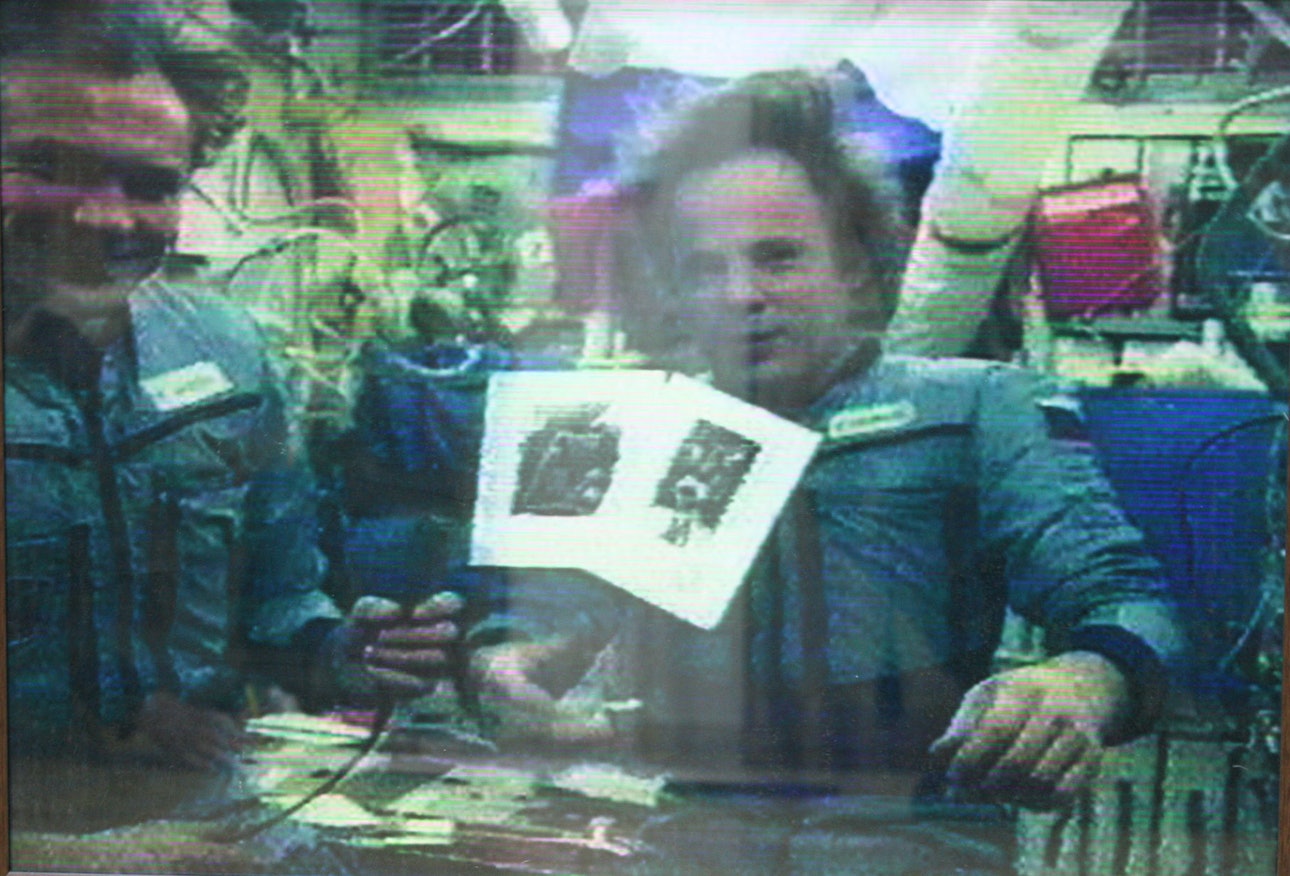
The artists announced themselves with a stunning action “Art in Space” (1993), in which they showed video documentation of Ihor Podolchak’s personal exhibition of etchings on the orbital station “Mir.” Being in open space in a state of weightlessness, the cosmonauts commented on the works, essentially taking on the role of performers. The project questioned the concept of “cultural context,” showing the possibility of a work existing outside the usual coordinate system — with the viewer, gallery, curators. At the same time, it gives an idea of the unlimited possibilities of the early 1990s, when the commercial system had not yet formed and the work truly “levitated” in “empty” space.
The standard of art trolling can be considered the postal actions of the Masoch Fund: “Happy Victory Day, Mr. Müller,” during which the artists sent Victory Day greetings to all people with the most popular surname in Germany — Müller; or “Telegram of sympathy to the Korean people on the death of the Great Leader Kim Il Sung.” The artists confronted society with complex, unspoken, often taboo topics, roughly pushing for a rethinking of history.
The artists confronted society with complex, unspoken, often taboo topics.
![4 R UMAX PL-II V1.5 [4]](https://birdinflight.imgix.net/wp-content/uploads/2018/12/1995_S-Dnem-Pobedy-gospodin-Myuller_pochtovaya-otkrytka.jpg?fm=pjpg&q=70&fit=crop&crop=faces&w=1000 "«С Днем Победы, господин Мюллер»")
“Happy Victory Day, Mr. Müller”
Victim’s Obligations
The group’s activity resonates with the principle of “aesthetics of interaction” — a term introduced by French art historian and curator Nicolas Bourriaud in the early 1990s. According to it, the starting point for art is human relationships, and the work becomes the result of interaction with the audience. The Masoch Fund often “forced” viewers to become involuntary performers of its actions, placing them in uncomfortable and choice-demanding situations.
In “The Last Jewish Pogrom” — one of the most provocative projects of the mid-1990s — the artists did not leave the audience the right to be passive participants. They divided all visitors to the exhibition into two groups, forcing each to choose the role of victim or pogromist and behave accordingly during the project. Each was given a pogromist’s memo or victim’s obligations, which they had to sign. “Victims” were not allowed to leave the exhibition space, for example, to go to the toilet, and had to obey the pogromists unconditionally. Pogromists could move freely, drink alcohol, and behave outside moral norms and rules. Three banners imitating granite tombstones were installed at the exhibition: one without inscriptions, another with the names of victims, and the third with a swastika drawn over the names. These slabs corresponded to the stages of the pogrom’s development: anticipation, the pogrom itself, and the perpetuation of the victims’ memory.


![2 R UMAX PL-II V1.5 [3]](https://birdinflight.imgix.net/wp-content/uploads/2018/12/Last_Jewish_Pogrom_Leaflet_Original_Program_Original_Scan.jpg?fm=pjpg&q=70&fit=crop&crop=faces&w=620)

![2 R UMAX PL-II V1.5 [3]](https://birdinflight.imgix.net/wp-content/uploads/2018/12/Last_Jewish_Pogrom_Leaflet_Original_Victim_Original_Scan.jpg?fm=pjpg&q=70&fit=crop&crop=faces&w=620)
In the text for the action, the artists wrote: “The pogrom is the main structural element of Jewish history throughout the entire period of the absence of Jewish statehood. Thanks to pogroms, Jews managed to develop a national character that allowed them to seize dominant positions and recreate Israel. One can speak of the POGROM as a positive selection compared to war — a negative selection.” By transferring the pogrom from the historical space to the sphere of art, the artists thus kind of “closed” this topic.
The harshness and cold-bloodedness, detachment, and straightforwardness of the artists caused indignation and misunderstanding. In 1995, “The Last Jewish Pogrom” became the reason for the closure of the entire exhibition “Kyiv Art Meeting,” held at the Ukrainian House in Kyiv.
“The Last Jewish Pogrom” became the reason for the closure of the entire exhibition.

Albert Einstein, from the project “Best Artists of the 20th Century”

Albert Einstein, from the project “Best Artists of the 20th Century”

Albert Einstein, from the project “Best Artists of the 20th Century”

Mao Zedong, from the project “Best Artists of the 20th Century”

Mao Zedong, from the project “Best Artists of the 20th Century”

Kim Il Sung, from the project “Best Artists of the 20th Century”

Kim Il Sung, from the project “Best Artists of the 20th Century”
People as Material
In 2001, the artists created their most large-scale and provocative project “Best Artists of the 20th Century.” Working with the main thesis of contemporary art proclaimed by Joseph Beuys — “everyone can be an artist” — Ihor Dyurych and Ihor Podolchak declared politicians, terrorists, sexual maniacs whose activities horrified and simultaneously fascinated as the best artists of the 20th century. Dictators Adolf Hitler, Mao Zedong, Pol Pot, and Kim Il Sung; serial killers Albert DeSalvo and Jeffrey Dahmer; scientist Sigmund Freud; war criminals Karl and Ilse Koch; bandits Bonnie and Clyde; gangster Al Capone; pedophile and murderer Marc Dutroux and others acted as artists for whom humanity was the working material. For each “artist,” a body of works and a brand under which goods were released were developed.
Photos of bloody crimes — “works” of Al Capone — or sparrows dying in convulsions — “project” of Mao Zedong — horrified and at the same time captivated the gaze. The aestheticization of violence revealed a new paradigm of the time, largely anticipating the main event of 2001 — the explosion of the Twin Towers in New York. This terrorist act would rivet millions of people to TV screens; later art critic Achille Bonito Oliva would call it “bin Laden’s ‘performance.'”
The aestheticization of violence revealed a new paradigm of the time.

Albert DeSalvo, from the project “Best Artists of the 20th Century”

Albert DeSalvo, from the project “Best Artists of the 20th Century”

Albert DeSalvo, from the project “Best Artists of the 20th Century”
In 2001, the project “Best Artists of the 20th Century” was selected to participate in the first Venice Biennale of Contemporary Art since Ukraine’s independence. Having passed all procedures and competitions, the project was scandalously removed and has not been shown in Ukraine since.
The Masoch Fund was and remains a unique artistic phenomenon, the emergence of which in “picturesque,” traditionally thinking Ukraine causes surprise. The activities of the Masoch artists, which arose against the backdrop of the collapse of the USSR and the uncertainty about the future it caused, were at the same time consonant with international processes.
The appearance of the Fund in “picturesque,” traditionally thinking Ukraine causes surprise.

Al Capone, from the project “Best Artists of the 20th Century”

Al Capone, from the project “Best Artists of the 20th Century”

Al Capone, from the project “Best Artists of the 20th Century”

Al Capone, from the project “Best Artists of the 20th Century”

Al Capone, from the project “Best Artists of the 20th Century”

Al Capone, from the project “Best Artists of the 20th Century”

Al Capone, from the project “Best Artists of the 20th Century”

Al Capone, from the project “Best Artists of the 20th Century”
Photos provided by Ihor Podolchak.
Comment type: Publications of the Research Platform
Author: Tatyana Zhmurko
Sources: Zhmurko T. The Masoch Fund: From Lviv with Love [Electronic resource] / Tatyana Zhmurko // BIRD IN FLIGHT. – 2018. – Access mode: https://birdinflight.com/ru/pochemu_eto_shedevr/20181214-fond-mazoha.html.