Yevhenii Pavlov: “There was one driving force — the need to make photography an art in the eyes of others”
Yevhenii Pavlov — a well-known Kharkiv photographer, co-founder (together with Yurii Rupin) of the Kharkiv photographic group “Vremya” (Time). Pavlov’s works have been exhibited at various international exhibitions, and in recent years they have increasingly appeared at Ukrainian art exhibitions where we try to understand our own art history.
This conversation was recorded in 2017 in Kharkiv at the Pavlovs’ studio, or rather in the premises of the GRAFPROM design studio, founded by Ilya Pavlov and Masha Norazyan. But the overall mood and place allow me to call this space a “studio,” where an atmosphere of creativity, openness, liveliness, and spontaneity reigns.
This text is published today in connection with the PinchukArtCentre project “Forbidden Image” — a solo exhibition of Borys Mykhailov and the group exhibition “Crossing the Line. Kharkiv School of Photography,” which presents a fairly large body of works by Yevhenii Pavlov, including his famous series “Violin,” “1×7,” “Orvochrome,” “Mythologies,” “Psychosis.” This text is an excerpt from a 4-hour conversation with Yevhenii Pavlov. Although it seems you know almost all the artist’s series and works, every conversation with him is a renewal and inspiration, a bright intellectual breath of non-speculative communication.

“Self-portrait,” 2018
I would like to address the origins, the activities of the group “Vremya.” Today it seems like an alternative photographic movement. However, this movement was formed and emerged within official photo clubs, which, in turn, existed at state enterprises. At what point did the group “Vremya” become labeled as alternative, underground art, and how did this connection between official and unofficial happen? On the one hand, the photo club was at an enterprise, so as a subject, an author, you belonged to that enterprise to some extent, but on the other hand, you made photos that did not quite fit the overall picture of official Soviet photography. How did you manage to balance this situation, and how did the group “Vremya” exist at all?
The context you described is correct. Indeed, people who felt that photography was something more than what they saw in everyday life gathered at photo clubs. Since photo clubs varied in size, naturally, manifestations of some underground movement, dissent were most pronounced where many people gathered. In Kharkiv, there was a regional club at the House of Trade Unions on Gamarnik Street. It had over a hundred members, and we gladly met there on Thursdays — it was an evening you awaited all week. It was intoxicating — a meeting of people sharing your interest in photography. How to reconcile underground dissent and the official status of the club? No way! The conflict between the group “Vremya” and the regional photo club was precisely on this level. The group “Vremya” demanded from the club the opportunities it envisioned in photography and by its very existence demanded to exhibit our works.
So the photo club implied exhibition activities?
Naturally. It was a whole network of artistic amateur activity. The regional photo club was part of the Regional House of Artistic Amateur Activity as one of its structures. These were all budget state organizations, and obviously, they paid for the photo club’s existence, supporting it, and had the right to dictate what the reporting exhibitions should be like.

“Untitled,” 1974
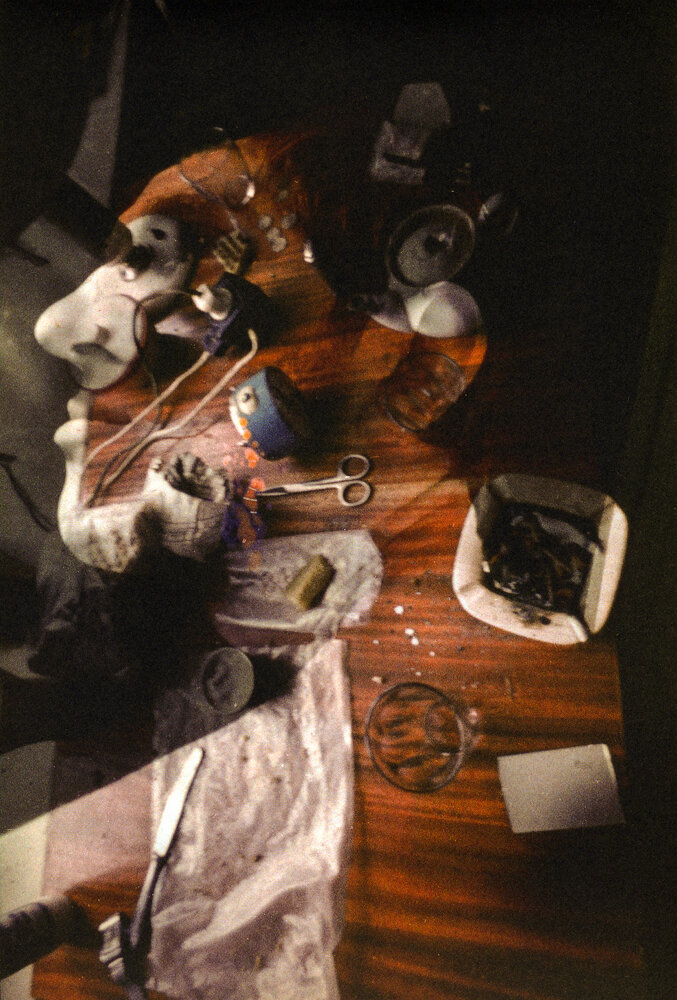
“Untitled” (Portrait of Borya Kagan), 1974-1976

“Self-portrait,” 1975
What else did they provide?
We had equipment that could be rented. They could print photo works if the author did not print them himself for these reporting exhibitions. They provided premises where we could gather in any weather. They organized certain creative meetings with people necessary for the development of photo culture. The principle on which the group “Vremya” was created, of course, contradicted the purpose of the regional photo club. Since Zhdanov’s times, any “groupism” was categorically condemned. And as soon as the word “group” was used, the bureaucrat’s mind immediately recalled some directive instructional materials that forbade any group work of creative workers. And although photography, perhaps even to our then happiness (in terms of safety), was not considered art, the taboo on “grouping” was nevertheless not lifted. When we began to declare ourselves as the group “Vremya,” it already alarmed the director of the House of Artistic Amateur Activity.

“Alone with oneself,” 1987
How did you declare yourselves? Did you write a manifesto or was it oral history?
Since we all communicated live among ourselves, naturally it was oral information. And when we exhibited at regional reporting exhibitions, we began to write group “Vremya.” Already inside the regional photo club, we were isolated into a kind of pack. The group “Vremya” paved a certain path along which more or less everyone else walked, not noticing that this path was paved. People are such that something exists as a given. We are not interested in how this given arose. Photography, universally criticized, was a completely hopeless pursuit from the art theory perspective of that time: according to the ideological version of art theory then, photography had no rights to be art. Because it had such disgusting traits as naturalism. You have to take the formulation of socialist realism and see if photography fits into socialist realism? It turns out that it can be accepted in some way, with reservations, if it serves the party’s cause, that is, if it is journalistic. And journalists in the Soviet Union were instruments of ideology. But this profession was quite free relative to a person who worked at a factory. It did not matter if he was an engineer or a locksmith; he had to be at that factory “from start to finish.” Even during breaks, people usually did not leave the factory premises. And this “camp” life encompassed almost the entire adult working population. If you worked as a journalist, it meant you could walk wherever you wanted but in the direction of the place you had to get to. And this alone made this work attractive. If you were a photojournalist, you could raise your camera somewhere, shoot without fear that you would be dragged by the sleeve to the police. Or the policeman himself would not approach and ask what you were doing because you could proudly show your booklet and say: “I am a journalist”. This was a kind of protective pass. And the figure of any other photographer — not a journalist — was a despised figure of a semi-educated invalid who stands by a monument, with photos hanging on a tripod against the monument, and some shabby bellows camera — also on a tripod. And he, freezing, stands by the monument, sniffling, gloomily and passively waiting for a client. Such a collective image of a photographer. Completely unsympathetic.
But being a photojournalist in Soviet times was not a very good fate, at least for me. It all depends on how compatible you are with the tasks journalism sets for itself. At first, we did not see this difference. I thought it was possible to combine our energetic impulse with journalism. Then it seemed possible. As I moved away from youth, the divergence between journalism and what I wanted to say increased and increased until it formed the consciousness that there is an informational and an image language. Everything connected with the Soviet was inclined to a special informational language, and I was not interested in further cooperation with a state that broke arms. When I entered film school, I was under the illusion that cinema was art. When I started studying and got into the subject a bit, I realized that cinema becomes art only in 3-5% of what is shot on film. Everything else is film production for entertaining the “workers.”

From the series “Mythologies,” 1988
Let’s recall your exhibition “Anonymous Society.” The essence of that society was such that everything was built like in Dostoevsky’s “Demons” — by cutting off heads. As soon as someone sticks out, that head is cut off. That is, the whole society had to be monolithic, one-level, so that there was no protrusion of the self. Then there was much talk about “yachestvo” (a term meaning ‘individuality’ or ‘selfhood’). And what is yachestvo: a negative description of a situation when a person demonstrates his personal qualities. Personal qualities should be used with caution so that, God forbid, you do not stand out from the crowd. Why were the stilyagi (hipsters) persecuted in their time? It was a natural rebellion of the young — “to be unlike everyone else.” But people in the mass were one hundred percent zombified beings, not realizing it themselves. Any person who realized himself as a personality and did not want to extinguish it already entered into conflict with the environment. The innovation of the group “Vremya” was that it began to stand for the right of a person through photography to express personal subjective interests — the biological life of existence, its emphasized apolitical nature, its different intellectual power, another intellectual quality. To express! And there was another driving force — the need to make photography art in the eyes of others. So much effort was spent, at least in my life, to tell people every time “this is art, this is art” and to prove that it is art. And from this follows the need to make this photography conspicuously noticeable by other means, in particular, by shock value. To make people start thinking about photography, it must be noticed. Therefore, shock plays not the least role in the group “Vremya.” I do not know if these words were spoken then, but in retrospect, reflecting on that time, I believe that this subconscious need to shock people arose from the objective necessity to make photography a noticeable phenomenon when you subjectivize your pictures through form.


From the series “Mythologies,” 1988
How did the group “Vremya” dissolve?
Everyone asks when the group “Vremya” ended? The thing is, there is no definite answer to this question. While the group existed within the photo club, its existence was clearly outlined because it was prominent against the club’s activities. But they could not disperse the group. They had no power because we did not ask them for money, were not on staff, we were free people. In the literal sense of the word, they could not forbid us, so they simply dissolved the photo club. The group ceased to be noticeable because the background on which it was visible was removed. And what other background? The life of Kharkiv? That is not a background because to be visible on that background, you had to have the opportunity to exhibit your works. And who would hang those works? So it can be said that with the dissolution of the photo club, it looked externally as if the group “Vremya” was dissolved. But that is also not true. The group gathered not to be inside something but to be together, and this together can be of different degrees of association and dissociation over extended time.

“Self-portrait,” 1976
Once long ago I visited, and you said that in the 1970s everything was connected with super-effort, and one of those super-efforts was the desire to prove that photography is still art, you wanted somehow to legitimize photography. What is this connected with? If there was such a desire to prove it is art, did you have predecessors, considering that Kharkiv is a city with an avant-garde tradition: theater, constructivist architecture, etc.?
We ourselves were surprised that we emerged as if on a wasteland. I say “as if” because today I understand the full existence of that environment. Living in one city, each of us had his own everyday environment, and its content was different for each. For example, Malevanyi, Tubalev, and Borya Mykhailov (Oleh Malevanyi, Hennadii Tubalev, Borys Mykhailov — all members of the group “Vremya” — ed.), living in the city center since childhood, had their own circle of acquaintances defined by the culture typical of central Kharkiv. I always lived on the city’s outskirts, in a proletarian district of quite bandit content. The word “culture” was not much friendly there. This is the tractor plant (referring to the Kharkiv Tractor Plant area) and nearby. Rupin came from Krasnyi Lyman (Donetsk region) and had roughly the same history. Makienko was also near the tractor plant with me but came from a family of employees, which gave a certain tint to his image. Living in one city, we all represented its different layers. Suprun spent his childhood in the suburbs and only became a city dweller forever after entering KhPI (Kharkiv Polytechnic Institute). These markings follow a person from childhood throughout life and influence subsequent decisions and social movement. It seemed to me personally that we arose from nowhere. Later I learned that Borya attended Vladimir Grigorov. Malevanyi and Tubalev studied in Grigorov’s circle. And Grigorov was an artist who led a photo circle at the “Stroitel” Palace of Culture. Directors brought their film premieres to this Palace of Culture, which were significant for the intelligentsia. For example, Tarkovsky brought his films and showed them at the “Stroitel” Palace of Culture and came himself.
Grigorov was an artist who communicated with his “circle members” on a special cultural level. It is no coincidence that Malevanyi and Tubalev went there. Based on this circle, they made their exhibition at the “Stroitel” Palace of Culture, through which I learned their names back in 1967. I saw these photographs and thought, “Wow! I thought that such photography should be made. And I did not suspect that there were such people in Kharkiv.” I was struck to the heart that there are people in Kharkiv who make photography that I think of as real. Only later did I meet them at the regional photo club. Today this cultural history begins to clear up. By the way, Tanya (referring to Tetyana Pavlova — art historian, photography historian — ed.) described in her book how through Grigorov a chain from Vasyl Yermilov and Borys Kosarev indirectly reached us. Yermilov died only in 1968, and Kosarev in 1997. In theory, we could have communicated with them, but other names were more well-known.

“Portrait of Father,” 1967-1992. From the series “Total Photography” (1965-1994)
What names were well-known?
The most notorious at that time was Sizikov — the Kharkiv chairman of the Union of Artists. He was a completely reactionary figure. Somehow it happened that creative unions were headed not by leading artists but by appointees of the regional party committee. But each of us had a cultural environment in which we developed as photographers and personalities that was different. Borya, Oleh, and Hennadii, living in the center, knew many artists… Because this one studied at school with them; that one knows them because he lives in the neighboring yard; that one has a workshop nearby. The world is small, especially in the center of a city like Kharkiv. Everyone knows each other by face. My outlook was limited to what I read in books and magazines. But I did not read about Kharkiv artists.
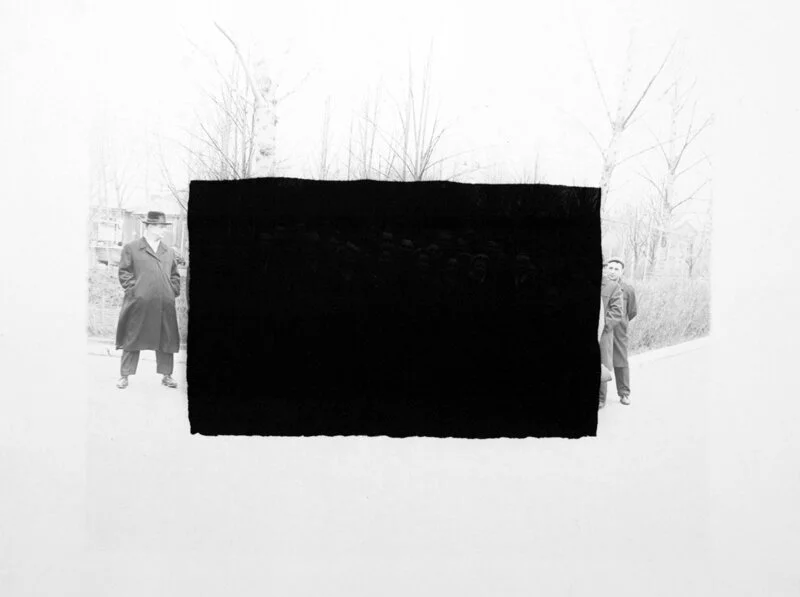


“Eclipse,” 1999
I have another question in the context of the exhibition “Anonymous Society,” where two of your series “Eclipse” and “Life of the Plant” are shown, based on anonymous photography. One of the exhibition’s questions is precisely about the manifestation of voice, or rather, the possibility of its manifestation. How to understand anonymous? On the one hand, it can be perceived as grayness, facelessness, but on the other hand, in criminology, it is confidential information, witness protection; on the third hand, anonymity as denunciation. Anonymity can also be perceived as an innate or inherited desire not to stand out from the crowd. What is your process of working with anonymous photography, with the anonymous archive connected with?

From the series “Life of Plants,” 1990
At one time, I made many efforts to study photographic language that would equate photography with art in its accepted categories. Hence — complex montages, a certain quality of works so that people would have no objections to the assertion that photography is art. For example, technological sophistication. So that a person looks and says, “Well, of course, this is not simple photography.” Being involved in this, serving the idea of photography as art, for a long time I somewhat underestimated the straight photography I had been shooting all my life. And when the need to prove that photography is art was exhausted, then the feeling of love for straight, pure photography, which had been pushed to the background, was activated. A belated love for pure photography. When I began moving along this path of self-purification and self-analysis, I realized I was dealing with a somewhat hidden phenomenon that I needed to decode for myself. To a friend in the army, architect Borya Kagan (we served together), I said: “Bob, look at this picture!” And he said: “Show me where it is beautiful?” Remembering Borya Kagan like this, I ask myself: “Where in the photograph I am looking at is the most attractive point that I truly react to?” It can lie on the periphery. I came to a simple conclusion that in anonymous photography, the main content is often on the periphery. It is not colored by any subjective distortion because the photographer, even the most unskilled, strives to be subjective, not realizing it. Because there was always an imperative “make it better, beautiful”. It flashed in heads as a desire to clear the space of the unnecessary. I think the place where the photographer’s will is not directed preserves its divine purity. Although it may be dirt. You can speak in theological or other language, but existence has its untouched forms, and as long as a person does not touch or deform them according to his tastes, it carries the fullness of information about that moment in time. On the frame’s periphery, it is most vivid. In anonymous photographs, there is little distillation of space. When an amateur shoots, he lacks the knowledge and skills to distort this space with his subjectivity. And the more naive the photographer, the cleaner the foreground, and the camera shoots with such details that the human eye never sees. And he will see it only when he gets the photo print. And the experience is that as a photographer develops professionally, he begins to see a lot in the direct, physical sense of the word, throughout the field of vision. That is, for a photographer, there is no peripheral space — he sees everything. Suppose I look at you. If I were not a photographer, I would see only you; I would not see anything else. But I already have the skill of vision, and besides you, I notice that — there, there, or there. And if I photograph you and look at the print, I will not be surprised by anything. But if I show it to another person and say: “Did you see this? Did you see that?” “No, I did not.” This is what distinguishes a photographer. But if a person conscientiously examines a picture, he will, of course, see everything. He may not be able to explain it but will feel that something important emanates from there. Suppose you look at a photograph from the 1930s. The people themselves are amazing. Each generation is its own breed of people. Each generation differs by a complex of mindsets, common reactions to some life phenomena. If you take time and slice it like a roll — each generation has its own “sausage” of time.
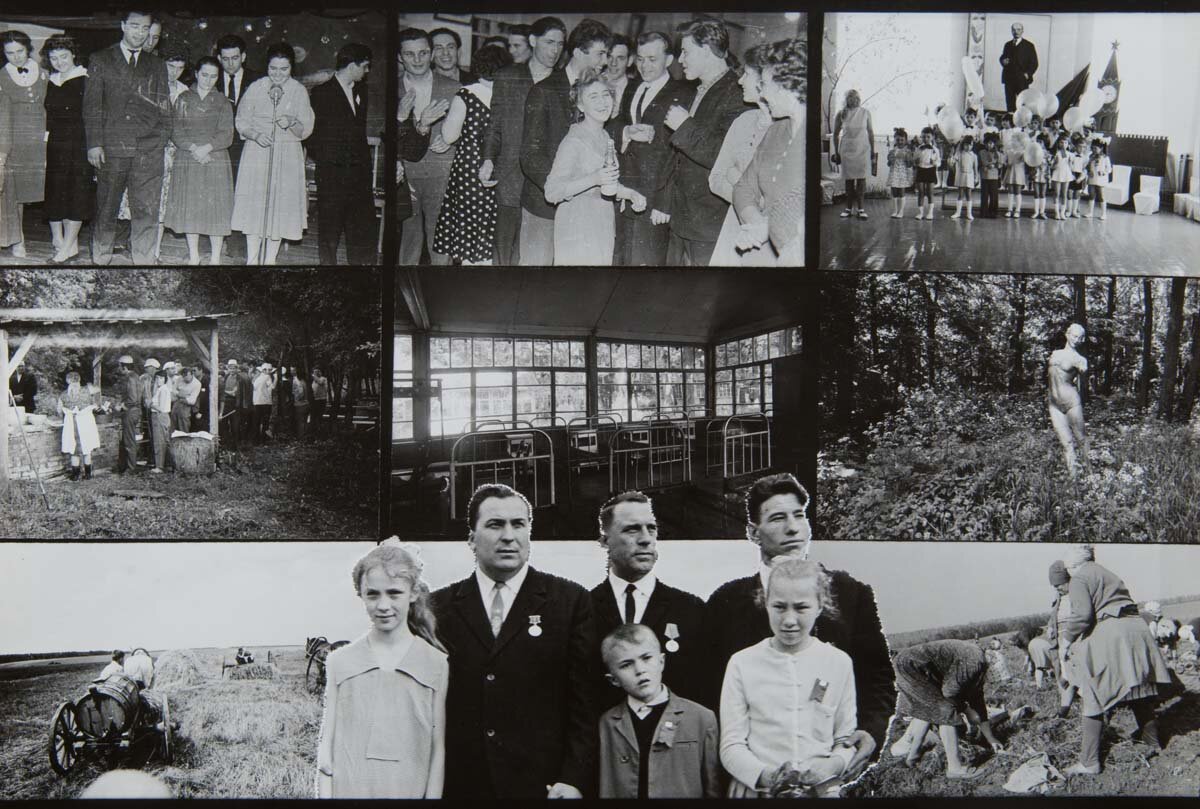
From the series “Life of Plants,” 1990

From the series “Life of Plants,” 1990
In its value system.
Yes, and it forms the topography of the face. Our generation reacted with its inherent temperament. And we have common wrinkles on the face, squints, gestures, intonation level, some emotional quirks, character of pressure, energy of monologue. In your generation, everything may be diametrically opposite. And if you speak from these positions, we have no points of contact. The generation struggle arises from this. It can be avoided if you realize what the difference is. Not that you have a clean forehead and we have a wrinkled one, but that there are certain values that are not transient. In a sense, when you look at graduates of the 1930s school, you cannot distinguish them. That is, this cultural climate, common reactions, common interests create their mimic traces on faces. And ultimately, each generation has common mimic traces. And for a person distant in time by 40 or 60 years, these traces are the most important sign of their commonality. They so overshadow the person’s personality that you say to yourself: how did they distinguish each other?

“Landscape with a Giraffe,” 1989
Essentially, anonymous photography accumulates this information.
Yes, anonymous photography is essentially an unbiased, perhaps not very skillful, but therefore only winning document that has conserved a fractal of time. Our sensitivity lies in that we somehow feel the nature of the time in which we live. I imagine it this way: time is not a word; it is a heterogeneously structured flow. When you come into contact with it, you react to this heterogeneity. This reaction can be described by the word “actuality.” At some point, some thought, feeling comes, and we cannot ignore them. Because it is experienced as a necessity related to the given moment. At the same time, you notice that something similar happens with other people, allowing the thought that it is the generation and consequence of something common to us, beyond our senses. This I feel as time.
You spoke about zombification of that reality, but do you think we are not experiencing some new wave of zombification now?
As long as there is state power or some sufficiently strong monopoly group that wants to influence people, believing that these people will be theirs, for whatever purpose, whether they are their buyers or their warriors, it logically comes to the need to prepare these people for themselves. And this process today is called zombification. It consists of creating some conditional, unconscious reflexes that lead a person along a certain behavioral path and lead to the necessary result for the rulers. As long as there is a need for some ruling people to form their henchmen or multiply the ranks of “party members,” there will be attempts at zombification.
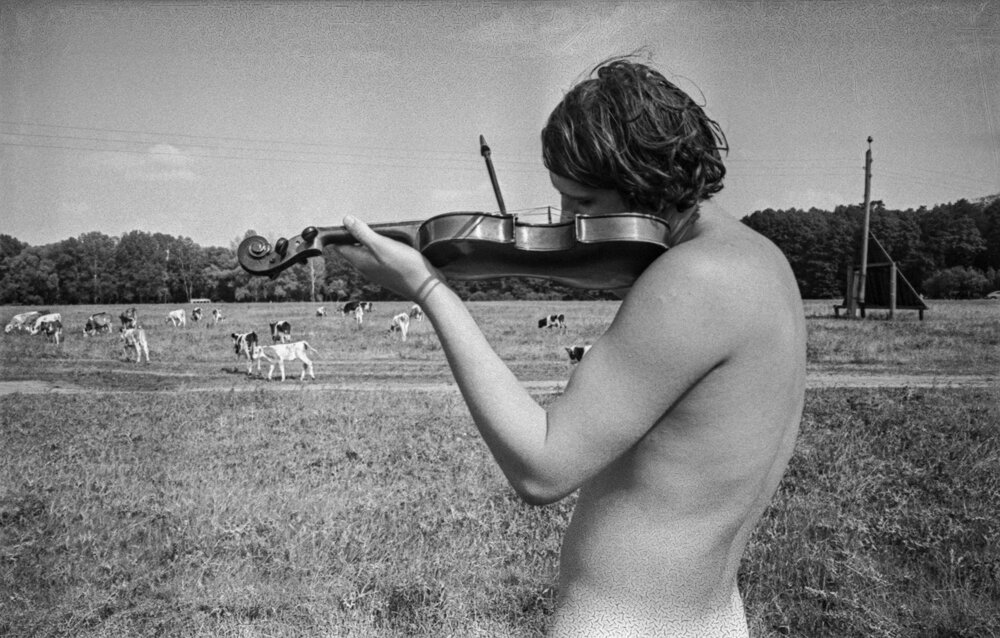
From the series “Violin,” 1972
You once said that your art was then oriented to a narrow group of psychotherapists, that you yourselves were psychotherapists for each other. Who was the audience besides the close circle?
The audience was all those people whom life brought together one way or another and to whom I considered it possible to show my works. Information spread by word of mouth. If there was a slide festival, a poster was made. We showed each other. Another form was an exhibition, but that was mostly after perestroika (except for the scandalous 1983 exhibition, which was closed on the first day). Looking back now, I realize that in the desire to demonstrate, we were excessively persistent. Borya noted exactly that our desire to show photographs reached rudeness. We were so blinded by this need.
What caused this need?
When people meet at a certain age, they want to show each other what they live by. And if you feel that you made a step compared to your yesterday self, and this step made you more significant, you want to share it. And probably photography was such a tool in this sense. That is, we parted ways then, and I made new pictures, and now I am different, and my pictures say this. Probably, the moment of self-affirmation was decisive.
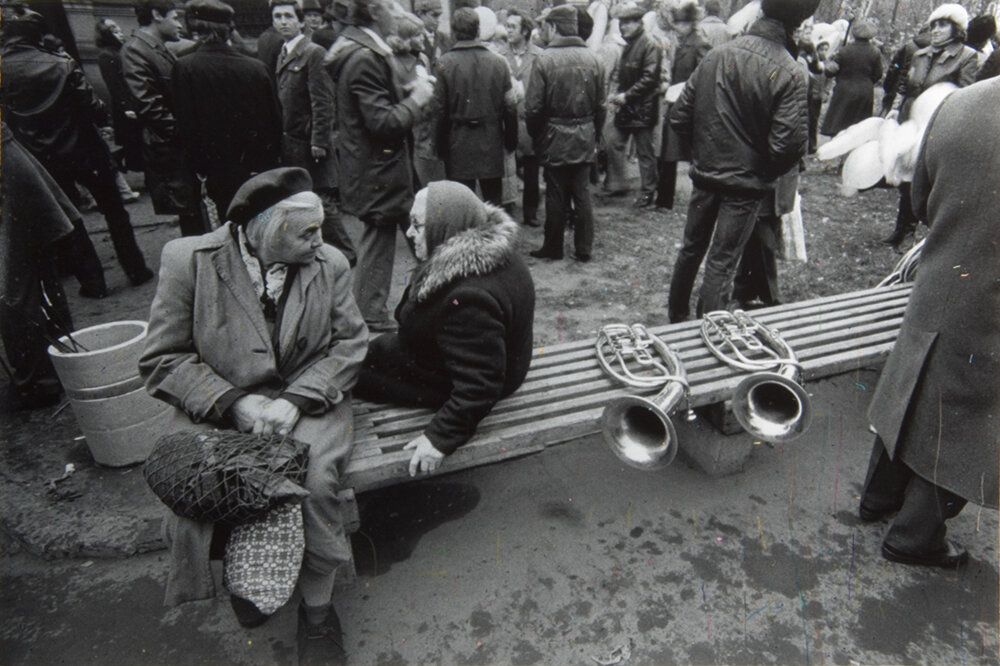
“Untitled,” 1975
Now the artistic practice of many artists is built on reflecting on the Soviet past, heritage, values. There is a term “nostalgia without memory,” when you talk about, evaluate experience you did not directly live through. In Soviet times, values such as respect, love, which are universal in any society, were also declared. How do you understand Soviet values for yourself?
The thing is, there are values declared in the Soviet period, and there is the real implementation of some value system. And there is a huge distance between them. A simple example: the constitution adopted by Stalin in 1936 was “the most democratic on the globe,” but it did not save the Soviet people from the GULAGs and their subsequent fate.
Between the declared document, which carries the main values of the Soviet person’s life, and his real life — a considerable distance. Do you think we had some special worldview or goal to be dissidents, heroes, and so on? No! We behaved like people who wanted a normal human life. It was a struggle for the norm of life. This included simple, not some unrestrained absolute freedom. It was the need to say what you think, the necessity of sincerity, which saves the energy of being. And when moments of sincerity appeared, they gave cathartic pleasure. That is, catharsis could be earned on the spot — by telling the truth. You just have to understand that truth is not the ultimate truth. Truth is just your honest statement about what you feel about this. But this was precisely closed! It was forbidden to be simply biologically expedient, which led to a neurotic situation. Because if this were allowed, tomorrow we would demand another freedom, the day after tomorrow another, and they did not need it; they would lose slaves. My father constantly said: “You change jobs so often. They will judge you as a flyer.” He remembered Stalin’s times well, kept those fears. I said: “Dad! Look: after school, I was a locksmith-pattern maker; a technician at the university; an engineer-economist at UkrGazProm; a senior engineer at the All-Union Scientific Research Institute for Air Conditioning and Ventilation; a senior engineer and head of the film-photo lab at the Institute of Orthopedics, and with each step, my salary increased”. But still, fear is deeper than the mind. Our behavior then could be qualified as dissent, but it was not an end in itself.
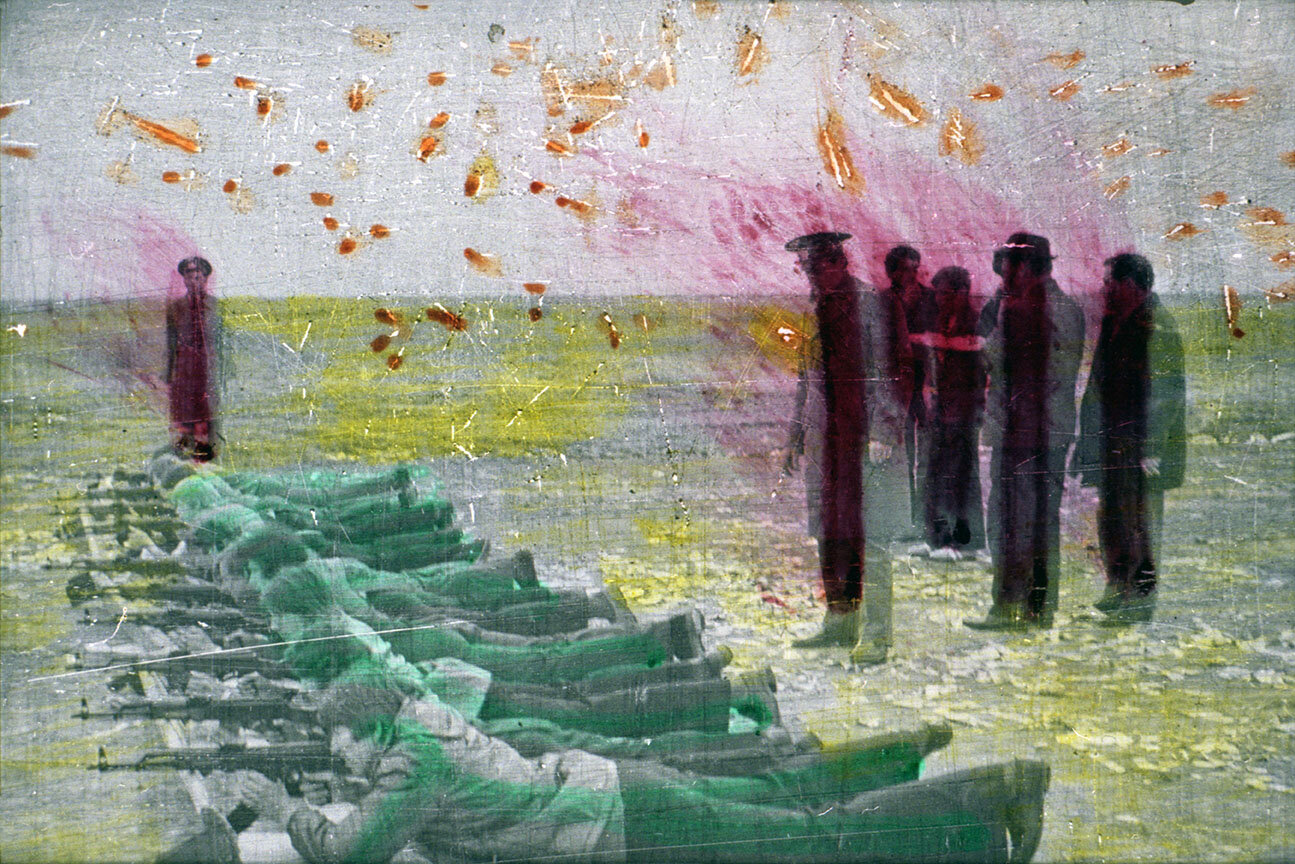
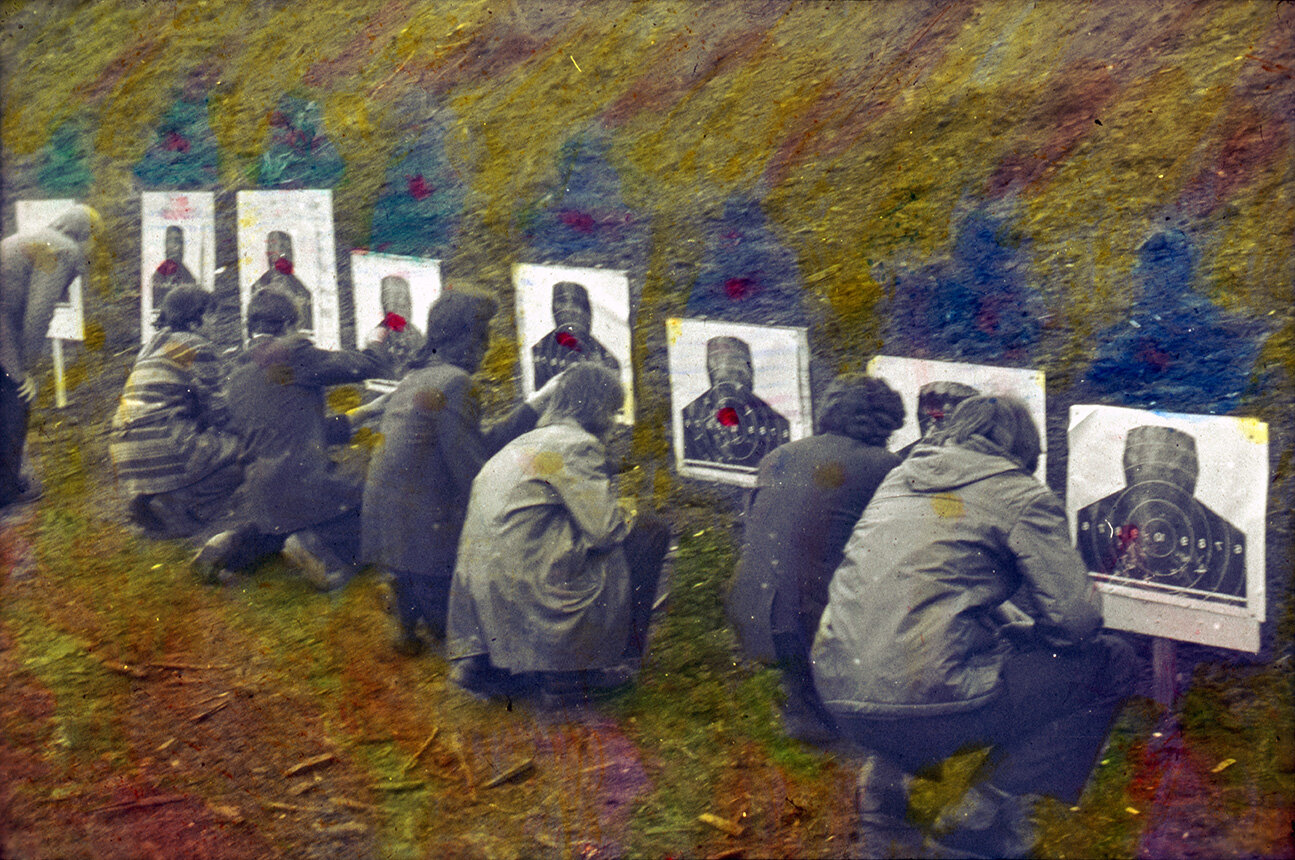
“Untitled,” 1968-1991. From the series “Total Photography” (1965-1994)
But in the 1990s many built their careers as “dissident” post factum…
That’s why I don’t like talks about the KGB. Then it turns out that a person’s value is measured only by how the KGB treated him. They look for some spice in this. But your communication with a person arose from another motivation. And this question seems to negate it. It can be asked to another person who will tell you even more about the KGB. At some point, the biography, the life of a photographer or artist became just a game in this formula “KGB — person.” So many people abuse it that it becomes bad form.
Art in this sense is a good form. You show it; it is not a violent gesture. Whoever wants — watches and maybe reacts. And most likely, people perceive not the meanings we put into them. No need to go far: we looked at Soviet painting with sadness because, first of all, we read ideological mythologemes from it. Then the Soviet pain began to subside, and it turned out that Sergey Gerasimov’s “Collective Farm Holiday” is such a great painting! The ideologeme goes away, and painting in all its professionalism appears fully, and the reaction to it changes. And this gives reason to think that everything you do, what you put in, will not necessarily be read with the same meanings. The new generation will put their actualities and contents there. And probably, this is right, as long as the picture gives a reason to cash out these contents.

“Untitled,” 1974
Tetiana Kochubinska