
In Search of the Average: The Theme of the Hero in Kharkiv Photography at the Turn of the 1980s–2000s
… I keep thinking about the hero and the hero’s gesture: how relevant can this hero be in the future?
Sergey Bratkov, from an interview with Mikhail Sidlin [1]
In Sergey Bratkov’s works of the late 1990s – early 2000s, there is a painful desire to find the “hero.” To understand who he is, what his gesture is, and how he reflects a pivotal time. His series from that period form a whole gallery of portrait types. In some ways, they evoke associations with the “Peredvizhniki” tradition, which sought to affirm the values of the simple real person. Sailors, riot police officers, steelworkers, secretaries, and many other heroes of Bratkov, in contrast to creating an idealized generalized image, offer an intimate, humanistic story, representing society as it is. “In Soviet times, we dealt with characters. Here is a party worker, here is an engineer, here is the artist Kabakov, who was the first to understand this character nature. Then, during perestroika and the nineties, people allowed themselves to be heroes” [2], says Bratkov.
Today, too, there is a call to heroism. Using Soviet slogans and clichés, the current ideology gives them a modern ultra-patriotic flavor. But in the late 1990s, perhaps heroism could be seen in the everyday fearlessness to face the uncertainty of existence. Based on dictionary definitions, in this text, a hero will be understood as “a person embodying characteristic, typical traits of their era, environment” [3].
Noting the “social morbidity” [4] in Vagrich Bakhchanyan’s drawings, Boris Mikhailov thereby defined the Kharkiv artistic environment as a whole. Social morbidity characterizes the features of the pivotal era of the 1980s–2000s. Fragility, vulnerability, uncertainty, sensitivity — these distinguish the heroes of Kharkiv artists, this is what attracts these heroes. Speaking about his characters, Kabakov noted that “they are half fantastic, half real…” [5]. The heroes of Kharkiv photographers are essentially real. Social morbidity defined the focus of interest on the unmanifested, unnoticed, humiliated, vulnerable; that which is real and preferred not to be seen or noticed. In this attention lies the humanistic manifestation of Kharkiv photography, the empathy characteristic of Kharkiv artists. Above all prevails the desire to affirm the possibility and necessity of living a “normal” human life (normal in the desire to allow oneself to express subjective judgment, emotionality) [6], inherent to a person, not a clichéd demonstrative hero, not a construct of a person like the “Stalinist homunculi” [7], reflected in Sergey Livnev’s film “Sickle and Hammer” (1994).
“In a half-starving but painfully proud country” [8], as Eduard Limonov noted, Kharkiv photographers paid attention to what was offstage — they noticed and criticized the morbidity of this pride, presenting the morbidity of a society that has nothing but former pride. In one of the photographs from his “Archive Series” (1988), Yevgeny Pavlov captures a particularly dramatic yet utterly everyday scene, striking with its social transgression. Amid the perestroika chaos, shortages, and queues, a crowd of citizens does not notice a dead man lying on the asphalt. This shot declares the devaluation of human life, which remains characteristic of our territory to this day.

Yevgeny Pavlov. From the “Archive Series.” 1988. Pigment print, hand coloring. Courtesy of the artist
A few years earlier, Pavlov created “Psychosis” (1983). The title itself precisely expresses the feeling of the time: a silent, terrifying, hidden psychosis. “…the era was uninitiative. And a huge number of people then became alcoholics: they could not realize themselves and justifiably considered themselves a lost generation” [9], notes Leonid Parfenov. The “Psychosis” series was shot in the psychiatric ward of one of Kharkiv’s hospitals, depicting patients suffering from alcoholic psychosis. Various unexpected angles, tense bodies seemingly frozen in death throes and suffering. The chosen complex angle with foreshortened perspective evokes associations with the composition “Dead Christ” by the 15th-century Italian artist Andrea Mantegna.

Yevgeny Pavlov. From the “Psychosis” series. 1983. Pigment print. Courtesy of the artist
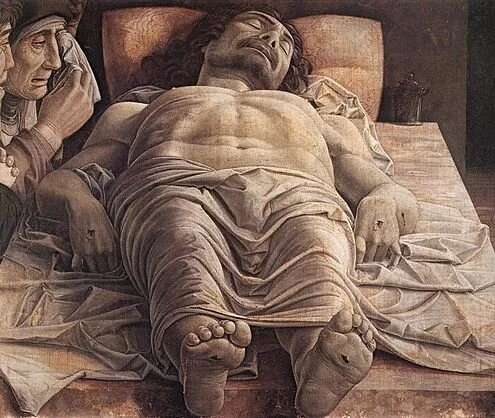
Andrea Mantegna. Dead Christ. 1475–1478. Canvas, tempera. 68×81 cm. Pinacoteca di Brera, Milan
Mantegna’s monochrome painting is perceived as evidence of severe torture endured for the redemption of humanity’s sins. Christ here appears as a real man who endured unimaginable torment and pain. The legs of Pavlov’s hero, bound with hospital bandages, testify to ongoing pain, self-torment, and the impossibility of self-realization and acceptance of reality. Christian motifs often arise in the works of Kharkiv artists and probably reach their apotheosis in Boris Mikhailov’s “Medical History,” created in 1997–98.


Yevgeny Pavlov. From the “Psychosis” series. 1983. Pigment print. Courtesy of the artist
Much has been said and written about this series. Here, I would like to emphasize the connection with the larger picture, with the desire to “frame” — in both literal and figurative senses — these heroes who could not adapt to new living conditions, lost in an era lacking a core, like the heroes of Pavlov’s “Psychosis.”
But while Pavlov acts as a chronicler of the era, distanced, Mikhailov’s portrait series (and later Bratkov’s) are distinguished by involvement in the process of working with the hero. As Bart de Baere noted, “the images primarily concern relationships and humanity: the photographer often finds himself in dangerous situations where he establishes connections with people” [10]. In his famous series, which can boldly be called epochal in the history of contemporary Ukrainian art, Mikhailov managed to establish relationships with homeless people who emerged as a mass class after the collapse of the USSR. He also managed to establish a “material image of the time,” according to Elena Petrovskaya: “If history as a science cannot capture the life of a generation, then art can. In this sense, art is more receptive and a more faithful documentarian than individual representatives of historical science. It is much more faithful to its time and therefore much more capable of reflecting it. Although, apparently, this happens unintentionally — I don’t think Mikhailov set such a task for himself. But it must be admitted that he succeeded” [11].
Vulnerability, defenselessness, aggression, violence — these are what Mikhailov’s heroes experience and face. If in the series “At the Earth” (1991) and “Twilight” (1993) the artist captures the loss of ground beneath one’s feet, a stop, a pause, then in “Medical History” the hero’s detachment occurs during the decomposition of totality: “I am always working on watching how life changes” [12], notes Mikhailov.
“Medical History” reflected radical changes in Soviet society’s life, visibly transforming into post-Soviet and soon new (independent) Ukrainian society. In this series, Mikhailov consciously highlights a number of photographs in the so-called “Requiem.” According to him, “…Requiem is the form in which they (the homeless — author’s note) allowed themselves to be shown. […] Or maybe it is like looking tragedy in the face, which appears in different parts of the Earth and at different times? A look of hopelessness of forced wandering” [13]. He prints this series in large format, sometimes framing them, which contributes to the monumentalization of images, revealing unnoticed or unnoticed everyday traits. Large-format staged photographs refer to the tradition of formal portraiture and also to the idea of a large painting, especially Russian realist art of the second half of the 19th century.
One of the images of the “Requiem” is very close to V.G. Perov’s painting “The Holy Fool” (1875). If Perov’s holy fool, a Christian ascetic, is the result of observations of post-reform Russia’s life a little more than a decade after the abolition of serfdom, then Mikhailov’s hero is a fixation of observations of “post-reform” Ukraine’s life a few years after the Soviet Union’s collapse.
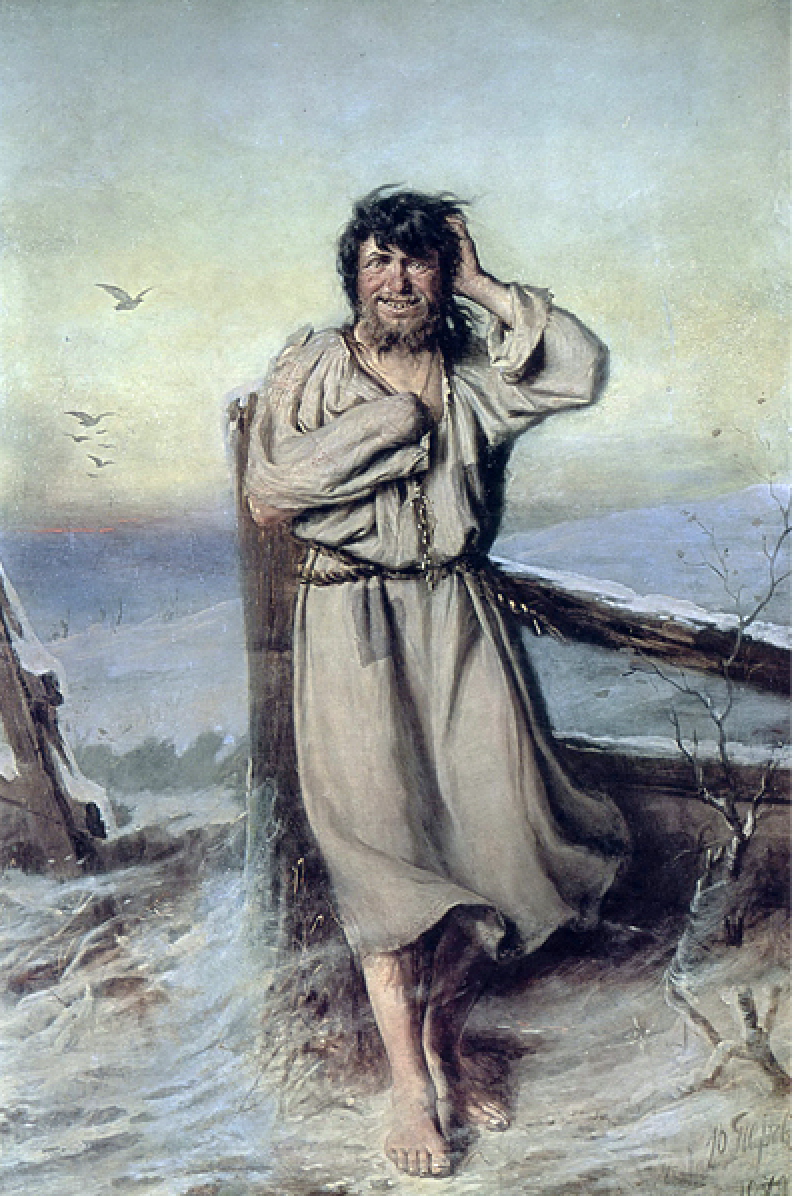
Vasily Grigorievich Perov (1833–1882). The Holy Fool. 1875. Canvas, oil. 153 x 101 cm. National Museum “Kyiv Art Gallery”

Boris Mikhailov. From the “Medical History” series. 1997–98. Color print
What unites these works is the appeal to the inner psychological life of a person during a breakdown of consciousness, radical socio-political change. They question the possibilities of a new life, the acute need to find and discover oneself in new conditions. In the first case — after the abolition of serfdom, in the second — the acquisition of an independent state. Both images are deeply humanistic because they are directed at the person.

Boris Mikhailov. Medical History. 1997–98. Exhibition view of “On the Edge. Ukrainian Art 1985–2004” (2015), PinchukArtCentre. Photo by Sergey Ilyin. Courtesy of PinchukArtCentre
Such defenselessness is reflected in Bratkov’s series “Birds” (1997), in which the artist intersperses photographs of children from orphanages with shots of bird taxidermies from natural history museums.


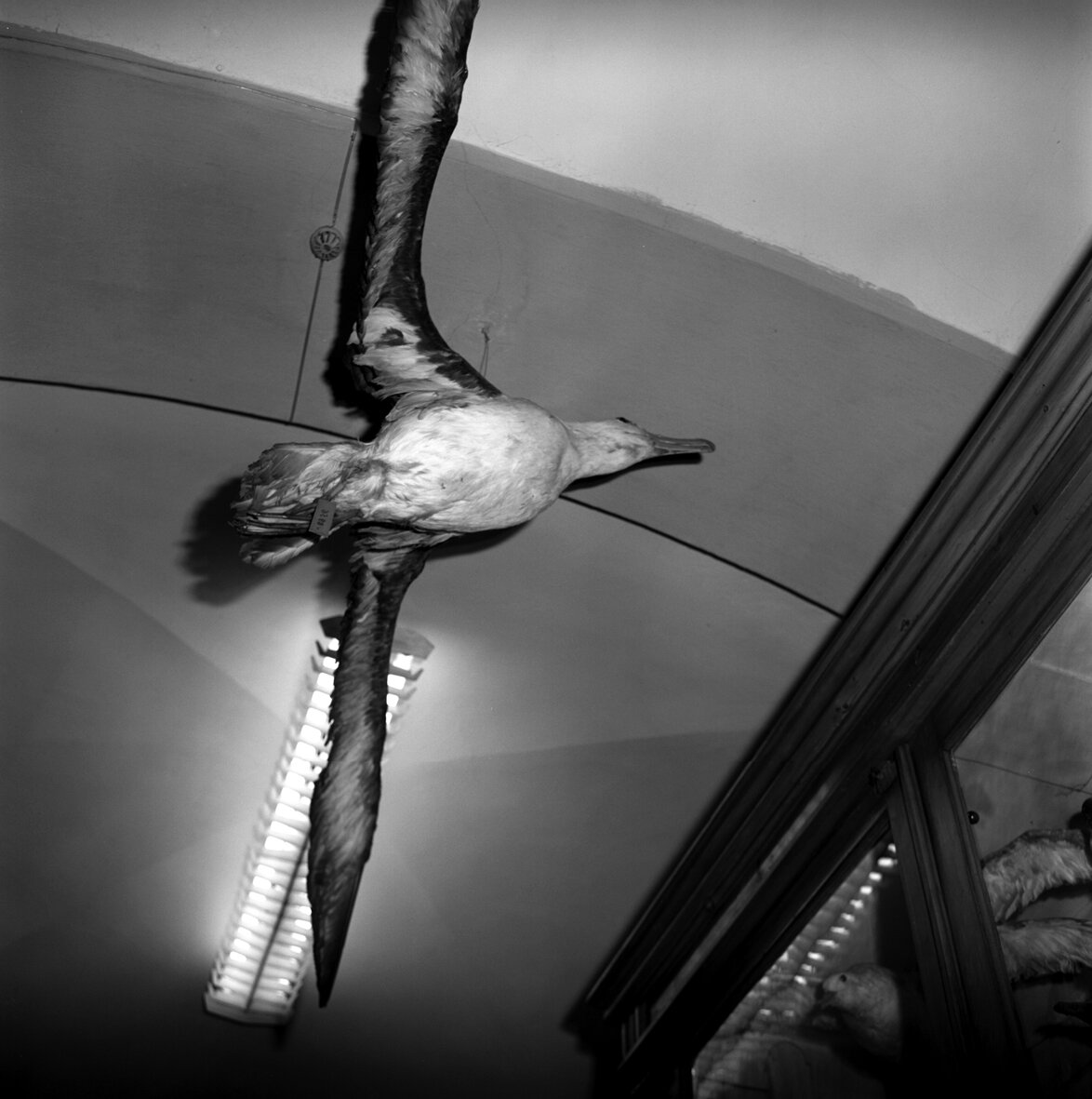


Sergey Bratkov. From the “Birds” series. 1997. Silver gelatin print. Courtesy of the artist
The feeling of abandonment, alienation, and uselessness acquires an even more heartbreaking character because all the children’s gazes, upon any departure and viewing of the photograph, unconditionally, painfully look at the viewer.
The image of the child is not accidental. “Children represented important heroes because the turn of the century was underway” [14], analyzes Sergey Bratkov. Philosopher Boris Buden sees a political metaphor of post-communist society in the image of the child: “In the ideological structure of post-communism, the metaphor of the child plays a special role. It means the idea of a new beginning, innocence inherent in the newly opened democracy, as revolutions of 1989 are often described. At the same time, children are the image of infantile Eastern European societies freed from totalitarianism and reaching adulthood, which they have not yet achieved in history” [15]. Bratkov created the “Drug Addicts” series (2001) in a juvenile detention center, redefining the concept of childhood. As Boris Buden noted, the child here is not a defenseless social unit requiring care but rather an embodiment of danger. What does a grown juvenile criminal bring to society? Using a 6×6 camera, Bratkov creates double exposures, achieving the effect of a blurred dual reality, as if conveying a drug-poisoned view of reality.


Sergey Bratkov. From the “Drug Addicts” series. 2001. Color photograph. Courtesy of the artist
Roman Pyatkovka embodied the idea of rediscovering democracy as a metaphor for an immature new beginning in the series “New Hero,” created at the end of the USSR in 1988. In this series, Pyatkovka embodies the image of informal, protest youth, whose protest lies in indifference, disregard for norms, appearance, clothing, declaring the moment that must be valued in life — here and now. Over each photographic image from the life of Kharkiv punks, Pyatkovka applies fragments of lyrics from popular rock bands. In these images and the “pulsation of veins,” the notorious “We are waiting for changes” by Viktor Tsoi already resounds fully. The desire to savor life without limits, curiosity, intrigue, nihilism, the assertion of freedom through appearance and behavior contrasting with the gray reality, the feeling of “after us, the flood” — in such a context of the era of change, a new hero was formed.


Twenty years later, the SOSka group created the project “Dreamers” (2008), where Buden’s thesis about a forming young society gains particular eloquence and expressiveness. If in Pyatkovka’s work it was the rebellion of a young organism against any dogmas and clichés outside political circumstances (in 1988, political circumstances were such that a mohawk or torn jeans was enough to reveal rebellion), then in 2008, SOSka’s work raises the question of finding one’s own identity and self in this world.
In this series, the artists turned to the teenage subculture “Emo.” Their heroes seem to levitate above the Derzhprom building in Kharkiv, pondering the eternal existential question of their own purpose in this world. Both Pyatkovka and SOSka speak about the new hero, about his embodiment through musical subcultures as a way to oppose the banality of life despite normalizing mechanisms and dogmas.


Group SOSka. Dreamers. 2008. Digital print. Courtesy of the group SOSka
Today, questions about heroism, on the one hand, seem to have been clarified. There is no need to ask. The agenda again includes the fight against the enemy, “patriotism,” and the fatherland. On the other hand, perhaps soon the centennials generation will completely abolish such questions. And it is unclear what gestures and heroes will be possible in the future?
[1] Mikhail Sidlin. The Art of Brutal Irony. Why Sergey Bratkov photographs children, riot police, and metallurgists: https://www.photographer.ru/cult/person/712.htm
[2] Mikhail Sidlin. The Art of Brutal Irony. Why Sergey Bratkov photographs children, riot police, and metallurgists: https://www.photographer.ru/cult/person/712.htm
[3] One of the definitions from the Great Explanatory Dictionary.
[4] Nikolay Ridny, Anna Kriventsova. Interview with Boris Mikhailov: http://xz.gif.ru/numbers/70/mihailov/
[5] Kabakov, Ilya; Groys, Boris. Dialogues. — Vologda, 2010. — p. 26.
[6] See interview with Yevgeny Pavlov, in which he speaks about “the right of a person through photography to express personal subjective interests — the vital biologism of existence.”
[7] According to Yan Levchenko’s definition.
[8] Eduard Limonov. We Had a Great Era (1987). Moscow, Glagol, 1992.
[9] Quoted from: Leonid Ushakin. The decomposition of totality: objectification of late socialism in post-Soviet biochronicles. New Literary Review. — 2013. — No. 89.; https://www.nlobooks.ru/magazines/neprikosnovennyy_zapas/89_nz_3_2013/article/10519/
[10] Bart de Baere in: Sergey Bratkov. Glory Days. — 2007. — p. 141.
[11] Elena Petrovskaya. Theory of Image. — Moscow, 2010. — p. 29.
[12] In the documentary film by David Tebula “Boris Mikhailov. Tea. Coffee. Cappuccino” (2019).
[13] Igor Solomadin. Boris Mikhailov: “Reaching Understanding.” Pictures from the Exhibition:
https://glavnoe.ua/articles/a8435
[14] Mikhail Sidlin. The Art of Brutal Irony. Why Sergey Bratkov photographs children, riot police, and metallurgists: https://www.photographer.ru/cult/person/712.htm
[15] Boris Buden in: Sergey Bratkov. Glory Days. — 2007. — p. 132.
Prepared based on materials from the PinchukArtCentre Research Platform
Tetyana Kochubinska