Kalita A. VALERIA TRUBINA ABOUT “NEW WAVE”, THE ART FOR FREEDOM EXHIBITION AND LUHANSK DURING THE WAR [Electronic resource] / A. Kalita, D. Slobodyanik // Your Art. – 15. – Access mode to the resource: https://supportyourart.com/conversations/valeria_trubina/.
Kalita A. VALERIA TRUBINA ABOUT “NEW WAVE”, THE ART FOR FREEDOM EXHIBITION AND LUHANSK DURING THE WAR [Electronic resource] / A. Kalita, D. Slobodyanik // Your Art. – 15. – Access mode to the resource: https://supportyourart.com/conversations/valeria_trubina/.
Publications
VALERIA TRUBINA ABOUT “NEW WAVE”, THE ART FOR FREEDOM EXHIBITION, AND LUHANSK DURING THE WAR
From July 8 to 17, the Wadström Tönnheim gallery in the Spanish city of Marbella is hosting an exhibition-sale of contemporary Ukrainian art. The participants of the exhibition are the most famous Ukrainian painters and sculptors — Darya Alyoshkina, Nazar Bilyk, Artem Volokitin, Petro Gronsky, Vasyl Hrublyak, Oleksiy Zolotaryov, Darina Mykytiuk, Nina Murashkina, Yuriy Koval, Tetiana Malynovska, Vitaliy Kravets, Liliya Studnytska, Valeria Trubina, Ivan Tsyupka, INS (Yevhen Hladenko). The exposition includes painting, graphics, photography, and sculpture, and the project’s integral mission is charitable.
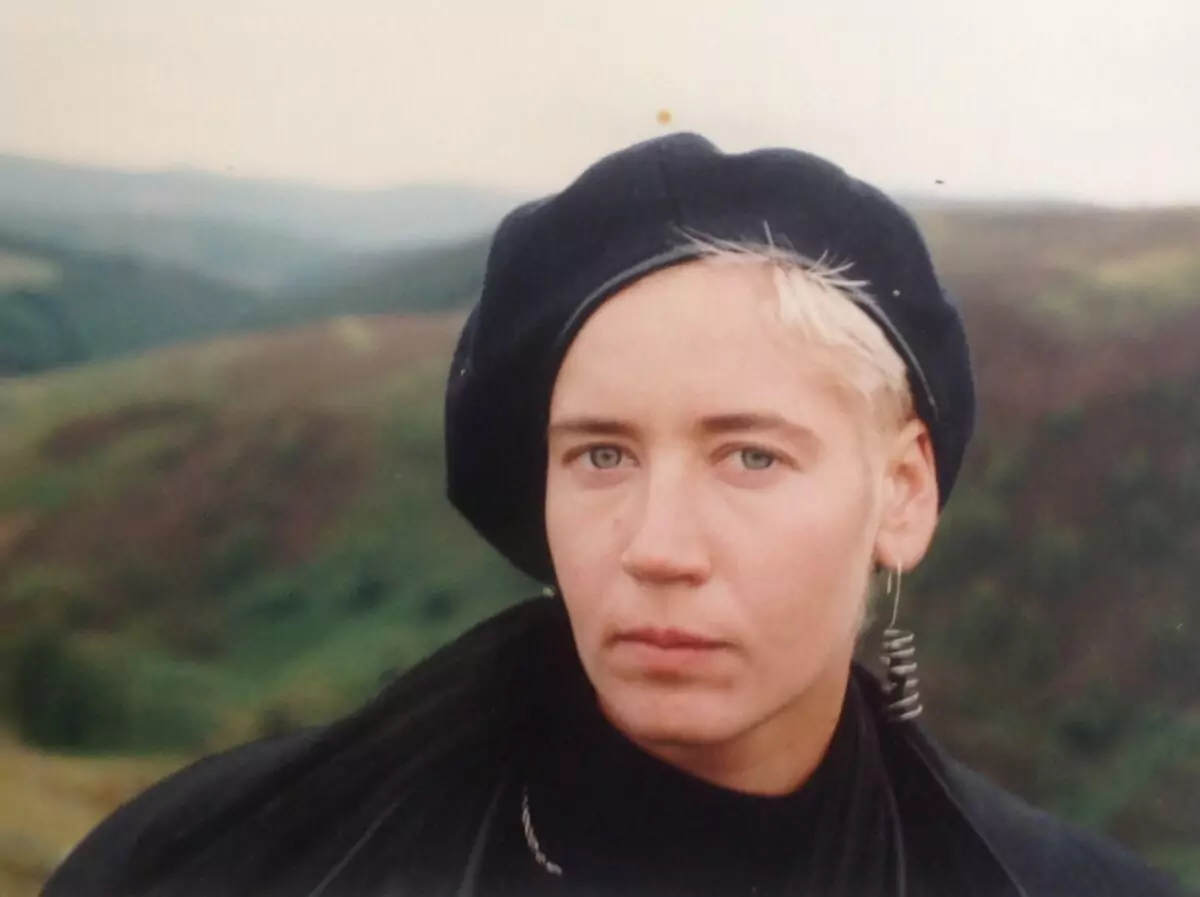
Darya Slobodyanyk and Nastya Kalyta spoke with one of the project participants — Valeria Trubina — about her work in Luhansk during the war, Ukrainian art, and memories of “Parkomuna.”
Tell us where you are now, what is happening to you, and how you feel after the events of February 24?
I came to Luhansk from the USA on October 23, 2021, because my mother was hospitalized with a heart attack. When I crossed the border, there was a strange feeling as if a huge iron curtain had fallen behind me… I felt like I was trapped… Intuitively, I felt that way. And that’s what happened when the full-scale war began in the country on February 24. Everything started on February 24, and my mother passed away on March 10. So, tragic events in the country combined with personal ones for me. How do I feel? In total isolation. Because I have only two or three friends — close people I studied with. And that’s it. Here in Luhansk, there is a huge influence of Russian propaganda. Everyone who watches TV or listens to the radio here has their brains washed. There is no freedom here at all, unfortunately. Surrealism everywhere. When I go outside, it feels like I’m in a black-and-white movie about Stirlitz… It seems like I’m surrounded by a zombieland — everyone has brainwashed minds. I have to very carefully control my speech: with whom, what, and how I speak to show my pro-Ukrainian position. I feel sorry for these people because this is a zero level of consciousness. It’s a consequence of Soviet ideology and mentality. Many people who left for Russia in 2014 have returned — everyone is drawn home, no matter how bad it is here. I talked here with a woman I have known for a long time because I buy incense from her at the market. Since 2014, we talked about how soon the Ukrainian army would come to drive away all this evil. And now she says: “I just can’t understand one thing: why can’t they brainwash me, but they brainwashed everyone else?” I answer: “Maybe you have a fairly high level of self-awareness!”
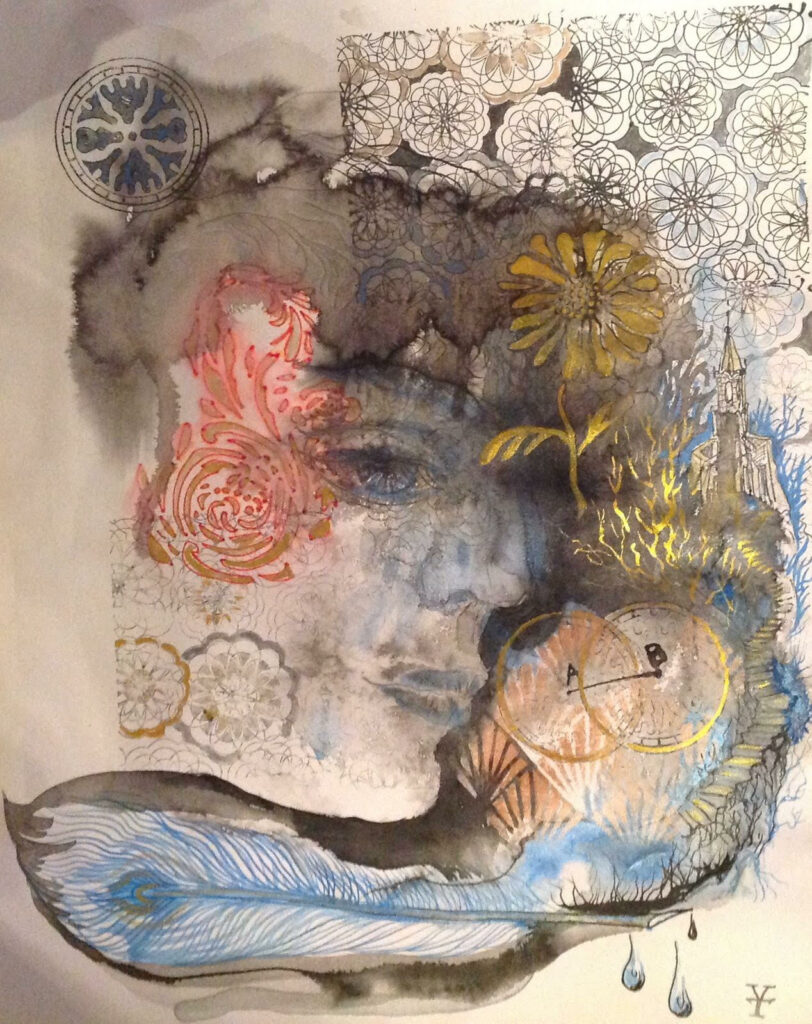
“Premonition,” February 18, 2022
The war has affected everyone; artists have started creating quite a lot of works inspired by tragic events. Tell us about your creative mood during the full-scale invasion?
It’s very personal. My personal situation was difficult: I saw that my mother wouldn’t live long… When I arrived, I wrote something, but it was more for her. Of course, it was sad. Maybe it was my premonition. There were certain dreams, signs; I felt the war. Although I really didn’t believe that the war would start. I remember saying about Putin: “He’s a bastard, but not an idiot.” And now I understand that he’s just crazy! For me, it was a shock layered on top of my mother’s passing. I was in serious depression and am only now starting to come out of it. So, I simply didn’t have time or energy for work. I watched what other artists were doing. But such topical art based on hot war themes is still not for me. I need time for awareness; you have to look at it from a distance. It’s clear there is pain. But pain has two sides: either it breeds more pain or catharsis. I still think I’m waiting for another level — that catharsis. I made several new works. I have many ideas.
How do you like working in the family home, in the studio where it all began many years ago?
I believe there is no evil without good… I rethink a lot. In my studio in Luhansk, in the family house built at the beginning of the 20th century, there is a lot of unfinished work. There are many large canvases that I cannot take out of this territory because a special permit is required, and I won’t get it since I would like to take them to the territory of Ukraine. So, I have the opportunity to review these works, every stroke. My studio in Luhansk is a special place. Something between a sanatorium and a concentration camp… I don’t know if people will understand me. On the one hand, such harsh restrictions… On the other — I am here in my bubble. I have a nice house, a wonderful garden, and around me, there is a war. I am here like in space.
Now I am more immersed in literary activity. I record my feelings, impressions of a day, events. I want to keep such diaries. Earlier, I didn’t understand when I could leave, but now I realize that I won’t leave soon. I realized I have to wait. And this is a completely different state of feeling; I have slowed down a bit and can think about it more slowly. There is no hysteria — oh, now, now! My art historian friend said: “Paint black paintings, paint red ones, you must express pain!” But I thought: well, I’ll paint, hang it online, but that would be hysteria. The viewer doesn’t have to see your kitchen, your inner self. They should see a product that gives them something. Hysteria is not very good; it’s for psychotherapists. And the viewer is not a therapist; you shouldn’t experiment on them. I respect the viewer and don’t really like aggressive art. Art must be gentle; it shouldn’t be bloody because then it starts to repel. I respect it and do not recognize art as therapy. I want it to remain pure from all coercion.
What is your attitude towards the cancellation of Russian culture?
I am generally not very interested in Russian culture. I live abroad, and my own, Ukrainian culture, is more interesting to me because my roots are here. Russia and Moscow have never attracted me. I went there, and I felt awkward because this Soviet mentality has always disgusted me. Frankly, if we talk about art, in the last 30 years, I haven’t heard a single interesting name from Russia. I watched biennales and other contemporary art fairs and found nothing meaningful or bright there. Nothing. Ukraine has many more interesting names that have emerged in the last 30 years. Not because I know them — no, rather only visually familiar since I live far away. But if you take the visual language, we have development. And they have everything very stable, commercial, and marginal. In three words.
“Lilac,” 2022
“Journey from point A to point B,” 2021
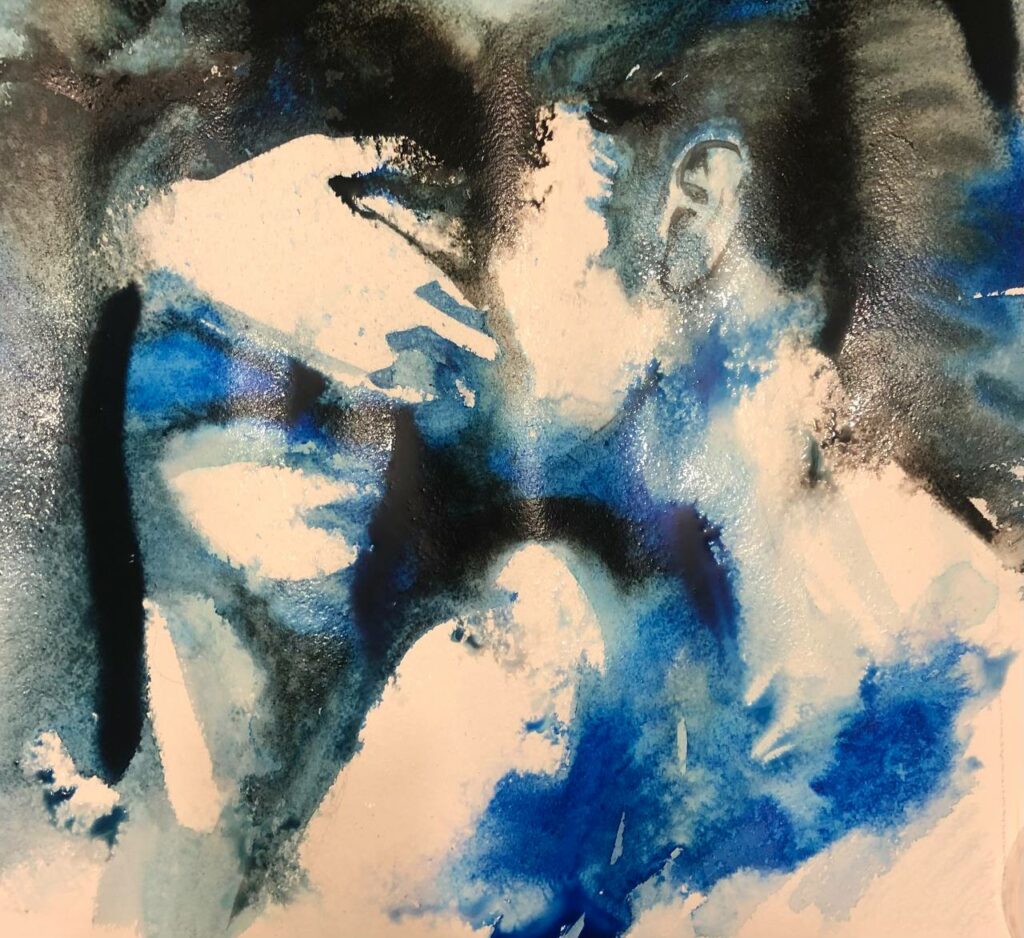
“Don’t Look,” 2022
“Lilac,” 2022What do you most often remember now from the times of the formation of “New Wave”?
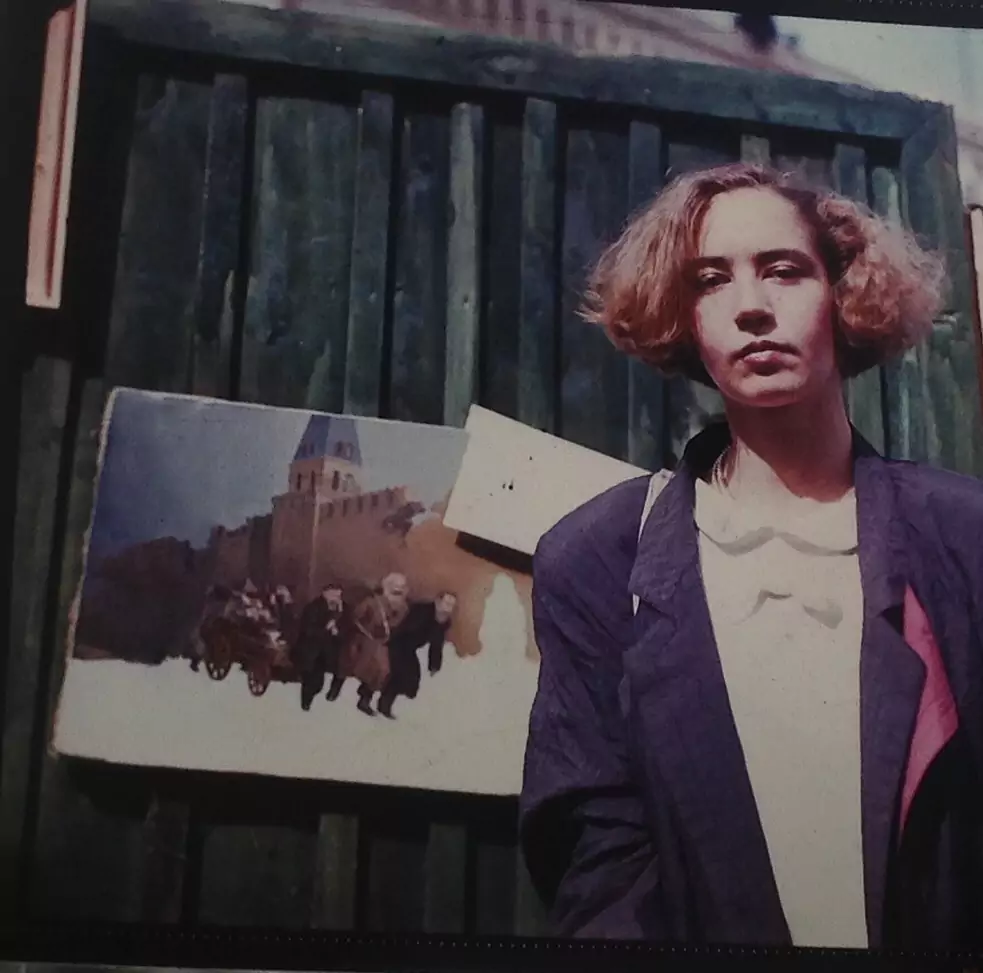
Of course, “Parkomuna.” I miss that time, the friends, because almost all of them are gone. The last straw was that Sasha Roitburd passed away. Quite unexpectedly — he himself didn’t believe it. He was such a life lover that no one expected it. It was hard. When we met, we talked only about art: about what is happening now, what is interesting, what development there is. I miss it. Sasha is gone, and I feel like I am almost the last one left from that cohort. There is Arsen (Savadov — ed.), yes, but we don’t communicate as closely as we did with Sasha or Hnylytskyi. Time passes, everything changes. How was it in “The Matrix”? Something changes but something never changes. But yes, still, something never changes. There is that core — what formed us as artists. What drove us. Now, from a distance, it is clear that it was not just like that. It was such a hope for freedom, hope that you can do something different than what you were taught. It was such a breakthrough! Now I look and still don’t understand how it was possible to do such things then? There was nothing — we were penniless! The country was bare and barefoot; we survived as best we could, I still don’t understand how.
So, to produce art, you didn’t need a budget like now?
(Laughs). No, a budget was necessary. All the money was spent only on materials; that was sacred. Alcohol and everything else came later. Buying a bolt of canvas — that was important. We attacked this artists’ union — give us canvases! If someone sold a painting, the first thing done was to go for materials. Everyone rushed, ordered a car, whoever took as much canvas as they could. A bolt of canvas is 10 canvases 3 by 2 meters. That was enough only for a month. During the 4 years of “Parkomuna,” a huge body of work was created. Besides, we saw nothing of what was happening in the world. Greenaway’s films were shown in pirate quality, but there was such a thirst for something else, though these were just drops. So even for me, this is a phenomenon. I return in thought there and think: God, how did we live! It was some kind of magic! We had a studio — walls and a roof — and nothing else was needed. We didn’t spend money on clothes — everyone went to the Sennyi market, dressed in worn-out clothes.
But you looked very bohemian, you were simply the star of “Parkomuna.”
I sewed my own clothes because I knew how to sew and loved it. I also dressed Oleg (Holosiy — ed.). Everyone altered clothes, so it looked so bohemian.
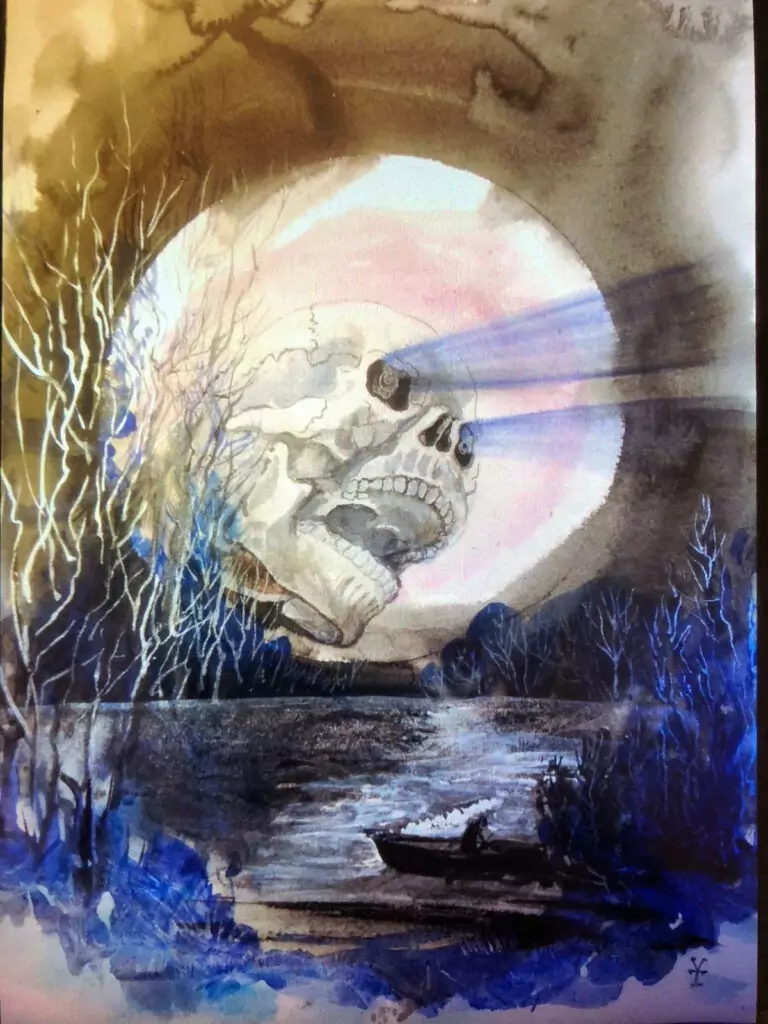
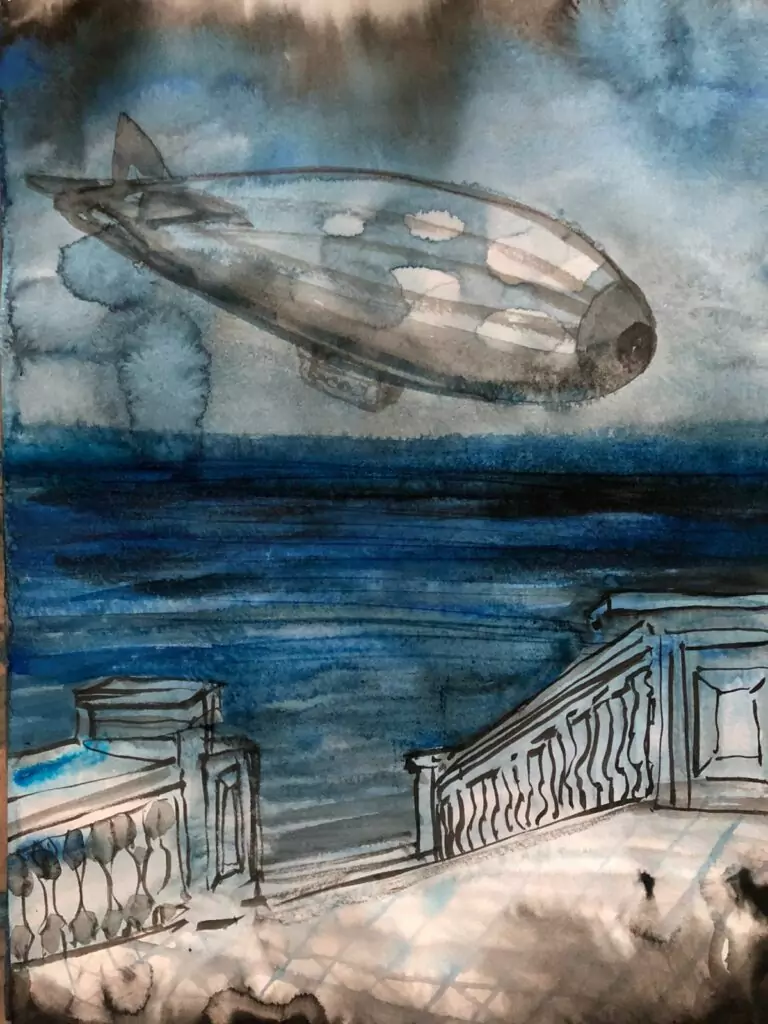
“Night Boat,” 2022
What is important for you to talk about now through art as an artist?
About the split. Between families, between people. What they did is simply impossible to comprehend. Probably, for me, it is especially felt because I am in such a “special” place. It’s very hard to talk about because I personally cannot communicate with many people who were close to me in Luhansk. And that’s the worst. You don’t want to offend a person; you value them, but when you start explaining something, you see complete misunderstanding. I really feel sorry for these people. It shows a very low level of self-awareness. These people don’t even understand what the mind is, why it was given to us at all. They senselessly watch television, not understanding one simple thing: everything that enters your mind never leaves and forms your personality. You need to have informational hygiene; you can’t allow fast food into your mind. It’s hard for me to talk about this because I mean very close people once. But we have to talk about it. Otherwise, people will turn into zombies — total, aggressive zombies.
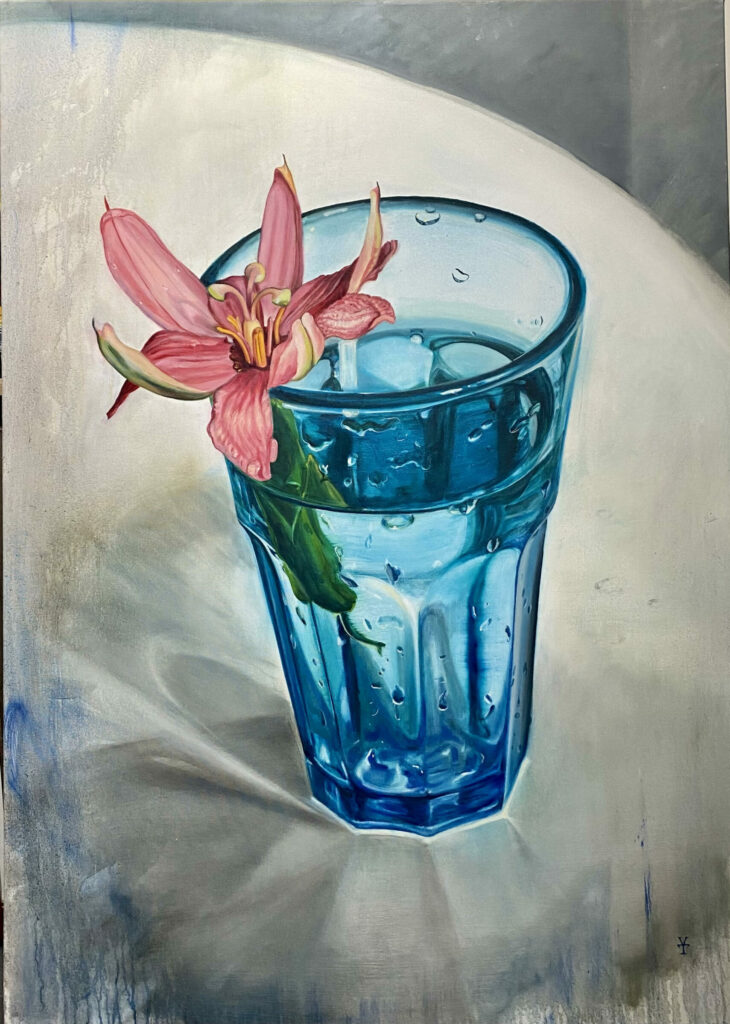
“Flower in a Blue Glass,” 2020
These days in Marbella, southern Spain, the ART FOR FREEDOM exhibition will take place, where your works will also be shown. What is the importance of presenting Ukrainian art abroad now?
From a political point of view, frankly, no one in the world knows what Ukraine is. We have always been erased, hidden. It’s generally a happiness that we escaped from that “prison of nations” with blood and sweat. And now… There is no evil without good. This war will do great good for our country because we will be able to show the whole world our “quality of soul.” Through art as well. Because we are different people than Russians — we give more, we are kind and generous, we don’t want to snatch anything from anyone. And it is important to show this. Just to show your character as it is. This must be emphasized — the kindness of the soul, not just embroidery. Regarding art, we have something to show. We have many painters — there are not so many in the world, maybe only in Italy. So for us, these are good opportunities, even in such sad circumstances. We have a powerful visual school; it deserves attention.
If you find a mistake, please highlight the text fragment and press Ctrl+Enter.
We use cookies to personalise content and ads, to provide social media features and to analyse our traffic. We also share information about your use of our site with our social media, advertising and analytics partners who may combine it with other information that you’ve provided to them or that they’ve collected from your use of their services.