From Reaction to Thought. Part 2: Underrated Projects
This text is the second in a series of articles by the Research Platform about Ukrainian art of the independence era. The list of projects included in the article is not exhaustive but sufficient to see the development and diversity of practices that took place but practically did not receive proper critical reflection and did not become an impulse for the development of thought. Starting a dialogue about the relevance of clarifying our contemporary art history, including more and more projects and phenomena, we invite other art researchers to join and continue this process.
Under normal circumstances, the culture section is one of the key ones for any reputable publication. However, given the priority of commercial stability, the development of the press and journalism in Ukraine since independence initially led to the reduction of culture departments and later to their actual disappearance. Factors such as lack of funding and an unsystematic approach had a dramatic impact on the further development trajectory of Ukrainian art criticism. In the first decades of the 21st century, lifestyle and show business sections replaced culture, and with rare exceptions, cultural journalism began to be satisfied with simple rewriting of press releases, photo reports from openings, or at best — quasi-poetic essays on exhibition topics. In fact, only a few publishers could afford to publish materials about art. However, the current situation with cultural journalism seems less hopeless compared to what happened ten years ago.
The lack of consistent industry development and continuity in state or sponsorship support for exhibition projects, as well as the absence of long-term investments or even adequate competition between institutions, led to their social incapacity and insularity. As a result, there was no full dialogue with society, sometimes not even elementary gradual accumulation and later processing of archives of Ukrainian art institutions, so many projects remained underrated or forgotten.
Marta Kuzma’s comment on the exhibition “Alchemical Capitulation” generally characterizes the situation that formed in the early 1990s: “At that time, the exhibition was a strategic concept rooted in the awareness that to exhibit works that fell outside traditional categories of aesthetics, the artist had to seek ways to cross borders and institutional codes. The exhibition explored how a pause or gap in the shift of changing power structures creates an opportunity for artists to present independent initiatives to provide public platforms for their works. In 1995, Ukraine’s art was characterized by a series of incursions aimed at creating a push for change, provoking the existing infrastructure of art institutions to recognize contemporary art as valid. It was an attempt to find a place — a home” [1].
MASTERING THE SPACE

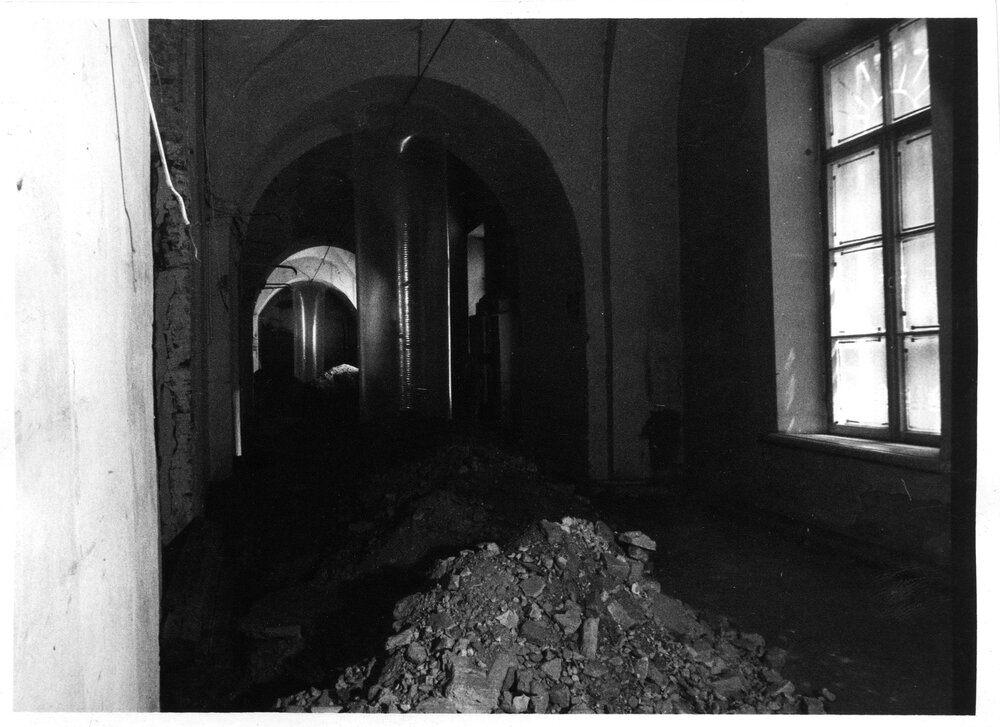
Mykola Matsenko. Untitled. 1993. Site-specific installation created for the action “Kyiv-Mohyla Academy.” Photographer: Yuriy Sklyar. Photo from Valeriy Sakharuk’s archive
The three-day artistic action “Kyiv-Mohyla Academy” took place in May 1993 in the building of the Old Academic Corps of the Kyiv-Mohyla Academy. The idea and organization were by artist Anatol Stepanenko, who invited colleagues — Mykola Matsenko, Viktor Kasyanov, Nadiya Kyrychenko, Oleg Tistol, Oleksandr Kharchenko, and Suzanna Niederer. The action continued Stepanenko’s concept outlined during the project “Kosyi Kaponir” (1992), realized in the premises of the former military-political prison. The concept involved a “subjective exploration of space” — rethinking a certain place, its historical, cultural, and social layers through artistic interventions. The “Kyiv-Mohyla Academy” action continued the practice of mastering alternative exhibition venues, becoming a work with the authentic semi-ruined space of the former 17th-century monastery territory. Semi-visible, almost ephemeral objects and installations by the project participants organically merged with the surrounding ruins. Mykola Matsenko created columns of transparent polyethylene that seemingly supported the arched vaults, and Oleksandr Kharchenko partially painted a pile of construction debris on the floor blue and placed photographs of the sky in massive passe-partouts on the walls, only emphasizing the surrounding ruin situation. Kateryna Stukalova in the magazine “Terra Incognita” noted that the exhibition participants worked “with problems more of context than of the work, playing with the dissolution of the artistic sign in the field of other signs: historical (the aura of this place), social (the principle of ‘ruins’ and ‘permanent repair’ evoked obvious associations with the surrounding reality), cultural (memories of the classical museum once located in the historic KMA building…)” [2]. The project became one of the first attempts in the history of Ukrainian contemporary art to master a complex non-gallery space and an example of successful work with it. A year after the action, at the initiative of curator Marta Kuzma, the Soros Center for Contemporary Art exhibition space opened in this Kyiv-Mohyla Academy building. It is important to note that the SCCA at NaUKMA in Kyiv became the only space among similar institutions in other countries for which funds were allocated for construction. Another exception was the opening of the second independent Soros Center for Contemporary Art in Ukraine — in Odesa.

Natzprom. From the series “Ukrainian Money,” 1995, paper, collage, stencil. From the collection of Ihor Abramovych. Exhibition “Borderline.” Photos provided by PinchukArtCentre © 2015. Photographer: Serhiy Illin
In 1995, the exhibition “Kyiv Art Meeting” took place at the Ukrainian House, which since 1993 had ceased to be Lenin’s museum and was transforming into a cultural center. The idea of repurposing a building that carried the ideological burden of a bygone regime into a place for the development of independent Ukraine’s culture seems logical and almost symbolic of the process that should be happening in the country. In reality, this meant managing to fit new practices and art into the specific modernist Soviet interior of the building so that they would not appear as involuntary hooliganism, amateurism, or a short-term action after which life inevitably returns to the usual previous state. Everyday life, habits, and matter do not change as quickly as strategies or slogans, and the newly created cultural center remained the same Soviet museum. Therefore, in representing contemporary artists from Ukraine, Poland, and Russia, curator Valeriy Sakharuk faced the additional conceptual task of not only mastering the space but understanding its role as an equal component of the exhibition alongside the artworks themselves. The exposition included works by Katarzyna Kozyra, Oleg Kulik, the Masoch Fund, and the site-specific installation “Ukrainian Money” by Oleg Tistol and Mykola Matsenko. The theme of the last work was especially timely in society, as the new national currency, the hryvnia, was introduced only in 1996. The curatorial statement focused on the contrast between old and new (aesthetics, principles of institution functioning, values), and the installation with images of banknotes emphasized the connections between culture, ideology, power, and wealth. However, the exhibition did not receive proper attention because it was closed almost an hour after opening due to a conflict with the National Guard, whose soldiers gathered for a celebration simultaneously taking place in the Ukrainian House and suddenly began destroying the exposition [3].
Curatorial exhibition by Marta Kuzma “Crimean Project II” in 1998 was a continuation of her widely known “Alchemical Capitulation,” presented in 1994 on the military ship “Slavutych” in Sevastopol. Realized during political instability and uncertainty in the context of Russian-Ukrainian disputes over the division of the Black Sea Fleet, the project referred to the transmutation ideas of alchemy and philosophy and appealed to the capitulation of political space before the space of art [4]. The location for “Crimean Project II” was chosen as the Livadia Palace — an estate primarily associated with the Yalta Conference of 1945, dedicated to establishing the post-war peace order. The territory itself prompted an intertwining of contexts such as the fact of the direct division of the world that took place within the palace walls, the historical memory of Stalin’s deportation of Crimean Tatars to Central Asian republics, the fate of servicemen on both sides of the front, and problems of contemporary artistic communication. These became the starting point for the conversation about Crimea as a region defined by agreements and treaties, external decisions that continuously influenced local identity and way of life since the peninsula’s conquest by the Russian Empire. In the curatorial text, Marta Kuzma noted that the project was more a concept than an exhibition, revealing these social relations connected with communication, history, and myth-making. Uniting in a common narrative works by Crimean Tatar artists Ismet Sheykh-Zade, Akhmet Ametov Abdula, Mamut Churlu, representatives of Kyiv and Kharkiv art circles Oleksandr Hnylytsky, Illia Chichkan, Kyrylo Protsenko, Borys Mykhailov, and Serhiy Bratkov, as well as European artists Joseph Beuys and Johan Grimonprez, “Crimean Project II” offered a view of Crimea as part of the contemporary European multicultural landscape from the perspective of shared art. The artists found themselves in an exhibition environment where the exhibition itself embodied the characteristic historical context.
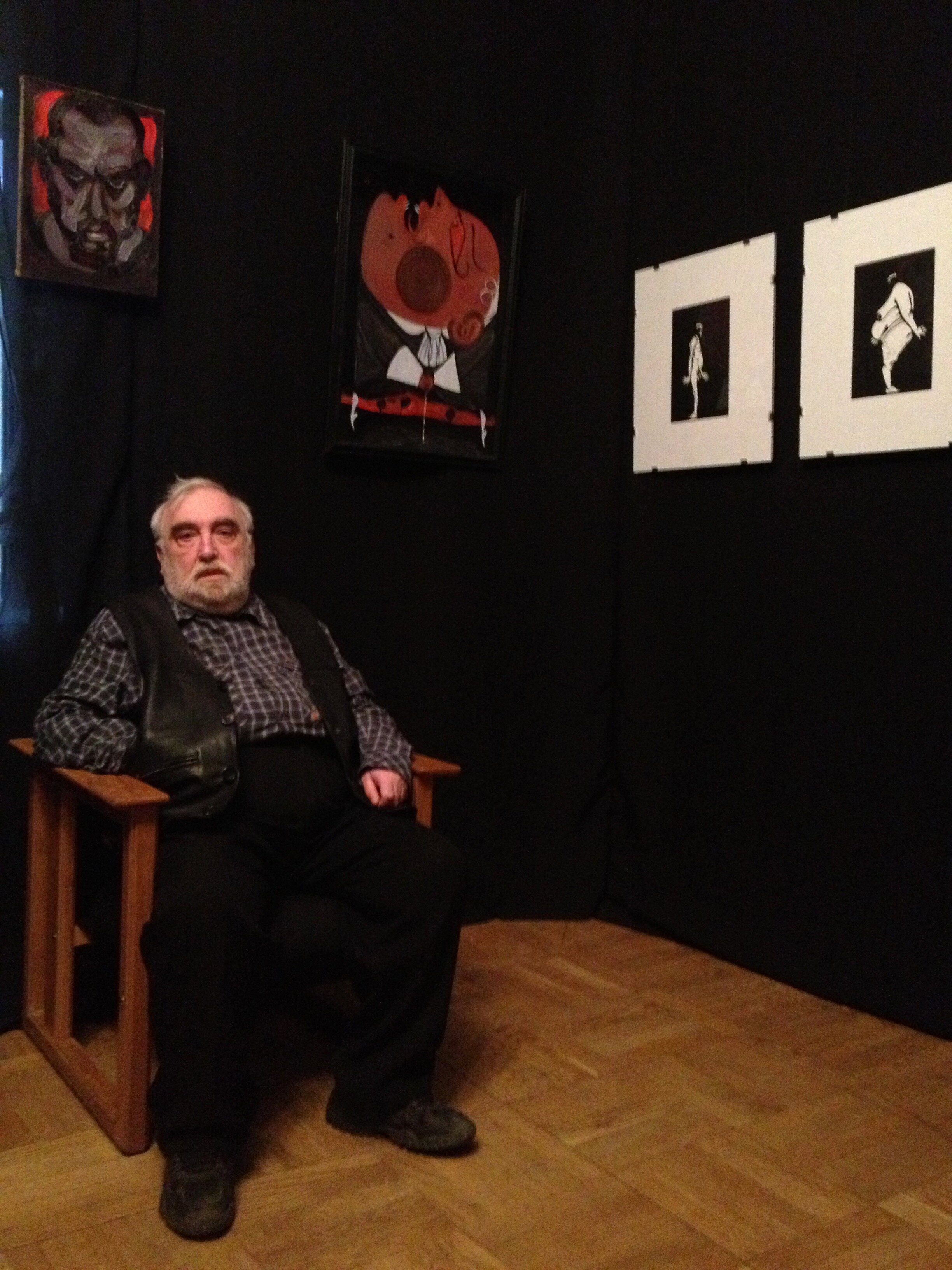
Viktor Toporov in the exhibition “OUT: Dreams Awake,” Kyiv, Taras Shevchenko National Museum, 2013. Photo (c) Kostyantyn Doroshenko
The international project “OUT,” held in Kyiv in 2010, 2011, and 2013 — was the first attempt in Ukraine to consider the topic of autism through the lens of contemporary art in a global socio-cultural context. The ambition of the initiator and organizer Oksana Hryshchenko became an antidote to the inferiority complex and prejudice regarding the helplessness of the art environment in Ukraine concerning global issues. The first exhibition (curator Tetiana Hershuni) took place in the Chocolate House, a building embodying the idea of autistic escapism — each room decorated in different styles as if the inhabitants travel through the world and time rather than being in a confined space. A fundamentally important task for the project was to provide visitors the opportunity to “experience the autistic state through interaction with art objects” [5]. Participants in the 2010 exhibition included authors from Canada, the USA, and Ukraine, including Risa Horowitz, Taras Polatayko, Anatoliy Ulyanov, Uta Kilter, Oleksiy Sai, Valeriya Trubina. In 2011, under the theme “Neurodiversity” at the Museum of Contemporary Art on Hlybochytska Street in Kyiv, American curator Koan Jeff Baiza presented works by American and Ukrainian artists, both professional and outsiders. Among them were Nina Yankovits, Marsha Smailak, Nazar Bilyk, Michael Mador, Anna Shabunina. The curator of the last exhibition of the project, “Dreams Awake,” in 2013 at the Taras Shevchenko National Museum was Russian literary critic Viktor Toporov, who chose the theme of visionary phenomena. Participants from Germany, Russia, the UK, and Ukraine included Maksym Kantor, Michael Merfenko, Pavlo Losev, Hryhoriy Yushchenko, David Chichkan. At the intersection of art and medicine, specifically mental disorders, there is always a danger of turning the project into a pitiful attraction, where sympathy for the other is rooted in confidence in one’s own wholeness, unlike the autistic, savant, or other “different.” In contrast to this distorted tolerance, “OUT” demonstrated that the brain and psyche can function differently, not only as the majority is accustomed to. To realize the breadth of the declared topic, the exhibition was supplemented by a package of interdisciplinary events: lectures, literary and publishing activities, scientific discussions, and round tables.

Exhibition 3/3. 1994. Material from open sources
REPRESENTATIONAL CRISIS
Lack of infrastructure and venues suitable for exhibitions, randomness, experiments, and thirst for novelty — the reasons for seeking unusual places for cultural events may vary, but successful integration of concept and location provides additional space for reflection and meaning. In 1993, the exhibition “3/3” (Hanna Sydorenko, Hlib Vysheslavskyi, Serhiy Yakunin) took place in the Kyiv Planetarium building. In halls used for scientific enlightenment, projections of handwritten texts from Ecclesiastes — an Old Testament book that is rather a philosophical reflection on fate, the meaning of human existence, and the incomprehensibility of life’s cycle — appeared on white walls. On the first floor, the hall’s floor was covered with sand laid in a spiral shape visible when ascending to the second floor. The conflict between rational and mystical, technological and natural, skillfully directed by curators, was left to viewers for free interpretation. The use of mystical, New Age, and esoteric motifs in constructing the exhibition atmosphere now seems somewhat naive, but at the time they were rather a bold and almost hooligan gesture in the premises of the University of Contemporary Knowledge of the “Knowledge of Ukraine” society.
Alongside the search and mastering of places for art, there was an awareness of the need to expand opportunities for its display, studying contexts and environments that would become alternatives to traditional exhibition space. In 1995, art historian and critic Oleg Sydor-Hibelinda attempted a radical transformation of the representation format in the project “Nonexistent Exhibition”, realized at the “Blank-Art” gallery in dialogue with artists Vasyl Tsagolov, Oleg Tistol, and Hlib Vysheslavskyi. Insisting that traditional forms of art historical discourse had exhausted themselves, Sydor-Hibelinda implemented the exhibition project in the form of a printed publication. The brochure consisted of three sections, or as the critic himself called them, “spaces of the nonexistent exhibition,” each dedicated to the work of a particular artist — “space of memory-imagination” of Tsagolov, “space of living conversations, ‘stream of consciousness'” of Tistol, and “space of pseudo-theatrical performance in a dark room, essentially a parody of a culturological essay” of Vysheslavskyi [6]. Interestingly, immediately after the opening, Sydor-Hibelinda himself disappeared — critic colleagues lured him to a studio on Olegivska Street, completing the concept with the absence of the author himself in the exhibition space. Such experiments with transforming the exhibition form became a natural but belated response to similar searches by global curators and artists of the late 1960s, including Seth Siegelaub’s group exhibition in the form of the book “Xerox Book” and catalogs of Lucy Lippard’s “numbers exhibitions.”
![Програма другого міжнародного бієнале «Імпреза-91». За матеріалами статті Ольги Романської [7]](https://images.squarespace-cdn.com/content/v1/5cb6e9c2d86cc95c603b4792/1586530334566-178NNG086KARAMKXMD3U/ke17ZwdGBToddI8pDm48kHFnmntegnVXpN4y4ldn3ixZw-zPPgdn4jUwVcJE1ZvWQUxwkmyExglNqGp0IvTJZUJFbgE-7XRK3dMEBRBhUpxco7Gi2cI2YfBk8ZWdc_m6Xcr86dXh8TsiE3NyioNRZj9sD37Ved1vsRvl2h0UxBw/4_Impreza_91.jpg)
Program of the second international biennale “Impreza-91.” Based on materials from Olga Romanska’s article [7]
Compared to other projects in this selection, the biennale “Impreza” received perhaps the greatest attention — in 2012, a book of memoirs about five exhibitions from 1989 to 1997 was published, and in 2014, on the 25th anniversary of the biennale, the exhibition “Once” with works by “Impreza” participants was held at the Center for Contemporary Art in Ivano-Frankivsk. This biennale, among whose initiators was writer Yuriy Andrukhovych, and whose main and constant organizers included artist Ihor Panchyshyn and director of the Museum of Arts of Prykarpattia Vasyl Romanets, on the one hand, is a positive example that even in unstable times of perestroika, it was possible to realize an international cultural project that did not necessarily seek a place with an existing audience ready to perceive contemporary art or focus only on capital locations. After the success of the first, the second biennale could boast participation of 600 artists from 48 countries. If one does not emphasize conceptual selection and artistic value questions, “Impreza” demonstrates that as long as there is desire and strength, no objective obstacles become a reason to abandon the project. At the same time, it is obvious that with only “ideology” and dedication, burnout is inevitable. As with “Impreza,” the viability of ambitious art projects in Ukraine still mostly correlates with the enthusiasm of their organizers rather than the ability to build processes, long-term partnerships, and a strong team. Projects of such scale cannot survive without patron and state support, even if all other success factors are present.
![Петро Гончар. Тополі котрих стає все менше. 1991 (диплом журі бієнале «Імпреза»). За матеріалами статті Анатолія Звіжинського [8]](https://images.squarespace-cdn.com/content/v1/5cb6e9c2d86cc95c603b4792/1586530370213-BOY1NGEWYKQFUPTHVXYW/ke17ZwdGBToddI8pDm48kB95ZKfqzIPT0hUVJ4l1JNsUqsxRUqqbr1mOJYKfIPR7LoDQ9mXPOjoJoqy81S2I8N_N4V1vUb5AoIIIbLZhVYy7Mythp_T-mtop-vrsUOmeInPi9iDjx9w8K4ZfjXt2dgTvkQiL_6pqxwniR0bYHvM_Da1lR_iDtvl-oFiuHBULJvwGh1qtNWvMhYKnvaKhbA/3_Impreza_1993_gonchar_p_topoli.jpg)
Petro Honchar. Poplars That Are Becoming Fewer. 1991 (jury diploma of the “Impreza” biennale). Based on materials from Anatoliy Zvizhynskyi’s article [8]
COLLECTIVE PRACTICES
Characteristic for Moscow in the late 1960s and Kyiv and Odesa in the late 1980s, the practice of “apartment exhibitions” found an unexpected continuation in Kharkiv in the 2010s. Against the backdrop of the institutionalization of art development, Kharkiv remained somewhat hermetic and characterized by a lack of exhibition venues. The attraction of young artists to present their artistic practices and the need to create a platform for proper exchange and dialogue led to active self-organization among members of the Kharkiv community. Participants of the SOSka group (Mykola Ridnyi, Hanna Kriventsova, Serhiy Popov) created a namesake gallery-laboratory and organized the “Class” program, which included meetings and discussions. In 2010, the group initiated “Days of Apartment Exhibitions”, held until 2013, which, according to the organizers, aimed to unite different art groups and venues through regular collaborative practices. Exhibitions and presentations took place in private residential spaces and alternative locations such as the garage gallery “At Roza’s,” founded by artist Alina Kleitman, and the aforementioned SOSka gallery-laboratory. In 2013, Lviv artists joined the project — the program included simultaneous exhibitions and video screenings, performances in public spaces, actions outside the city, and a Skype bridge between Kharkiv and Lviv. Apartment exhibitions became an act of protest by young artists against the lack of alternatives in Kharkiv galleries’ activities, which tried to experimentally create an impulse for the city’s urgent institutionalization.

Nataliya Zotykova. Domestic Capitalism. Photo installation. As part of the “Days of Apartment Exhibitions.” Communal apartment on Sumskaya Street. Kharkiv, 2013. Photo from the website www.soskagroup.com

Taras Kamennoy. Stability. Site-specific object. 2013. Lake in the village of Zelenyi Hai, Kharkiv region. As part of the “Days of Apartment Exhibitions.” Photo from the website www.soskagroup.com

SOSka gallery-laboratory. Photo from the website www.soskagroup.com
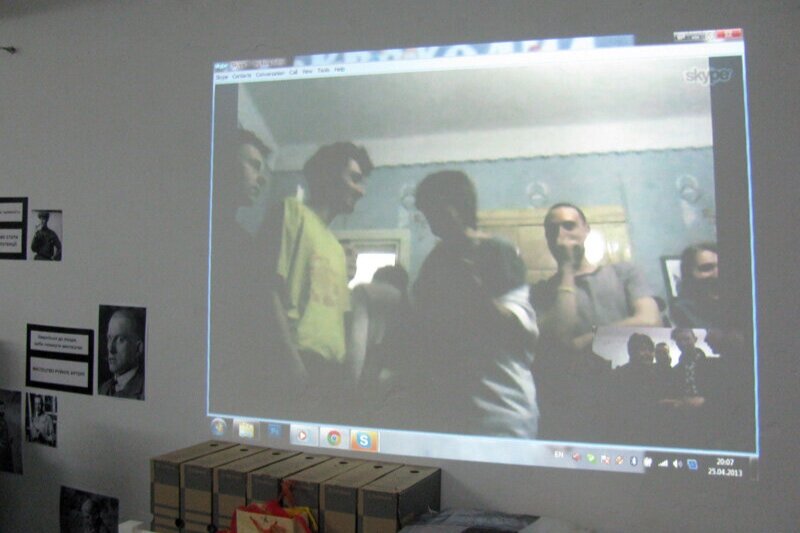
Skype tour as part of the “Days of Apartment Exhibitions” in Kharkiv and Lviv. 2013. Design studio on Artema Street. Photo from the website www.soskagroup.com
The curatorial project of the Open Group “Degree of Dependence”, presented in 2016 at the Awangarda BWA gallery in Wrocław, was an attempt to explore collective artistic practices in Ukrainian art, the specifics of forming particular environments, and various types of interactions between artists, groups, and creative centers. The exhibition covered the period from 2000 to 2016 and probably for the first time presented collaborative practices of Ukrainian artists in such volume. Reflecting on their own collaborative experience (the Open Group itself, self-organized spaces of the “Koridor” gallery in Uzhhorod and “Detenpula” in Lviv), the curators questioned the very issue of interaction, which lies at the core of group practice. A few days before the exhibition opening, posters with the question “How are we without you?” appeared in Wrocław’s urban space, and on the opening day, this inscription was scaled across the entire glass facade of the gallery space. The text at the entrance emphasized the condition of group entry — to see the exposition, individual visitors had to wait for someone to accompany them. Such an authoritarian curatorial gesture from the start encouraged viewers to forced contact, cooperation for a common goal. The exhibition was conditionally divided into four sections: research of the collective phenomenon as such; temporary, short-term interactions; systematic collective collaborations; interaction formed by the environment. Another curatorial gesture was a specially written anthem (words by Vasyl Lozynskyi, music by Anton Degtyaryov), which sounded in the exposition three times a day, interrupting and absorbing the sounds of artworks. The project is a demonstrative example of how, due to the lack of institutional capacity, artists had to become curators themselves and engage in reflecting on the history of Ukrainian contemporary art. A similar attempt at a cross-section should have taken place in Ukraine but became possible where appropriate institutional and financial conditions were created. Attempts to comprehend collective creativity existed in contemporary Ukrainian art earlier, notably in the practice of the R.E.P. group. Particular attention deserves their “Community Project,” held in 2007 at the CSM gallery at NaUKMA in Kyiv and later presented at the “Arsenal” gallery in Białystok. Although it should be noted that R.E.P.’s work did not claim the comprehensiveness characteristic of the “Degree of Dependence” exhibition.

Exhibition “Degree of Dependence. Collective Practices of Young Ukrainian Artists 2000-2016.” BWA Awangarda Gallery, Wrocław. 2016. Curators: Open Group (Yuriy Bilei, Anton Varga, Pavlo Kovach, Stanislav Turina). Provided by Open Group
DISTANCE
Unlike projects that received minimal media response and which over time become almost impossible to reconstruct during research, attention and hype around exhibitions that may initially seem excessive or unfair is a normal and natural situation. If an event received feedback, it at least means there is a multitude of statements and viewpoints to discuss after some time when emotions subside.
However, a cognitive illusion may arise here, which consists in the scandal around the exhibition, and thus nominally a large number of publications, giving curators and participants satisfaction in advance. For example, one can recall stories around projects such as “Apocalypse and Renaissance” (2012, curators Kostyantyn Doroshenko, Anastasiia Shavlokhova, Oleg Kulik, Chocolate House) and “Ukrainian Body” (2012, curators Oksana Bryukhovetska, Serhiy Klymko, Lesya Kulchynska, CEC). Discussions directly about censorship and scandals in these cases pushed the exhibition itself out of focus — the artworks, concept, and exposition remained largely ignored. However, unlike projects of the 90s, in these situations we have catalogs and/or photo documentation of the projects.

Leonid Voitsekhov. By the way. 1983/2015 (reproduction of the 1983 performance). Exhibition “Borderline.” Photos provided by PinchukArtCentre © 2015. Photographer: Serhiy Illin
Understanding art and recording its history becomes possible when there is temporal distance. It allows a detached research perspective, free from the immediate influence of journalism, memoirs, and personal impressions. Then what seemed outstanding and important may turn out banal, secondary, or truly exceptional. The question is only whether information about the art has been preserved and whether it was at least somewhat reflected upon at the time. Around works considered iconic for contemporary Ukrainian art, certain generally accepted myths and narratives have formed — axioms that usually do not invite reconsideration or lead the viewer out of comfortable automatic perception. Regular analysis and retrospection — a sign of maturity and adequacy of the art environment — requires the ability to step away from the personal and generally accepted and be guided by a critical approach and logic. The 2015 project “Borderline” is an example of revising Ukrainian art from the 1980s to 2004 and an attempt to abandon “formal division into schools and the use of established definitions such as, for example, ‘New Wave,’ ‘Kharkiv School of Photography,’ and ‘Odesa Conceptualism'” [9]. Conceptually, the exhibition focused on the moment of society and country’s transition to a new order. Perestroika means not only renewal and positive changes but also chaos and deep destructive processes that found specific reflection in the art of that period. However, the exhibition is primarily remembered for conflicts that erupted, some of which remain unresolved in the art community.
Myths, circulation of the same interpretations and opinions, lack of criticism and alternative views create a cozy crony environment that, however, does not promote development, discussions, and diversity of viewpoints. Post-Soviet artists are mostly not inclined to accept critical analysis, expecting art historians to rewrite their own thoughts and statements about projects and practices. In the case of “Borderline,” the proposed concept was rather externally ignored by the art community, and disputes were conducted behind the scenes.
The problems faced by curators of all the above-mentioned projects have not disappeared, and the experience gained has not always been taken into account and developed. One of the recurring challenges — working with space and understanding it as a conceptual component of the exhibition, despite perfect solutions implemented, remains mostly peripheral, solved formally and primitively. Even in territories where successful approaches were implemented. For example, last year’s exhibition of Borys Lurie in the Chocolate House (curator Yuliya Kisina) took place without any interaction with the unique space — organizers blocked it with movable structures that hid historical interiors and ornaments, not very successfully recreating the neutral “white cube” environment. This loses the meaning of a specific special location.
Lack of funding, long-term investments, and the need to start anew each time remain our realities — ambitious festivals and biennales in Ukraine appear and disappear with the enthusiasm of their organizers, the life cycle of new ambitious spaces like “Set” in Kyiv is cut short at the landlord’s whim despite contracts, as until recently it was more profitable to rent premises to commercial entities. In the crisis caused by COVID-19, the culture budget was the first thing the authorities proposed to cut. However, this crisis reveals the fact that the economy cannot be the sole guarantor of a healthy society, and the reputational losses of a state unable to speak the language of contemporary culture only grow in the eyes of the global community.
[1] Kuzma M. Text for the exhibition “Crimean Project II” / Marta Kuzma // Livadia. — 1998
[2] Stukalova K. Kyiv-Mohyla Academy / Kateryna Stukalova. // Terra Incognita. — 1994. — No. 1-2
[3] Botanova K. Running in Circles [Electronic resource] / Kateryna Botanova // Korydor. — 2013. — Access mode: http://old.korydor.in.ua/texts/1336-bih-po-kolu.
[4] Furdiak O. Marta Kuzma “Personal Gesture as a Way of Limitation” / Oleksa Furdiak. // EXCESsus. – 1998. — pp. 27–28
[5] Documentation of the international project “OUT” — Kyiv: Oranta, 2010. — 76 p.
[7] Romanska O. Exhibition for the 30th anniversary of the “Impreza” biennale opened in Frankivsk [Electronic resource] / Olga Romanska // Reporter. — 2019. — Access mode: http://report.if.ua/kultura/u-frankivsku-vidkryly-vystavku-do-30-richchya-biyenale-impreza-foto/
[8] Zvizhynskyi A. IMPREZA. MEMORIES AND REFLECTIONS [Electronic resource] / Anatoliy Zvizhynskyi // http://csm.if.ua/. — 2013. — Access mode: http://csm.if.ua/impreza-spogady-i-refleksiyi/?fbclid=IwAR3ryIdSQbXE00AUqt7yAyTCp73Kc0p5rPD-mJd9GIGNTDqG2yCw7p9cV0o
[9] “On the Edge. Ukrainian Art 1985-2004” — group exhibition of Ukrainian artists [Electronic resource]. — 2015. — Access mode: http://pinchukartcentre.org/en/exhibitions/28812.
Prepared based on materials from the PinchukArtCentre Research Platform
Daria Shevtsova and Iryna Tofan
Comment type: Publications of the Research Platform
Author: Daria Shevtsova, Iryna Tofan
Sources: Shevtsova D. From Reaction to Thought. Part 2: Underrated Projects [Electronic resource] / D. Shevtsova, I. Tofan // Your Art. – 2020. – Access mode: https://supportyourart.com/researchplatform/from-reaction-to-thought-part-2.