From Reaction to Thought. Part 1: Reactive Works of the Independence Era
With this text, the Research Platform team of PinchukArtCentre begins a series of three articles about Ukrainian art of the independence era. Using the example of the most notorious artworks, iconic and underrated curatorial projects, as well as the progress of cultural critical journalism and publicism, we will examine the transformation of the Ukrainian artistic paradigm from the reactive method of creating art to idea-creation as an urgent demand of the country’s recent history.
TWO METHODS
The 20th century is distinguished by a special perception of reality as a constant struggle between self and other, good and evil, the desire to create something new, the construction of conditional borders and attempts to overcome them — existence within the paradigm of permanent confrontation. Throughout the century, art developed several templates by which it existed. These same templates, with certain formal but not essential changes, migrated into the art of independent Ukraine and continued to reproduce old methods and approaches in understanding the present.
Analyzing the Ukrainian intellectual progress through the prism of postcolonial theory, we note that the Soviet authorities controlled the formation of philosophical-intellectual circles in Ukraine for decades and generally “extinguished” noticeable manifestations of idea-creation in Ukrainian science and culture. As befits a province, instead of decisions being made locally, Ukrainian art was not supposed to produce thoughts, as it played a secondary role compared to the artistic processes of the metropolis, i.e., Moscow. Even the powerful socio-political upheavals of the 1990s and 2000s, such as the collapse of the USSR, the Granite Revolution, miners’ strikes, and the Orange Revolution, did not significantly change the development of artistic-intellectual thought, generally relying on past patterns where an illustrative approach prevailed, and praising or denying remained the main forms of reaction to events.
The text discusses art from the early 1990s to today, during which a diversity of media in Ukrainian art has formed. Analyzing the artistic practice of this period, two main lines can be clearly distinguished, which have a fairly stable trajectory of development until the mid-2010s.
The first is based on formalist approaches and interpretations of artistic practice. This group includes the Kyiv art group “Pictorial Reserve” and its related circle of artists, the Kharkiv group “Liter A”, the circle of artists of the Odesa art association “Mamai”, Volodymyr Budnikov, and others. On one hand, these artists continue the line of avant-garde art in aesthetics, focused on formal tasks and abstract studies. On the other hand, ideologically, they expand the practice of the formalists of the 1960s. Experimenting with painting methodology, analyzing material, brushstroke, colors, this type of artistic practice remained in the field of intuitive and personal searches, which did not aim to react to the surrounding reality. The artists rather existed in a hermetic artistic and intellectual field.
The second block of artistic practices discussed in the text, which we distinguish as a certain tendency, was associated with media new to late Soviet artists, such as video, installation, performance, action, happening, etc., through which artists reacted to the surrounding reality, trying in the most radical way to depart from the imposed Soviet norms and rules. This group partially includes authors from the Kyiv Paris Commune circle, Lviv artists such as Vlodko Kaufman and Petro Starukh, the Kharkiv Rapid Response Group, Odesa artists Anatoliy Hankevych, Myroslav Kulchytsky, Vadym Chekorsky, and others — generally all those who practiced video art and adopted the performative tradition. Their practice had as its main intention reacting to new political circumstances and social processes by changing the medium, themes, and aesthetics. Art historian Bohdan Shumilovych notes the difference in perceiving tradition and the specificity of protest against it. Remarks about Lviv artists are characteristic of Ukrainian art at the turn of the 1980s-1990s in general: “They [the artists] did not have an excessive desire to shake established schools or stereotypes of Soviet Ukrainian art by means of contemporary art. Performances or neo-Dada aesthetics were rather used as means for personal liberation” [1].
Rapid and dizzying changes in society demanded from artists primarily a quick reaction, not analysis; they called for production, not reflection. As a result, art appeared that was quite literal in artistic method with a share of shock, provocation, and transgression. Based on already formed socio-political situations and templates, such art usually did not offer its own concepts, did not ask questions, but radically worked with existing ideological paradigms and reacted to them with new methods — ironically, deconstructing, desacralizing reality. This led to reflecting the flaws and difficulties of the time — as if in a distorted mirror.
The term “reaction” is used here in a broad sense, meaning the intention and form of the artistic method, not only reactivity as a method of actionism or happening. If we start from the general concept of “reaction,” which means an action/movement/opposition arising in response to another action or event, basic principles can be distinguished: secondary relation to the situation, as well as a form of operational confrontation. These can be various media, from traditional painting to ephemeral participatory actions, but usually they have similar techniques at their core, including shock, provocation, and others.
The principle of the Soviet narrative, based on social myth-making, the production of clear rules and templates, as opposition between good and evil, combining incompatible traits of ideology and entertainment, providing answers to questions rather than provoking them, turned out to be so total and absorbed at all possible levels of perception that artistic practice inevitably built itself through appeal to the Soviet. Subconsciously or not, criticism of the Soviet picture by artists reproduced the principles by which this Soviet picture was constructed. What is the shock of the 1990s if not the reverse side of Soviet pathos?
REACTION IN UKRAINIAN ART
The change in the structure of art functioning with the collapse of the Soviet Union leads to a transformation of artistic practice, not the ideas and intentions of art, which prolongs the “Soviet methodology.” The monumental, spectacular, and pathos-saturated Soviet painting or monument, with the collapse of the ideological framework, transforms into no less spectacular shocking and provocative projects. Irony, cynicism, sarcasm, absurdity, which artists used as the most effective means of influence in the 1990s, now look like a reverse of Soviet megalomania. The overarching goal of all these projects is to achieve the effect of maximum shock to the viewer through shocking, absurdizing reality, carnivalization, hyperbole, burlesque, and the word “steb” became common in culture then.

Ilya Chichkan. Mutated Embryos in Portholes. Installation. 1994. Illustration from the catalog of the exhibition “Alchemical Capitulation”
If the Soviet system constructed the structure of moral dogmas with a clear understanding of the categories of good/bad, right/wrong, then the 1990s became a time of absence of any moral norms and a mandatory undermining of previous ones. Indicative in this regard is the work Ilya Chichkan “Sleeping Princes of Ukraine” from 1994. The author created it for the now cult exhibition project “Alchemical Capitulation,” which took place on the ship “Slavutych” in Sevastopol under the curatorship of Marta Kuzma. In this installation, the artist used human embryos with mutations borrowed from the Museum of the History of Medicine and installed them in the portholes of a military ship. With this gesture, the artist reacted to the image of the military ship as an embodiment of power, death, destruction. This project is indicative of 1990s art. It reveals mutation processes in post-Chernobyl and post-catastrophic Ukrainian society, which primarily became an embodiment of the era of transgressiveness, as well as a search for new landmarks and the erasure of moral and rule boundaries in Ukrainian art.

Mazokha Foundation (Ihor Dyurych, Ihor Podolchak). The Last Jewish Pogrom. 1995. Documentation of the action at Marat Gelman Gallery, Moscow. Provided by the author
This same system of undermining moral norms and initiating conversations about taboo topics in society is continued by the project of the Lviv group Mazokha Foundation “The Last Jewish Pogrom“ from 1995. It took place at Gelman Gallery in Moscow in 1995. The action did not allow for a passive viewer, forcing everyone to become an active participant and choose a role: “pogromist” or “victim.” Three granite tombstones were installed at the exhibition: without inscriptions, with a list of victims’ names, and with a swastika drawn on the names. Each participant was given a memo regarding their chosen role with a list of rules that had to be strictly followed. According to these leaflets, “victims” were not allowed to leave the action space, use the toilet without the permission of the “pogromists,” and had to obey the latter. “Pogromists” could move freely and behave outside accepted ethical conventions.
Alain Badiou in his book “Century” writes that “[The 20th century] was extremely effective in trying to think […] the connection between real violence and visibility, face and mask, nudity and masquerade. We encounter this search in very different registers — from political theory to artistic practice” [2]. Mazokha Foundation blurs the boundaries between art and reality and, using the method of provocation, raises questions of choice and responsibility for it.

Mazokha Foundation (Ihor Dyurych, Ihor Podolchak). The Last Jewish Pogrom. 1995. Objects from the action. Marat Gelman Gallery, Moscow. Provided by the author
Boris Mikhailov best showed the portrait of Soviet society and the collapse of the Soviet body into cultural, realistic, and semiotic layers in his photo project “Disease History“ 1997—1998. The homeless people photographed by the artist expose their bodies, which began literally to decompose due to neglect and street life. This is a generalized portrait of a certain layer of Soviet society that did not survive the collapse of the superpower and descended from the average homo soveticus to a marginal state. Using the strategy of shocking, the artist puts the viewer in an uncomfortable position of viewing unpleasant shots, which are nothing but a collective portrait of post-Soviet society. There is no criticism in the project, rather a visualization of oneself as part of a large collective body seeking itself in a new coordinate system, despite not understanding what this system generally is.

Boris Mikhailov. From the series Disease History. 1997—1998. Photo by Maksym Bilousov. Provided by PinchukArtCentre
No less provocative in the history of independent Ukrainian art was the photo series by Arsen Savadov and Oleksandr Kharchenko “Donbas-Chocolate“ from 1997. Dressing real Donetsk miners in ballet tutus and theatricalizing the mystery of the underground world, Savadov and Kharchenko highlight several fundamental historical and social problems of Ukrainian society at the turn of the 20th-21st centuries: invisible and devalued labor of miners, miners’ protests and the country’s economic collapse in the 1990s, gender segregation, and closed professional communities. All this becomes a semiotic overlay of the ballet tutu as a screen for political collapse after the events of the GKChP coup on the Soviet system’s ideologized 1920s image of the miner and the heroization of his labor. The literal combination of imperial myths, cultural clichés about great ballet, and the greatness of human labor creates a pornographic impression. The artists’ reaction to the current context is not only criticism but also an artistic flirtation with the socio-political status of miners in the late 1990s.
As part of the Deep Insider project, alongside “Fashion at the Cemetery,” the “Donbas-Chocolate” series still clearly proclaims the mutating state and fusion of symbolic systems of the Soviet and independence eras, rather than their recoding for the purpose of rethinking and analyzing political and social situations.

Arsen Savadov, Oleksandr Kharchenko. Donbas—Chocolate. 1997. From the Deep Insider project. Provided by the author
Social collapses occur in Ukraine with frightening regularity, each time affecting different social layers and generations. The Orange Revolution, on the wave of social activity, revealed a new artistic paradigm of socially critical art in the person of the R.E.P. group and a circle of artists, writers, journalists, and cultural scholars of the curatorial association Hudrada. A striking change in collective consciousness matured already in the early 2000s. This transitional period of “Euro-renovation” thinking of the post-Soviet society, the desire not to change but to decorate and embellish uncomfortable reality, was aptly noticed and embodied in the “Euro-renovation” project by the R.E.P. group in 2010. Those who emerged on the Ukrainian art scene precisely on the wave of the revolutionary events of 2004 became the first socially critical generation in the history of Ukrainian art of the independence era. And although they are often opposed to their predecessors, their practice is also built on the principle of reaction, despite the fact that the tools and methods, as well as the authors’ focus, shift from scandalization, grotesqueness, and carnivalization of reality to a metaphorical and research plane. As researcher Anastasia Ryabchuk rightly notes, “Euro-renovation” as a phenomenon in Ukrainian post-Soviet everyday life not only voiced the Euro-integration aspirations of post-Soviet citizens but also offered an attractive facade for unattractive social transformations, such as growing social inequality and the emergence of a new class that supposedly “created itself,” but in reality was a product of the Soviet nomenclature and lawless chaotic 1990s [3]. The substitution by Ukrainian society in the 2000s of the ideas of European freedoms and the rule of law with decorative “Europeanness” in forms typical of kitschy post-Soviet taste lasted until the mid-2010s.

R.E.P. (Revolutionary Experimental Space). Euro-renovation. Cross-section, 2012. Photos provided by PinchukArtCentre © 2012. Photographer: Serhiy Illin
In 2013, tragic events occurred in Ukrainian history, and fundamental changes in collective consciousness are considered the cause of a principled transformation of Ukrainian public thinking and interpretation of reality — the Revolution of Dignity, the annexation of Crimea, and the unleashing of war in eastern Ukraine by the Russian Federation under the guise of LPR and DPR formations. The events of one winter in 2013–2014 accumulated volunteer potential and activist self-awareness of society, while the Ukrainian artistic community, including representatives of right and left political views, became direct participants in the events on Maidan. Their art, regardless of ideological position, was defined as reactive by the circumstances themselves. Activist posters, political graphics, street art — the product of the collective author of Maidan, as artist Mykola Ridnyi aptly called this phenomenon [4]. However, the artwork that united reactive and reflective methods is considered the project by Vlada Ralko “Kyiv Diary“ 2013–2016. Choosing the diary note type as the narration format and watercolor graphics as the medium, Vlada Ralko created, in our opinion, one of the most powerful artworks about the Revolution of Dignity and the events of winter 2013–2014. Instantly capturing individual and collective states, “Kyiv Diary” became simultaneously documentation and reflection by the author of social processes occurring in Ukraine and transforming society. Relying on the personality of experience, which the diary format presupposes, Ralko connected historical events with the human body in its symbolic and physical plane. After all, the body for Ukrainian society of the independence era suddenly became one that not only proclaims and manifests something but literally dies for its freedoms. The artist, in the flow of real revolutionary and combat actions, inscribed the human into the canvas of current history and generalized the local Ukrainian experience to universal categories of experiencing collective traumas and shocks. The emphasis on the individual bodily, which without opposition includes the animal and spiritual, among other things, is a refuge for the internal transformations of the entire Ukrainian society that continue today.
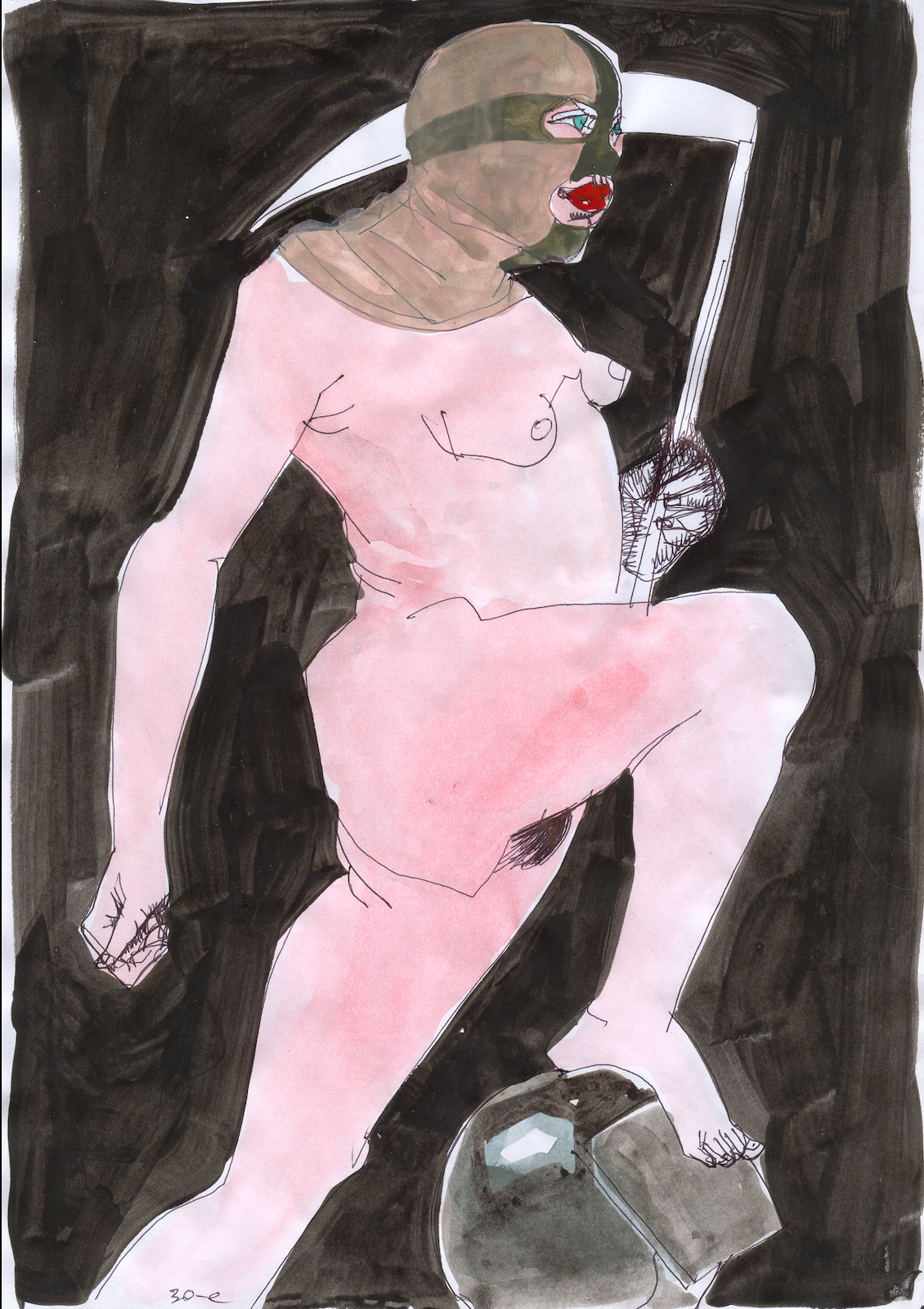
Vlada Ralko. From the Kyiv Diary project. 2013–2016. Paper, watercolor. Provided by the author

Vlada Ralko. From the Kyiv Diary project. 2013–2016. Paper, watercolor. Provided by the author
ANALYZING IS NOT RELEVANT, SHOCKING IS
German theologian and researcher Johannes Schwalina writes that “society needs to preserve and interpret collective memory to understand the present and imagine the future, and the past must transform and become material for a new reality” [5]. Rereading history, analyzing one’s victories and defeats, recognizing guilt, and rethinking the place of individuality in collective consciousness is based on a clear understanding of the past and preserving memory of it. However, the methods by which we comprehend reality, our intellectual-analytical apparatus, naturally change over time, with generational changes and new civilizational challenges.
The 2019 reenactment “Voices of Love” by Arsen Savadov gained scandal and publicity even before implementation. Not becoming Ukraine’s representation at the Venice Biennale, this year it was exhibited at the M17 space. The viewer almost physically feels in it the monumental pressure of the traditions of 1990s art, which shocked, traumatized, and did not leave indifferent. The layering of messages in the new “Voices of Love,” the dynamism of the depicted and expansive installation, along with simultaneous grotesqueness and sentimentality, literally disorients.
The techniques and methods that were organic at the time of the USSR’s collapse and subtly demonstrated confusion, disorientation, mutation of society, the fall of norms and boundaries, and formally contained criticism of the time — are repeated in the 2019 “Voices of Love,” turning the work into an echo of the past. As art critic Anna Kaluger notes in her exhibition review: “Despite its self-proclaimed innovation, “Voices of Love” […] was a retrospective work with a quite recognizable “Savadov style”: militarization of the female image, carnivalization of war as such, and the technique of “ironic sociology,” mixing pop art with current Ukrainian political history” [6]. Not feeling the nerve of the time, the project now resembles a Soviet grand painting created within the political agenda “Army. Language. Faith” [7].

Arsen Savadov. Voices of Love, 2019. Fragment of installation and video. Provided by the author and Center for Contemporary Art M17
In his 1924 work “Revolution and Art,” Anatoly Lunacharsky wrote: “…agitation differs from propaganda in that it primarily excites the feelings of listeners and viewers and directly influences their will” [8]. The ideologist of proletarian culture attributed art precisely to agitation. Considering the history of the 20th century, it becomes clear that even after 80 years, methods of quasi-synesthetic influence on the viewer and society still exist. This is explained by the fact that at the early stage of breaking away from and exiting the established paradigm of Soviet culture, radicalism of gesture in art, uncompromising methods of influencing the viewer, and transgressiveness of themes — i.e., agitation of actions — were demanded and necessary. Changing and democratizing, Ukrainian society moves toward analysis, thought, and vision, unlike, say, Russian society, where radicalism of actionism is a demanded cry in the monotony of conformist regime culture.
The transformation of the current artistic process from reaction to thought, ongoing for 30 years of independence, was most sharply and noticeably manifested in the conflict around the competition for the Ukrainian pavilion at the 2019 Venice Biennale and became indicative of the change in the thinking paradigm. The opponent to Arsen Savadov’s “Voices of Love” was the project “Falling Shadow of ‘Mriya’ on the Gardens of Giardini” by Open Group, proposed by the artists as an idea and implemented by them as an idea. Form was less of a priority for the authors than the concept. The selection situation became conflictual also because individual positions of participants in the Ukrainian art scene were sometimes built on speculating problems of confrontation between artistic elites, generations, or generally on an alleged misunderstanding of the mechanics of implementing interstate cultural representation.

Open Group. Falling Shadow of “Mriya” on the Gardens of Giardini, 2019. Video screenshot, part of the project. Provided by Open Group
The process of transition from the Soviet model to independent state-building and new forms of socio-economic relations has been ongoing for almost 30 years. During this time, the method of irritating the viewer to provoke a reaction gradually changes to a method of analysis and comprehension. This also explains one of the reasons for the current rejection by a significant part of the artistic community of the methods of 1990s art, which existed and influenced earlier but are losing their relevance today. Whether we now have to talk about a generational change or rather state the beginning of a change in the specifics of Ukrainian self-identification and, with it, self-representation — remains an open question.
With the development of the internet and social networks, the oversaturation of the system with diverse content catering to the wildest user demands, when the flow of history is generally written not by facts but by precedents of info-events, and the ephemerality of truth has become not a poetic image but a reality — true shock now takes the form of virtual dissidence. Especially under conditions of total isolation, when virtuality becomes almost the only means of communication and social activity, the challenge is the attempt to break free from dependence on information flows and the illusion of virtual presence. For the opinion has formed that Ukrainian society is now transforming and re-educating stress from a permanent thirty-year crisis and the pain of war. But perhaps it is now being transformed by the arbitrariness of virtual activity and the illusion of social influence.
[1] Shumilovych, Bohdan. 1993 in Lviv: Transgressions and Aesthetic Rituals of Transition / Zbruc, 23.05.2019. — Access mode: https://zbruc.eu/node/80025
[2] Badiou A. Century / Alain Badiou; trans. from French A. Repa. — Lviv: Kalvaria Publishing House; Kyiv: Nika-Center, 2014. — 304 p. — p. 71
[3] Anastasia Ryabchuk. Euro-renovation of the Soviet Soul // R.E.P. Revolutionary Experimental Space. — The Green Box. 2015. — p. 200
[4] Ridnyi, Mykola. Maidan: Between Art and Life / Art Magazine, 27.01.2014. — Access mode: http://moscowartmagazine.com/issue/5/article/24
[5] Schwalina Johannes. Silence Speaks. The Present Remains, Only Time Passes. Strengthening Peace by Comprehending the Past / Trans. from German Olga Plevako. — Kyiv: Dukh i Litera, 2016. — p.5
[6] Kaluger, Anna. Some Thoughts on “Voices of Love” by Arsen Savadov // YourArt, 2020. — Access mode: https://supportyourart.com/columns/golosy-lubovi
[7] Note: “Army. Language. Faith” — political slogan of the 5th President of Ukraine Petro Poroshenko. Became popular during the 2019 presidential elections in Ukraine.
[8] Lunacharsky, Anatoly. Revolution and Art. — In the book: Lunacharsky A. V. Art and Revolution. Moscow, 1924. — p.74
Prepared based on materials from the Research Platform of PinchukArtCentre
Halyna Hleba and Tetiana Zhmurko
Comment type: Publications of the Research Platform
Author: Halyna Hleba, Tetiana Zhmurko
Sources: Hleba H. From Reaction to Thought. Part 1: Reactive Works of the Independence Era [Electronic resource] / H. Hleba, T. Zhmurko // Your Art. – 2020. – Access mode: https://supportyourart.com/researchplatform/from-reaction-to-thought-part-1.