The term “children’s discourse” appeared in domestic art criticism in the 1990s, mainly used to denote children’s themes in the works of Kyiv and Odesa artists. In contrast to Moscow conceptualism (whose dictionary includes the concept of “Collective discourse of childhood”), Ukrainian art critics Kostyantyn Akynsha and Oleksandr Solovyov considered the “childish” rather as an attempt by artists to “escape from reality rather than a ground for intellectual play. The childish is something impossible to grasp, describe, analyze, because it does not conform to adult logic” [1]. Infantile plots, any plots with quotes from animated films, children’s books, with playful depictions of animals, were included in the children’s discourse.
Alongside the sweet and naive children’s discourse of Hnylytskyi, Holosi, Trubina, and other artists, there existed another “childish” narrative in Ukrainian art, where the childish borders on the cruel and terrifying. Such works evoke neither smiles nor irony; instead, they are full of fear, tension, and anticipation. In the language of Alfred Hitchcock, they seem created at the moment of suspense when viewers witness the sharpest moment of waiting.
This article will analyze works and the artistic context in which the “childish” plots of Ukrainian artists border on frightening surreal stories.
It primarily concerns the work of Larysa Rezun-Zvezdochetova, an artist from Odesa. Her creative path began in the 1980s. The artist worked at the Odesa House of Creativity, and at the end of the 1980s, she went to Moscow, where she met the “Moscow conceptualists,” including her future husband, the “mushroom” Kostyantyn Zvezdochetov. For several years, Larysa Rezun-Zvezdochetova lived in a squat on Furmannyi Lane.
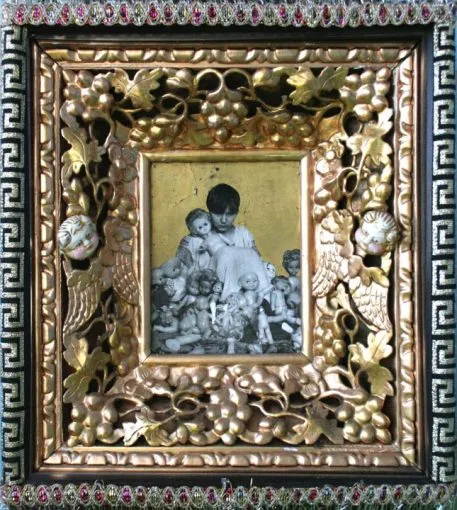
The work “Icon of Larysa” is an answer to the question of what art is. As the artist herself often recalls, at the beginning of the 1980s, she held a rather conservative and traditional view of art. However, after meeting Margarita Zharkova’s circle [2] in Odesa and reading publications in the magazine “A–Ya,” her perception of art changed.
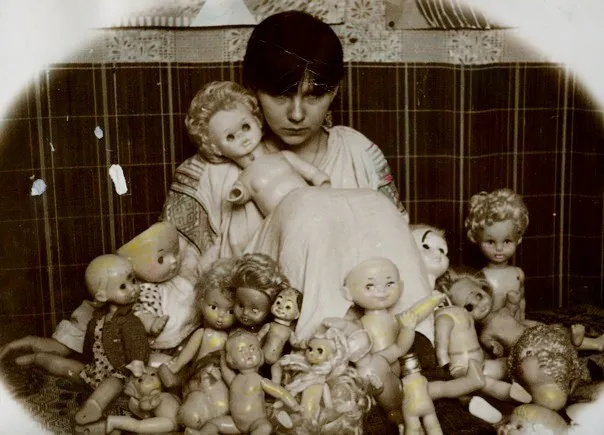
“Icon of Larysa” is a kind of homage to religious art. In the center of the work, the artist placed her own photograph, taken in the corridors of the squat on Furmannyi, where she sits surrounded by naked plastic dolls. She painted over the background of the photograph with gold paint, as in icon painting. The portrait is placed in a golden frame decorated with angels, grapes, and a silver ribbon.
Similar to surrealists, Larysa Zvezdochetova created a creepy surreal icon-painting where the sacred, the living, and the dead are combined in an eclectic mix. The artist’s gaze directed at the viewer induces panic and eerie feelings. The plastic dolls resemble skeletons, bones. In the book “Mimesis in Visual Arts,” Maria Chernyshova describes the surrealists’ experience, who were attracted to mannequins by the collision of human features with the properties of objects: from the mannequin-doll emanates both the animation of the thing and human death, the miraculous and the terrifying [3].
Dolls and toys constantly appeared in the artist’s work. Around the same period as “Icon of Larysa,” two more works were created. The ready-made “Ryzhik” and “They Are Tired” no longer have this “terrifying” subtext, but even in them, the author seeks to address serious topics using a “childish form.” For example, the work “They Are Tired” is based on prison slang: it is a phrase that prisoners “tattooed” on their legs when they were tired of sitting in prison.
Rezun-Zvezdochetova found dolls in ruins and garbage. She calls herself an archaeologist who collects old things: “I have always been interested in such old things. Things that live with you for some time and then become unnecessary. I decided to engage in a kind of modern archaeology — collecting small traces of our life, recording them in my work. I had such an idea. That is, I consider myself a kind of modern archaeologist. Because, as a rule, some important, significant works of art remain, but small things disappear” [4].
In 1996, Marta Kuzma, director of the Soros Center for Contemporary Art in Kyiv, organized the exhibition “A View with Jam,” where most works represented the “childish” theme: “The exhibition was dedicated to the theme of childhood rehabilitation, the metaphor of which was already in the very title of the exhibition — such a desired and almost always forbidden jam for a child” [5].
The curator herself defined childhood as a period of complete freedom and unique experience. “Throughout our lives, we remain intrigued by drawings that seem to be best personalized in little demonic creatures. This is often shown in films, for example, ‘The City of Lost Children,’ where children fight against their adult oppressors and are equal to them in courage. We are delighted by their mysterious pranks, their clashes with vulgar honesty, their cherubic innocence, which gives them a ‘carte blanche’ for complete chaos” [6].
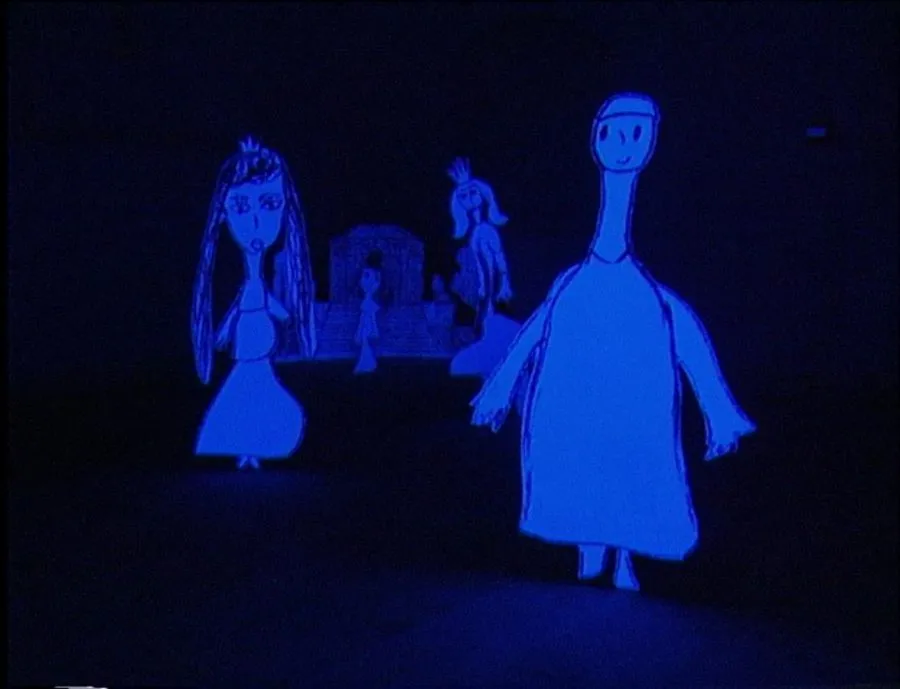
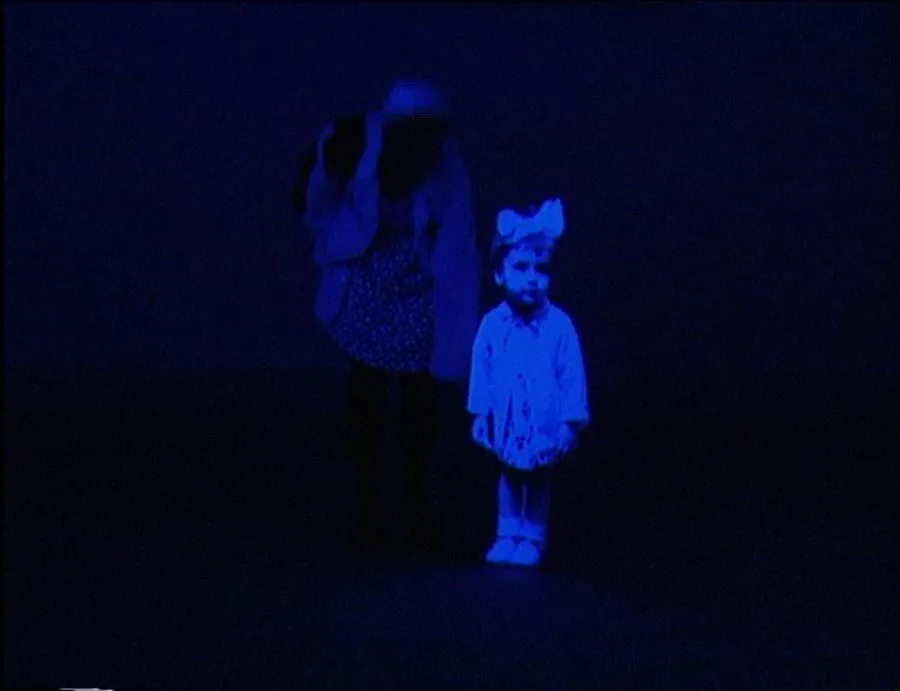
Among all the works at the exhibition, art critic Oleksandr Solovyov singled out the “Children’s Room” by Taya Halahan (Tetyana “Eva” Hershuni). “The multimedia project encompassed various installations, the most original of which was probably Tetyana Hershuni’s ‘Children’s Room.’ The dark room with cut-out silhouettes of children arranged inside made a special impression due to the specific approach the artist had been inclined to since the mid-1990s. In her work, Hershuni actively used fluorescent effects that refer to disco culture and leave the impression of an ‘otherworldly’ realm emanating from the works” [7].
In the “Children’s Room,” the artist placed numerous paper images of dolls and a photographic image of a child standing aside, as if “on edge.” The very word “on edge” (slang meaning “risky, causing fear”) best describes the state of the viewer who finds themselves in a dark room among white fairy-tale ghost figures that seem to surround them and prepare to do something.
In this multimedia installation, as in “Icon of Larysa,” there is a connection with surrealism. The artist herself confirms this: “Realism and surrealism are the two main currents that coexist for me as an eternal and inseparable alchemical substance. Paul Delvaux, his worlds electrified by inner desire, passion, and external emotional vacuum, where women wander the streets in a ‘lunatic’ ecstasy, probably appeal to me the most. My installation, presented in the Kyiv project of curator Marta Kuzma Sugar Plum Vision several years ago, has a direct visual and emotional reference to Delvaux” [8].
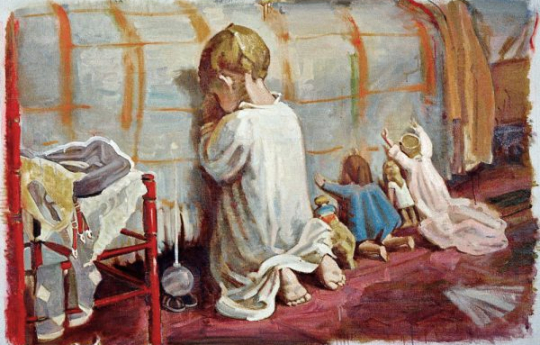
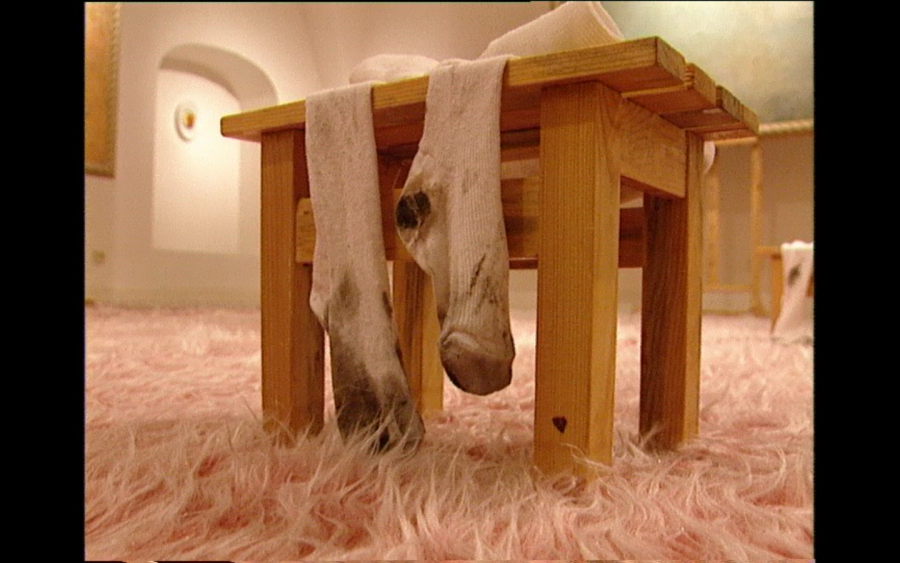
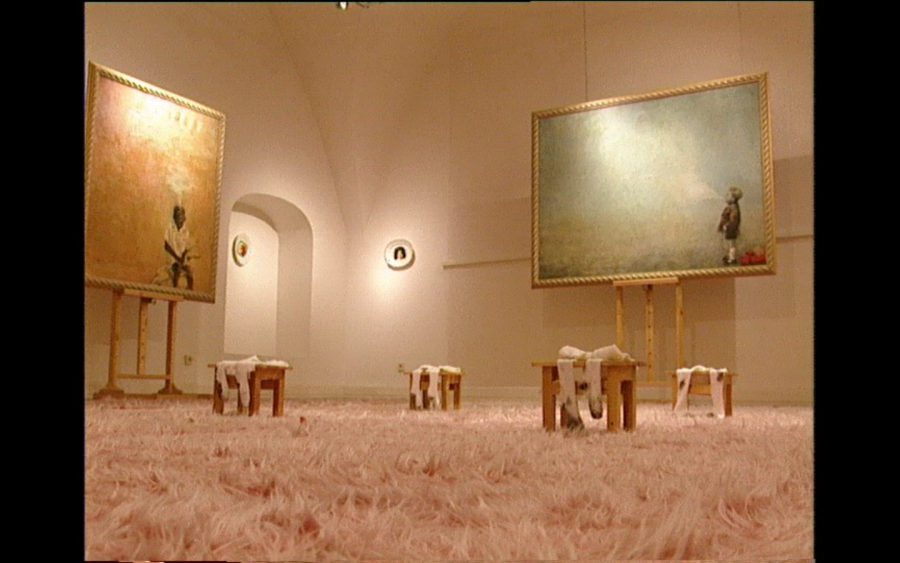
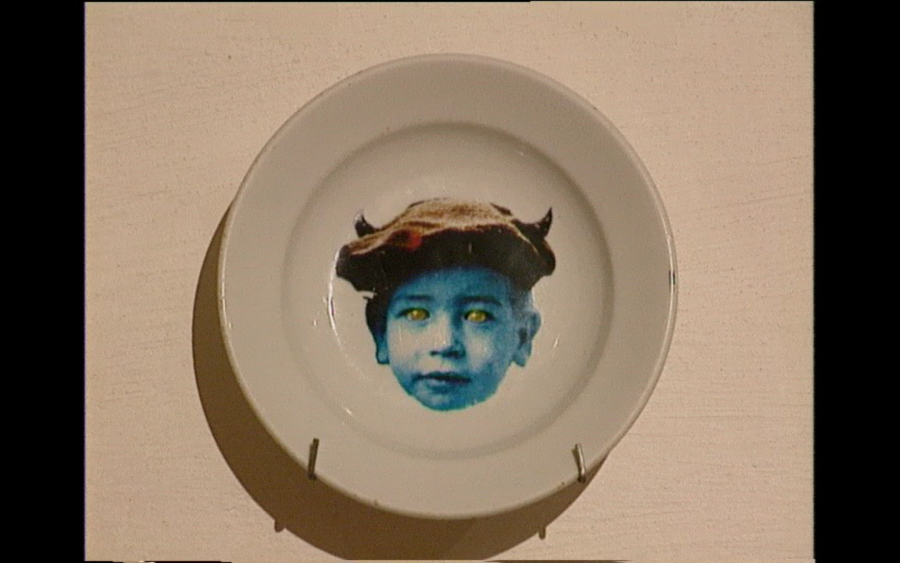
Another “children’s” room at the exhibition was created by Illia Chichkan, who, unlike Halahan, “decorated” it in sweet-pink tones: a pink carpet lay in the middle of the room, on which tiny chairs with pink children’s tights stood; around the perimeter of the room were paintings depicting children smoking and plates with children’s portraits. This sweet-pink room seemed innocent and chaste only at first glance. The pink children’s tights, neatly and carefully laid out on the chairs, upon closer inspection appeared dirty and stained. Moreover, the excessive neatness in the placement of objects in the space created an uneasy effect, as if something had happened in the ‘children’s room’ and the viewer already feels the consequences of this event. Violence in the air. A similar feeling of sadism and invisible tyranny arises when viewing Arsen Savadov’s painting “Care” (2002–2005), which depicts a little girl kneeling in a prayer pose by the bed. The dramaturgy of waiting and mystery is enhanced by her toys painted next to her in the same pose.
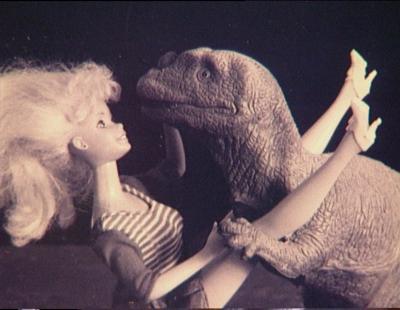
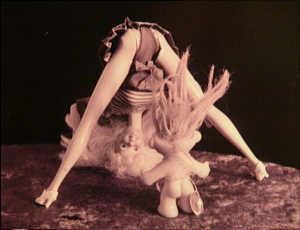
The installation “Barbie — Ken’s Wife” by Vasyl Ryabchenko consisted of 24 staged photographs depicting sexual games of the Barbie doll with other toy characters. The photos were hung on the wall in three rows. The composition was completed by a heart made of artificial flowers above the photographs. Such a cohesive composition resembled a shrine, a place of prayer. Unlike American photographer Al Carbee (1914–2005) [9], who was “obsessed” with Barbie and became famous for his collages, Ryabchenko’s famous doll is not a fetish but only a figure of mass culture familiar to everyone.
Describing the artist’s series “Others” (1994) and Naked Dream (1995), Darya Shevtsova noted the close connection between photography and painting: “These are black-and-white studio shoots in which Ryabchenko depicts models ‘decorated’ in multilayer surreal compositions made of various objects and materials. Such theatricality and staging are equally characteristic of the artist in working with photography and painting” [10].
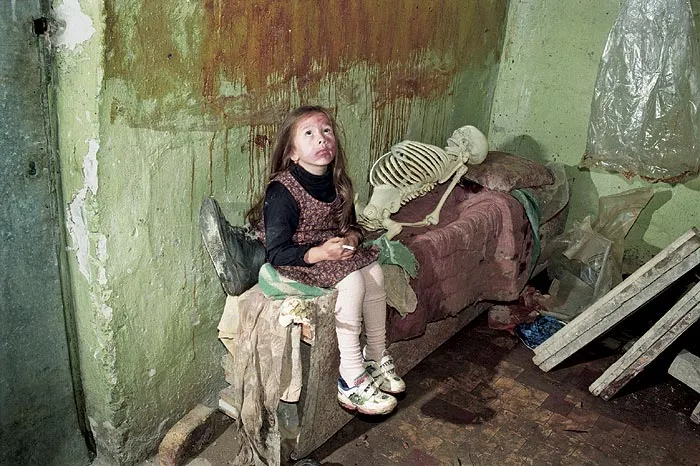
Serhiy Bratkov provocatively used children’s games and the image of a child and teenager in his work, deliberately provoking disgust in the viewer. In the series “Scary Stories,” he turned to the game. His heroes, small children, reproduce plots of “black” children’s folklore — short rhymes-stories meant to scare the listener (translated from Russian):
“Sharik was very loved by Petrik, / First stabbed, then sewed up. / A guest came to the pioneers. / A nail stuck in the guest’s head. / The elder hammered the nail / So the guest wouldn’t go anywhere.”
Bratkov seems to visualize children’s secret thoughts and desires — what is hidden in the depths of their non-childish fantasy. In “Scary Stories,” traditions of fairy tales combine with current problems of a child’s real life [11]. These photographs, full of violence, are made as if jokingly, unseriously, but visually have a completely different effect: alongside “innocent” children appear “brutally tortured” soft toys, animals, and people. According to Dmytro Desiateryk, “Bratkov managed to convey ‘sadistic’ microplots with appropriate humor […] From the same category of creepy humor is the ‘Chikatilo Diary,’ an imitation of the notebooks of the famous killer. Both funny and scary: the maniac appears as a completely ordinary philistine — ‘homo sovieticus'” [12].
Describing the photographic conditions of surrealism in Hans Bellmer’s dolls, American researcher Rosalind Krauss noted that the main condition for displacing childhood trauma is to create an image capable of instilling fear. This, according to her, is a “strategic achievement of anxiety” that arms the subject in advance against the pressure of trauma.
For artists of the 1980s–1990s generation, trauma may mean a “rupture” between old themes and forms and new realities when artists tried to adapt to the new, already post-Soviet person with their needs and desires.
Bratkov explains: “For me, the 1990s were difficult; I even gave up my apartment and moved to a studio. And next to my apartment was an orphanage where foreigners adopted children. I came to the orphanage for the first time in my life, and it impressed me so much. When the lights went out, we had to wash the children by candlelight. That’s how it was. Like attracts like. Something pulled me in, and I need to carry this expression to the end. It also happens with exhibitions: one country, and you go there, go there, it cuts off, you find another country for yourself” [13].
The heroes of Bratkov’s “Scary Stories,” like Chichkan’s “Children’s Room,” could quite well become characters in Maryam Petrosyan’s novel “The House in Which…,” which also describes the closed world of a children’s orphanage with its naivety and cruelty.
On the one hand, “childishness” here is a symbol of “naive” cruelty that arises constantly in all spheres of life. On the other hand, it is an attempt to escape serious themes, to veil them under a “dream,” to make them less serious. Escape is an important factor in Ukrainian art. Initially, it was an escape from the previous canon, then from centralization and Moscow, attempts to analyze one’s art and describe it, escape from context, and finally, from responsibility for one’s actions within this context.
Описуючи фотографічні умови сюрреалізму в ляльках Ханса Белмера, американська дослідниця Розалінд Краус завважила, що головна умова витіснення дитячої травми — створити образ, здатний вселити страх. Це, за її словами, «стратегічне досягнення тривоги» заздалегідь озброює суб’єкта проти натиску травми.
Для художників покоління 1980–1990-х під травмою може матися на увазі «розрив» між старими темами і формами та новими реаліями, коли митці намагалися адаптуватися до нової, вже пострадянської людини з її потребами і бажаннями.
Братков пояснює: «Для мене 1990-ті тоді були важкими, я якось навіть здав квартиру і переселився до майстерні. А поруч із моєю квартирою виявився дитячий будинок, де іноземці брали дітей на всиновлення. Я вперше в житті прийшов до дитячого будинку, і це мене так вразило. Коли вимикали світло, доводилося дітей мити при свічках. Ось так це було. Подібне притягує подібне. Щось втягнуло, і потрібно цей вислів довести вже до кінця. Так буває із виставками теж: одна країна, і ти до неї їздиш, їздиш, відрізає, знаходиш собі іншу країну» [13].
Герої братковських «Страшилок», як і чичканівської «Дитячої кімнати», цілком могли б стати героями роману Мар’ям Петросян «Будинок, у якому…», де теж описано замкнутий світ дитячого будинку-інтернату з його наївністю і жорстокістю.
З одного боку, «дитячість» тут — символ «наївної» жорстокості, яка виникає повсякчас у всіх сферах життя. З іншого боку, це спроба втекти від серйозної тематики, завуалювати її під «сон», зробити менш серйозною. Втеча — важливий чинник українського мистецтва. Спочатку це втеча від попереднього канону, згодом — від централізації і Москви, спроб проаналізувати своє мистецтво і описати його, втеча від контексту, зрештою, від відповідальності за свої дії в межах цього контексту.