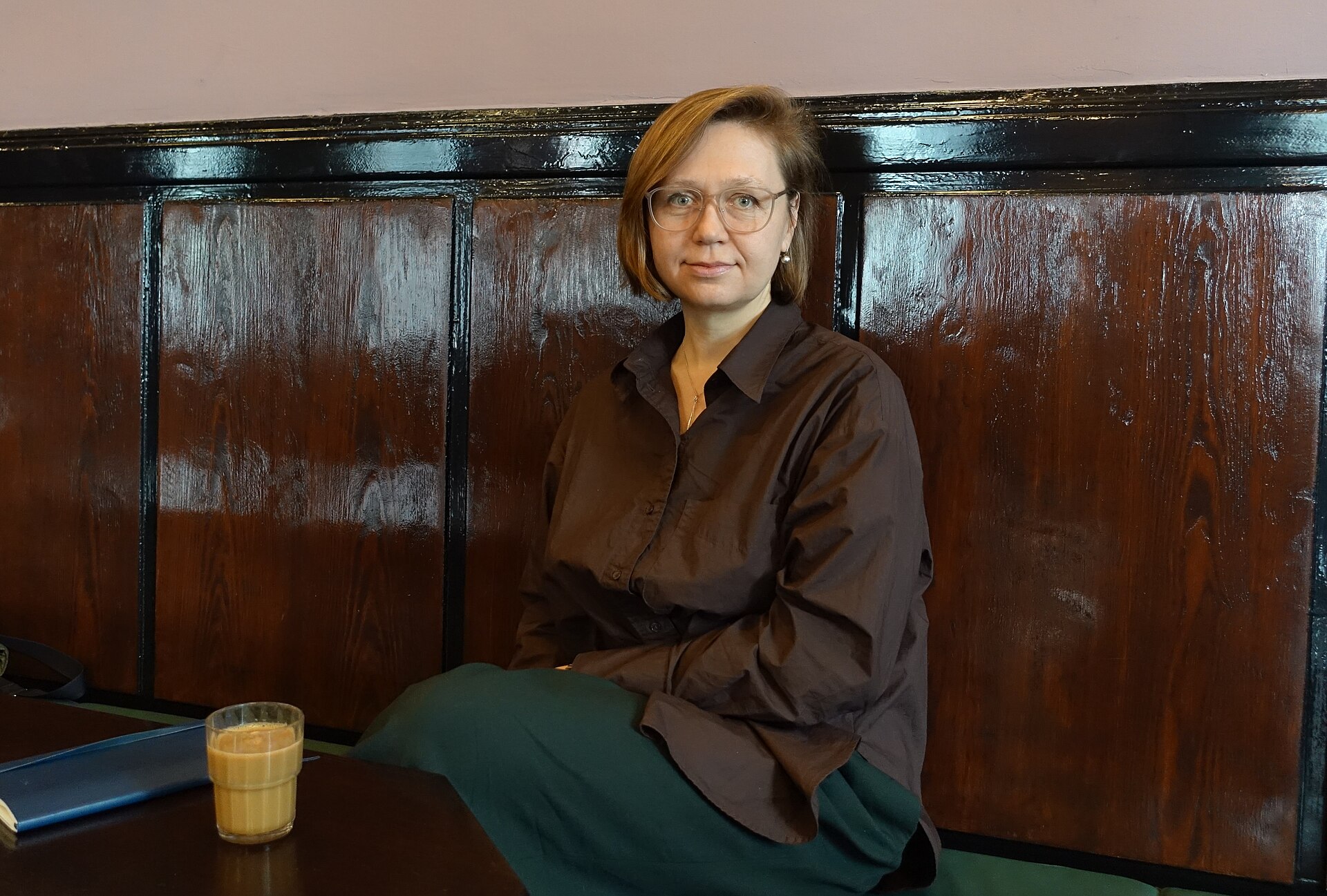
Lada Nakonechna

Biography
1981
Born in Dnipropetrovsk, Ukrainian SSR (now Dnipro).
1996–2020
Received a designer diploma from the Dnipropetrovsk State Art School (now — Dnipropetrovsk Professional Art and Culture College), Dnipro, Ukraine.
2000–2006
Graduated from the National Academy of Fine Arts and Architecture, Kyiv, Ukraine. Worked as a graphic artist, researcher, and lecturer (master's degree).
2003
Won the III All-Ukrainian competition of young curators and artists (Center for Contemporary Art, Kyiv, Ukraine).
2005
Became a member of the artist group R.E.P. Participated in an annual residency at the Center for Contemporary Art at NaUKMA, Kyiv, Ukraine.
2006–2009
Completed the advanced training and teaching program at the National Academy of Fine Arts and Architecture, Kyiv, Ukraine.
2008
Became a member of the curatorial and activist association "Khudrada." Participated in the Leipzig International Art Program, Leipzig, Germany.
2009
Participated in an artist residency at Villa Waldberta, Munich, Germany.
2010
Was a participant in the residency program Kulturstiftung Landis & Gyr, Zug in collaboration with BINZ39, Zurich, Switzerland.
2011–2013
Became a co-founder of ISTM — the Artists' Self-Defense Initiative.
2012
Worked as a co-curator of the educational and research program "Course of Art" (www.courseofart.com): A-I-R Laboratory, residency curatorial program, "Ujazdowski Castle," Warsaw. Future Generation Art Prize — shortlist (as part of the R.E.P. group).
2013
Received the Second Special Prize of the PinchukArtCentre.
2013–2016
Became a co-founder of a series of training programs for artists from the informal educational program "Art Course", Kyiv, Ukraine.
2014
Received the Kazimir Malevich Art Award (Polish Institute), Kyiv, Ukraine.
2015
Became a co-founder of the "Method Fund" — an independent non-profit organization supporting contemporary art and culture. Worked as a co-curator of CreatingRuin.net — an online collection of artistic and research projects.
2016
Served as co-editor of the online magazine about art, literature, and politics Prostory (Prostory.net.ua). Enrolled in the postgraduate program at the National Academy of Fine Arts and Architecture, Kyiv, Ukraine (2016–2023).
2020
Received the "Women in Visual Arts" award and the "Women in Art" award (UN Women in Ukraine and Ukrainian Institute), Kyiv, Ukraine.
2022
Was invited as a guest lecturer at the University of Fine Arts Hamburg. Hamburg, Germany.
2023
Studied in the postgraduate program at the University of Kassel, Kassel, Germany.
2023–2024
Worked as a research fellow at the Documenta Institute. Researched artistic and archival materials on socialist realism art as a "method" and its contemporary representation.
2024
Read the series of public lectures "Global Modernities?" (Kunst und Gesellschaft Fachgebiet Universität Kassel and Documenta Institut, concept and moderation: Liliana Gomez, Charlotte Bank, Lada Nakonechna).
Overview of artistic practice

Researcher Yevheniya Butsykina

Education and Community Building

Lada Nakonechna grew up in a family of artists—her father, Volodymyr Nakonechnyi, was a painter, and her mother, Olena Hodenko-Nakonechna, an art historian. From early childhood, she was immersed in the art world, including the National Union of Artists of Ukraine, gaining first-hand insight into how the Ukrainian system of artistic production operates. She graduated from the Dnipropetrovsk State Art School (now Dnipropetrovsk Professional Art College), specializing in Design. The design course taught by Lana Korolevska, a graduate of the Kharkiv Art and Industrial Institute (now the Kharkiv State Academy of Design and Arts), played a significant role in shaping Nakonechna’s approach, as her teacher introduced “early Soviet, avant-garde thinking on balance and color juxtaposition” into the curriculum: “We studied compositional, abstract formulas: where the center of gravity is on the page, where the dynamics are… My interest in volumes, spaces, interactions probably started there, through that education.”[1] Later, Nakonechna enrolled at the National Academy of Fine Arts and Architecture in Kyiv (Faculty of Graphics, specializing in Printmaking, in the studio of Andrii Chebykin, then the rector of the Academy). Her initial choice of design, followed by graphics, reflected a deliberate refusal to study painting. Within the walls of NAFAA, she first developed a preference for certain materials and methods: “We simply sat in those workshops experimenting with etching, acids, printing, metal. That’s probably where it came from, this idea of reproduction. The material I work with is found images.”[2]

In parallel with her academic training, Nakonechna also received informal education, primarily through exchanges with like-minded peers in artistic collectives. Discussions and collaborative projects became a way to critique established institutions and build alternative, grassroots initiatives. In 2005, Nakonechna joined the R.E.P. group (Revolutionary Experimental Space), whose projects challenged entrenched political and social structures and relationships in Ukraine, including those within the art academy (“Correspondent. Academy,” 2006). She was also a member of Hudrada (2009–2013), a curatorial collective of artists, architects, activists, translators, and others working on experimental and socially critical exhibitions, as well as Method Fund (since 2021)—an educational project founded together with Kateryna Badianova, Tetyana Endshpil, Olha Kubli, Ivan Melnychuk, and Denys Pankratov. They organized courses on contemporary art as alternatives to formal academic programs, accompanied by collaborative practices, discussions, and exhibitions with students. These initiatives shaped her personal trajectory and her engagement with the history and representation of academic education. Seminars and lectures organized by Method Fund on Socialist Realist art and the surrounding artistic system encouraged Nakonechna to delve deeper into the subject in both her exhibitions and her dissertation research, which began at NAFAA and continues at the University of Kassel.

Media and Methods

Despite the relative insularity of Ukraine’s cultural and educational systems at the time, Nakonechna and her peers sought influences in both Ukrainian and global art history. Conceptual art has had the strongest impact on her practice, particularly because of its roots in avant-garde traditions. The avant-garde aimed to break reality down into basic elements (forms, colors, lines) that are universally perceptible. Nakonechna has adopted these strategies and drawn on 20th-century Ukrainian art history to analyze the discursive structures of institutional systems by referencing real events and narratives from the past.

Nakonechna’s work is characterized by deep reflection: the creation and presentation of a piece is typically preceded by extensive research. As such, her artworks are results of meta-analysis: she invites the viewer to focus on and reflect upon issues that often transcend a specific time or place, although they are frequently anchored in current events and the exhibition space itself.

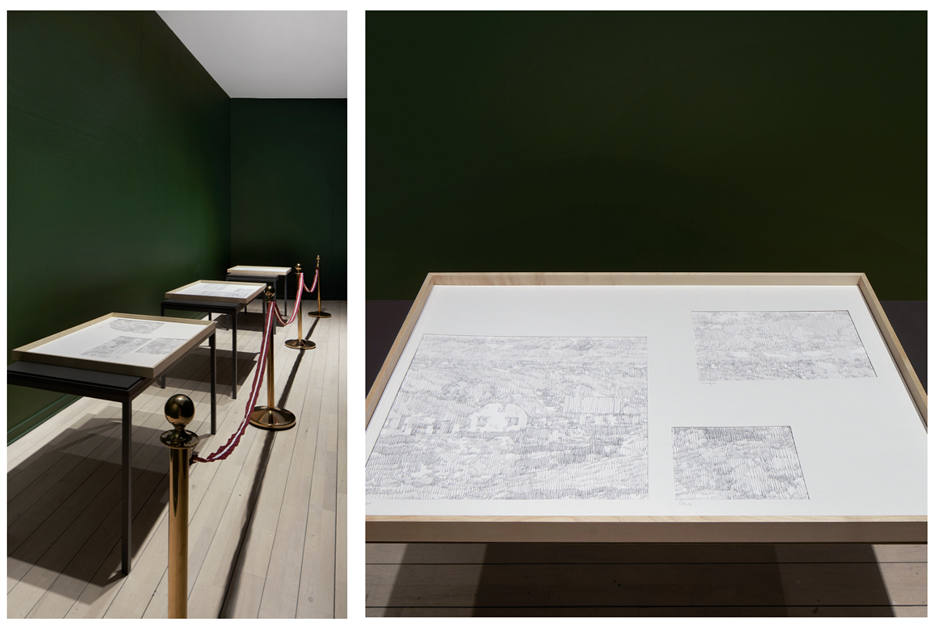
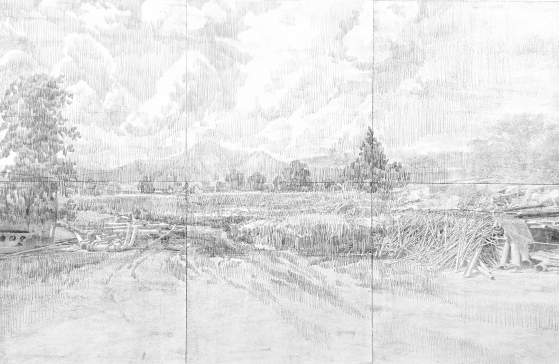
Drawing is Nakonechna’s primary medium. Her technique involves monotonous hatching, shading from left to right, mimicking the habitual motion of handwriting developed through years of schooling. This is not “expressive” drawing but rather “drawing within a preset matrix”—over printed reproductions, sometimes over projected images, filling in gaps on the surface, light areas, or illuminated objects. Nakonechna’s drawing practice is multifunctional: it can serve as an element of an installation, a standalone piece, a “trap” in the exhibition space, or a visual deception (“Laboratory,” “Place,” “Perspective,” “Trap,” “Untitled. Art Institutions”). Her drawings prompt the viewer to question artistic reality, to allow doubt to creep into the image, and to challenge habitual patterns of perception.

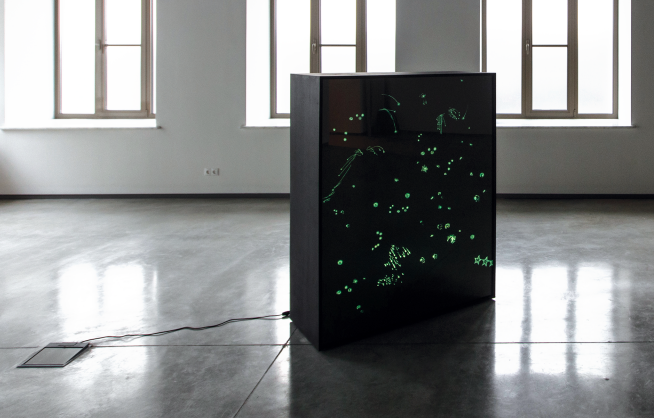
Photography rarely appears in Nakonechna’s work as an autonomous medium; instead, she uses it as a tool (“Facade Restoration,” “Merge Visible,” “Almost the Same,” “David’s Nose,” etc.). She works with photographs found online, in archives, or captured in her own documentation. Photography serves as a foundational and necessary tool for her core practices: copying, reproduction, replication, fragmentation. The photograph (light is often an active medium in her work, as in “Study of Manipulation Systems,” 2009) allows her to manipulate the image according to the logic of her research.

Performance (“Another Day,” “Bad Face of Ukraine,” “We Will Face the Possibility”) is another multifunctional medium within Nakonechna’s artistic vocabulary. It helps to equalize the roles of author and viewer, allowing the artist to take the position of the observer, redirecting attention to her own work and creating a recursive effect. Her works are recursive in the sense that they encourage the viewer to examine their own gaze—its reflection in art, and the underlying reasons and contexts for how it has been formed. To this end, Nakonechna borrows forms and methods from academia, but places them “in brackets”—challenging, deconstructing, sometimes distorting and satirizing them to the point of unrecognizability.

The deconstructed image in Nakonechna’s work exerts influence and alters reality. Its purpose is to interrupt the function of the traditional, “correct” image and to expose its constructed nature. The artist analyzes it by identifying ruptures in continuity, which she reveals as imposed and artificial. In describing her Method Fund course “Imitation Practices,” she asks: “How do we construct our own art history? Maybe it can be built through ruptures? … If everything was previously constructed on ruptures of forgetting, then that, too, forms a line—a dotted one. But this raises the question of how we reflect on those continual historical breaks, or on the disjunctions between actions and context.”[3]

In recent years, Nakonechna has aimed for a comprehensive, articulate form of expression through exhibitions. In her practice, the exhibition becomes a polyphonic statement that reflects long-term research. Its goal is collective reflection—realized through shared presence with the viewer, shared inquiry, and shared responsibility: “I look at these works as tools that can help someone else, together with me, to see what I saw. If we saw it together, we’ll act differently from that point on.”[4]

Her orientation toward conversation with the viewer reflects Nakonechna’s resistance to the hierarchical relationship of “author-recipient,” “artist-viewer,” typical of the art world. This introduces a feminist principle—not as a subject, but as an approach and form of expression, drawn from the educational ethos of the Method Fund: “self-criticism, transparent distribution of responsibility, mutual respect and care, collectivity that respects individual freedom.”[5]

Forms of Critique and Exhibitions as Complex Statements

Nakonechna often turns to the academic genre of painting considered least ideologically charged: landscape. This may take the form of romantic landscape, rooted in the concept of the picturesque as a pedagogical matrix for the aesthetic education of the 18th–19th-century elite. She references the quintessential painter of this genre—Claude Lorrain—and the presence of ruins in his landscapes. Nakonechna projects the contemplative, romantic gaze upon ruins of a different kind: those not built for beauty, but resulting from historical upheaval. This is central to the “Creating Ruin” project within the Method Fund’s work and to several of Nakonechna’s own projects (“Constructing a New Landscape,” “Popular View Through the Lilac in Kyiv’s Botanical Garden Toward the Drieper River,” “Left to Right,” “Historical Paintings of Contemporary Ruins”). In these, she uses the ruin as a metaphor to break down cultural and historical processes into elements that demand a distanced view.

Nakonechna “creates ruin” by delving into the history of Ukrainian art, systems of production, and education, identifying two key periods: the avant-garde and Socialist Realism. These become opposing paradigms of how art is understood and produced, mirroring the conceptual dispute between Bertolt Brecht and Georg Lukács on the role of modernism in art. Nakonechna aligns with Brecht (“Appropriated Phrases (from: Bertold Brecht, The Good Person of Szechwan),” 2012), who saw modernism’s emancipatory and political potential. Lukács, by contrast, promoted “progressive bourgeois realism” as the only valid art under totalitarianism, leading to the replacement of modernism with Socialist Realism (effectively neo-academicism). Nakonechna seeks to trace how this shift unfolded in Ukrainian art institutions—how one set of principles replaced another—and how this historical collision continues to affect contemporary practice, perception of art, and professional education.

Ultimately, Lada Nakonechna’s artistic practice is grounded in complex, gradual critique. Narrative critique: close examination, detachment from context, and deconstruction (“War in Ukraine” [“Hybrid War,” “Civil War,” “Russian-Ukrainian War”], “So-Called”). Socio-political critique (“Unstarted Dialogue with Unnamed Characters,” “Negotiations Table,” “Personal Shield,” “Reserved”): responses to current events and societal challenges that surface what is invisible but essential. Institutional critique: directed at institutions shaping Ukraine’s contemporary art system and public perceptions of art. Within this framework, Nakonechna began to explore exhibitions as complex statements, adapting them to specific institutional settings (“Exhibition,” “Background Mode,” “Images from Abroad”).

Nakonechna focuses on a thorough investigation and critique of Ukraine’s academic art education system and the concepts of “teacher,” “school,” “Socialist Realism,” and the phenomena behind them. This process culminated in two exhibitions in 2021—“Disciplined Vision” and “Disciplined Vision. School”—where she continued to “work with visuality as something laden with the hidden: gazes, admiration, intentions, motivations, ideas, ideologies,” and approached Soviet-era artworks as “documents capable of revealing more than their artistic qualities.”[6]

In 2022, following Russia’s full-scale invasion of Ukraine, Nakonechna temporarily left the country and continued her research, presenting her work in European institutions and reinterpreting Socialist Realist art in local archives and collections (“Studying the Human,” “Conditioned Reflexes,” and “Conditioned Reflexes 2,” “Below Ground Level”).

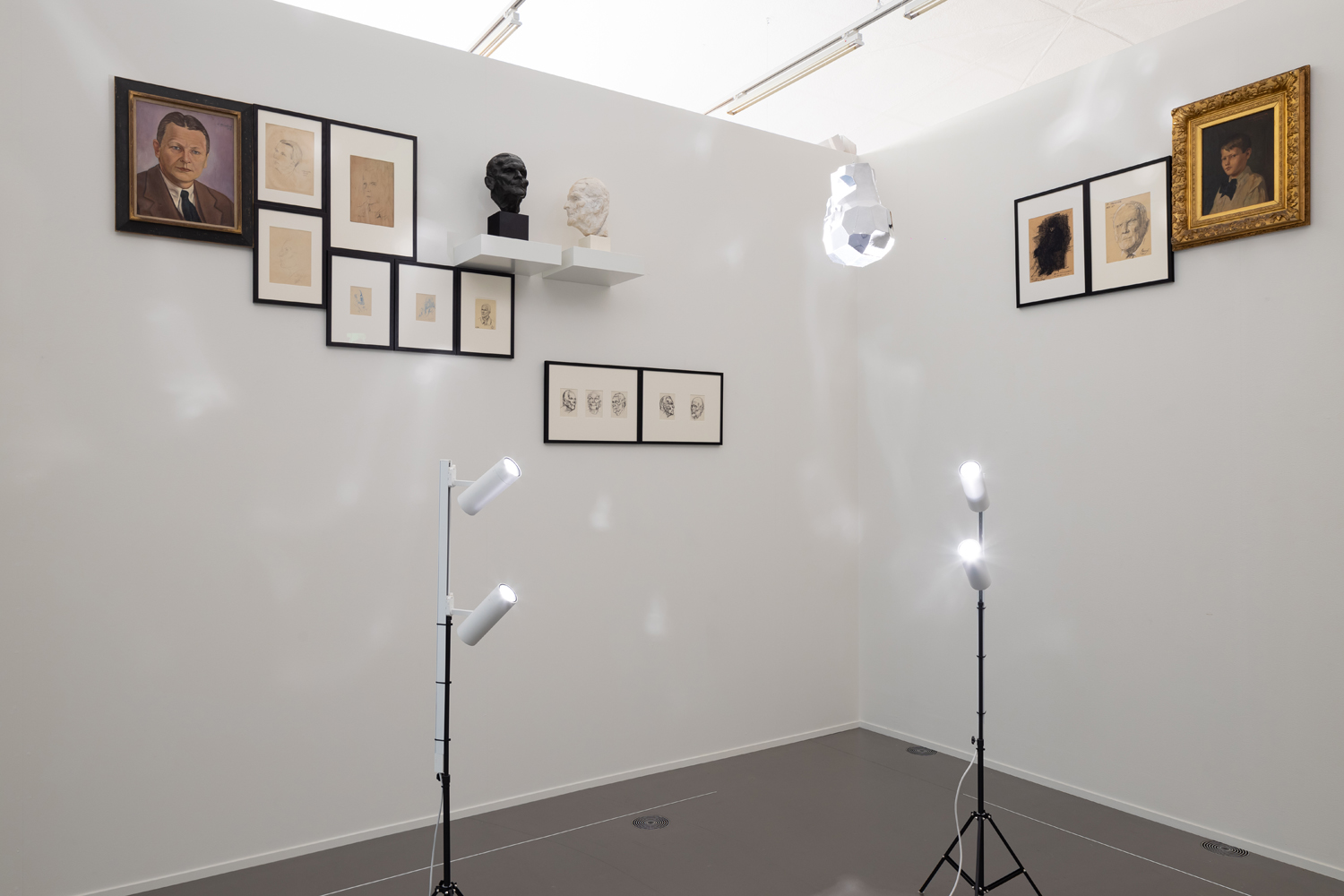
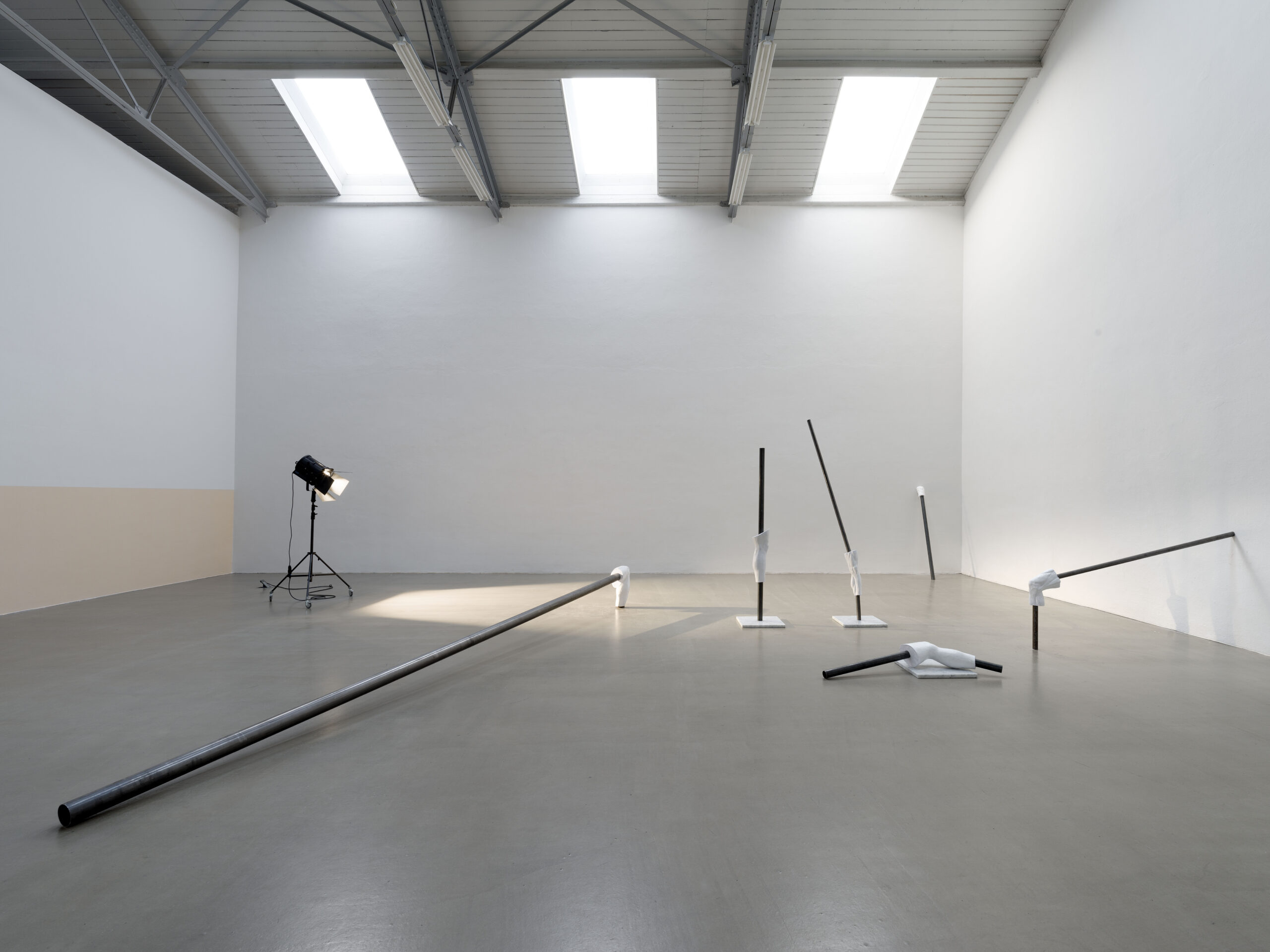
For Lada Nakonechna, it is important to define her art as political, given its critical stance toward institutions of power—including those where her exhibitions are held. Her work in exhibition spaces (lighting experiments, wall painting and decoration, added elements) is preceded by long-term research in archives and museum collections. Nakonechna critiques entrenched social structures by analyzing the conditions and possibilities of seeing, shaped by the art and education systems of each era and institution. In this way, her practice steadily moves toward an answer to the question of how art can help us analyze contemporary reality—through historical continuity and the reinterpretation of past epochs, always in open and direct dialogue with the viewing community.

  1. From an interview with Lada Nakonechna, 14.03.2025.
  2. Ibid.
  3.  Yakovlenko K. Lada Nakonechna and Kateryna Badyanova: “We Don’t Need to Invent Something from Nothing.” Artslooker. 26.10.2020. URL: https://artslooker.com/lada-nakonechna-ta-katerina-badyanova-nam-nemae-potrebi-vigaduvati-nove-z-nichogo/
  4. From an interview with Lada Nakonechna, 14.03.2025.
  5. Badyanova K., Nakonechna L. Lada Nakonechna. Secondary Archive. Accessed: 16.04.2025. URL: https://secondaryarchive.org/artists/lada-nakonechna/
  6. From an interview with Lada Nakonechna, 14.03.2025.
Exhibitions
2024
Below Ground Level, Galerie EIGEN+ART Leipzig/Berlin, Berlin
2024
Socialist realism discourse trap or how to gaze at self-confident man from DDR. Intervention into the Gesichter der Arbeit section of the exhibition The 20th And 21st Century. Art From Leipzig at MdbK, Leipzig
2024
Zeichnung. Idee – Geste – Raum. Museum unter Tage, Bochum
2024
The Latvian Collection. Latvian National Museum of Art, Riga
2024
Observe this moment-how it convulses, Galeria Arsenał w Białymstoku, Poland
2024
Höhe x Breite x Tiefe, Galerie EIGEN+ART Leipzig/Berlin, Leipzig, Germany
2024–2022
Peilung — series of meetings at daadgalerie, Berlin (2022–2024), co-curated with Bettina Klein (curatorial project)
2023
Kaleidoscope of (Hi)stories: Ukrainian Art 1912–2023, Albertinum, Staatliche
2023
Kunstsammlungen Dresden, Dresden and Museum De Fundatie, Zwolle
2023
Days, days. Gallery “Khlibnia”, Sofia Kyivska National Reserve, Kyiv
2022
Studium des Menschen, Galerie EIGEN+ART Leipzig/Berlin, Leipzig
2022
Spots of Modernity, guided tour-performance (with Kateryna Badianova), MdbK, Leipzig
2022
Traditional replays (with Zhanna Kadyrova), BWA WARSAW, Poland
2022
We No Longer Feel the Future, MUZA – Eretz Israel Museum, Tel Avivtvian Collection. Malmö Art Museum, Sweden
2022
The Latvian Collection, Malmö Konstmuseum, Sweden
2022
Push & Pull – Territorien zwischen Land und Meer, Schloss Plüschow, Germany
2022
Letter from the Front, Haus der Kunst München, Germany
2022
Letter from the Front, Kunsthalle Münster, Germany
2022
I Have No Words - There is No Title, Rathausgalerie Kunsthalle Munich, Germany
2022
Preserving the shape, Galerie Raum mit Licht, Wien
2022
Nadzieja radykalna, Galeria Arsenał w Białymstoku, Poland
2022
Odnowa / Renewal, Biennale Zielona Góra, Poland
2022
Distant Tolerant Murder — Polish-Ukrainian billboard exhibition in central Berlin, Germany, co-curated with Anna Lazar (curatorial project)
2021
Embraces (with Monika Drożyńska), NAMU, Kyiv
2021
Disciplined Vision, NAMU — National Art Museum of Ukraine, Kyiv
2021
Disciplined Vision: School, Artsvit Gallery, Dnipro, Ukraine
2021
Garden After the Gods, JUMP Contemporary Art Center, Poltava, Ukraine
2021
Dedication: Traces and Tactics, Kristianstads Konsthall, Sweden
2021
Ukraine: A different Angle on Neighborhood, The International Cultural Centre in Krakow, Poland
2020
Bodies at a Distance, Galeria SKALA, Poznan, Poland
2020
Images from Abroad, Galerie EIGEN+ART Leipzig/Berlin, Berlin
2020
The economy of borders. We lost our soft soul, by crossing the borders, facade of the Tiergarten City Hall, Berlin
2019
About Independence, J.D. Bukhanchuk Kmytiv Museum of Fine Arts, Kmytiv, Ukraine
2019
War in the Museum, J.D. Bukhanchuk Kmytiv Museum of Fine Arts, Kmytiv, Ukraine
2019
At the Front Line: Ukrainian Art 2013–2019, The National Museum of Cultures, Mexico Cit
2019
Personal Motive, Mykola Yaroshenko Poltava Art Museum (Art Gallery), Poltava, Ukraine
2019
Tale of Novorossiya, Arsenal Municipal Gallery, Poznań, Poland
2019
Listen to Us — Artistic Intelligence: Works from Central and Eastern European Artists from Art Collection Telekom, City Art Gallery, Plovdiv, Bulgaria
2019
Searching for Identity (in the Time of the Selfie), Studio Tommaseo, Triest, Italy
2019
Just Don't Tell Slava Yet, Museum of Contemporary Art in Kherson, Ukraine
2019
11/944 — from the Collection of Galeria Labirynt, Galeria Labirynt, Lublin, Poland
2019
The Influencing Machine, Galeria Nicodim, Bucharest
2019
The Missing Planet, Visions and Re-visions of "Soviet Times" from the Pecci Centre's and Other Collections, Centro Pecci, Prato, Italy
2019
Gifts for you, Galerie EIGEN + ART Berlin, Germany
2018
Background Mode, Galerie EIGEN+ART Leipzig/Berlin, Leipzig, Germany
2018
The World on Paper, Palais Populaire, Berlin
2018
Zeitgeistlos, curated by Eszter Lázár & Edina Nagy, Knoll gallery, Vienna
2018
I am the Mouth: Works from Central and Eastern European Artists from Art Collection Telekom, Museum of Contemporary Art Zagreb, Croatia
2018
Follow the Line — Positions of contemporary drawing, Kunsthalle der Sparkasse, Leipzig
2018
The Opposing Shore, Université de Bretagne Occidentale, Brest, France
2018
Pedagogical Acts, SKLO Art Space at M. Dragomanov Pedagogical University, Kyiv
2018
Sediment, Werkschau, Spinnerei Leipzig, Germany
2017
Teacher (intervention), NAMU, Kyiv
2017
Festivities Are Cancelled!, The Kyiv International — Kyiv Biennial 2017, curated by Hudrada, “UFO” at metro Lybidska (Ukrainian Institute of Scientific, Technical and Economic Information) and Pavlo Tychyna Literary Memorial Museum, Kyiv
2017
Revolte, Galerie EIGEN+ART Leipzig/Berlin, Berlin
2017
Attention! Border!, Galeria Arsenał elektrownia, Białystok and Galeria Labirynt, Lublin, Poland
2017
A Story about Certain Histories, Galeria Labirynt, Lublin, Poland
2017
Postponed Futures, GRAD Gallery, London
2017
Artists’ Motto, Kyiv Poetry Week, Plivka, Kyiv
2017
À la Frontière: Old and new borders in Europe, Artspace of Barfuss Theater am Schillerpark, Berlin and Šv. Jono gatvės galerija, Vilnius, Lithuania
2016
The music stops. The guests are embarrassed. Pause, EIGEN+ART Leipzig/Berlin, Berlin
2016
Experiments (with Zhanna Kadyrova), BWA WARSZAWA, Poland
2016
Exhibition, PinchukArtCentre, Kyiv
2016
Into the Darkness, Vozdvizhenka Arts House, Kyiv and WUK, Kunsthalle Exnergasse, Vienna
2016
The School of Kyiv. Leipzig Class. Seminar: Politics of Form, GFZK — Galerie für Zeitgenössische Kunst, Leipzig
2016
Meanwhile, what about socialism?, Gallery North, Northumbria University, Newcastle, Great Britain
2016
Universal Hospitality, Alte Post, Vienna
2016
After the Rally, Studio Gallery, Palace of Culture and Science, Warsaw
2016
Dependence Degree, BWA Wrocław — Gallery of Contemporary Art, Wrocław, Poland
2016
A Story about Certain Histories, Poninka House of Culture, Poninka, Ukraine
2016
Bud’mo, Galeria BWA, Zielona Góra, Poland
2016
Semantic Riots, Ausstellungsraum Klingental, Basel, Switzerland
2016
Collections, Zachęta—National Gallery of Art, Warsaw, Poland
2015
The Deception of Distance, Mikhail Bulgakov Museum, Kyiv
2015
À la Frontière: Old and new borders in Europe, Studio Tommaseo, Trieste Contemporanea, Italy
2015
Meshes of the Afternoon (The Plein Air School of Landscape), Kyiv Biennale, Kunsthalltrondheim, Norway
2015
In Spite of Everything, Polish Institute Dusseldorf, Germany
2015
Best Evidence Rule, Verein für zeitgenössische Kunst Leipzig, Germany
2015
Lest The Two Seas Meet, Museum of Modern Art in Warsaw, Poland
2015
Walk the Line: New Ways of Drawing, Kunstmuseum Wolfsburg, Germany
2015
Demonstrating Minds: Disagreements in Contemporary Art, Museum of Contemporary Art Kiasma, Helsinki, Finland
2015
R.E.P.: 10 years. On the Method, Contemporary Art Space, Batumi and Georgian State Art Museum, Tbilisi, Georgia
2015
Limited Liability Pavilion, apartment exhibition during the 56th International Art Exhibition — la Biennale di Venezia, Italy
2015
Art Has No Alternative (An Archive of Artists in Action), tranzit.sk, Bratislava, Slovakia
2015
Manifest Thought Form, Kuad Gallery, Istanbul, Turkey
2015
Good Art? I Want It!, Auf AEG, Nürnberg, Germany
2015
Open, Galerie EIGEN+ART Leipzig/Berlin, Berlin
2015
Paradigma Blickwechsel, Tapetenwerk, Leipzig
2014
Homey (intervention), Krakow Theatrical Reminiscences (festival), Poland
2014
The State of Things, Toulouse Art Festival, Espace Croix-Baragnon, Toulouse, France
2014
Mobile Portable Model, Galerie EIGEN+ART Leipzig/Berlin, Berlin
2014
Referendum on Withdrawal from the Human Race, Teatr Powszechny, Warsaw and Closer Art Center, Kyiv
2014
Through Maidan and Beyond, Architekturzentrum Wien, MuseumsQuartier, Vienna
2014
R.E.P.: 10 years. On the Method, Galeria Labirynt, Lublin, Poland
2014
Sister Europa, Kunstraum Lakeside, Klagenfurt, Austria
2014
Deprivation, Galeria Arsenał, Białystok, Poland
2014
Disconsent, Center for Contemporary Art, Plovdiv, Bulgaria
2014
Postcards from Maidan, Ujazdowski Castle, Warsaw
2014
The Ukrainians, Daadgalerie, Berlin
2014
Gender and Diplomacy: the “Ladies’ Programme”, Haus der Kulturen der Welt, Berlin
2014
Leipzig — Heldenstadt?, Goethe Instituts Paris, France
2014
Imaginary Archive, Les Kurbas National Theatre Arts Center, Kyiv
2014
The Wall, Art Face to Face with Borders, Care of DOCVA, Milan, Italy
2014
Disobedience Archive (The Park), SALT Beyoğlu, Istanbul, Turkey
2014
Piazza dell'immaginario, exhibition in public space, Prato, Italy
2014
Unpurposeful Use of the Premises, curated by HudRada, Khreschatyk 34, 2 floor, Kyiv
2014
Open City: Festival of Art in Public Space, Lublin, Poland
2014
Referendum on Withdrawal from the Human Race, Closer Art Center, Kyiv and Teatr Powszechny, Warsaw, Poland (curatorial project)
2013
Self-Government: Cultural Evolution vs. Revolution, Odessa Biennale of Contemporary Art, Museum of Odessa Modern Art, Ukraine
2013
Measures of Saving the World — Part 3, < rotor > — Center for Contemporary Art, Graz, Austria
2013
Economics in Art, MOCAK — Museum of Contemporary Art in Krakow, Poland
2013
Racing with Time: Art of the 1960s–Early 2000s, NAMU, Kyiv
2013
Ukrainian News, Ujazdowski Castle, Warsaw
2013
Orienting in Place, NAMU, Kyiv
2013
Disobedience Archive (The Republic), Castello di Rivoli Museo d’Arte Contemporanea, Turin, Italy
2013
Showing Its Colors: What Makes Art, MARTa Museum, Herford, Germany
2013
Sun of the Poor, Ya Gallery, Dnipro, Ukraine
2013
Love of the Space, 10th Krasnoyarsk Museum Biennale, Krasnoyarsk, Russia
2013
Court Experiment, Galerija SIZ, Rijeka, Croatia
2013
Union of Hovels, HudRada, Island of Lido, Venice
2013
The Future Generation Art Prize @Venice 2013, 55th Biennale di Venezia, Palazzo Contarini Polignac, Italy
2013
Whisper Down the Lane, Gallery 400, Chicago, USA
2013
Global aCtIVISm, ZKM — Museum of Contemporary Art, Karlsruhe, Germany
2013
On Paper, EIGEN+ART Lab, Berlin
2013
Revisiting Footnotes, Latvian Center for Contemporary Art, Riga, Latvia
2012
Entfremdungseffect, Galerie EIGEN+ART Lab, Berlin
2012
While I Can See (performance), Galeria Arsenał, Białystok, Poland
2012
Weekdays, Center for Contemporary Art Ujazdowski Castle, Warsaw
2012
Red Carpet (public art project in the city centre), Leipzig, Germany
2012
Project (with Nikita Kadan), Pop-up exhibition in a pre-revolutionary building, Kyiv
2012
Ukrainian Body, VCRC, Kyiv
2012
In Best Form: Highlights from 14 Leipzig Galleries, Kunsthalle der Sparkasse, Leipzig
2012
Cantastoria, Utah Museum of Contemporary Art, Salt Lake City, USA
2012
It isn't important, it's only art..., Galeria Arsenał, Białystok, Poland
2012
Disputed Territory, curated by HudRada, Sevastopol Art Museum in Crimea, Ukraine
2012
The Best of Times, the Worst of Times: Rebirth and Apocalypse in Contemporary Art (main project), First Kyiv Biennale of Contemporary Art ARSENALE 2012, Mystetskyi Arsenal, Kyiv
2012
Double Game (Special project), ARSENALE 2012, Mystetskyi Arsenal, Kyiv
2012
Distorting Mirrors (Parallel project), ARSENALE 2012, Taiss Gallery together with Lavra Gallery, Kyiv
2012
Gender in Izolyatsia [Isolation]: The Right to Self-Construction in Conditions of Patriarchy, Izolyatsia, Donetsk, Ukraine
2012
The Picture Hides the View, NAMU, Kyiv
2012
The Myth of the Ukrainian Baroque, NAMU, Kyiv
2012
Who told you so?! #1 Truth vs. Government, Onomatopee Projectspace, Eindhoven, The Netherlands
2012
Atlas Critique, Parc Saint Léger – Contemporary Art Center, France
2011
One More Day (performance), NAMU, Kyiv
2011
While I Can See (performance in public space), Kyiv
2011
Sale, Mala Gallery of Mystetskyi Arsenal, Kyiv
2011
Perspective (public art project), Leipzig University Bibliotheca Albertina (in cooperation with Leipzig International Art Program), Germany
2011
Disciples and the Illuminated Plane, Mala Gallery of Mystetskyi Arsenal, Kyiv
2011
2 stories — 3 worlds (with Ivan Bazak), BINZ39 Foundation, Zurich, Switzerland
2011
Fashion Ukraine, Kunstraum Reto Ganz, Zurich
2011
Rewriting Worlds, Main project of the 4th Moscow Biennale of Contemporary Art, Moscow
2011
October Project, Flutgraben e. V., Berlin
2011
Exhibition of the Shortlisted Artists for the PinchukArtPrize 2011, PinchukArtCentre, Kyiv
2011
Prosto. Art, NAMU, Kyiv
2011
Newspeak, Mala Gallery of Mystetskyi Arsenal, Kyiv
2011
Independent, Mystetskyi Arsenal, Kyiv
2011
Labor show, curated by HudRada, VCRC, Kyiv
2011
Court Experiment, ArtVienna 2010, Vienna
2011
Life in the Forest, Galeria Arsenał, Białystok, Poland
2011
A Complicated Relation, Part 2, Kalmar Konstmuseum, Kalmar, Sweden
2011
Making and Art, Stadtgalerie Schwaz, Austria
2011
Public Folklore, Grazer Kunstverein, Graz, Austria
2011
Six and Three: Artists of the SOSka and R.Е.P. Groups, Brown Stripe Gallery and Cheremushki Apartment Gallery, Moscow
2011
Impossible Community, Moscow Museum of Modern Art, Moscow
2011
Patriotism. Trick (work in public space), Gorlitz, Germany
2011
Space Odyssey 2011, Mystetskyi Arsenal, Kyiv
2011
ATLANTIS 11, The alternative Bulgarian Pavilion, 54th Venice Biennale, Italy
2011
Let's talk about Nationalism! Between Ideology and Identity, Labor C3, Budapest
2011
Labor Show, Center for Research of Visual Culture, Kyiv, Ukraine
2011
Court Experiment, non-commercial programme of VIENNAFAIR, Austria
2010
Court Experiment, curated by HudRada, VCRC, Kyiv
2010
Videozone 5, Tel-Aviv, Israel
2010
Those Who Arrived in the 2000s, M17 Contemporary Art Center, Kyiv
2010
Minimal Differences, White Box, New York City, USA
2010
IF. Ukrainian Art in Transition, PERMM — Museum of Contemporary Art, Perm, Russia
2010
At Home in Wollishofen, Artfoyer Cavigelli, Zurich
2010
Special project at Art Paris, Grand Palais, Paris, France
2010
Over the Counter, Műcsarnok — Kunsthalle Budapest, Hungary
2010
Euro Renovation in Europe, Kunstraum München, Munich
2010
Great Surprise, NAMU, Kyiv
2010
Motherland Shop, SUPERMARKET — the artist-run art fair, Stockholm, Sweden
2010
Let’s Talk about Nationalism! Between Ideology and Identity, KUMU, Tallinn, Estonia
2010
Art-Kyiv Contemporary (Parallel program), Mystetskyi Arsenal, Kyiv
2010
Protests, Subversions, Communities, Markets: Public Space in Contemporary Ukrainian Art — screening, Flat Space, Chisinau, Republic of Moldova
2009
Place, CCA at NaUKMA, Kyiv
2009
Viewers in the Forest: The Artist and Manipulation, Weltraum, Munich, Germany
2009
The Testimony of Things, GEDOK Munich
2009
Arranging the environment so as to preclude needless trouble, Kyiv.FineArt Gallery, Kyiv
2009
Views, curated by HudRada, CCA at NaUKMA, Kyiv
2009
Revolutionary Moments, CCA at NaUKMA, Kyiv
2009
Communism Never Happened, Feinkost Gallery, Berlin
2009
The Future Was Yesterday: Self-Organized Artistic Practices from Ukraine, Gallery PM/HDLU — Mestrovic Pavilion and Gallery SC, Zagreb, Croatia
2009
Leipzig Calling, New York Academy of Art, New York City, USA
2009
Homestories II, Arttransponder, Berlin
2009
Open City: Festival of Art in Public Space, Lublin, Poland
2009
2nd Katowice Biennale, Katowice, Poland
2009
No More Reality: Crowd and Performance, Depo, Istanbul, Turkey
2009
Land of Human Rights: Being Responsible for Resources, < rotor > — Centre for Contemporary Art, Graz, Austria
2009
Views, Center for Contemporary Art, Kyiv, Ukraine
2008
Patriotism. Art as A Present, PinchukArtCentre, Kyiv
2008
Alphabetical Order: John Baldessari, R.E.P., Ahmet Öğüt, Index — The Swedish Contemporary Art Foundation, Stockholm, Sweden
2008
Another City. Another Life, Zachęta National Gallery of Art, Warsaw
2008
No More Reality, De Appel Arts Centre, Amsterdam, Holland
2008
Qui vive?, Biennale of Young Artists, State Centre for Contemporary Art, Moscow
2008
Satellite Tunes, Hungarian University of Fine Arts, Budapest
2008
Schengen, Feinkost Gallery, Berlin
2008
The Art World, Feinkost Gallery, Berli
2008
Checkpoint, F.A.I.T. Gallery, Krakow
2008
Transit, curated by R.E.P. group, Ya Gallery, Kyiv
2008
5th International Biennial of Contemporary Art, Gyumri, Armenia
2008
Common Space, exhibition in public space, curated by R.E.P. group, Kyiv
2008
New Ukrainian Language, curated by R.E.P. group, Karas Gallery, Kyiv
2007
Exteriors, CCA at NaUKMA, Kyiv
2007
Generation UsA, PinchukArtCentre, Kyiv
2007
Consequences and Proposals, Biennale of Young Artists, Tallinn, Estonia
2007
Contemporary Art Norwich, Norwich, England
2007
Ukrainian Pavilion, 52nd Venice Biennale, Venice, Italy
2007
Critically In-between, Special project at Art-Athens, Greece
2007
Progressive Nostalgia, Centro Pecci, Prato, Italy
2007
3rd Prague Biennale, Prague, Czech Republic
2007
Return of Memory, KUMU, Tallinn
2007
Petroliana, 2nd Moscow Biennale of Contemporary Art, Moscow
2007
Communities Project, CCA at NaUKMA, Kyiv and Galeria Arsenał, Białystok
2006
Barwy klubowe, F.A.I.T. Gallery, Krakow
2006
Testing Station, Skulpturens Hus, Stockholm
2006
Postorange, Kunsthalle, Karlsplatz, Vienna
2006
Intervention, Ujazdowski Castle, Warsaw
2006
Contested Spaces in Post-Soviet Art, Sidney Mishkin Gallery, New York City
2005
Intervention, CCA at NaUKMA, Kyiv
2005
Control, CCA at NaUKMA, Kyiv
2005
Ukrainian Hermitage, CCA at NaUKMA, Kyiv
2003
Comfortable Environment, Centre for Contemporary Art at NaUKMA, Kyiv

Bibliography
  1. Alberti, S. “Ukrainische Künstlerin Lada Nakonechna.” Monopol. https://www.monopol-magazin.de/lada-nakonechna-eigen-art-leipzig.
  2. Art Collection Telekom. “Lada Nakonechna.” https://www.art-collection-telekom.com/en/artists/nakonechna-lada.
  3. Artsvit. “Disciplined Vision. School. Lada Nakonechna.”
  4. Blatton, P. “Images from Abroad: Lada Nakonechna.” Ocula.
  5. Creating Ruin.
  6. Drucks, A. “Re-Reading: Alienation Effects—Drawings by the Ukrainian Artist Lada Nakonechna.” ArtMag.
  7. Disciplined Vision: Exhibition Catalogue. By Lada Nakonechna. Kyiv: Maister Knyh, 2022.
  8. Group R.E.P. Green Box. Berlin, 2015.
  9. Hodenko-Nakonechna Olena, and Lada Nakonechna. “Art History Education in Soviet Ukraine in Historical Context.” In Entangled Histories of Art in Ukraine. Routledge, 2025.
  10. Kalyta, N. “Lada Nakonechna: On the Importance of Local Discourse.” Your Art.
  11. Kral, K. “Detailing the Darkness.” Prostory.
  12. Method Fund. “Founders.”
  13. Nakonechna, Lada. “Against the Department of Contemporary Art.” In Deschool!. Poland: Arsenal Gallery, 2020.
  14. Nakonechna, Lada. “Art Education and the Artist’s Creativity: The Path from Producing Objects.” Annales Universitatis Paedagogicae Cracoviensis. Studia de Arte et Educatione, no. 13 (2018): 105–114.
  15. Nakonechna, Lada, and Olena Godenko-Nakonechna. “Art History Education in Soviet Ukraine in Historical Context.” In Entangled Histories of Art in Ukraine. Routledge, 2025.
  16. Nakonechna, Lada. Catalogue. Leipzig/Berlin: Galerie EIGEN + ART, 2015.
  17. Nakonechna, Lada, and Kateryna Badyanova, eds. Dictionary of Contemporary Art: A Handbook. Vol. 1. Kyiv: FOP O. O. Lopatina, 2021.
  18. Nakonechna, Lada. “Effect of Tension.” Leipzig: Eigen + Art LAB, 2012.
  19. Nakonechna, Lada. “Formation of Modernist Art Education in Ukraine in the First Third of the Twentieth Century.” Zhivot Umohliadnosti, no. 103 (2018): 46–63.
  20. Nakonechna, Lada. “History of the Reforms of the National Academy of Fine Arts and Architecture.” Kurbas Readings, no. 12 (2017): 34–43.
  21. Nakonechna, Lada. “Instagram.”
  22. Nakonechna, Lada. “Institutionally Unclarified. Part 1.” Your Art.
  23. Nakonechna, Lada. Institutionally Unclarified. Parts 1 and 2. Kyiv: YouArt.
  24. Nakonechna, Lada. “Lada Nakonechna.” Le Nouveau Printemps.
  25. Nakonechna, Lada. “Method of Socialist Realism in International Relations: Examples of Ukrainian and Ethiopian Art Education.” Acta Academiae Artium Vilnensis (2025). Forthcoming.
  26. Nakonechna, Lada, and Kateryna Badyanova. Method of Form. Kalektar.org, 2021.
  27. Nakonechna, Lada. “The Society of Friendly Creators: An Essay on the Work of Larion Lozovyi.” Lerchenfeld, no. 69 (2024): 52–55.
  28. Nakonechna, Lada. “Audience.” In Dictionary of Contemporary Art, 12–17. Kyiv: Method Fund, 2021.
  29. Nakonechna, Lada. “Official Website.”
  30. Nakonechna, Lada. “Works.” Galerie EIGEN + ART
  31. Nepyivoda, M. “We Still Look at Ukrainian Art through Soviet Eyes …” Gazeta.ua.
  32. “Online Presentation of the Catalogue Disciplined Vision.” YouTube.
  33. Preface: Documentation of the Seminar Series. Edited by K. Badyanova, L. Nakonechna, and D. Pankratov. Kyiv, 2016.
  34. Radionova, A. “If Only the Two Seas Could Meet …” Zbruc.
  35. Secondary Archive. “Lada Nakonechna.”
  36. Smirnova, Y. “Lada Nakonechna: ‘Conceptual Art …’” Art in Ukraine.
  37. Socialist Realism: It Seems, Something Else. Notebook nos. 1–2. Edited by K. Badyanova, L. Nakonechna, and D. Pankratov. Kyiv, 2017.
  38. Volkova, Y. “The Experience of Attracting the Shadow: Hand, Eye, Lightning.” Prostory.
  39. Vtorshyna, M. “Every Person Is an Artist …” Your Art.
  40. Weekdays Exhibition. Ujazdowski Castle.
  41. Why Are There Great Women Artists in Ukrainian Art? Kyiv: Publish Pro, 2019.