
The Body of “Time”
KHARKIV PHOTOGRAPHIC GROUP “TIME” (1971–1980s)
The text was prepared and first published in “Sztuka Europy Wschodniej.” An expanded and supplemented version was published as part of a collaboration with the PinchukArtCentre Research Platform
One of the important chapters in the history of contemporary Ukrainian art is the activity of the Kharkiv photographic group “Time,” which marked the beginning of the development of alternative photography in late Soviet Ukraine. The image of the body in Kharkiv photography became a subject of separate analysis as a tool for socio-critical expression and artistic expressiveness.
Let us consider the first generation of the Kharkiv School of Photography [1] — the group “Time” from 1971 to 1976 [2], as well as the individual artistic approaches of certain authors in depicting the nude body. The general method of working with photographic images among the Kharkiv photographers was aimed at the destruction of photographic documentality. The artistic method was based on the “theory of impact” developed by the members of the “Time” group, according to which the authors positioned photography as a work of art in opposition to the pseudo-documentary official Soviet photography. The nude body and “naked sociality” are prevailing themes in the Kharkiv “theory of impact.” Besides this, Kharkiv photographers actively used collage, montage, and overlays (the so-called “photographic sandwich”) as a way to create metaphorical and alternative realities in attempts to deconstruct the documentary; social reportage; coloring photographs and kitsch as a reaction to absurd reality; collectivity of photographic practices in developing ideas and methods; as well as actions, photo-installations, and photo-performances as a way to go beyond the photographic plane [3].
“Time” was an alternative association of young photographers that operated in the city photo club at the Palace of Trade Unions. The initiators of the group were Yevgeniy Pavlov (1949) and Yuriy Rupin (1946–2008), joined by Boris Mikhailov (1938), Oleg Malevany (1945), Alexander Suprun (1945), Alexander Sitnichenko (1949–?), Gennadiy Tubalev (1944–2006), and later Anatoliy Makienko (1949) [4].
Amid the geopolitical upheavals of the 20th century, the image of the body manifested the idea of man and humanity in art and world culture. The documentary involvement effect inherent in photography emphasized and highlighted the polarity of the perception of the body in society. According to photography historian Irina Chmyreva, the ambiguity of the interpretation of the body in photography as an embodiment of the idea of man is felt in the second half of the 20th century through the geopolitical opposition of the USA and the Soviet Union, when two military-political camps coexisted in cold political and social confrontation [5]. In turn, Tatyana Pavlova, in an article about the body in Ukrainian photography of the 1970s–1980s, outlines a different fault line, more focused — between Ukraine and Russia — emphasizing that the mental split did not arise in the 20th century but existed in this territory since ancient times [6]. But both researchers note that in the polarity of the perception of the idea of man, there is a manifestation of simultaneous propaganda and revolutionary nature of the theme of corporeality in Soviet photography, which existed in the grip of photographic documentary properties [7].
Since 1960, in the Soviet Union, the depiction of the nude body was legally positioned as pornography and was criminally punishable [8]. Researcher Nadezhda Kovalchuk notes that the nude body “was part of the traditional triad of shooting prohibitions. It was also forbidden to shoot from a high angle, and strategic objects — factories, railways, military facilities” [9]. In conditions of censorship and bans on depicting any manifestations of sexuality, whether literal eroticism or the nude body as an artistic metaphor of intimacy, the nude body became for Kharkiv photographers a tool for releasing internal ideological and political tension, which young critically thinking people felt most acutely in the post-thaw period and demanded a response.
The “theory of impact” is a concept of perceiving photography as a work of art in opposition to official Soviet photography as a document. The concept of “impact” became bright, aggressive photography that literally “hits the viewer” and forces an engaged reaction to the photographic image. The justification of the “theory of impact” in the 1970s at the Kharkiv photo club was formulated and conceptualized by the members of the group for themselves.
If we structure and thematically separate the generations of the Kharkiv School of Photography, particularly in their work with the image of the body, we can distinguish three generations and three decades. The first generation, represented in the history of Kharkiv photography by the group “Time” and the decade of the 1970s, partly identified the nude body with the category of a driven individuality under the pressure of ideology and socio-political control. Tatyana Pavlova explained it as follows: “Only in the context of those years, when defeminization and demasculinization were imposed by the Soviet regime, is the dominant cult of the nude body in the photographs of the ‘Time’ group understandable as one of the fundamental positions of their ‘theory of impact'” [10]. A decade later, the generation of the 1980s adopted from their senior colleagues in the “Time” group social reportage and a palette of methods for working with photographic images, but the body in their practice, intimate and personal, manifests with the literalness and audacity characteristic of the social moods of the 1980s. Among the authors of the 1980s are Roman Pyatkovka (1955), Viktor Kochetov (1947), Mikhail Pedan (1957), Sergey Bratkov (1960), Igor Manko (1962), as well as the circle of authors of the “Gosprom” group. The 1990s in the history of Kharkiv art are marked by going beyond clear photographic boundaries — authors practice performativity and installation through photography. In the context of geopolitical processes, compared to Eastern European art of the 1990s, where the body in the situation of the war in the Balkans acquired the interpretation of “physically vulnerable, pushed to the periphery of social reality” [11], the body of Kharkiv artists in the conditions of the general mood of the collapse of the USSR and the formation of a new political reality acquires theatrical features reflecting new social constructs and, accordingly, new roles [12]. In particular, the “Rapid Response Group” practice [13] is characterized by a collective approach to creating works, which fundamentally distinguishes the activities of Kharkiv photographic groups from each other: “Time” in the 1970s and “Gosprom” in the 1980s, despite group work in understanding and discussing photography, did not collectively create works.
It is worth separately considering the category of collectivity in the practices of the “Time” group, as it can be mistakenly associated with the tendency toward collective actions in Western European art of the 1960s–1970s. Tatyana Pavlova describes the specificity of the collectivity of the “Time” group with the words of Boris Mikhailov: “At this first stage, the group was like one person, with a common hero, <...> realizing itself as an otherworldly element of the social machine. It is no coincidence that in 1987 at the historically important exhibition at the Student Palace <...> Mikhailov, already recognized as the leader of the group, insisted on the monolithic image of the house. ‘Its walls,’ he said, ‘Malevany, the foundation — Suprun, the roof — Pavlov.’ Mikhailov himself undoubtedly represented the hearth of this ‘cardboard’ house, to which, by that time, I would say, a mezzanine had already been added — V. Kochetov, S. Solonsky, R. Pyatkovka, and a terrace — the ‘Gosprom’ group — M. Pedan, V. Starko (founders), S. Bratkov, G. Maslov, L. Pesin, I. Manko, K. Melnik — completing the classical architectural appearance” [14].
Having united into a group, the authors actively discussed, viewed, and commented on works. Becoming heroes of each other’s photo narratives, photographers introduced a performative component into the images, which manifested as a metaphorical projection of their own lives through the camera lens. The lack of professional photographic discourse led the authors to form a circle of communication, where gradually, in a regime isolated by Soviet ideology from global artistic trends, ideas and alternative artistic visions of photography were developed and voiced. The focus of discussions included both the theoretical foundations of photography and the exchange of technical and methodological developments among the authors.
Members of the “Time” group, even before its creation in 1971, individually experimented with creating alternative photography within the photo club. For example, Boris Mikhailov created the first works of the famous “Overlays” series (also known as “Yesterday’s Sandwich”) already from the late 1960s. The peculiarity of Mikhailov’s “Overlays” was not exclusively the nude body; the series is rather one of the vivid examples of conceptual social photography with an embedded metaphor of dual-layeredness between the literal and hidden Soviet reality. According to Boris Mikhailov: “[one of] the ‘overlays,’ where text from school notebooks is superimposed on the image of a woman (there lies the girl Suzy) [the heroine of Mikhailov’s series ‘Suzy and Others’ — author’s note], is quite a kitschy picture. The text runs over the woman and kind of ‘fucks’ her like a man. The same method as in social art is used. The lines of text embody the Absolute Anonymous, but the image of a naked woman is difficult to visually represent within Russian conceptualism” [15] [16]. Mikhailov showed the method and the series “Overlays” in the 1970s to the members of the “Time” group in the format of a slide film set to music by Pink Floyd, which was also a new and experimental form of presenting works within the typical Soviet leisure of the trade union photo club.

Boris Mikhailov. From the series Yesterday’s Sandwich. Late 60s–late 70s. Courtesy of Sprovieri Gallery, London
Despite the similarity of Mikhailov’s practice with the key methods of Moscow conceptualism, the artist recalled that Kharkiv authors first saw the naked woman in photography from Lithuanians [17]. After the creation of the Lithuanian Union of Photographers in 1969, the first professional association of photographers in the entire USSR, Lithuania became the only “photographic republic” in the Union and a model for photographers of other republics to follow. Lithuanians had the opportunity to earn money through official commissions, publish their albums and catalogs, and were allowed to send their works to international exhibitions, which allowed them to become part of the global photographic process even then. Lithuanian photography, with its humanistic emphasis, represented a “new vision” in Soviet culture, including exposing the body in photography. The connections with Lithuania among Kharkiv photographers were not limited to distant contacts. Photographers visited each other, spent leisure time together, actively exchanged developments, sent their photos to European competitions through Lithuanian colleagues, and also received fresh information about new trends in world photography from them. Vitas Luckus (1943–1987) was one of the most daring authors among Lithuanians, whose influence on the practice was noted by members of the “Time” group. In particular, Boris Mikhailov and Yuriy Rupin, together with Vitas Luckus, while resting in Crimea, created performative portraits of each other, which allows us to speak both about close personal ties between photographers of different republics and the direct circulation of a new vision of photography and artistic manifestations in the authors’ practice [18]. The naked woman among Lithuanians was romanticized, poetized; Lithuanian photographers did not resort to sharp social themes in aggressive visual forms. They very delicately felt the boundary of what was allowed, drawn by the Soviet authorities. Kharkiv photographers, however, were under constant and thorough KGB control already after their first public meetings within the club as the “Time” group [19]. Their photography was more than striking, sometimes provocative, almost always with a shade of sociality and criticism of Soviet power, as well as with the characteristic “fig in the pocket” of the late Soviet intelligentsia — an internal protest against bans and censorship.

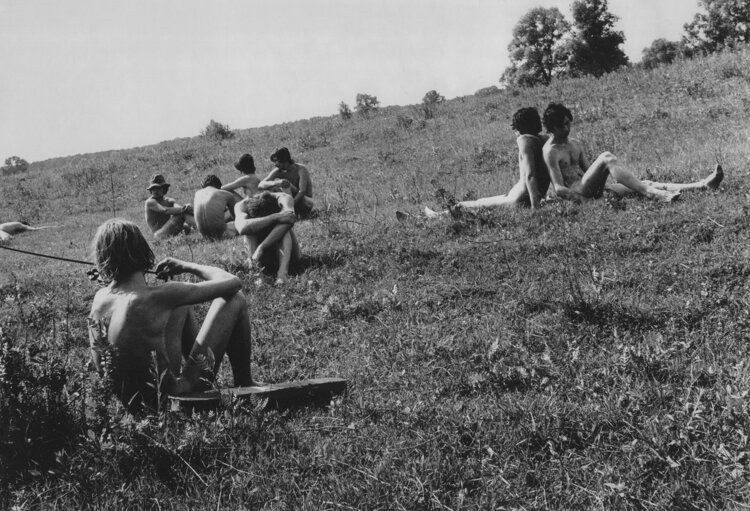
Yevgeniy Pavlov. From the series Violin. 1972. Silver gelatin print. Courtesy of the artist’s family
Within the “Time” group, the depiction of the nude model had several distinctions. Following the example of painting life model practice, models for photographers were mostly girlfriends and wives — women close to their circle. Such nude photos might ideologically not correspond to the then image of the Soviet woman but intuitively met the generally accepted canon of female attractiveness.
For many members of the “Time” group, despite the forbidden nature of the image, the female image in photography was partly drained and reduced to a certain conventional standard: the category of attractiveness relative to the nude woman in photography remains dominant, mostly depicting a young body with correct proportions. Thus, the nude female body in Oleg Malevany’s photography appears attractive, aesthetic, even after the author applied a number of stylistic distortions and transformations to the shots. But the nude nature in Boris Mikhailov’s work was the complete opposite of the aestheticized standard of female beauty and femininity. In Mikhailov’s photography, the woman is most often not idealized in her forms; her body is shown old, young, thin, or full, but always different; the author does not follow the unified tacit canon of attractive female nudity. Attractiveness for Mikhailov becomes a marker of the idealized Soviet image, against which he acts in his visual practice by means of photography. But it is important to note that Kharkiv photographers within unofficial Soviet photography were much bolder in photographing the nude male body. One of the first programmatic embodiments of the “theory of impact” through the image of the nude body can be considered the “Violin” series created by Yevgeniy Pavlov in 1972. Pavlov sent a dozen shots from it for publication to the Polish magazine Fotografia, and bypassing Soviet press, “Violin” was partially published in the Western press in 1973 with comments by Polish critic Jan Sunderland [20]. The “Violin” series captures a group male nude photo session in a natural environment. The male body in Pavlov’s work is a poetic image of openness and freedom, a metaphor for vulnerable dissent, uncensoredness, and non-conformity. The composition and frame in Pavlov’s work are clearly structured and visually create a sense of surrealism of what is happening. Among other things, this is almost the first male nude in late Soviet photography. The danger of depicting a group nude male body was that it could be perceived by the authorities as propaganda of homosexuality. For post-Soviet society, this topic remains stigmatized to this day, and in the Soviet 1970s it was punished more severely than the depiction of female nudity in the category of “pornography.” Even the attempt to depict the nude body in public space beyond the natural conditions of permitted nudity — baths or during hygienic procedures — already bordered on provocation and a political gesture. The entire shooting process of the series was planned by the author, took several days, and was implemented as a kind of happening, but the result was an artistic series of photographs, not documentation of an event [21].
In the same year, photographer Yuriy Rupin created the “Bath” series, which is also a vivid example of a male nude group photo session. Unlike Pavlov, Rupin photographs naked men during hygienic procedures. Thus, deliberately crossing the line of what is allowed but not violating it — this is a play with legislation and the system. The steam surrounding the subjects of the shoot veils the nudity, creating an imaginary screen that covers the subjects and gives the entire series a feeling of voyeurism. The mist from the steam is also a flirtation of the photographer with the aesthetics of pictorial photography of the early 20th century, which was stigmatized by Soviet authorities as “bourgeois” and therefore inconsistent with Soviet reality.
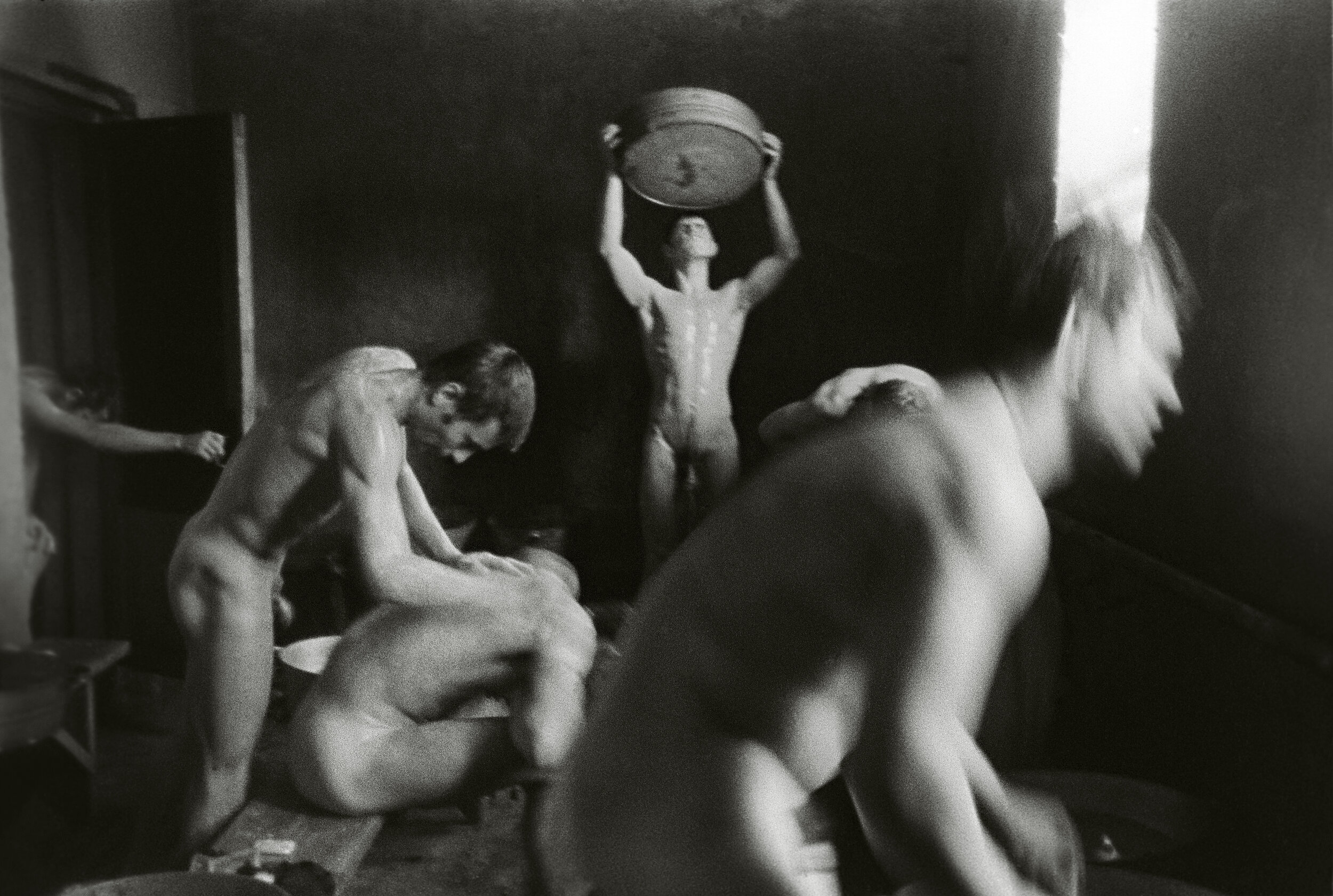
Yuriy Rupin. From the series Bath. 1972. Silver gelatin print. Courtesy of the Kharkiv School of Photography Museum
Nadezhda Kovalchuk notes in the “Bath” series Rupin’s fascination with the bodily plasticity of pioneers of Soviet photography — Boris Ignatovich, Arkady Shaikhet, Max Penson [22]. According to her, the body in Rupin’s work was not only an attempt to provoke the authorities with literal corporeality within permitted categories but also an awareness of one’s own body as the last bastion of privacy and inalienable experience. This was most vividly manifested in the early “Two and the Sea” series of 1975, and in particular, the work “We” of 1971 [23].

Yuriy Rupin. We. 1971. Silver gelatin print. Courtesy of the Kharkiv School of Photography Museum
Rupin’s work “We” is an intimate family self-portrait. The relaxed and languid female figure next to the restrained and sensual male figure, which compositionally lie near each other within the frame, add a sense of co-presence to the depicted scene. The couple embodies an image of another, intimate and tender family life, existing outside the social stamps of the Soviet “cell of society,” but within the humanistic tradition of world photography of that time. This similarity is noticeable when comparing Yuriy Rupin’s practice with his Lithuanian colleague Vitas Luckus, who also shot family self-portraits, placing individuality and humanity above the category of sociality.
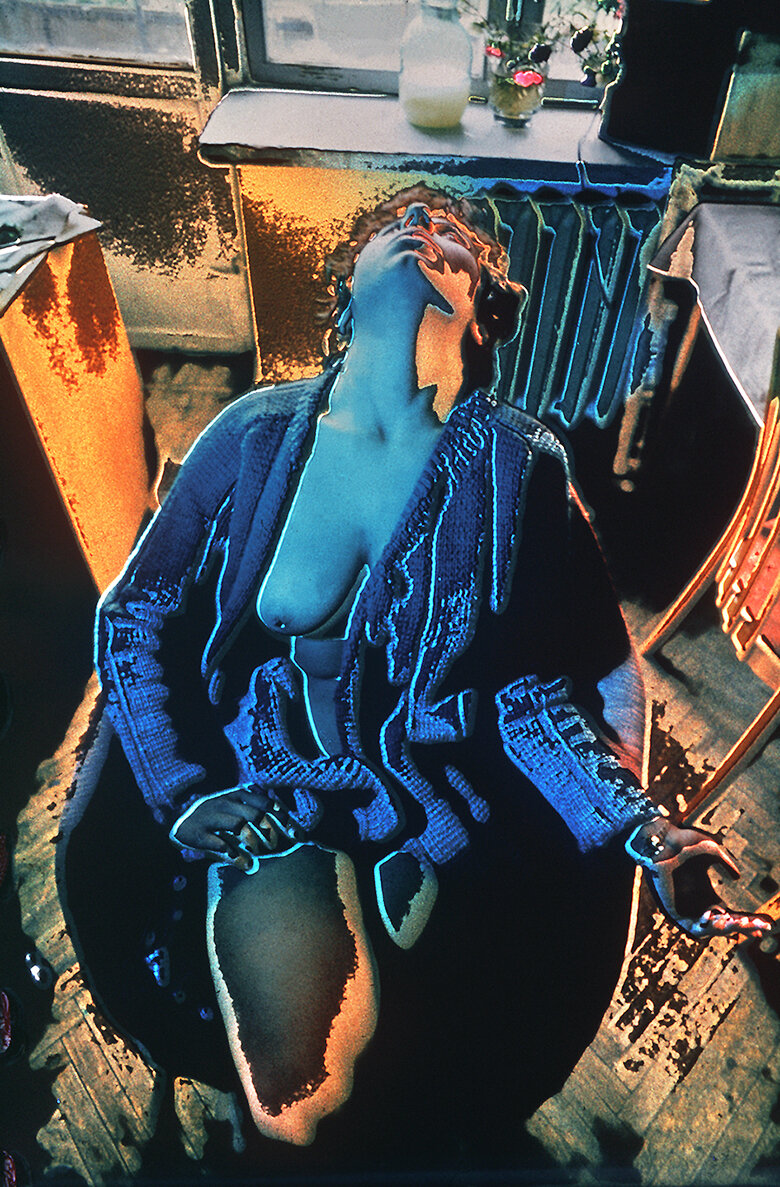
Oleg Malevany. Expectation. 1971. Color isogel technique. Courtesy of Grynyov Art Foundation
Another aesthetic photography, richly embellished with visual effects, was pursued by “Time” group member Oleg Malevany. He was recognized as a technological master among Kharkiv photographers, mastering various complex approaches in working with the photographic layer, with the process of alternative color introduction into photography — the equidensit technique. Color and the “melting” of form determine the perception of the body in Oleg Malevany’s photography. His interest is the female body. There is no sociality in it, but there is an unmasked fascination with the aesthetic characteristics not only of the final result of his work — the photograph — but also of the heroines he photographs. For example, in the work “Expectation,” the author, using a wide-angle camera from a high shooting angle, portrays a girl sitting on a chair with her head thrown back. In such an angle, the image seems to melt before the viewer’s eyes, creating a feeling of narcotic intoxication, as if it dissolves like a drop of gasoline in a puddle with various shapes and colors. The color isogel technique successfully emphasizes the variability of possible interpretations, and the anxious shades of blue-yellow, white, and black reveal a psychedelic subtext.
In another well-known series “Gravity,” Malevany creates an alternative reality using the black-and-white collage technique, assembling it from fragments of already existing photographs. The frame depicts female nude figures against the background of an apocalyptic landscape; the fragility of the depicted heroines is emphasized by the anxiety of the surrounding reality. Initially, “Gravity” was created as a lyrical work, but after the Chernobyl tragedy, it acquired new connotations and was interpreted as artistic visionary work — the author’s premonition of a technogenic catastrophe.
Modifications of the body, the introduction of additional elements into its integrity and external appearance, whether piercing, tattoos, or even non-conformity to accepted norms of appearance in Soviet society, were perceived as manifestations of dissent, marginality, and even identified with prison subculture. Partly for this reason, the alteration of the body image in art was also perceived as an attempt to violate the natural “perfection” of the human body, to bring it into a formal plane. For art, especially photography with its unequivocal function in Soviet society — documenting reality — such an approach became a dangerous manifestation of formalism, which was condemned at that time.

Gennadiy Tubalev. Ghost of Matriarchy. 1971. Silver gelatin print. Courtesy of Grynyov Art Foundation
Fragmentation of the body and construction of a new bodily form was practiced by “Time” group member Gennadiy Tubalev. His work “Ghost of Matriarchy” of 1971 is a montage, a contrasting black-and-white symmetrical image assembled from photo fragments of the female body — breasts, the roundness of hips and waist. Tubalev objectifies the bodily form, bringing it to a utilitarian image similar to objects of decorative and applied art — a vase or surrealistic sculpture. This, in turn, refers to images of voluptuous primitive Venuses and multi-breasted mythological goddesses. But the surrealism of forms, allowed in the field of historiography, literature, and mythology, was forbidden to be introduced into the field of Soviet visuality.
The body of the Soviet person practically belonged to Soviet power. Soviet society itself perceived itself as a body, a certain corpus, in which there was an opposition of proper/improper, own/alien, formal/informal, official/unofficial, and even an extremely subjective opposition of beautiful/ugly. And just as it was improper for a Soviet citizen to reveal their soul to a foreigner, so the Soviet body was forbidden to be naked before the eyes of the Western world. At the same time, the body in late Soviet alternative culture was by no means limited exclusively to nudity: it existed between the physical and ontological qualities of corporeality. It was simultaneously defined as a social cog of Soviet society and as the embodiment of the individual in non-conformist culture.
“About these years, Mikhailov recalls, speaking of the ‘fan of pain’ expressed by the group, where each had their degree of turn: Malevany — aesthetic pain, Pavlov — bodily, Mikhailov himself — social,” — writes Tatyana Pavlova in her article about the “Time” group [24]. The definition of “pain” as bodily pain requires explanation, as most authors at one time or another also photographed the nude model, or as the Kharkiv photographers themselves called it, — “acts.” Pavlova’s close connection with corporeality in Mikhailov’s definition is justified by one of Yevgeniy Pavlov’s programmatic series — “Alcoholic Psychosis,” created in 1983.
“Alcoholic Psychosis” is a reportage that the photographer shot in a psychiatric hospital. Formally and thematically, this work preceded the famous series by Boris Mikhailov “Case History.” The convulsive and literally hospital-rope-bound corporeality in Pavlov’s “Alcoholic Psychosis” transformed 15 years later in Boris Mikhailov’s “Case History” into political, marginal pain and became an extremely real, though artistic, reflection of Soviet and post-Soviet reality.
The sexual revolution in Western culture was the opposite of the Soviet idea of the “cell of society.” The process of freeing the body from the shackles of religious moralism defined the social post-revolutionary agenda of the 1920s and was evidence of progressive socialist ideas. The second wave of sexual liberation was ripening in the 1960s, parallel to the sexual revolution in the Western world. This internal tension of Soviet society never turned into mass ideas of sexuality but turned into an internal boiling volcano of thirst for freedom.
Oppressed and hidden corporeality acquired a critical social interpretation and became a hidden metaphor for rebellious ideas. In the context of those years, Kharkiv “acts” in photography existed outside of eroticism. Despite nudity, in the nakedness, the authors saw much more social metaphor than literal pornography. This became an internal need to expose their own thoughts within the circle of the “Time” group members, to be frank in working with photography and perceiving it as a megaphone of their own social moods. And it was embodied in ideas of group communication, the emergence of the “theory of impact,” and the creation of an alternative photographic form in late Soviet Ukrainian photography.
In post-war Ukrainian art, there was a natural division into official and unofficial artistic products, often created by the same authors. In unofficial practice, artists used the image of man for formal modernist experiments with color, composition, form, working out the “modernisms” of the early 20th century that were not realized in Ukrainian art. The theme of the contemporary and timely man was of little interest to unofficial art at that time, while socialist realism, from the official agenda’s perspective, took on the function of creating the image of the “ideal Soviet man.” But all this was not a real reflection of reality. Until Kharkiv photographers, in attempts to destroy the pseudo-documentality of Soviet photography with artistic tools, showed contemporaries themselves, revealing alternative realism through the photographic medium in late Soviet Ukrainian art.
NOTES
[1] The phenomena of the Kharkiv School of Photography are not fully theoretically described, comprehended, and conceptualized. The main aspects of the initial period of the “Time” group’s activity were recorded in articles and publications by art historian and direct participant in the events, Doctor of Art History Tatyana Pavlova.
[2] 1971–1976 — existence of the “Time” group at the Kharkiv Regional Photo Club. Due to the “radicalism of the ‘Time’ group,” the photo club was closed in 1976. Photographers continued to closely communicate as the ‘Time’ group outside the photo club until the late 1980s.
[3] 5.6 (2012).
[4] Pavlova (2018: 2). From a private conversation with Yevgeniy Pavlov, it is noted that the group was created by analogy with Baltic photographic associations, particularly the Estonian group Stodom. The idea was supported by Boris Mikhailov, Oleg Malevany, Gennadiy Tubalev, and Alexander Suprun. Later, other group members joined.
[5] Chmyreva (2014: 209).
[6] Ilyushina (1997: 15).
[7] More on the theme of the body in late Soviet photography see: Ilyushina (1997: 14–17).
[8] In 1960, Article 228 of the Criminal Code on the manufacture or sale of pornographic items was adopted in the USSR Criminal Code, which still legislatively censors the depiction of the nude body in art in independent Ukraine.
[9] Kovalchuk 2019.
[10] Pavlova (2018: 3).
[11] Badovinac (2015: 25).
[12] In the classification of the Eastern European art collection of the Museum of Contemporary Art in Ljubljana, the curators conceptualize art through the image of the body and its perception. Thus, the 1980s period is described by the authors through the image of the body as “theater.” But for Kharkiv and, in particular, the “Rapid Response Group,” with the collective series “If I Were a German,” performativity and theatricality in the conditions of social and political roles is the most comprehensive definition and denotes the 1990s period in Ukrainian art.
[13] Rapid Response Group (1994–1996), members Boris Mikhailov, Sergey Bratkov, Sergey Solonsky. The group was founded after Boris Mikhailov and Sergey Bratkov participated in the “Alchemical Capitulation” project on board the flagship of the Ukrainian Navy “Slavutych” in Sevastopol under the curatorship of Marta Kuzma.
[14] Pavlova (2013).
[15] Ridny, Kriventsova (2008).
[16] By “Russian conceptualism,” Boris Mikhailov means Moscow conceptualism.
[17] Vikulina (2008).
[18] This refers to portraits of Boris Mikhailov and Yuriy Rupin by Vitas Luckus from the series Colleagues 1958–1986. The photos were taken in Sudak and Yalta between 1971–1982 (Luckus 2014: 126, 128, 129).
[19] Rupin (1980s).
[20] Pavlova (2018: 8).
[21] Pavlova (2018: 5).
[22] Kovalchuk (2019).
[23] Kovalchuk (2019).
[24] Pavlova (2013).
BIBLIOGRAPHY
5.6 (2012) = 5.6 [journal -], 7 (2012), May — Kharkiv School of Photography.
Kovalchuk (2019) = Kovalchuk, Nadezhda: Photographic tropes of Jury Rupin. [Electronic resource] URL (Accessed: 28.05.2019).
Luckus (2014) = Vitas Luckus. Kuryba. Works, sub.Margarita Matulyte, Tatjana Luckiene–Aldag, Lithuanian Art Museum, Lithuanian Photographers’ Union Kaunas Branch, Vilnius 2014.
Pavlova (2018) = Pavlova, Tetiana, Pavlov, Yevgeniy: Violin, Rodovid /Grafprom, Kyiv/ Kharkiv 2018: 2–11.
Badovinac (2015) = Badovinac, Zdenka, Krsteva, Snezana, Pishkur, Boyana: Grammar of Freedom / Five Lessons. Works from the Arteast 2000+ Collection [catalog], Garage, Moscow 2015.
Vikulina (2008) = Vikulina, Ekaterina: “Playing with Photography. Boris Mikhailov — about how it all started and what came of it,” Photographer.ru. URL (Accessed: 30.05.2019).
Ilyushina, (1997) = Ilyushina (Pavlova), T.: “Body: Ukrainian Photography 70–90s,” Parta, 1 (1997): 14–17.
Pavlova (2013) = Pavlova, Tatyana: “Fan in the Fist,” Gallery [Electronic resource] URL (Accessed: 30.05.2019).
Ridny, Kriventsova (2008) = Ridny, Nikolay; Kriventsova, Anna: “Boris Mikhailov: ‘Conceptualism for me is an analytical position'” //Art Journal, 70.2008). [Electronic resource] URL (Accessed: 30.05.2019).
Rupin (1980s) = Rupin, Yuriy: Photographer’s Diary (with author’s comments thirty years later). [Electronic resource] URL (Accessed: 29.05.2019).
Rupin (2000) = “Yuriy Rupin. Photographer’s Diary in KGB Archives.” [Electronic resource] URL (Accessed: 29.05.2019).
Chmyreva (2014) = Chmyreva, I[rina]: “Photography in the USSR: Forty Years from Victory to Perestroika. Overview of Trends in the Development of Photographic Language and Space,” in: Unofficial Art in the USSR. 1950–1980s, ed.-comp. A. K. Florkovskaya, chief ed. M. A. Busev, Research Institute of Theory and History of Fine Arts of the Russian Academy of Arts, BooksMart. — Moscow 2014: 206–221.
Halyna Hleba