
Yuriy Rupin: Naked Gray Kharkiv
Yuriy Rupin was one of the founders of the group “Vremya” — a Kharkiv association of photographers that included Boris Mikhailov and Yevgeny Pavlov. However, he is remembered much less than his contemporaries. Kateryna Yakovlenko tells about the artist’s photographic and literary experiments.
Of all the Kharkiv photographers, Yuriy Rupin seems to remain somewhat outside the frame. The artist died in 2008, leaving behind not only artistic and documentary photo series but also two novels. In them, he describes the Kharkiv artistic environment from which Yevgeny Pavlov, Boris Mikhailov, Yuriy Rupin himself, and others emerged. Despite numerous photos and texts, many questions remain regarding Rupin’s legacy. Who is he primarily — a documentary photographer or an artist experimenting with photography?
Yuriy Rupin was born after World War II in the city of Krasnyi Lyman, Stalin region. By the late 1950s, he was already buying a camera and starting to shoot. After studying at the Sloviansk Technical School, Kharkiv Polytechnic Institute, and the Repin Leningrad Academy of Arts, he, along with another photographer Yevgeny Pavlov, founded an informal photo association based on the Kharkiv Regional Photo Club — the group “Vremya.” It included Oleg Malevany, Boris Mikhailov, Gennady Tubalev, Alexander Suprun, and Alexander Sitnichenko.
For 14 years, Rupin worked as a photo correspondent for TASS, the publications “Vecherniy Kharkiv” and “Krasnoye Znamya,” and was also a photographer at the Kharkiv Advertising Combine. This reporter practice inevitably influenced many of Rupin’s series, for example, “May Day Demonstration.”

“We” © Museum of the Kharkiv School of Photography
“You Can’t Mistake a Drunkard for a Ballerina”
There are not many texts about Rupin — perhaps the most comprehensive statements about his work can be found in his own novels. One of them — “Photographer’s Diary in the KGB Archives” — is written from the perspective of a narrator nicknamed the Photographer, who supposedly is familiar with Kharkiv photographic circles but adheres to the party line.
It remains a mystery whose voice narrates the story, but all other names in the diary are real. Rupin seems to look at himself and his colleagues from the outside, evaluating their shots, sometimes condemning or disdainfully commenting on certain works. He describes himself as follows: “Rupin said that the main thing in photography is not the quality but what is depicted in the photograph because if you photograph some drunk lying on the street in his own urine and make this photo with very good quality, no one will ever mistake that drunk for a prima ballerina.”
Like many at the time, Rupin experimented a lot, transforming the image in various ways during printing. For example, he used solarization — a gelatin silver printing method in which the optical density of the image is reduced and parts of the photo appear “overexposed.” In this way, Rupin seemingly removes the unnecessary from the photograph, focusing the viewer’s attention on what is important to the author. For example, this technique was used in the series “Anxiety” — the first thing you notice is the large, staring eyes of the mother.

“Anxiety” © Museum of the Kharkiv School of Photography
Interestingly, if you believe the “Diary,” photographers criticized this series as “discrediting the concept of motherhood.” In Soviet photography, young mothers were depicted next to children, holding infants or with strollers; the mother was portrayed as fearless and strong, capable of raising a healthy and proper citizen. Certainly, a proper mother was not supposed to show her anxiety (except in war-related subjects).
Unusual in Rupin’s photography is also the naked breast of the mother. Soviet photographers rarely showed a nursing mother to a wide audience, as such a subject could evoke associations with the Virgin Mary. For example, Kuzma Petrov-Vodkin’s “Petrograd Madonna” holds a child at her breast, but it is covered by dense clothing. Larisa Kirillova’s painting also depicts a nursing mother, but her face is modestly lowered.
Soviet photographers rarely showed a nursing mother to a wide audience, as such a subject could evoke associations with the Virgin Mary.
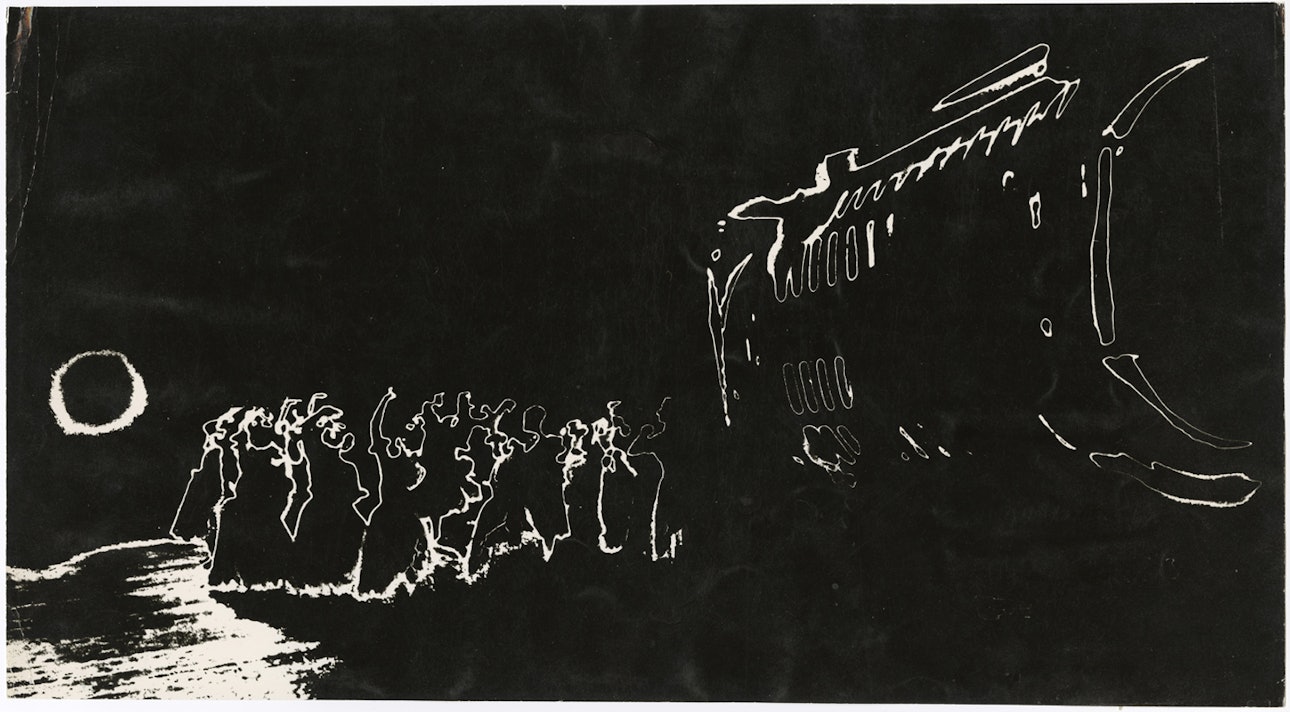
“Ballet Ghosts” © Museum of the Kharkiv School of Photography

“Two and the Sea II” © Museum of the Kharkiv School of Photography

“Two and the Sea I” © Museum of the Kharkiv School of Photography

“BAM Energy I” © Museum of the Kharkiv School of Photography

“BAM Energy II” © Museum of the Kharkiv School of Photography

“Act 12” © Museum of the Kharkiv School of Photography
For the first time in the Union: Male Nudity
This is not the only case where Rupin, contrary to accepted norms, uses the nude figure. The series “Bathhouse” (also made using solarization) was one of the first in Soviet photography to show the naked male body.
This case is also described in the “Diary”: “Yesterday Rupin brought a new photograph, and in my opinion, this already goes beyond decency. He photographed in a men’s bathhouse and then made a ‘solarization’ from this photo. It’s good that he at least thought to retouch all the indecent parts on this photo that men have and that no one should see because it is indecent.”
Rupin writes about himself as an innovator who dared to show the men’s bathhouse for the first time. The women’s bathhouse was already published in the magazine “Soviet Photo” at that time, fortunately, the bodies shown in such photos were not erotic — it was a story about hygiene and everyday life. But the aestheticization of the naked male body could refer to the condemned and “vicious” gay culture. As art historian Tatyana Pavlova writes, “nudity in photography primarily acted frighteningly, and the main connotation of this fear was the sphere of criminal liability.”
The aestheticization of the naked male body could refer to the condemned and “vicious” gay culture.

“Bathhouse,” original version 1972 © Museum of the Kharkiv School of Photography

“Bathhouse,” late 1990s version. Photo provided by the author’s family

“Bathhouse,” late 1990s version. Photo provided by the author’s family

“Bathhouse,” late 1990s version. Photo provided by the author’s family

“Bathhouse,” late 1990s version. Photo provided by the author’s family

“Bathhouse,” late 1990s version. Photo provided by the author’s family

“Bathhouse,” late 1990s version. Photo provided by the author’s family

“Bathhouse,” late 1990s version. Photo provided by the author’s family
The photographer also depicted the naked female body: he believed that this way he conveyed true female beauty. Rupin said that “the true beauty of a person is usually hidden under clothes because clothes are made according to fashion, and fashion changes from time to time, and there is nothing funnier than a photo of a woman dressed in the fashion that existed ten or twenty years ago. But on a naked woman, there is no fashionable clothing, and the body remains beautiful always, regardless of what can be put on it.”
Rupin said that “the true beauty of a person is usually hidden under clothes because clothes are made according to fashion.”
Naked women appear in Rupin’s work in unexpected places — among the forest, lying in a boat or on the pavement, under an arch. In the photo “We,” he showed himself and his wife Alena naked. He sits half-turned to the viewer; she faces us with her torso, slightly lowering her head. Today, such an image can be read as a reference to the stories of Adam and Eve. Later, Rupin and his wife will appear in other photos as well.

“Night” © Museum of the Kharkiv School of Photography

“Act XX” © Museum of the Kharkiv School of Photography
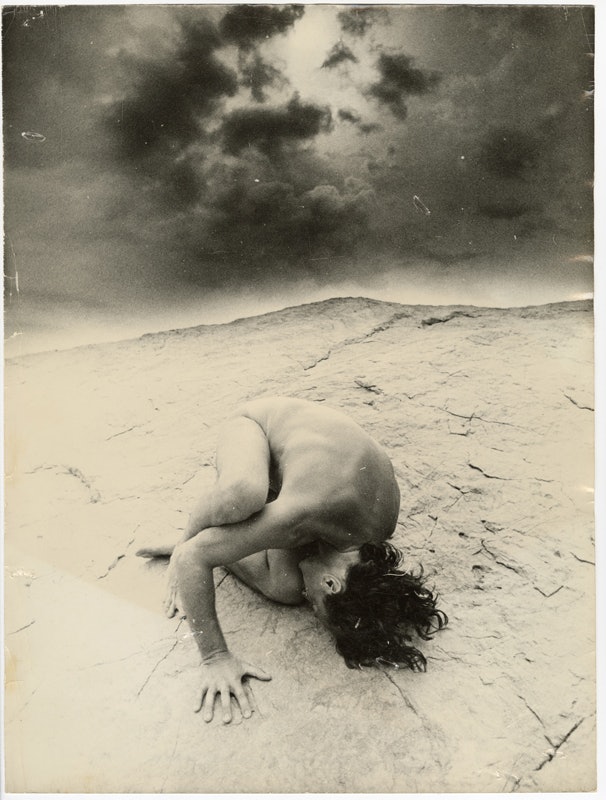
“Early 80s. Crimea. Yura and Bob were traveling. This is Bob” © Museum of the Kharkiv School of Photography
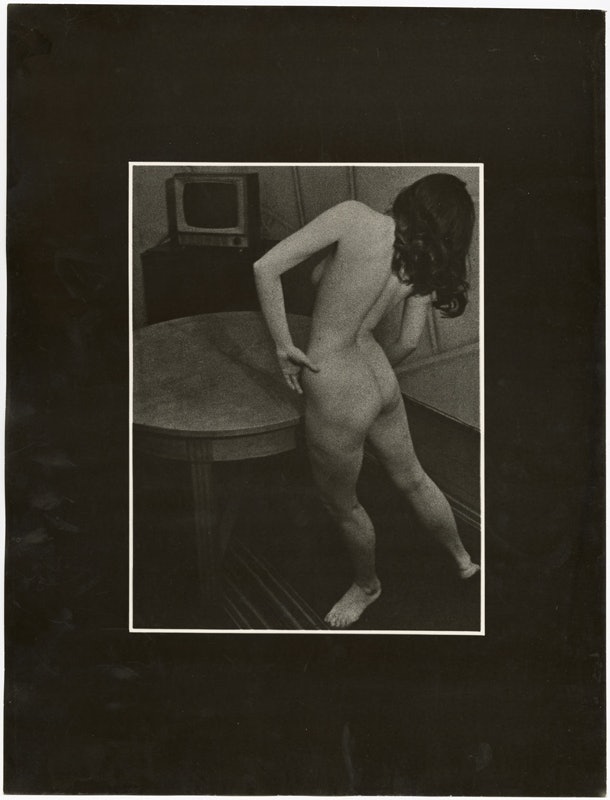
“Act” © Museum of the Kharkiv School of Photography

“Dream” © Museum of the Kharkiv School of Photography

“Loneliness II” © Museum of the Kharkiv School of Photography

Untitled © Museum of the Kharkiv School of Photography

“Boris M.” © Museum of the Kharkiv School of Photography
Freedom and Loneliness
Rupin was one of the first Kharkiv authors to turn to color printing — both in commercial photography and artistic. Perhaps one of his most famous color works is “Kharkiv Woman,” in which a young woman stands against the backdrop of a residential area. High boots, a short coat, a relaxed pose — the woman seems to manifest her freedom and independence.
Many Kharkiv photographers of that time featured the motif of a dog — often lonely, wandering through an empty city. Rupin is no exception: for example, in the photo “Loneliness,” a yard dog wanders along a deserted and cold Kharkiv street, from one house to another. This is the image of a lonely Soviet intellectual in existential search, probably describing the difficult time in which the photographers lived like no other.
In the late 1980s, Rupin moved with his family to Vilnius. He opened one of the first private galleries in Tallinn, “MRK,” which lasted three years. A year later, he opened the stock photo agency “Rupinkom,” which lasted until the early 2000s. At the same time, he wrote diaries in which he recalled the group “Vremya.”
Rupin died in Vilnius; after his death, only photos and texts remained. His name rarely appears in photo publications and books. However, his practice preserves the spirit of the time that can no longer be touched.
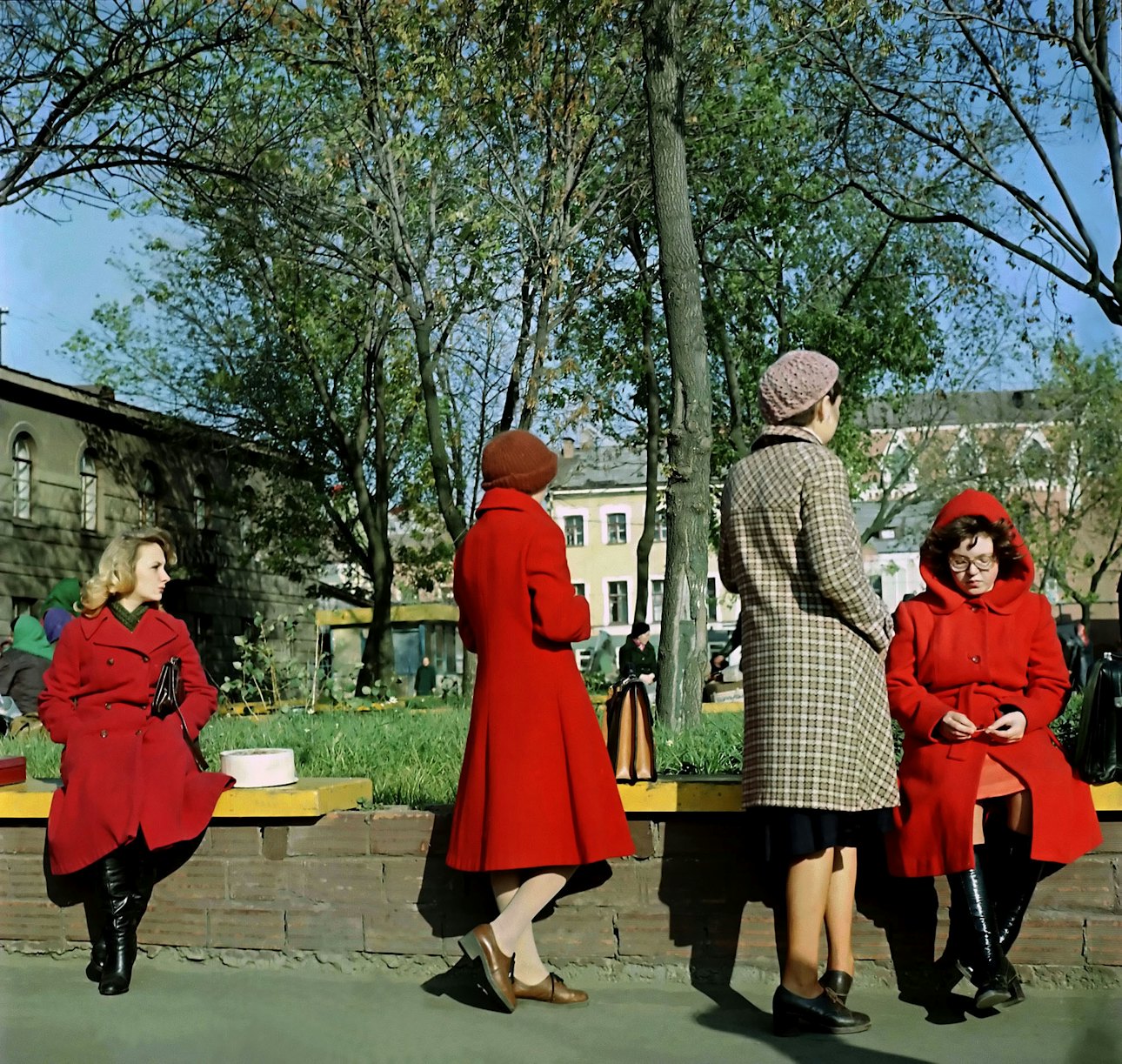
“Bus Stop.” Photo provided by the author’s family

“Bus Stop.” Photo provided by the author’s family

“Painters.” Photo provided by the author’s family

“Dinner on the Lake Shore.” Photo provided by the author’s family

“Kharkiv Woman.” Photo provided by the author’s family