Today I spent a day with the artist in the company of Stas Volyazlovsky – an artist who lives and works in the city of Kherson. The famous author of “chanson art,” a participant in many international projects and biennales, spent several days in Kyiv, where at the request of ART UKRAINE he was caught off guard by the curator of the Small Gallery of Mystetskyi Arsenal – Dana Brezhneva.
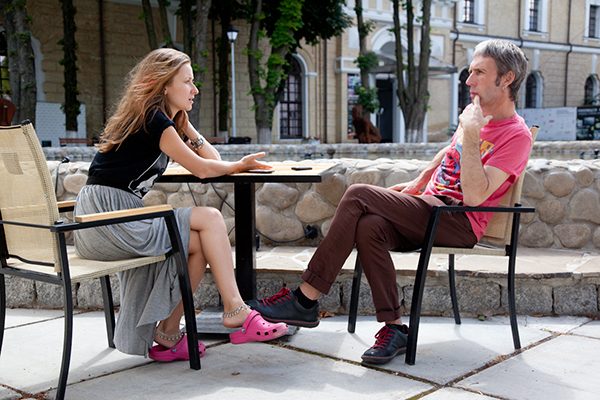
Photo by Kirill Haidai-Roskoshnyi
It should be explained that in my gallery activity I am guided by a great interest in artistic manifestations in the regions of our country. In particular, I have already spoken with Max Afanasyev, with whom you closely cooperate within the TOTEM group, and I know a little about the SOUS association (South Ukrainian Culture – a resource about the culture of Southern Ukraine). Now it is interesting to learn your point of view on what is happening in Kherson. Besides your activities, what else is happening in the city’s artistic environment?
My friends and I are endlessly delighted by the activities of the Kherson Union of Artists. Their exhibition hall is located on the main square, 150 meters from the regional state administration and the Lenin monument, from whose pedestal, after the leader’s fall, they made a monument to the “Heavenly Hundred” – they covered Lenin’s pedestal with oracal vinyl in the style of embroidery with the inscription in a Narbut-style font “Monument to the Heavenly Hundred,” and on top, a “flag.” Again, a “creative invention of the Kherson Union of Artists.” Part of their creative activity is earning money to survive. To keep the organization alive, renting helps. For example, they rent a piece of their wall to some bank, where they installed an ATM. The face of the machine is obviously outside, but the backside is inside the exhibition space. The part inside is humanely covered with a curtain so as not to interfere with the integrity of the exhibitions consisting of still lifes, landscapes, portraits of bread growers who died long ago, as did the artists who painted them. And so people look at the paintings, and suddenly pieces of gold start falling and rattling behind the curtain at the ATM – everyone, of course, jumps in surprise. And when the machine swallows people’s cards, they start demanding that the hall attendants pull them out “FROM YOUR SIDE!” There was even a case when this hall was broken into because of the ATM; the ATM was not opened, but the establishment’s landline phone, 15 hryvnias, and window cleaning detergent were stolen, while the paintings remained in place. It’s a pity. There were no cinematic empty frames with remnants of canvas rolled up and already on their way to Amsterdam or somewhere else where they were ordered and awaited, smoking a $200 cigar, tapping another hand with a 60-carat ring on a case with a million euros prepared in exchange for an immortal work. The ATM itself somehow locked especially during the break-in. It turned out this was designed so that if you pry the ATM with a crowbar, it locks, so the law enforcement had to bring a guy in handcuffs who opened it in 7 minutes. The police applauded him, put the handcuffs back on, and took him away. And all this happened in the exhibition hall.
There are few events in the city, so sometimes I attend them – just to laugh. When openings take place there, exactly at three o’clock everyone gathers and takes turns giving speeches – everything is very “solemn.” At this time, people in bulletproof vests with automatic rifles and metal boxes come in, shouting “Make way!” and head to the ATM. The whole solemn crowd parts, they pass through and start rattling the boxes, and everyone stands and waits.
The Union also likes to host, for example, a women’s lingerie store in their premises. When you are there looking at paintings, you turn a corner, and there is such a store – it throws you back, like when you accidentally enter a women’s restroom. The most interesting thing is that what can be called a performance happened even before the ATM and bras. Around 2005, I went to an exhibition of an artist who paints flowers. She paints them very beautifully. Since nothing beautiful is alien to me, despite my “this is mine and that is yours”: in the first hall there were indeed flowers, but in the second I was stunned. There were shelves with glasses, an eye chart, and a lady in a white coat who checked the eyesight of everyone who wanted. It turned out that the “Ochkarik” store had moved in, where you could check your eyesight, pick glasses, buy them, and look at the artist’s flowers, which she paints very beautifully, in a new way. Her works were not removed – only one where the eye chart hung.
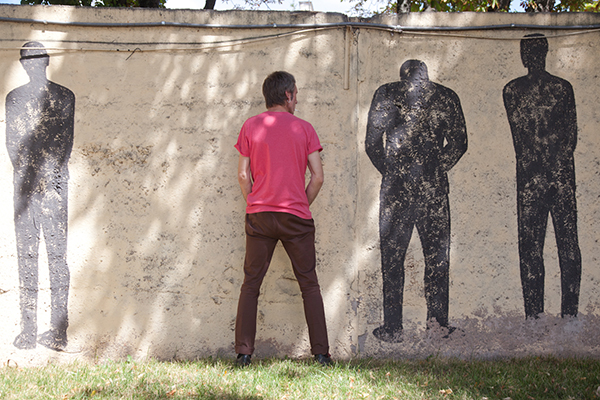
Photo by Kirill Haidai-Roskoshnyi
This reminded me of your video about the exhibition of dwarf monkeys at the Kherson Art Museum. And what is your relationship with the Union?
I participated in the Union’s exhibitions for quite a long time. That was a long time ago. I exhibited ceramics there for 10 years. By the way, I taught ceramics at a vocational school and a children’s and youth center in one of Kherson’s districts. I have 9 years of teaching experience and not a single corruption case (laughs).
The Union brothers loved ceramics. First, the windows are empty, and the windowsills are not small. Women, folk craftswomen, bring knitted napkins, and on top your ceramics – beautiful like at home, cozy in the exhibition. Floor vases in the corners – even the corners are filled.
Union members repeatedly offered me to join the Union. I even came to a meeting, but then what I called the “paradox of the 16th Shevchenko” happened. When selecting works for the all-Union exhibition, everyone, of course, brought portraits of Shevchenko. At the 15th, the chairman said, “That’s it, no more Shevchenkos,” and then the oldest Union member entered the door proudly carrying his 16th Shevchenko, and for some reason, he was in a tuxedo and with a white chrysanthemum; clearly “under the influence,” judging by the smile that did not match the background where Cossacks were fighting “to the death” – either with Poles or someone else “for our Ukraine.” He was colorful, while the Cossacks were all gray. The chairman looked at the “creative brothers” – well, he said, we have to respect it – and so the 16th Shevchenko went from Kherson to Kyiv.
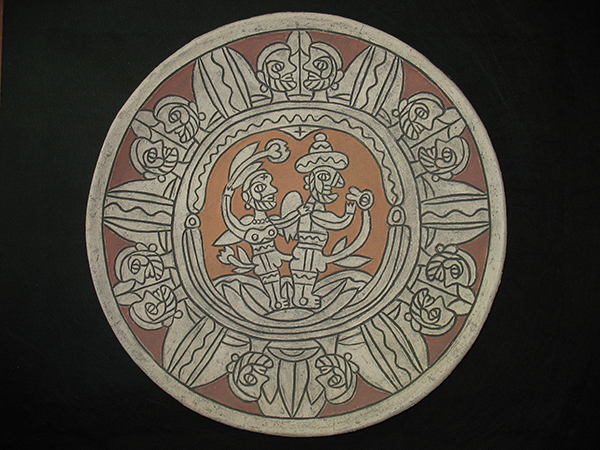
I developed a protest against these participations and admissions – phallic symbols began to appear in my ceramics. To put it mildly, phallic symbols. At first, they had some ethnic character, and then I somehow made a composition on wall plates where guys impaled each other: everything was very subtly ornamental – from a distance it seemed just a beautiful ornament. They even hung them – people there still trust each other since Soviet times: well, it can’t be that some artist in the USSR brought Lenin with a dick instead of a nose! People at the opening said from afar – what beauty! And this prolonged “aaa…” as they approached the work. From afar it was flowers, but up close, dicks. They stopped inviting me.
At some point, I realized that I had completely exhausted ceramics. I was never particularly interested in form – I just made a vase or a plate; it was, for me, a kind of sheet of paper on which I applied an ornament. Ceramics has one problem – deliberate souvenir-ness.
How did you switch to graphics?
Now I make “rags” – that’s what I call textiles, with which I am known today. These are old sheets, ballpoint pen, tea. I have always done graphics, ex-libris. I even have an etching press. I sent many works to various ex-libris and small graphics events. I received catalogs from different countries. Nice… But even there they started to freeze, the subjects were not the right ones… Not their format.
The impetus for the aforementioned “rags” – and not even rags, but rather a form or language that I call CHANSONART – was given to me by Yura Solomko, for which I will always be very grateful to him. They are old friends with Slava Mashnitsky, who created and registered the Museum of Contemporary Art in Kherson, where works by Alexander Hnilytsky, Oleg Holosi, Maksym Mamsikov, Mykola Matsenko, Serhiy Anufriyev, and others were exhibited. By the way, the exhibition of Matsenko in the Union was also funny: although his work is quite calm, it still caused a stir in Kherson. We found the following entry in the book of reviews and suggestions: “Only after viewing the exhibition of artist Mykola Matsenko can one fully appreciate the work of the Union of Artists, all its still lifes, paintings… The artist needs treatment.” And the signature – a certain psychiatrist, and bang – his personal doctor’s seal.
So, Yura Solomko came to Slava, they came to my studio, he looked at the works and wildly criticized. He said: well, everything is, of course, good, but somehow everything is raw. “Think more,” he says. “Why are you doing all this – everything seems to be here: stylization, composition, and you have good taste.” And then he thoughtfully added, “your works remind me of schizophrenics’ works.” I was not offended, I started thinking: why indeed? And also: somehow, with all these dicks, I felt that it was just a dick. Well, to irritate Kherson… Despite my hooliganism, there was no courage in this. I remembered a character from Ilf and Petrov who deliberately went to a psychiatric hospital to openly criticize the Soviet government, and I thought that I was indeed within some limits. Then I began to experiment with rags, text, images, and let go of consciousness. Then Sasha Solovyov came to Kherson – he had a working trip around Ukrainian cities. He saw me in the magazine “Nash,” where I was published a lot. I had an exhibition at Slava’s museum, where we met. He liked everything, took disks with my works. After a fairly short time, I came to Kyiv, stayed with Yura – I had an exhibition at the “Tsekh” gallery. Solomko immediately noted my reaction to his criticism. It really helped me. I am very grateful to him.
He told me: “Stas, you came up with a very convenient format – you folded the rags into a backpack and took a solo exhibition anywhere.” It was also nice that Oleg Tistol approached me and said: “You did what we always wanted but were shy to do.”
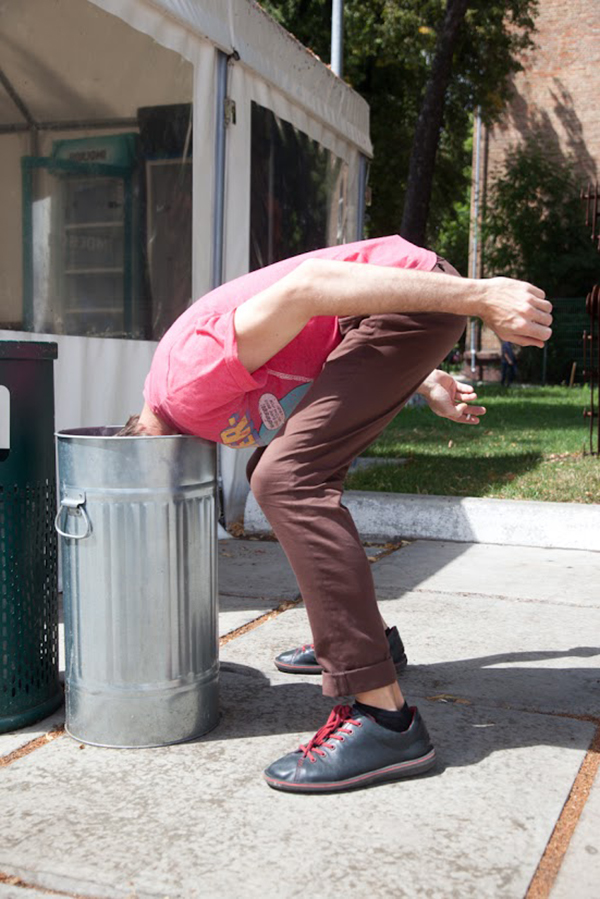
Photo by Kirill Haidai-Roskoshnyi
What is your relationship with Moscow – as far as I remember, you have been working exclusively with the “Regina” gallery for several years? How are things there?
I met Volodya Ovcharenko at the opening of the exhibition “GENERATIONS. UA/USA.” at the PinchukArtCentre, and since then I have been cooperating with the “Regina” gallery in Moscow. I have already had two solo exhibitions there, and I also participated in group exhibitions – the Third Moscow Biennale, “Art Moscow.” Thanks to Volodya, my works travel to many art fairs around the world.
My work is in the collection of Sidney Sherman. In Turin, a collector hung my “rag” next to a Basquiat painting.
Regarding the question of prices, etc. – this is not a topic for an artist. And, as Volodya said in one interview: “Volyazlovsky is a wonderful artist. He is exactly the example of a person from whom art simply bursts out. Stas is sincere, he has no calculation: like, I’ll make something to quickly sell it. He is interesting not only in Ukraine and Russia. Such art has a future.” I’m not bragging. Although, I won’t hide it – it’s pleasant.
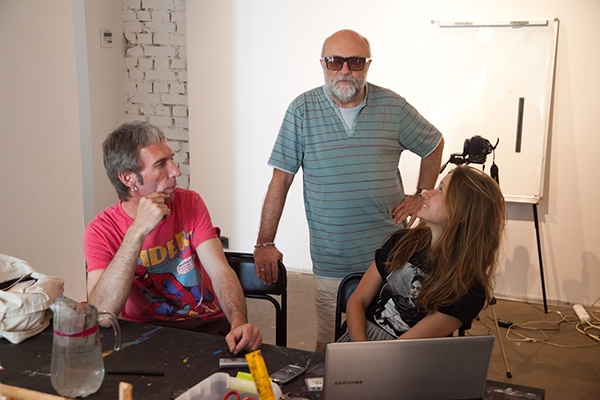
Photo by Kirill Haidai-Roskoshnyi
Tell us about your tender friendship with Serhiy Bratkov. I think he adores you.
Let it sound banal, but he is a very good person. We have been friends for quite a long time, he gives me advice both concerning creativity and life. I communicate with him almost every day, well, at least every week.
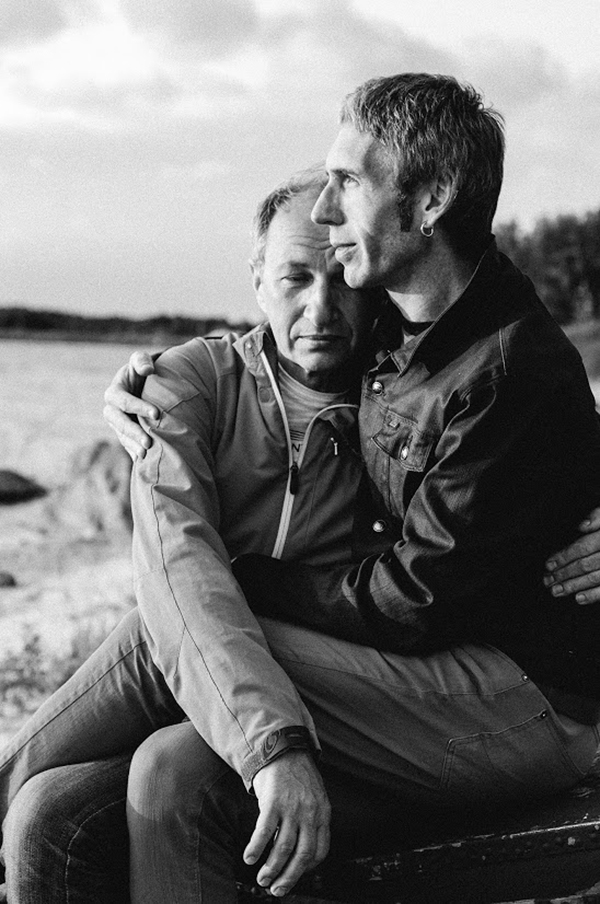
Photo by Anna Bekerska
Brother, as they call him.
Brother… I have no brothers in the family sense, I would like him to be my brother. Like an older brother. Although I constantly feel that he is younger than me. I look at his energy, attitude to life, how easily he overcomes difficulties. Many artists become the same, repeat themselves, while they can be excellent, maintain the achieved level, but in the end, they bore both the artists themselves and the audience. It doesn’t work. The theme is exhausted, blind self-production begins.
But Serhiy doesn’t have this, he never lets go of the camera. He is very lively both in life and in creativity – he does not stop at what he has achieved, constantly searching, searching, searching…
Also, with him, you can always get beaten up. When we were in July at the residency in Irshansk from “Biryuchiy,” Serhiy made a project “North Korean Pavilion.” It was a site near the sanatorium where we all lived, with gazebos, swings – a recreation area. It was among birches and firs; it looked like a piece of Russia, which, obviously, right before our eyes, is turning into something like North Korea. In the gazebos, he placed photos of Kim Jong Un, parades, mixed with dogs in tights, worms, and other nonsense. Of course, this cannot be taken seriously, but there was a person who was looking for Bratkov to beat him up. It turned out he lived in the room right above us. Once we heard a conversation: “Damn, where is this artist?? I haven’t beaten him up yet.” Later, when Bratkov was not nearby, I met this person – he came from the ATO and, apparently, seeing the red star, decided it was the Soviet Union.
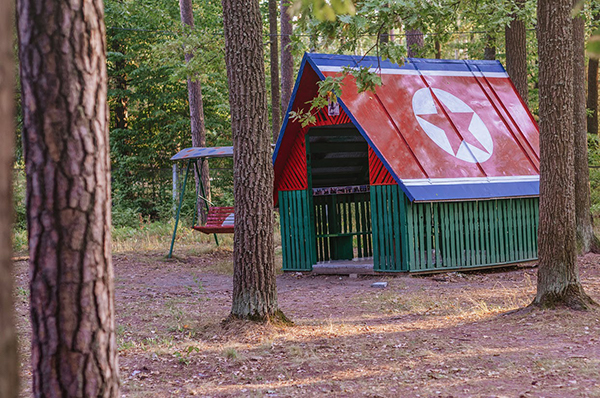
Photo by Anna Bekerska
Yes, now everyone is very sensitive to this symbolism.
I really talked to him: “Look, there is a dick hanging next to the flag, understand, this cannot be taken seriously.” And I add: “See, art caught you!” He especially liked this phrase – because it means he understands it!
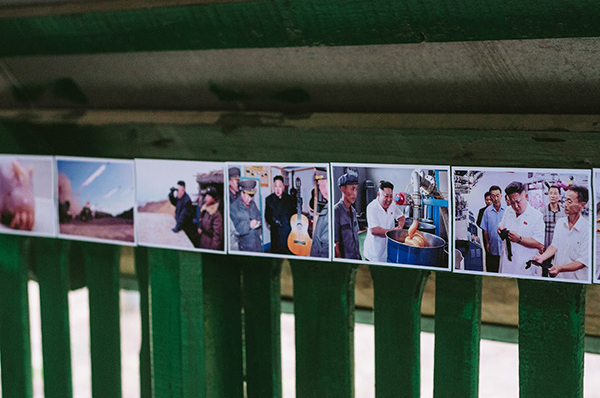
Photo by Anna Bekerska
Let’s focus on recent projects. Tell us about your work in Irshansk.
In Irshansk, I painted a rag. It is dedicated to IGOK – Irshansk Mining and Processing Plant. I hurried for Metallurgist’s Day, made it in time. The text was composed with my creative brother.
We lived together in one room of the local sanatorium-preventorium. And at night something ran and scratched, apparently in the room above. Very scary. The concierge gave keys and said to read the “Our Father.” I took a Bible and keys from her, and my brother, of course, took a camera. But the room was empty. In this Irshansk, everything is made of black polished granite. Like in a cemetery. They mine this stone there. At the entrance to our sanatorium stood a slab with a grave inscription – Sanatorium-Preventorium Irshansk. Very scary. A person comes to get healthy, but his grave meets him. One-way trip. But they are used to it – even children’s sandboxes are fenced with slabs there.
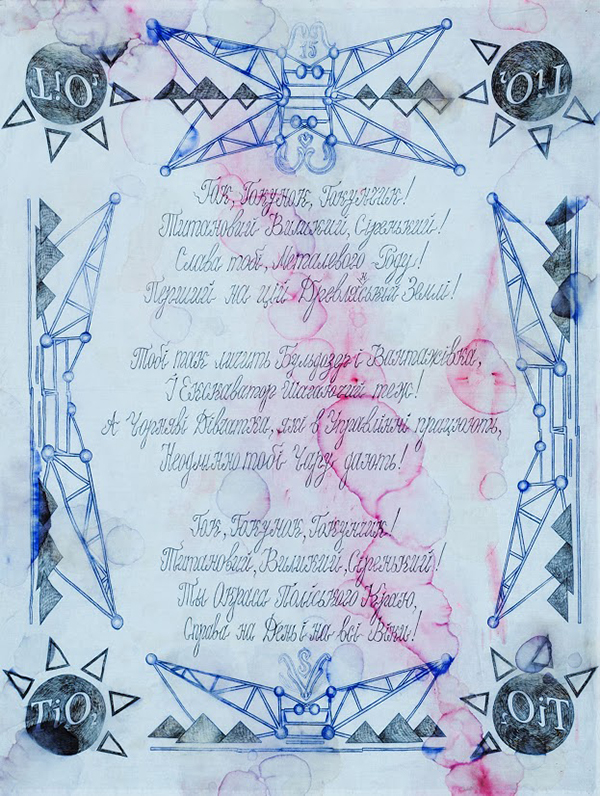
Photo by Anna Bekerska
Tell us about the Malevich Prize you received in 2010 – I might not have asked about it, but you recently were in Düsseldorf thanks to the Polish Arsenal Gallery and the Polish Institute in Düsseldorf. What can you tell us about the projects you did thanks to the prize?
Because of it, I was not only in Düsseldorf. Every two years, new prize winners are added, projects are formed, replenished with new names. Specifically, in Düsseldorf, I had my project “Cozy,” which you could see at the National Art Museum. I first showed it in Poland, in the city of Białystok, at the “Arsenal” gallery.
Don’t you think the project lost relevance after the fall of Yanukovych’s regime, when Pshonka’s houses, Mezhyhirya, etc. were exposed and ridiculed?
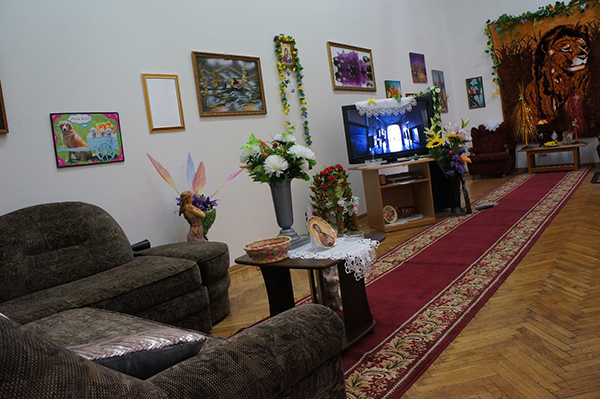
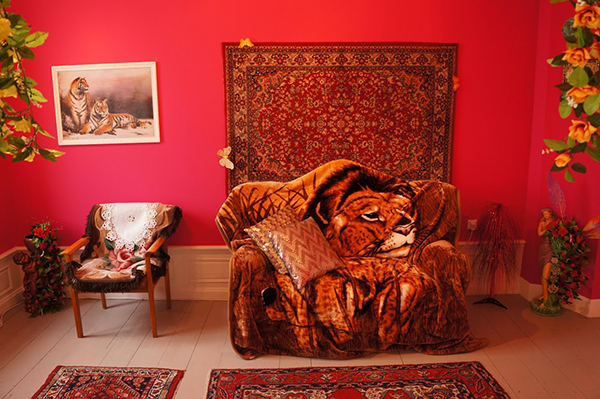
The installation was made long before these events. I always emphasized that it is absolutely everyday. All this is sold at Auchan, Epicenter, and is still bought in huge quantities. When I watch interviews with people who visited Mezhyhirya, I notice that at least half of them have shining eyes – they would like to live like that. It’s popular: for example, the owner of two or three kiosks can live like this, only not ordering furniture from Italy or stealing it from museums, but taking it from some nearby Auchan. All items will be made of plaster, covered with gold and velvet. The main thing is that it looks beautiful. Therefore, my project has not a political subtext, but rather an everyday one. It is the people’s love for beauty.
In Kherson, in the private sector, they also like to build feudal palaces with round windows, towers, family monograms, lions, and so on. Maybe they watched fairy tales in childhood: “Cinderella,” “Robin Hood,” etc. So, it does not lose relevance even after it was publicly ridiculed.
This is the same chanson art framework you stick to, only in the interior.
Exactly. But the most interesting thing is that I made the first “Cozy” in Poland, and I asked them to paint the walls pink and could not explain exactly what color I needed. They poorly understood me until I showed them my underwear, which was exactly the right shade (a girl once gave it to me – she was thrilled when I wore them). And they are of such a color that when you look at them, then close your eyes, you can still see them. Like a pink sunbeam. We went to the store to choose paint – of course, there was no such disgusting color as my underwear, so I had to show them to the sellers so they could mix it. That’s the story about the underwear. And when the Poles laughed at the opening, looking at the resulting coziness, I told them that all the items were bought precisely in Białystok. I stood in a huge queue at a Chinese store. And people were grabbing all this crap just the same. This kitsch exists everywhere.
In Düsseldorf, the best “Cozy” was shown, the exhibition space had a ceiling with monograms. It was the building of the Polish Institute in Düsseldorf.
A good group project you recently participated in – “Master Art”. Tell us about your impressions.
The exhibition turned out interesting. I think there has never been anything like this in Ukraine. I encountered this format for the first time. A “company” producing contemporary art hired Chinese to make copies of works by six artists: Zhanna Kadyrova, Viktor Pokidants, Lesha Say, Maksym Mamsikov, Nikita Kravtsov, and mine. These copies were actively sold there – I got 500 hryvnias for two.
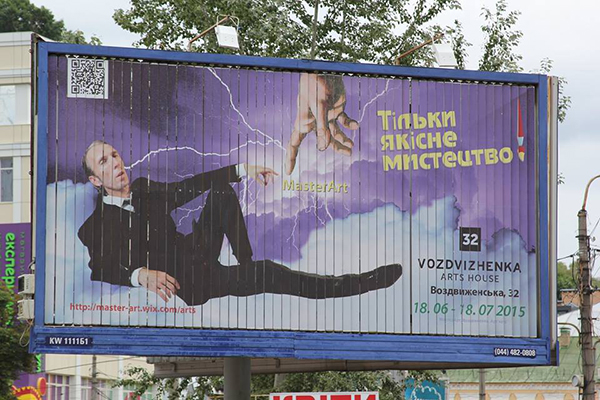
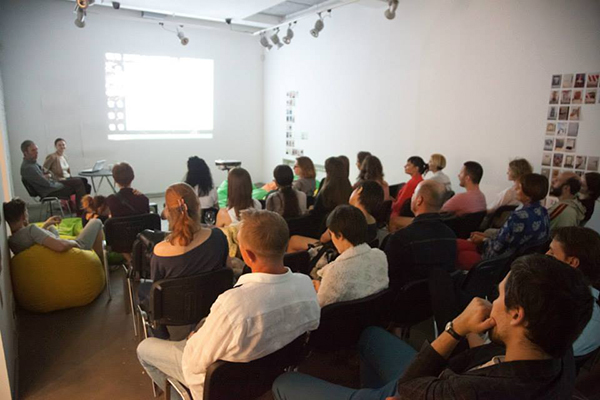
A month ago, in the Small Gallery of Mystetskyi Arsenal, together with the Open Archive of Ukrainian Media Art, we held a screening of your works. I really liked your comments. Have you thought about teaching, since “modern art clubs” have become so fashionable now?
Honestly, I am used to working with small children. Modeling from clay. That’s one thing. Recently, I was offered to give a lecture on contemporary art for children from Donbas. I failed. Stories I had heard many times kept spinning in my head about how Donbas children, brought here during lessons, fall to the floor and hide under desks at the sound of firecrackers, and I have to tell them why Picasso put eyes on the back of people’s heads, mouths where eyes should be. What if they saw their classmates like that after those “firecrackers and salutes”?
And for adults… I don’t feel that I have the right to teach anyone anything. I have neither the desire, nor the vocabulary, nor the knowledge to convey consistently. I don’t consider myself sufficiently literate, although I have seen and read a lot.
About my creativity – yes, I can talk. My art is closed in itself. It is outsider. It is naive. It is information digested within my life in Kherson – hypertrophied, grotesque perception. I can talk about why I do it, what for, how I started doing it, but criticizing someone or saying this is good and that is bad – not for me.
Do you like giving interviews?
I gave my first interview in life at vocational school No. 4, where I worked as a production training master in 2003. I had small animal sculptures. The journalist asked me: “What inspired all this and how did you do it?” and I answered, “Well, how, well, how, I sat down and did it.” Silence in response – then she went to someone else…
The thing is, I draw and often don’t know what the work is about until I finish. It’s a stream of consciousness. Sometimes a story appears, often invented by me, about my life. Exaggerated, idiotic, but when you laugh at yourself, it’s somehow not scary to live on.
In one of your interviews, I read that this is how you unload yourself from some–extra information.
Yes, it is a kind of art therapy. I never wanted to live with my works, especially with chanson art. I don’t have them at home, they weigh me down. That is, I saw people who bought my works and even hung them on the wall. I asked: “HOW?” Apparently, they lack some darkness in life: everything is so good that it needs to be a little bad. It’s akin to a pile in the corner.
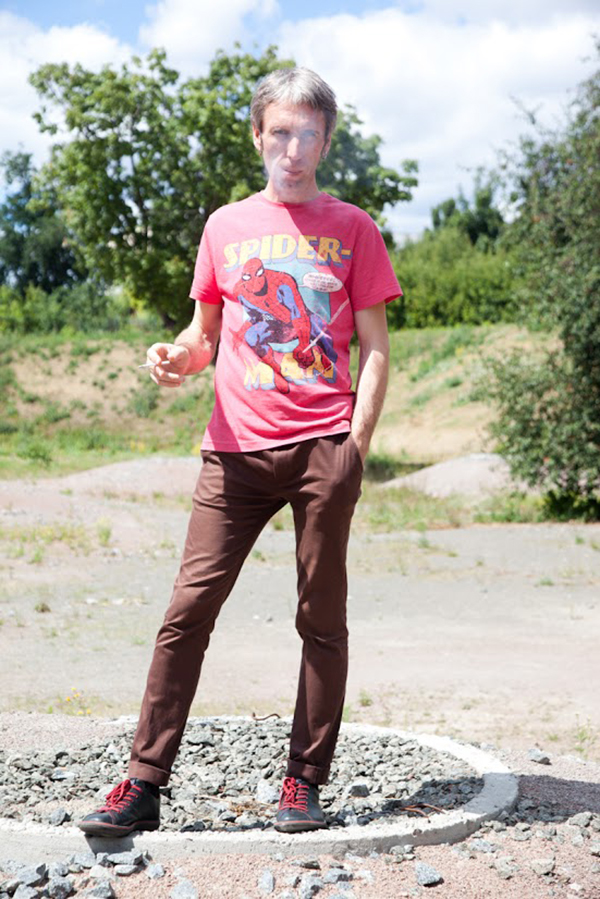
Photo by Kirill Gaidai-RoskoshnyLink