
On January 8, Stas Volyazlovsky passed away, one of the most vivid and undoubtedly important artists working in contemporary Ukraine. He was 46 years old.
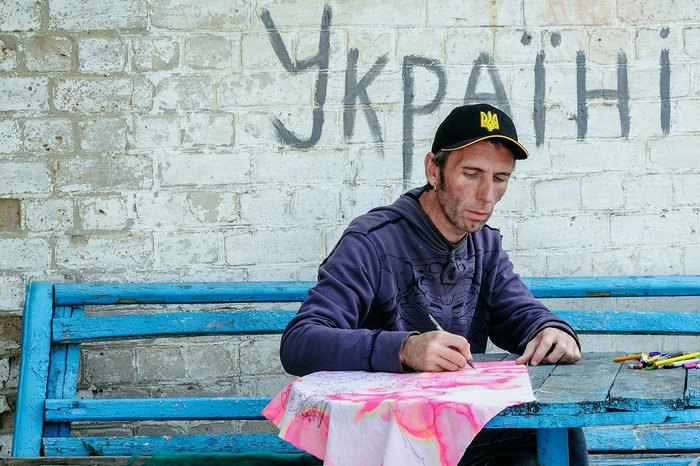
Volyazlovsky lived and worked in Kherson, where already in the late 1990s an active and absolutely special environment had formed around the “TOTEM” association, of which Volyazlovsky was an integral part. It so happened that many “local geniuses” sooner or later move from different parts of the country to Kyiv (Moscow, Berlin, and so on) in search of greater professional opportunities and simply a life richer in cultural events. Volyazlovsky chose to stay in his place and did not move anywhere, although he was very close to various artistic communities, including the Kyiv one. Speaking generally, he was the main conduit of the phenomenon “contemporary culture of Kherson” beyond his region. Nikita Kadan writes on his Facebook page about an important project involving Stas:
“I remembered how in 2007 Stas brought a huge number – by my impression, hundreds – of works by Kherson artists to Kyiv for the exhibition “Community Project.” In a day or two, he covered the huge hall of the CSM at NaUKMA from floor to ceiling with them. In addition, many video works were shown. At this exhibition, he himself, Sasha Pechersky and Zhukovsky, Vyacheslav Mashnitsky, Elena and Maksim Afanasiev, Yulia Volyazlovskaya, and various names I had never heard before or after were presented. I remember my feeling from the hall as absolute blissful amazement. A story about altruism that was never flaunted, and loyalty to the place and community, which meant a lot to Stas.”
One of Volyazlovsky’s last Kherson collaborations was his joint group “Rapany” with Semen Khramtsov, whose aesthetics literally turned spontaneous Ukrainian visuality and everyday kitsch inside out. All the group’s DIY “clips” are freely available on YouTube. The last live performance and screening of the group’s clips took place in Lviv in October 2017, at the invitation of the head of the art academy Oleg Suslenko, as well as the informal gallery “Detenpyla.”
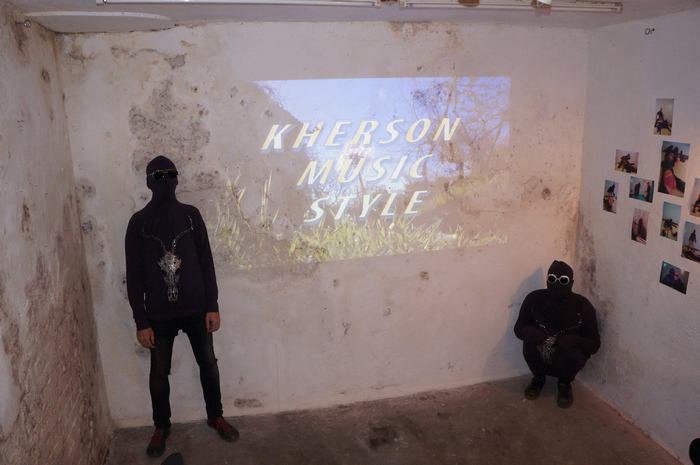
Performance of the group “Rapany” in Lviv
Volyazlovsky’s artistic practice is difficult to reduce to a set of terms. Everything he created – whether for exhibitions, for a YouTube channel, or without a specific project goal – was his living reaction to the surrounding reality, a pure statement about the beauty and absurdity of life. He called his most iconic works – drawings with a ballpoint pen and tea on paper and sheets (“rags”) – CHANSONART. In these works, Volyazlovsky dissected topical political themes and filled them with his own “personal mythology”: a system of signs and images mixed with erotica, the aesthetics of criminal tattoos, and references from mass culture.
Artist Volyazlovsky was successful. He participated in many important group exhibitions in Ukraine, collaborated with curators and gallerists, exhibited in European institutions. For a long time, he collaborated with the cult Dnipro magazine “NASH.” After meeting gallerist Volodymyr Ovcharenko at the Generations.UsA exhibition at PinchukArtCentre (2007), he collaborated for a long time with one of the largest Moscow galleries “Regina.” In 2010, he received the Kazimir Malevich Prize, initiated by the Polish Institute in Ukraine. He participated in the 3rd Moscow Biennale of the famous French curator of the “old school” Jean-Hubert Martin.
And also, artist Volyazlovsky was loved and respected, it seems, by absolutely everyone who knew him well or at least had episodic contact with him. Among the stream of memorial posts on Facebook after the news of his passing, I especially remember the most accurate and comprehensive comment by Sasha Dolgiy, an artist and head of the main underground Kyiv space EFIR:
“Stas was the only one in contemporary times who was honestly f***ing cool and very beautiful and did not try to hide it.”
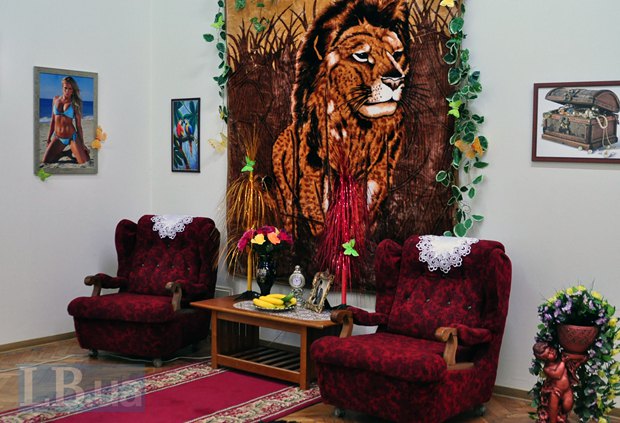
Stas Volyazlovsky’s Cozy Project at the Malevich Prize winners exhibition at NHMU in 2014
Thinking about Volyazlovsky, his work, his place in the contemporary art process and now in its history, I remembered the last conversation with NAOMA professor Anna Zavarova, the scientific supervisor of my diploma, one of the last “grands” of the Kyiv art history department. I had just graduated from the academy and enthusiastically talked about my desire to get a “real curatorial education.” After listening carefully, Anna Vladimirovna succinctly countered my enthusiastic fantasies with criticism of the institutional system in which art exists today. This system has generated not only various opportunities to support artists, including the curatorship institute, but also a certain semantic cap (the quote is not exact), inside which today it is impossible to imagine the emergence of a figure like, say, Van Gogh. At that time, of course, I disagreed, and the reference to Van Gogh (even if conditional) seemed unconvincing to me. Over time, I understand more and more what she meant and increasingly agree with it.
I suppose this episode came to mind now precisely because Stas Volyazlovsky was exactly that “Van Gogh” – an exception to the rules, absolutely free, independent of market conjuncture, curators’ conjuncture, attributes of “institutional success” and official recognition, which he harshly mocked using the example of the Kherson Artists’ Union, renting out its halls to ophthalmologists and lingerie sellers. Volyazlovsky was unique and unrepeatable, forgive me this postcard-like phrase, which suits him like no one else.
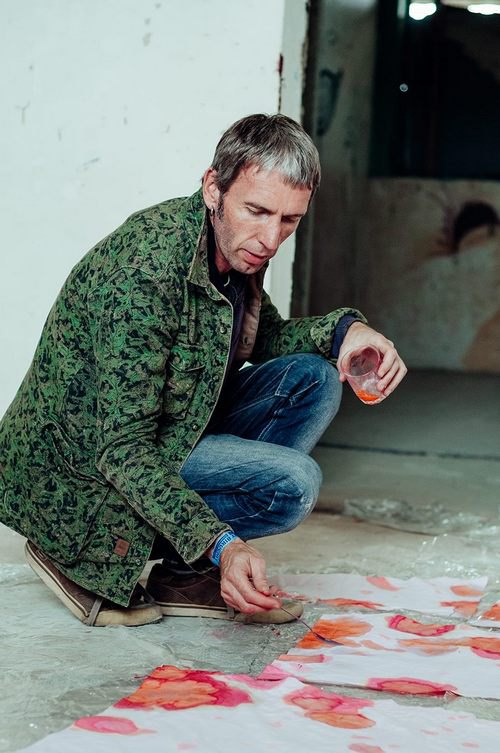
I was not a close friend of the artist. I cannot claim to be an expert on his practice, which definitely needs serious analysis. As a viewer, I am concerned about something else now. After the activity on Facebook and the “kitchen” talks subside, after (I hope) some number of memorial exhibitions and events take place, Volyazlovsky’s work will remain closed to a wide audience. There is no place for his works and archive, as there was and is not for other important artists of the past and present.
Living one’s life brightly and intensely, living it to the fullest was the artist’s right. And those who remain after him bear the responsibility to preserve his legacy, not to lose it, and not to rely on future archivists.
RIP, Stas Volyazlovsky, a truly beautiful and f***ing cool artist and person.Link