For two days now, his friends and acquaintances have been trying to come to terms with this thought. They reflect, finish unspoken words in mental dialogues, recall, tell funny stories from Stas’s life, ask the question “why?”.
He was an infinitely complex person, and everyone saw him in their own way. People argued with him, quarreled and made up, admired some of his works, were surprised by others, were outraged by yet others. And it is impossible to fit this entire huge world into the framework of one article. Especially an article that, in essence, will become an obituary for a person you had coffee with just three weeks ago.
I have known Stas for more than twenty years. We worked together in different newspapers. First in “Vzlyad”, then in “Vgoru”. He was a photographer. I was a journalist. I was always amazed and admired his ability to see what others do not see. He was a perfectionist – he spent hours selecting photos for materials, doubted, rejected. I was not allowed into his art workshop. There he was alone with his sheets and mattresses, clay and paper. I once asked him how he works. He said he improvises, never knows what the final result will be.
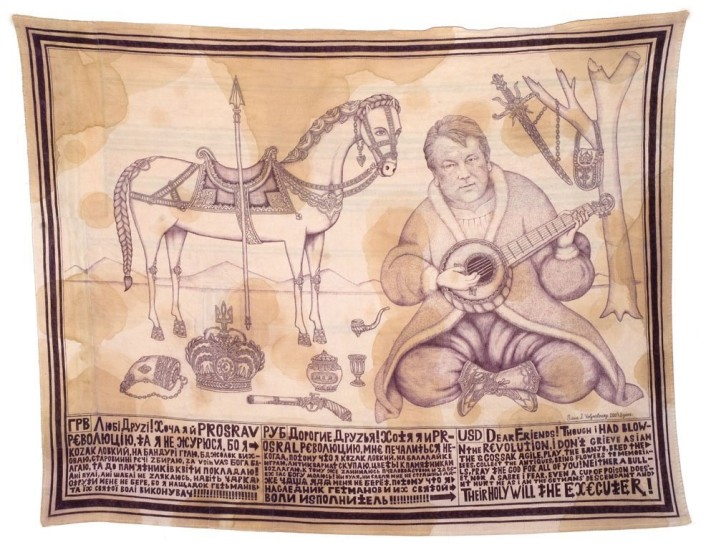
Stas Volyazlovsky. “Kozak Mamay 2008”, 2008.
A few years ago he gave an interview to the newspaper “Vgoru”, where he explained why and how he paints:
“This is my reflection on the world in which I exist, with its interests, problems, fears, religion, new cultural challenges, with its television and programs filled with stupid advertising, dismemberment, crime, pornography, series and politics, with its yellow press and its internet. Perhaps for me, this is a kind of art therapy. I really manage to free myself from everything that invades my brain against my will. I take and dump everything that has piled up in a kind of folk-concentrated form on a sheet of paper or old second-hand sheets, which I paint with ballpoint pens.”
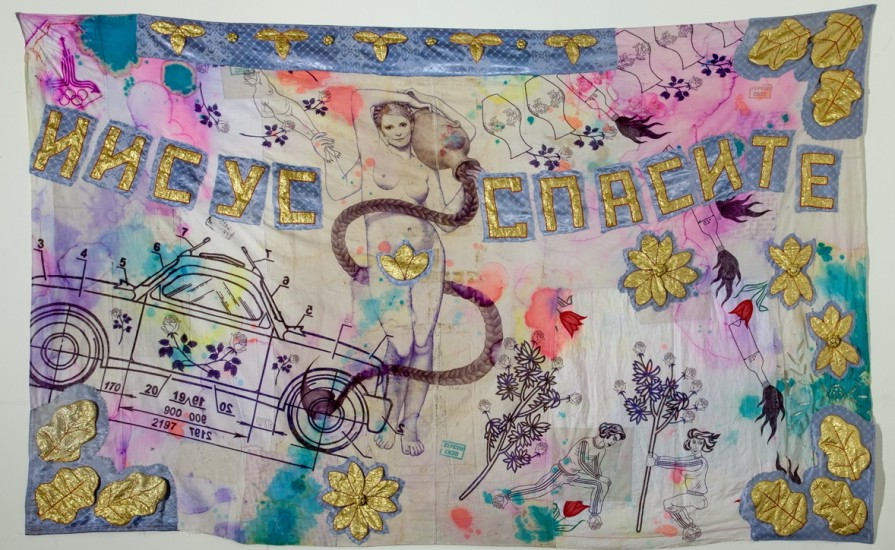
Stas Volyazlovsky. Jesus, save me, 2014.
And in the end, works were created that participated in international exhibitions in Poland, Sweden, Germany, Britain, and Russia. In 2009, Stas Volyazlovsky was a participant in the Moscow Biennale of Contemporary Art curated by Jean-Hubert Martin. In 2010, he became a laureate of the Kazimir Malevich Award of the Polish Institute in Ukraine. Stas’s works were exhibited at 5 solo and 20 group international exhibitions and biennales of contemporary art, including the Armory Show in New York, Artissima in Milan, Frieze Art Fair in London, Generations.USA at the PinchukArtCentre in Kyiv, and the 5th International Triennale of Small Graphic Forms in Vilnius.

A work from the mattress collection created by the Kherson artist Stas Volyazlovsky specifically for display at the largest American art fair Armory Show-2011, held in New York.

Photo from the “Vgoru” archives. Stas Volyazlovsky: Mattresses “aged” by time and by strong tea, drawing applied with a ballpoint pen…
People say about Stas: the founder of the “chanson-art” style and an unsurpassed master of political portraits, a witty summarizer and a bright videographer, a master of performance and author of fairy tales, poems, and manifestos. He appeared in contemporary Ukrainian art in 2007 and left at the beginning of 2018. He left unexpectedly for everyone.

Elena Afanasyeva (curator, TOTEM Center) recalls: Elena Afanasyeva (curator, TOTEM Center) recalls:
“It’s even hard to remember what year it was. The late 90s. TOTEM was then making TV programs about interesting people of Kherson, and someone introduced us to Stas. He taught ceramics to children at the Pioneer House on Sukharka, as we later said – sculpted hares. The hares, by the way, were very creative. Stas turned out to be a really interesting interlocutor, completely smashing the ossified artists’ union at that time, it was clear he wanted something different, new, fresh. Then there was the exhibition of young artists “Seven” at the museum. There really were seven authors. Stas’s works – a gouache cat and ceramics – were called “secondary” by a familiar art historian. But it was still “different” art, and since then our friendship with Stas began.
At the first opportunity, I invited him to a creative project and a trip to Uzbekistan. This could be a separate story, if not a novella. It was Stas’s first trip abroad, there was a lot of humor, and while our photographers documented the Eastern reality, Stas (who then still did not have a camera) decided to make a series of comics about our journey. These comics later illustrated an article in the magazine “NASH”, and the style found on the trip Stas developed in fabric works.
The magazine “NASH” is also a whole era. In December 2017, the magazine turned 19 years old. On December 24, Stas wrote in comments on Facebook: “This is probably the best thing that has happened in my creative life.” We really “were friends as families” – Kherson’s TOTEM and Stas Volyazlovsky and Dnipro’s NASH. Not a single issue went without Stas’s photos or drawings. In NASH, he poured out all his irony and his special view of the world.”It was this special view that Stas always surprised me with. Other people need at least 5-6 years of education in some art history university, and then years of internships and practices to clearly formulate and convey the ideas that contemporary art lives by. Volyazlovsky, with his Kherson vocational school education, was able to express the essence of an exhibition or work so clearly in a few sentences that I was amazed every time by such precise, “targeted” intuition of contemporary art.
Along with the developing “intuition,” the level of works grew. In 2010, I nominated him for the Malevich Award, one of the most prestigious awards an artist can receive in Ukraine. For some reason, I did not even doubt the victory, although the competitors were more famous, with a huge track record of exhibitions abroad. When in the hall of the National Art Museum it was announced: “The laureate is… Stas Volyazlovsky, Kherson!”, I jumped, shouted, and almost cried. And Stas read some very funny poem from the stage, written the day before “on the knee.” I think even if he were given an “Oscar,” he would have made an ironic performance out of it.Now it seems to me that Stas had no shades of gray. There was only black and white. No wonder he was so good at graphics… In the “black state” he was very tense, nerves were wound up, not a person but pure stress. In the “white state,” Stas could make you laugh to tears with stories about artists’ parties and the adventures of his turbulent youth. Irony, it seems, was the only way for him to protect himself from Kherson reality, or at least to color it in bright colors… And at the same time, he did not want to move to Kyiv, saying that Kherson nourishes him… Probably, he was right: even in the comfortable rooms of New York hotels, Volyazlovsky continued to shoot something beyond the ordinary, beyond “decency,” in which he always felt cramped. He often said that he especially enjoyed standing unrecognized in the exhibition hall, behind the backs of random viewers, and listening to what they say about his works. And the more the viewers were outraged – the more interesting it was. So, when you look at Stas Volyazlovsky’s works, criticize. Be outraged. Be indignant. The author no longer stands behind your back. But this is part of the performance into which one of the best artists born in Kherson dragged us. And this is a fact – unfortunately, now a historical one.”.

Marina Usmanova (journalist, BO “Inaya”) writes:
“He was unsurpassed in nonverbal swearing – in painting and graphics. The pompous exhibition venues of Kherson often refused to exhibit this. To illustrate articles about his exhibitions in Kyiv or abroad, Kherson journalists had to sift through photos for a long time and look for something that editors would let through. We worked together at the newspaper. No one before or after him photographed the Kherson political elite so grotesquely. City council sessions, and everyone’s faces – like in Bosch’s paintings! He wore down the nerves of his women, regularly smashed mobile phones against the wall, had a bad temper… In general, I will miss him.”

Roman Bondarchuk (film director)
Stories are remembered that, of course, should have been filmed immediately. How Stas got acquainted with the conductors of reserved-seat carriages and bought old pillowcases with sheets from them – the scarier, the better: with stains, with holes. To then draw pictures on them in the Chanson-art style with a ballpoint pen.
How he greeted guests at his home – in Borat’s swimsuit: a strip of green satin between the legs, which turns into two thin suspenders – “I walk in it on the beach, the guys are almost used to it…”
New Year’s postcards that he shot in the yard near the house – a flash, a frightened black cat, a fragment of a gas pipe, someone’s forgotten rag with a Christmas decoration on it… And the caption – “I can’t choose one of the two. So that everything is as even as possible in the composition of the frame, dynamics, perspective, New Year’s atmosphere…”.
A sharp, absurd, ugly reality that he tried to undermine. Stas dissolved in the image of a contemporary artist who accepts these ruins around with pathos, lives in them, and even sincerely tries to love them. And invites us to love them.
– Are you comfortable in Kherson? – I asked.
– Here it’s more like a thing when you’re uncomfortable with yourself. Whether you’re in America or Milan – it’s great there, I was in New York. In Milan, they offered me to work and live. They say it’s so beautiful here. And I look out from my balcony, 50 degrees heat, guys drinking vodka in the yard – and this is my yard! You can’t run away from yourself.
Stas was creating the mythology of our south. His works are a reflection on absurdity, cynicism, poverty, double standards. An aesthetic in which we are all offered to live. Is it possible to be happy here and now? Is it possible to be normal here at all? Should we fight all this, or run away somewhere? Or, on the contrary, merge with the locality and rejoice in pink curtains, buy pineapple-shaped breast pads, wear shoes made of fur of sea lions, and collect money to ride a limousine once in a lifetime – to the beach, to a wedding, or to some anniversary.
His works always made life somehow easier, more fun. It was thought: no, no pink curtains in my life. And that you are not the only one who thinks about all this.
…Stas loved the sea very much. At the end of August 2017, on an empty beach, on a very hot and long day, we talked about everything. He told funny stories about his adventures in different cities of the world, said that he really missed stability in life, that the world is unreliable and fluid like sand, quoted Arseny Tarkovsky. And it was clear that if you scraped him thoroughly, there, deep down, there would be a frightened and cruel (as it should be in adolescence) boy who loves Arseny Tarkovsky’s poems and his mother but for some reason is very shy about it. And then he went swimming in the sea. And he swam for a very long time, and it felt like he would never come out of that sea, but he did come out, and we continued talking, and the day went on. That’s how I will remember him – on a deserted beach in Bolshevik, going into the sea…”