
Alexander Shevchuk: Bodies Wide Open
The name Alexander Shevchuk was well-known in the 90s — he exhibited widely and was published in the cult magazine “NASH” — but today few know about him. Kateryna Yakovlenko tells about the work of the Odessa artist who could express any thought through the naked body without vulgarity.
Alexander Shevchuk is one of the bright but little-known Ukrainian artists of the 1990s working with photography. Shevchuk was born in 1960 in Odessa. He became interested in photography as a child: his mother was an amateur photographer. But he learned to shoot and work with equipment on his own. He graduated from the Odessa Engineering and Construction Institute; his narrative and thematic searches were influenced by artists from Kyiv and Odessa — Alexander Roitburd, Anatoliy Hankevych, Valeriya Trubina.
Alexander Shevchuk is often remembered as a documentary photographer who created a massive photo archive of the bohemian life of artists. However, his shots are less a document of rave or everyday life and more a reflection on the artistic reality of that time.

From the series “Artist’s Tomb”

From the series “Artist’s Tomb”

From the series “Artist’s Tomb”
For the first time, the public was able to see Shevchuk’s photos at Alexander Solovyov’s exhibitions “Calm” and “Summer” in Kyiv in 1992. At that time, his photographs were shown alongside works by the AES group, Alexander Hnylitsky, Oleg Holosi, Arsen Savadov, and Georgiy Senchenko.
In most of his series, Shevchuk turns to female and male nudity. In his early photographs, the body is usually androgynous, “sculptural”; the artist often makes references to mythology and the Ancient world.
For example, in the series “Artist’s Tomb,” the author flirts with the artistic environment, portraying Odessa authors — Anatoliy Hankevych, Alexander Roitburd, Leonid Voitsehov, Oleg Migas, Dmytro Ligeroys, Dmytro Dulfan — as pharaohs and gods. Each hero of his photographic series is depicted surrounded by naked young men. This focus on the artists, a certain queerness and carnivalesque, conveys the irony characteristic of Odessa’s Ukrainian art at the turn of the decades.

From the series “Heat-2”

From the series “Heat-2”

From the series “Heat-2”
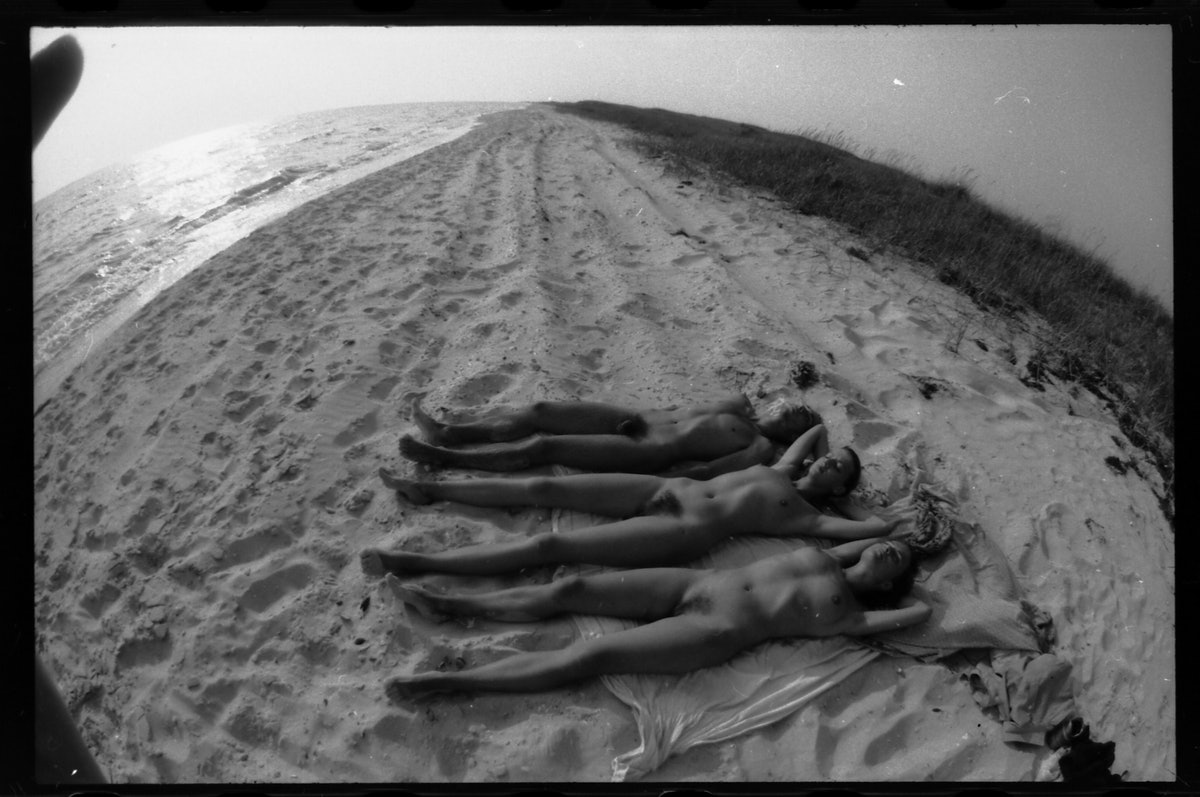
From the series “Heat-2”

From the series “Heat-2”

From the series “Heat-2”
Another example of playing with art history is the untitled series (sometimes signed as “Homo — Asterius Games”), in which human naked bodies are presented as if they were ancient sculptures. The photographs painted in scarlet create a surreal perception and convey a certain mysticism. The author embodied a similar plot and idea in another series — “Garden and Park Sculpture.”
In Shevchuk’s early series, the naked body is shown rather as asexual, although sometimes elements of eroticism and even queer-eroticism are present. The artist was more interested in texture, composition, geometry, experiment. For example, his series “Heat-2” with naked models on the Odessa coast may seem sultry, but the attitude to the body in these shots, despite sometimes too explicit poses, is not vulgarized. In some photographs, the body even merges with the hot sea shore, mimicking the sandy relief.
The search for composition led the author to create the series “Tic-Tac-Toe,” where the artist literally recreates the board game using human naked bodies.

From the series “Homo — Asterius Games”

From the series “Homo — Asterius Games”

From the series “Homo — Asterius Games”
However, from the mid-1990s, his “bodies” acquire traits of sexuality, and often even hypersexuality. The author increasingly turns to political and social themes, which he also reveals through nudity, but in a different, more radical way. His approach to shooting also changes: Shevchuk works more with digital photography and less with analog printing methods; color increasingly “seeps” into his photography.
The author increasingly turns to political and social themes, which he reveals through nudity.
In the 2000s, Alexander Shevchuk’s works often appeared in the cult magazine “NASH” alongside photographs by artists of the Kharkiv School of Photography and Nikolay Troha. Curatorial practice was also important for Shevchuk. He was one of the authors of the exhibition “NASHI,” dedicated to the artists of the “Paris Commune,” and a number of other projects.
With his photographic heritage, Shevchuk slips out of the conceptual textual and painterly Odessa context and, despite close ties with the scene, is an autonomous author.

From the series “Garden and Park Sculpture”

From the series “Garden and Park Sculpture”

From the series “Walks”

From the series “Walks”

From the series “Meat Grinder”

From the series “Meat Grinder”

From the series “Fed Up”

From the series “Fed Up”

From the series “Tic-Tac-Toe”

From the series “Tic-Tac-Toe”

From the series “Tic-Tac-Toe”

From the series “Tic-Tac-Toe”