
Place of travesty: was there queer in Kharkiv photography?
The human body in the paradigm of late Soviet Kharkiv photography of the participants of the group “Vremya” and subsequent generations of photographers was one of the visual tools through which artists embodied images of the social and cultural state of the time. In the visual culture of the Soviet Union, close attention was paid to the human body: the representation of the body and corporeality was strictly regulated. A person and their body had to conform to a certain norm, for example, there was a cult of the athletic and healthy body. But not overly athletic: health and sport were welcomed for achievements in work and military service, not for admiring beauty. Moreover, other things were regulated according to a person’s gender, for example, the female body was supposed to emphasize the maternal tasks of a woman, and the male body was to speak of strength, endurance, stability, and reliability. However, unlike the visual culture that prevailed in official art and advertising, life existed by other, more diverse laws, where people with different traits, characters, and personalities could exist. These discrepancies, in particular, interested Kharkiv artists who recorded them and intuitively transformed them into a metaphor of the time.
Reviewing the practice of Kharkiv photographers and the works of individual authors, it should be noted that alongside irony, kitsch, destruction [1], they are characterized by transgression and travesty in constructing metaphorical images. If transgression marks the time of crossing an impassable boundary, that is, the line where the possible and impossible intersect, then travesty, as an artistic form, denotes this transitional process from one symbolic system to another, which changes states and transforms the context of perception. That is, travesty creates artistic circumstances in which the “transition” is playful, understandable, and, accordingly, legitimate. However, not everything that is a game or looks like a game is travestied and transgressive.
Travesty as a genre was born in Italy to denote varieties of burlesque or satirical poetry, in which heroism and seriousness were presented in humorous and comic forms. Such a genre is characterized by provocation, carnivalization, simplicity of language, including colloquial and jargon expressions. It is a peculiar combination of high and low culture, the brutal with the sentimental, excess with simplicity. Travesty entered the history of Ukrainian culture through literary studies, while Ukrainian visual art was almost not considered through this lens. The most significant scholarly works in this context were made by the literary researcher Tamara Hundorova, who “re-read” Ukrainian literature through this focus. Following European colleagues, she considers travesty and kitsch also as postcolonial critique. Following her German colleague Clement Greenberg, Hundorova decodes colonial kitsch as “a special way of interpreting the ‘other,’ when the subjected object (in this case, a people, an ethnic group) is identified by the cultural metropolis with a specific set of ’empty’ and ‘secondary signs'” [2]. Among the features of travesty and carnival culture, the researcher identifies hybridity of language, style, ideology, and identity.
Critic Kostyantyn Doroshenko emphasizes the tendency toward theatricalization of life inherent in the late Soviet creative intelligentsia, when “the dull seriousness of official culture was opposed precisely by play.” “Trying on the roles of secretive Baron Munchausens and exalted Lancelots in opposition to pompous burgomasters and power-hungry dragons, which spilled out in annoying mockery, banter of local artistic postmodernism,” he stressed [3].
In the curatorial text of artist Nikita Kadan for the exhibition “Disobedient Bodies,” the author applied queer theory as the new avant-garde, noting that the art of the 1980s–1990s was “shock-transgressive.” In particular, he points out that “in the unofficial art of the perestroika period and in post-Soviet works of the 1990s, the body becomes an instrument of transgression, overcoming disciplinary order through shock effects of documentary display of the body or through transforming corporeality into a phantasm, an object of eroticized hallucination” [4].
Returning to the body as an image and metaphor, one cannot fail to notice the changes that occurred in visual representation. Starting from the 1970s, Kharkiv artists recorded different people with various manifestations that went beyond exclusively athletic and healthy individuals and respectable citizens, thus establishing a new normativity. As Boris Mikhailov noted, “this person is somehow different” [5]. Primarily, it was about a person’s gaze, behavior, social status. However, if you look closer, there were characteristic features that revealed this “otherness.” The human body could represent different definitions of personality, for example, a man could be sensitive, sentimental, and gentle, while a woman, on the contrary, could have so-called “male” traits — willpower, decisiveness, and steadfastness. This “bodily hybridity” is more pronounced during the Perestroika period. It is interesting to note how political perestroika also affected bodily perestroika.
Such a transition and conditional permission to have other unregulated traits can be attributed not only to travesty and transgression but also called queer. However, in this context, these terms should not be mistakenly understood as homoerotic and sexual scenes or hints of such nature. This term is borrowed from social anthropological discourse initiated by the Russian cultural journal “Raznoglasiya.” Understanding the delicacy of this term, researcher Nadya Plungyan begins her report “Queer in the Land of the Soviets, or Archaeology of Dissent” with methodological and terminological pitfalls arising from its broad use. She notes that the word “queer” in its broad interpretation is not used to denote sexuality but signifies an exit from dominant “normativity.” Quoting activist and publicist Valery Sozaev, Plungyan undermines in her text: “queer” is not only a non-essentialist (i.e., not essentialist) but primarily a playful (i.e., performative) category, in which “playing today, one can discard tomorrow” [6]. That is, it is about the emergence of something at the intersection between the past day and the present day. Analyzing the history of Ukrainian culture through literature, Tamara Hundorova in the book “Kitsch and Literature” repeatedly emphasizes that travesty and kitsch arise precisely in this way. She highlights, in particular, historical periods: such as Kotlyarevshchyna and colonial kitsch, secessionist kitsch in modernism, ideological kitsch in socialism, carnival kitsch in postmodernism, and kitsch as mockery [7].
The art of Kharkiv photographers has similar temporal circumstances: it emerged at the end of the Soviet Union; coincided with political and social changes after the Cuban Missile Crisis, the Chernobyl disaster, and the fall of the Berlin Wall; became a product of ideological socialist kitsch. And, as historian of Kharkiv photography Tetyana Pavlova aptly notes: “Playful photography [in the work of the group ‘Vremya’] was undoubtedly a projection of the carnivalistic paradigm. And it is triggered with every transitional period. The end of the 1980s was marked by it. There was a release of creative energy necessary for the transition to the new” [8].
Kharkiv artists borrowed this playful manner, a certain theatricality, from the Lithuanian school of photography. Carnivalization as an artistic form of flirting with nomenclature and regulated artistic order in the practice of some Kharkiv photographers created a peculiar fusion. Besides play and dressing up, where atypical clothing was a violation of normativity, the process of undressing and the body itself also became violations. Ideologically inappropriate images, clothing, poses, or even glances could be perceived by the Soviet system as deviations from the norm.
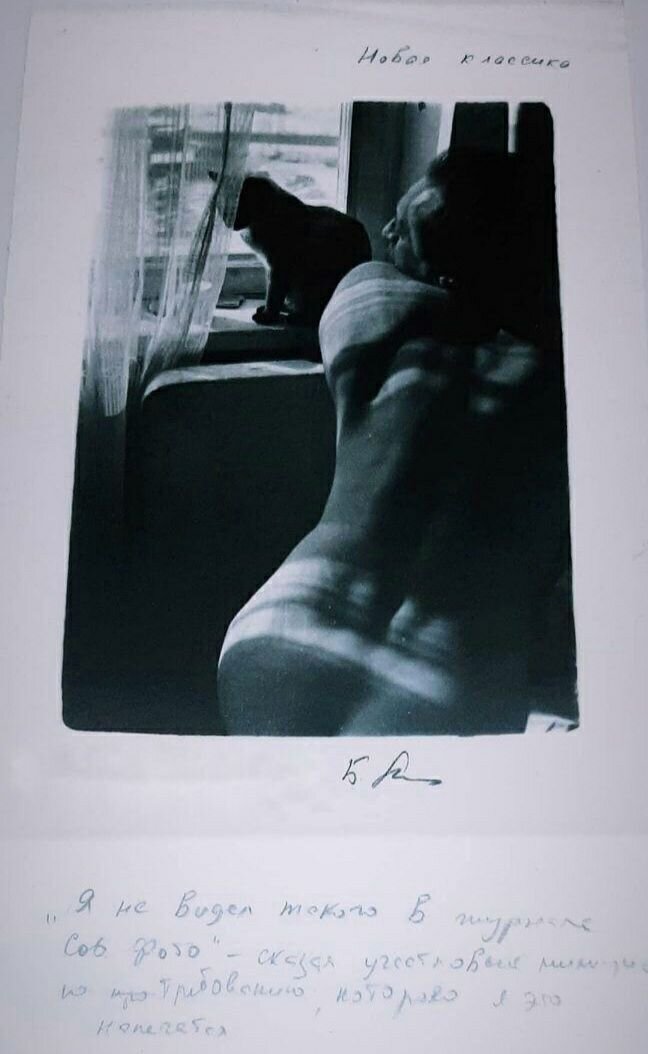
Boris Mikhailov. Sheet from the series “Viscosity.” 1982. Photograph from the exhibition “Forbidden Image,” PinchukArtCentre, 2019
For example, Boris Mikhailov’s autobiographical series “Viscosity” (1982) draws attention with a self-portrait where the artist takes a stereotypically feminine pose and imitates “female” sensitivity and tenderness in the frame. In some photos of the series, the author seems to try on certain social roles and images typical for both men and women. That is, the artist blurs the boundary of the actually permitted. Each photo is accompanied by captions where textual and visual interact, adding a diary-like character to the series. The textuality of the body and the possibility of “reading” a veiled idea between angles and poses, as if between the lines, is a characteristic feature of Mikhailov’s diary series. The peculiarity of this series is that the author seems to reproduce a personal intimate space closed to others. It is under such circumstances that a person can be themselves — sincere, uninhibited, playful, emotional, brave, and helpless. Researcher Olena Oleksandra Chervonik writes about transgressiveness in Boris Mikhailov’s work. Analyzing the series “Medical History” (1997–1998), she emphasizes that by turning to acts of artistic transgression, the artist “exposed the apparent limits of representation in the documentary genre, simultaneously revealing the limits of representation as such, as well as the position of the artist who breaks the documentary matrix” [9]. “Medical History” also reveals everyday domestic conflicts. However, this private space is not theirs; it is the artist’s home, who invites authors to themselves and offers them to play certain scenes from life.
Existential “Viscosity” in its total Soviet everydayness, combined with what could be defined as authorial clowning, mannerism, or theatricality, is actually transgression, that is, fixation of the transition to the territory of symbolic “otherness.”
Unlike Mikhailov, whose focus was on his own experiences manifested in his thoughts, texts, and images, other Kharkiv photographers construct peculiar decorations to create narratives and develop certain scenes. Occasionally, they act as actors/models in the frame, but more often the theme is manifested by the staged nature of the photograph and the attributes of the frame.

Yevhen Pavlov. Series “Love.” 1976. Silver gelatin print. Courtesy of Grynyov Art Foundation
An example of such theatrical play is Yevhen Pavlov’s series “Love.” The heroes of his photographic story are two young men and a woman who play out the plot of a love triangle. The man who was denied love and neglected in the relationship is dressed in the photos in elements of women’s clothing — underwear and torn stockings. Dressing in women’s underwear thus becomes a manifestation of the hero’s emotional weakness; compositionally and conceptually, he recedes into the background and occupies a subordinate position relative to the main characters of the series. That is, the process of changing clothes, in a way, the image, and with it the traditional social role, is a zone of transition regarding the metaphorical change of the hero’s role model without changing gender.
Another example of staging, which can be mistakenly perceived as transgressive, is Oleg Malovany’s “Blue Series” (1992), which the author dedicated to the LGBT theme. In the photos, a man performs theatrical etudes showing stereotypical female images. In one photograph, he playfully tries on two balloons placed in the chest area. The playful and mocking staging regarding the subject of his image proves that not every theatricality and play with repressed images is a travesty or transgressive method of working with the declared theme. It is a game within a game. Malovany’s hero pretends a certain stereotypically hypertrophied image of an LGBT community member in the eyes of the then conservative society. Such a formal approach rather superficially and literally illustrates social phobias than deeply comprehends the declared theme.

Oleg Malovany. Sheets from the series “Blue Series.” 1992. Silver gelatin print. Courtesy of Grynyov Art Foundation

Oleg Malovany. Sheets from the series “Blue Series.” 1992. Silver gelatin print. Courtesy of Grynyov Art Foundation
However, the real visual embodiment of the transition from one symbolic and political system to another is the cycle “Bestiary” by Serhiy Solonsky (mid-1990s–1997). The history of culture defines a bestiary as an anthology of fantastic and semi-real creatures [10]. What is described in them was what a medieval person could not know or understand. In fact, bestiaries reflected a wide range of sublimated fears about “otherness” in the mystical thinking of medieval man. The heroes of Solonsky’s “Bestiary” are those who are not yet known to the general public but are already radically different and completely unlike the average image of a Soviet person [11].

Serhiy Solonsky. Sheet from the series “Boudoir.” 1995. Silver gelatin print, collage. Courtesy of the Museum of Kharkiv School of Photography

Serhiy Solonsky. Sheet from the series “Body.” 1993. Silver gelatin print. Courtesy of the Museum of Kharkiv School of Photography
The “Bestiary” cycle includes several series, among which in the series “Body” the author creates a gallery of imaginary bodily transformations of the new person. It is noteworthy that the photos of this series, like Boris Mikhailov’s diary series, are also self-portraits, and the theatricality of the depicted is enhanced by the specifics of studio shooting. Here, performativity becomes the tool that allows the photographer to independently cross stereotypical boundaries and amplify theatricality to the level of travesty. Notable in the “Bestiary” cycle is the series “Boudoir” (1995), where the author constructs a body that combines male and female sexual characteristics. The layering of male and female embodies the chimera of metamorphosis of the Soviet socialist past into the new capitalist present. Using Tamara Hundorova’s literary definition, a time of specific burlesque — post-socialist, that is, kitsch as mockery — comes. Today, images from the “Boudoir” series can be read through a gender lens. Solonsky himself states that his heroines embody the qualities of the new woman who, at the turn of the eras, absorbed both female and male traits: delicacy and strength, mannerism and decisiveness [12]. Such a social construct was characteristic of late Soviet and post-Soviet society.
No less travestied in form is the work of the Rapid Response Group “If I Were a German” (1994). In it, the artists turn to playful forms, burlesque, and specific humor, raising important themes of history, memory, and heroism. They question the politics of viewing history through the eyes of the victor. The embodiment of such a provocative and ambivalent form was possible only in the cultural rupture of the 1990s and only from artists formed in the Soviet Union. It concentrates a deconstructive reaction to the formal, lifeless, intrusive cult of victory in the Great Patriotic War, introduced during Leonid Brezhnev’s rule, when songs, ribbons, exhibitions, literature, often censored or falsified memories of the war, ceremonies, and parades densely filled the informational space of a person from kindergarten to funeral speeches. Primarily ironic and burlesque, the series “If I Were a German” is defined by us as travestied and transgressive; here, the instruments of carnivalization reveal complex sociocultural aspects of memory and the construction of historical narrative.
If in literary studies travesty reveals the boundaries of high literature and simple speech, then in visual art such a marker became color. Thanks to photographers introducing striking color into reportage photography, the glorification of official events acquires features of burlesque and buffoonery and turns into a masquerade. Kharkiv photographers emphasized the importance of color. It is precisely with color in the series “Luriki” (1971–1985) that Boris Mikhailov emphasizes the popular character of the vernacular photograph by kitsch coloring. Hence the excessive use of bright colors in reportage of “popular masses” — rallies, demonstrations, etc. This is nothing but marking provincialism, folk character, popular print style, and primitiveness inherent in travesty as an artistic form. As the publishers of the journal 5.6 aptly note, “color gave an ironic distance necessary to transform an ordinary shot into an object of art” [13]. According to the journal’s authors, it was the introduction of color that turned photography into an experimental space. Viktor and Serhiy Kochetovy, for example, created a gallery of reportage photos of mass events where the introduction of color seemed to reveal hidden sociality. Meanwhile, Boris Mikhailov’s “Red Series” (1968–1975) manifests the totality of color in the system of Soviet ideology. The “Red Series” is a reportage where emphasis is made conceptually and literally fixes the repressiveness of the red color in the Soviet public and visual field. Describing the place of color in Kharkiv photographers’ practice, researcher Tetyana Pavlova emphasizes its excessiveness [14]. This opinion was supplemented by Oleksandra Osadcha, adding that in some series color is “a reaction to the new, unfamiliar, ‘non-Soviet’ environment” [15].

Rapid Response Group (Serhiy Bratkov, Boris Mikhailov, Serhiy Solonsky, with the participation of Vita Mikhailova). If I Were a German. 1994. Silver gelatin print, private collection, Moscow. Photographs courtesy of PinchukArtCentre © 2016. Photographer: Serhiy Illin
Turning to old forms but in a conversation about new ideas, Kharkiv photographers with their series and projects created a travestied dimension where there was room for transgressive manifestations: simultaneously play and non-play, seriousness and non-seriousness, moralism and amorality, personal and public, documentary and constructed. Such an exit beyond normativity, including bodily, emphasized the peculiarity of the time in which the artists lived and worked. They reproduced images that deviated from established norms and allowed themselves to demonstrate emotions and themes tabooed in society. Thus, Kharkiv photographers marked the zone of transition from the paradigms of the old order to new political and aesthetic systems.
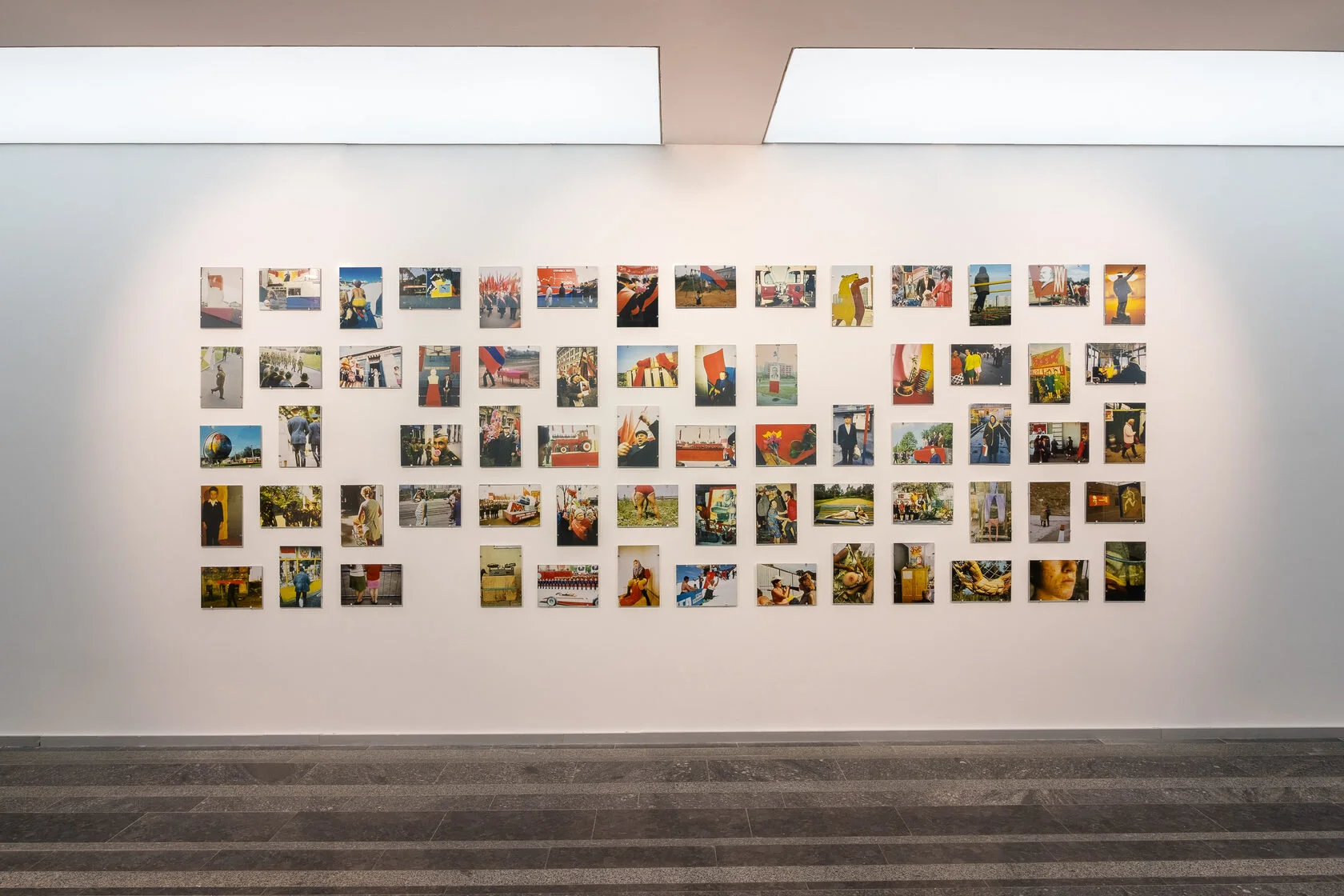
Boris Mikhailov. Red Series. 1968–1975. Color print. Courtesy of the artist. Photographs courtesy of PinchukArtCentre © 2019. Photographer: Serhiy Illin
[1] 5.6. [journal]. — May 2012. — No. 7.
[2] Hundorova Tamara. Colonial Kitsch in the Gogol Style. In: Die Welt der Slaven. Sammelbande. Studien zu Sprache, Literatur und Kultur bei den Slaven. Memorial Volume for George Y. Shevelov. — Verlag Otto Sagner, Munich-Berlin, 2012. — pp. 460–481.
[3] Doroshenko Kostyantyn. The multifaceted creative activity of Uta Kilter will be presented by the Museum of Contemporary Art of Odessa // Suspilne. — February 28, 2020. — URL: https://suspilne.media/16762-bagatogrannu-tvorcu-dialnist-uti-kilter-predstavit-muzej-sucasnogo-mistectva-odesi/ )
[4] Kadan Nikita. “Disobedient Bodies”: queer as the new avant-garde / Nikita Kadan // Your Art. — https://supportyourart.com/stories/quirkmytiv
[5] Boris Mikhailov – ‘Photography Was a Way Out’ | TateShots. — URL: https://www.youtube.com/watch?v=p14s9ZZn-pg
[6] Quoted from: Plungyan Nadya. Queer in the Land of the Soviets, or Archaeology of Dissent / N. Plungyan // Colta.ru. — August 30, 2016. — URL: https://www.colta.ru/articles/raznoglasiya/12083-kvir-v-strane-sovetov-ili-arheologiya-raznomysliya
[7] Hundorova Tamara. Kitsch and Literature. Kyiv: Fakt. — 2008. — 284 pages.
[8] Yakovlenko Kateryna. Tetyana Pavlova: “We picked myths as keys” / K. Yakovlenko, T. Pavlova // Korydor. — July 15, 2019. — Access mode: http://www.korydor.in.ua/ua/voices/tatyana-pavlova-my-podbirali-mify-kak-kljuchi.html
[9] Chervonik Olena. Urban Opera of Boris Mikhailov / Olena Chervonik // Korydor. — February 26. — URL: http://www.korydor.in.ua/ua/stories/urbanistichna-opera-borysa-myhailova.html
[10] Bestiary in Literature and Visual Arts: Collection of Articles / Ed. A. L. Lvova. Moscow: Intrada, 2012. — 183 pages.
[11] More about the change of hero in Kharkiv photography read here: Kochubynska Tatyana. In Search of the Average: The Theme of the Hero in Kharkiv Photography of the Late 1980s–2000s / Tatyana Kochubynska // Your Art. — February 26, 2020. — URL: https://supportyourart.com/researchplatform/hero-kharkiv
[12] Hliba Halyna, Yakovlenko Kateryna. Milk for Harm: Sexuality, Corporeality, and Intimate Space in Ukrainian Art of the 1990s / Why There Are Great Female Artists in Ukrainian Art. — Kyiv: Publishing Pro, 2019. — 224 pages.
[13] 5.6. [journal]. — May 2012. — No. 7.
[14] Pavlova Tetyana. On the History of Kharkiv Photography: Group “Vremya” / Tetyana Pavlova // Korydor. — June 30, 2019. — URL: http://www.korydor.in.ua/ua/context/11657.html
[15] Osadcha Oleksandra. Viktor and Serhiy Kochetovy: “Unapproved Moments” / Oleksandra Osadcha // Museum of Kharkiv School of Photography. — May 10, 2020. — URL: https://www.moksop.org/viktor-ta-serhiy-kochetov-ne-zatverdzheni-momenty/
Second publication, supplemented. First published in the KHARKIV PHOTO FORUM 2020 conference proceedings.
Text prepared for KHARKIV PHOTO FORUM: Ukrainian Club of Contemporary Art Collectors, Grynyov Art Foundation. Supported by UCF.
Prepared based on materials from the Research Platform of PinchukArtCentre
Halyna Hliba and Kateryna Yakovlenko