Artist Anna Zvyagintseva: “I don’t know if the Kyiv school exists”
Anna Zvyagintseva is a Kyiv artist, laureate of the PinchukArtCentre Special Prize 2015 and finalist of the PinchukArtCentre Prize 2017. Her new project “Inappropriate Touches” (curator — Tetyana Kochubynska) is an artistic exploration of the nature of touch. It is about the kinds of contacts between loving people; people in military conditions or conflict societies; acquaintances and strangers. Love and hate, war and peace, friendship and enmity are reflected in bodily practice. Through drawing, photography, sculpture, and animation, Zvyagintseva transfers touches into the exhibition and discussion space.
Speaking about your exhibition, Ukrainian artist Vlada Ralko noted one important feature – sterility. It seems to me a very apt description of the feeling that arises while being in your exposition. One can draw a parallel with a hospital space where a doctor diagnoses problems in a person’s body and treats them. Do you feel like a doctor intervening in social corporeality?
I often use the method of cleaning: I remove all the unnecessary, exposing and revealing the theme that interests me. I take various materials, look for different points of view, and then bring everything to a state where only the necessary remains.
The exhibition space can be called a laboratory with bright light, where the artist creates certain conditions for the viewer to meet the artwork, triggering reflections through the rules of the game established in this place. But I myself do not fully understand the theme I take on, and I work to understand it — so I cannot “heal” viewers by showing them a certain course of things. Rather, we have a joint “game of understanding,” in which my task is to invent the rules.
The theme of touches, which I talk about in the exhibition, is implicit, ambiguous, and exposing it is a surgically responsible task.
I think the exhibition “Anonymous Society”, located at the PinchukArtCentre right before mine, also played a role in creating the effect of sterility. It is an exhibition of photo and video works with many projections in dark rooms — so my exposition becomes a dazzling space for viewers who have passed through the darkness. When preparing my exhibition, I did not know what would precede it, but when I saw the two exhibitions together, I liked this effect.

Photo: Olga Ivashchenko
How did the theme of touch arise in your practice?
For the first time, I caught myself paying special attention to this theme during participation in street protest actions. When you go out into the protest space, you think about your safety: whether harm will be done to your body. You don’t put this at the forefront, but you still feel co-presence in the same space with sources of danger. When you are physically present on the street, in the square, you kind of articulate your protest through your body, communicating what you are ready to do. During preparation for protests, information spreads among participants about how to protect oneself and what to do if clashes are unavoidable.
Street protest does not exist without the body, without its presence on the street in joint action with other bodies. And I was interested in observing and developing the theme of how you interact with other people at a protest. Maidan sharpened my attention: among the crowd — anonymous, gigantic, filling all visible space — euphoria arises and the feeling that you are all one body. This aspect of implicit bodily contact is one of those I wanted to reveal in the exhibition.
Another reason why this theme surfaced in my art is my new experience of motherhood, which involves a lot of corporeality.
When you talk about touches, about the body, it seems everyone understands what is meant. But this is a purely individual experience. The experience of articulating bodily sensations in our society and in our language is limited — so sometimes it may seem that this experience is indescribable.
How do you combine these two experiences — being a mother and an artist?
The most obvious is the lack of free time.
It is harder to talk about this further. Motherhood is a unique, indescribable experience. One experience of motherhood is not identical to another, although each individual maternal experience consists of routine, identical actions. You will never find precise enough words to describe bodily experience — in motherhood, this manifested especially vividly for me.
I made a work in which I tried to talk about something similar — “Single Records.” The source material was a sheet from an office supply store with scribbles of pens and markers, which I embroidered on white fabric. The automatism of these scribbles makes them look similar to each other, although each is the work of an individual person. The collective ornament is a product of typologically identical but uncoordinated actions. The tangle of scribbles is a product of similarity in difference. It was a modest monument to unique routine actions.

“Single Records” 2016, fabric, machine embroidery

Photo: Olga Ivashchenko
In the online magazine “Prostory” you run a column “Drawing of Wartime”, where you publish works of your colleagues. What do you mean by the concept of “drawing of wartime”?
Currently, my author section is quiet, but this is temporary. The very title “Drawing of Wartime” contains two meanings: it is not only, and sometimes not so much, a drawing made during the war — but primarily what kind of drawing is created because of the war.
Roughly speaking, it is about how war influences the nature of the image — both its creation and perception. I can take works by artists who did not talk about war at all, but this will be my view as a curator and a person from a country living in conditions of war. Through this prism, I look at the works of my colleagues and try to build a certain sequence from the images they created, which I show in this section. In the future, this project may develop into an exhibition space or a book.
Often there are no comments from me — mostly I take comments from artists from their interviews, which, in my opinion, most accurately respond to the work. Sometimes I allow myself to give a small explanation — for example, why crosses constantly appear in Roman Uranek’s works. But the text is only a hint; I prefer the visual language.
You said that the theme of war is not chosen — only the point of view is chosen. How difficult is it for an artist to find it?
In those of my works directly related to this theme, I talk about what the artist’s gaze is and how he or she can speak about it. There are other authors close to me who talk about war in more detail: they analyze the basics of the concept of “war,” try to talk about terminology, return to the essence of war, removing details.
It is important to understand that we are all participants in events. And I would like all of us to feel our presence at war or near war, not closing our eyes to what is happening. My artistic approach in this case is that I consider how war colors peaceful processes, how the echo of war reaches every person and can influence everyday life.

Photo: Olga Ivashchenko
Can an artist influence society during war and to what extent?
It seems to me that one should not harbor illusions that someone here will bring practical changes through art — except perhaps quite modest ones at the level of propaganda.
If you feel that this theme is important to you, you cannot not talk about it. Certainly, I look for opportunities to do and say what I want, to find like-minded people — and just people interested in my view.
Is the existence of a “united artistic front” possible today?
Artists form a “front” not with art, but with their civic position. What kind of art they make may not be so important in this case. It is important that they sometimes gather together to articulate political positions and be able to say something.
Quickly uniting around some kind of conjuncture to show “works on the topic” seems wrong to me — although it may attract public attention for a short time.
If in the story with Mystetsky Arsenal and Vladimir Kuznetsov’s work all artists recognized that this is unacceptable, the situation would have been different, and the Ukrainian art scene would be quite different today. But in reality, only a small part of the community supported the protest. I do not put the effectiveness of the protest in place of its ethical meaning, but the “united front” is defined by the number of participants.
Accordingly, this raises questions about what they are ready to sacrifice for this unity.
In your practice, you refer to drawing as a theme and as a method. How flexible is it?
Drawing is a very good theme: precisely a theme, not just a tool. I often dissect the very idea of the drawing line as a thinking line, and I want to develop this further and further in my practice. For me, the idea of drawing is connected with how a person thinks.
Lately, any theme that interests me somehow finds its reflection precisely in drawing. And I am interested in how far I will go when there is absolutely nothing left of drawing — whether I can exhaust it for myself.

“My Father’s Sculptures” 2013, found objects
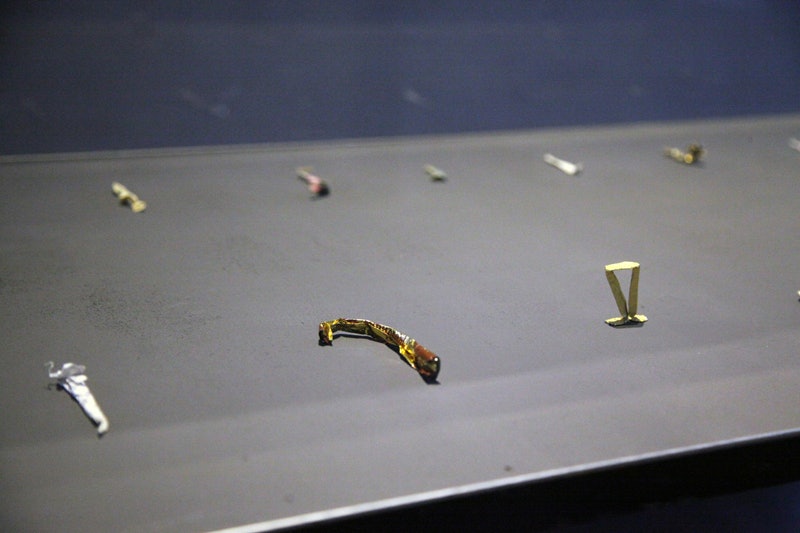
“My Father’s Sculptures” 2013, found objects
How did the academic environment influence you? Has the “Kyiv school” reflected in your practice?
When I studied painting at the National Academy of Arts and Architecture, only self-education could gather a more or less complete picture even of local art history. Only recently have they started talking about this period and these artists at the Academy — but sometimes this conversation is simply inadequate, covering emptiness with loud names like Kazimir Malevich.
In fact, I don’t know what the “Kyiv school” is and whether it exists.
Certainly, the Academy’s theme is now receiving quite a lot of attention as it marks its centenary. But this happens against the backdrop of an increasingly obvious crisis in the Ukrainian post-Soviet system of art education.
I am a third-generation artist: my grandfather, father, and mother are artists. Being in such an environment, among artists and books, was my introduction to art, to how an artist lives and works. However, I do completely different things than my parents and grandfather.
In the project I made with my father’s “sculptures” (actually, figures twisted by him in moments of thought from candy wrappers), I wanted to draw attention to what my father does not only on the easel but also in life. I called it art, although he did not call it that. It was a kind of “as-if-art” that I appropriated, translating the “artistic” into the very act of choosing and naming.