
Paraska Plytka-Horytsvit: Ukrainian Vivian Maier
Artist Paraska Plytka-Horytsvit survived Stalin’s camps, after which she lived almost her entire life in the Hutsul village of Kryvorivnia. Her photos depict the lives of entire generations of villagers — birthdays, holidays, religious rituals, and funerals. For a long time, her archive was considered lost, but it was found six years ago. On October 17, an exhibition dedicated to the “Homer of the Hutsuls” will open at the Kyiv center “Mystetskyi Arsenal.”
The Ukrainian folk writer, artist, and photographer Paraska Plytka-Horytsvit has only recently come into the spotlight. Her biographical story and the story of her photo and art archive are truly captivating. She is called the “Homer of the Hutsuls”: under the pseudonym Horytsvit (the Ukrainian name for the plant adonis), she wrote fairy tales, poems, created handmade books, sculptures, made ethnographic sketches, and engaged in painting and graphics. Among her works, there are even icons.
But today, greater interest is focused on her photographs. Some were shown at the Odesa Photo Days festival, and now the archive will be presented at the exhibition “Overcoming Gravity,” which will open on October 17 at the “Mystetskyi Arsenal” complex.

Photographs from the archive of Paraska Plytka-Horytsvit
Truth and Myth
Resident of the Carpathian Kryvorivnia, Paraska Plytka-Horytsvit returned to her native village after 10 years of imprisonment in Stalin’s camps and captured its traditions, rituals, inhabitants, and nature. A whole Hutsul world emerges in Plytka-Horytsvit’s numerous photos, illustrating decades and eras. After the author died in 1998, her photo archive was considered lost, but several years ago part of the materials was found.
Her photo archive was considered lost, but several years ago part of the materials was found.
The artist was born in 1927 into the family of blacksmith Stefan Plytka and his wife Anna, who was an embroiderer. It is known that Paraska completed only four grades of school but managed to get home education. She sang well, played various musical instruments (which she later made herself), had technical knowledge, and spoke foreign languages. When World War II began, she worked as a translator in the village office. In 1943, she went to Germany, where she did household work in a German family. Then she returned to her native village and joined the Ukrainian Insurgent Army. She worked as a liaison under the pseudonym “Swallow.”
When Soviet troops occupied Western Ukraine, many insurgents were arrested — this happened to Plytka-Horytsvit as well. In the winter of 1945, she was sent to Siberia, and from there to a special camp in Kazakhstan.

Photographs from the archive of Paraska Plytka-Horytsvit

Photographs from the archive of Paraska Plytka-Horytsvit

Photographs from the archive of Paraska Plytka-Horytsvit

Photographs from the archive of Paraska Plytka-Horytsvit
Although more is now being said about Paraska Plytka-Horytsvit, there are still many myths surrounding her biography. The exhibition curator and researcher Kateryna Radchenko explains that they often contradict the artist’s own archive: “One of the myths is that she led a hermit lifestyle. But in the photos, it is clear that she began photographing almost immediately after returning from the camps. Most often, she photographed family and fellow villagers. She participated in collective work — in the forest or during the harvest. Many students, cultural figures, and ethnographers visited Paraska. She corresponded with the Sixtiers — writers, artists, architects from various Ukrainian cities. Based on all this information, one cannot speak of asceticism, but rather of selective communication: she independently chose her circle of acquaintances. Paraska lived a few meters from her parents’ house and always maintained very warm relations with her parents and sister, as evidenced by diary and lyrical notes, photographs.”
The myth of loneliness may have arisen because she had neither a husband nor children. Sometimes it is explained by a story of eternal love: allegedly, in the camps, the girl met a Georgian artist she fell in love with, but due to her parents’ disapproval, she lost contact with him. Released by amnesty at 27, Paraska settled separately and never fell in love again. But this version is also a myth. “There is not a single piece of evidence that this happened,” Radchenko explains. “No letters, no photographs, no poems remain.”
Perhaps many villagers did not want to associate with a former political prisoner — as it could complicate their lives and attract the attention of security services. Radchenko clarifies that such an attitude was also towards other political prisoners: for example, a similar fate befell Paraska’s close friend and fellow villager Theodosia Plytka-Sorokhan, who lived nearby and was also lonely all her life.
In a way, Paraska Plytka-Horytsvit is the Ukrainian Vivian Maier, a self-taught photographer with the ability both to be among people and to distance herself from them.

Photographs from the archive of Paraska Plytka-Horytsvit
All by herself
The archive of Paraska Plytka-Horytsvit consists of smiling portraits of her fellow villagers, from infants to the elderly. She gave the photos to the people she photographed. Plytka-Horytsvit captured births, funerals, religious holidays, and family celebrations. Everything around her was in her frames. She seemed to be searching for something with her gaze, creating countless shots of the same subject, one after another.
Everything around her was in her frames.
It is unknown how and why Paraska began photographing. “Perhaps it was the influence of people from the camp,” suggests Radchenko. “After all, she was surrounded by intellectuals there; some conversations with these people could have pushed the artist towards photography. Perhaps it was the influence of the region itself: before the war, Verkhovyna district belonged to Austria-Hungary and was popular among photographers — there were more photo studios in the Carpathians than in the Odesa region. Photographers from Austria and Poland came to the Carpathians, photographing landscapes, folklore, making postcards, and developing the direction of photoethnography.”
Returning home, Paraska Plytka-Horytsvit got a job at the forestry department. With her first salary, she bought a “Smena” camera, and with the second — a photo enlarger. For a long time, she could not develop film and print photos at home because electricity was only connected to her house in the 1970s. Therefore, she printed her first photos at the forestry office.

Photographs from the archive of Paraska Plytka-Horytsvit

Photographs from the archive of Paraska Plytka-Horytsvit

Photographs from the archive of Paraska Plytka-Horytsvit

Photographs from the archive of Paraska Plytka-Horytsvit
“It was very easy to learn to do everything yourself back then,” notes Radchenko. “There was a lot of Soviet literature explaining photographic processes. In Paraska Plytka-Horytsvit’s library, we found several textbooks explaining technological photo processes. She learned a lot from correspondence. For example, in letters, she was told how to develop certain types of film. In addition, she was also sent film and paper, clippings from photography magazines. Her sources of inspiration and information were correspondence with friends, her environment, which later influenced her creativity and was embodied in the synthesis of Hutsul traditions and new directions.”
Paraska did not have a garden, she did not manage a household; all her time was occupied by creativity — writing, books, paintings, drawings, and photography. In the 1970s, she led expeditions in the Carpathians. Plytka-Horytsvit was interested in politics, liked philosophy, and was fascinated by the culture and traditions of India. A huge album dedicated to space was found in her archive.
Paraska lived in the village, but this did not prevent her from keeping up with new technologies and trends. “From her photographs, we see a balanced approach and understanding of how a person should behave in the frame. In photos from the 1960s, we see that she used shaped cutouts — this was popular in the 1950s–1960s. Sometimes she colored photographs — this was also popular in her contemporary period. She created masks for the photo enlarger to emphasize the central object in the frame; made collage vignettes; signed negatives with ink, creating a second layer — all these experiments reflected trends existing in the USSR in the 1950s–1970s,” says Kateryna Radchenko.

Photographs from the archive of Paraska Plytka-Horytsvit
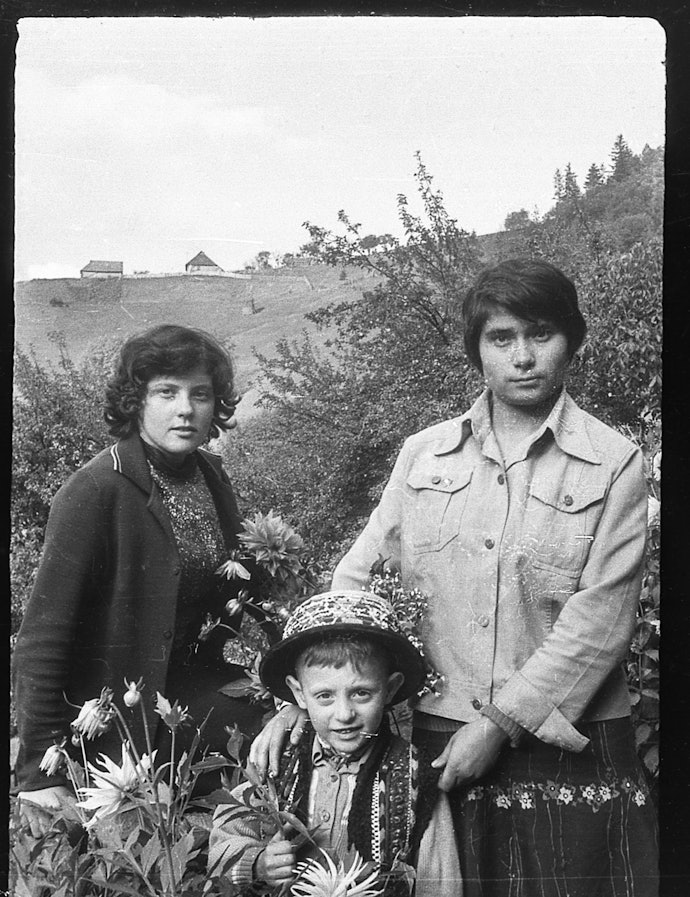
Photographs from the archive of Paraska Plytka-Horytsvit
Four thousand shots
When a group of researchers found Paraska Plytka-Horytsvit’s photographs, they were very dirty, and some materials were damaged. Because of this, it is impossible to count how many films the artist shot or how many she selected. Some are cut frame by frame, in others frames overlap, and some are almost destroyed. Sometimes Plytka-Horytsvit sent films to friends in Kyiv and asked them to develop and print them in the city.
Today, her photo archive includes more than four thousand works. “I believe that Paraska’s shots are excellent and powerful material for research,” notes Radchenko. “When we talk about women photographers in Ukraine, we face three problems. First: women photographers existed, but their archives are not accessible; at most, a few shots can be found in private collections. Second: the work of women who photographed in Western Ukraine, particularly in Lviv and Ivano-Frankivsk, now belongs to Poland’s artistic heritage. Third: photos by women photographers born and working in Ukraine but who emigrated at some point have become part of the heritage of Austria, Australia, the UK, France. Unfortunately, when telling the story of the entire 20th century, we can count the photographing women on the fingers of one hand. Paraska’s name will be among them, so the fact that the archive was found is incredibly cool.”

Photographs from the archive of Paraska Plytka-Horytsvit

Photographs from the archive of Paraska Plytka-Horytsvit

Photographs from the archive of Paraska Plytka-Horytsvit

Photographs from the archive of Paraska Plytka-Horytsvit
The artist’s archive belongs to the community of the village Kryvorivnia — after all, it was the history of its people and rituals that she photographed. These countless frames truly depict entire generations, one after another. Essentially — the history of the whole village in the second half of the last century.
These countless frames truly depict entire generations, one after another.
“When we talk about history, we must understand that there is an official narrative and a real history that does not enter archives,” explains Radchenko. “Paraska’s archive is evidence of ‘unofficial’ history, more truthful. This archive shows the author’s view of the region from the 1950s to the 1990s. In the photos, we see how tastes, fashion, politics, influence or lack thereof changed. But besides this historical/documentary significance, Paraska Plytka-Horytsvit’s photographs also have aesthetic value. This is evident in her approach to working with space and people.”
Now Plytka-Horytsvit’s house is an unofficial museum of her work. Kryvorivnia was once known for frequent visits by Ukrainian intelligentsia; Sergei Parajanov filmed his movie “Shadows of Forgotten Ancestors” here. Now it is also a place with a unique museum of an interesting artist.