(NOT) A LOST DECADE: ART IN THE SOCIO-POLITICAL CONTEXT OF THE 90s

The nineties are probably the most mythologized decade in the recent history of Ukraine. This period is chronologically very close to our present, and almost everyone has their own memories of life in those years, but the complexity and contradictions of the historical processes of this decade make it a very convenient material for manipulation and distortion.
One vivid example of such manipulation is the campaign initiated by Russian propaganda (at least since the second half of the 2000s) to create a specific image of the nineties, when the absolute dominants of social life were a severe economic crisis and the rise of crime, in contrast to the supposedly well-fed and safe “Soviet childhood.” At the same time, it ignores the fact that the deep economic decline and criminalization of society (including youth street banditry) began to intensify already in the early 80s, i.e., they were an organic product of the Soviet system, not a consequence of its collapse.
Equally manipulative is the widespread opinion that at the beginning of the 90s, the citizens of Ukraine did not fight for or deserve the independence of the state, but that it supposedly fell from the sky as a result of the collapse of the Soviet Union. This idea has especially intensified recently, combined with the claim that the real struggle for an independent state by Ukrainians actually began only at the Maidan in 2013-2014. Such an interpretation leaves out the activities of organizations such as the Ukrainian Helsinki Union, the People’s Movement of Ukraine, various student associations, as well as the significance of events like the “Revolution on Granite,” miners’ strikes (during which, besides political demands, economic demands were raised and which led, among other things, to the adoption in 1989 by the Supreme Soviet of the Ukrainian SSR of the Law “On the Economic Independence of the Ukrainian SSR”), and mass rallies and demonstrations that swept the country in 1989-1991.
On the other hand, it is impossible not to agree that despite the turbulent course of historical events and the active involvement of youth in these processes, a significant part of the population remained politically passive. As one of the activists of the “Revolution on Granite” recalled: “In fact, this <hunger strike – K.S.> is a very powerful tool. And using it then, as I thought, was premature. Because, in fact, we had a situation of 25% – for independence, and 75% – for the Soviet Union.”
In reality, as time showed, such an assessment was far from the truth: in the referendum of the same year, 90% of citizens voted for the proclamation of Ukraine’s independence. But it is clear that not all who voted for leaving the Soviet Union were supporters of building a new Ukrainian state on national grounds. The vast majority were driven by hope to overcome the deep economic and political crisis, in simple terms, the appearance of sausage in the stores. For a large part of the youth, the proclamation of independence was rather a guarantee of preserving and deepening freedoms and human rights, a pledge that the processes of democratization of society and breaking with the totalitarian past, which began with perestroika, would acquire an irreversible character.
As the future showed, those for whom the main agenda was national sovereignty underestimated the importance of economic factors to ensure it was not declarative and formal. Those who considered solving economic problems the cornerstone of changes in the state did not take into account the fact that building an effective economy was hardly possible without gaining political independence from the former metropolis, which constantly desired the return of lost colonies. Finally, the third group soon realized that without balancing the interests of the first and second groups, building such a state that could ensure the rights and freedoms of its citizens becomes extremely problematic.
Apoliticality was also characteristic of most Ukrainian artists in the early 90s. Expressions that would somehow reflect the processes taking place in the country are not abundant in the art of those times, to be frank. There were exceptions, of course – one can recall the 1993 performances in Lviv “Cross Transplantation of Independence” by Yuriy Sokolov and “The 8th Seal, or Letters to the Earthlings” by Volodymyr Kaufman; the 1994 Mazokh Fund action “Mausoleum for the President”; the series of actions by the “Rapid Response Group” in 1994-96. A separate chapter in this context is the work of Oleh Tistol, who, initially in collaboration with Kostyantyn Reunov and later with Mykola Matsenko, developed an original and witty creative strategy. It allowed him to work in the riskiest field for our context, dissecting the national mentality and those visual codes that arose at the intersection of traditional Ukrainian and nomenklatura Soviet imagery.
But the vast majority of representatives of the “new wave,” especially at the very beginning of the 90s, distanced themselves from artistic commentary on political life and social issues. As Valeriya Trubina recalls: “We were then so asocial and lived in our rather narrow circle that no one cared which leaders and political forces came to the arena and fought near the trough. When a conversation about politics started, everyone smiled. There was no scent of patriotism. I think the Soviet system had already so exhausted us by then that it was insanely disgusting in all its manifestations, so we treated the authorities with disgust.”

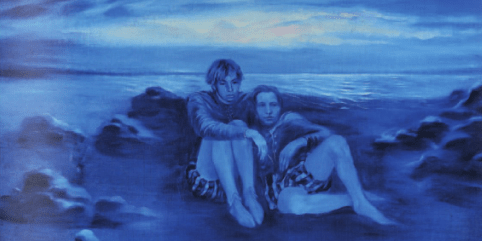
Valeriya Trubina, 1992, Youth by the Sea, canvas, oil, 200 x 150 cm
An apolitical attitude to reality, non-participation in protest actions, fear of losing one’s creative freedom at the moment of touching political expression – this is an old tradition in Ukrainian art, characteristic already of the sixtiers. The combination of the idea of art autonomy with the syndrome of learned helplessness, which was typical for the post-Soviet person, resulted in various forms of escapism – attraction to pure abstraction (the work of the “Pictorial Reserve” group), programmatic infantilism (the so-called “child discourse” propagated by some artists of the “Paris Commune”). Although there were no precedents of real repression for artistic expressions (the early 90s was a unique period when some censors had already left and others had not yet appeared, so there was a kind of round-the-clock “Festival of Disobedience”), there is evidence that fear of punishment for provocative artistic activity also existed. In 1997, Vasyl Tsagolov said, commenting on his 1994 project: “…The likelihood of criminal liability is too high, so there can be no question of flaunting oneself or showing off. <…> A court trial for an artist can become a rather gloomy industrial performance”[1].

N. Mandrych. 1994, Vasyl Tsagolov during the performance “I’m No Longer an Artist.” Source: Terra Incognita
The fascination of the “new wave” artists with the philosophy and aesthetics of postmodernism also contributed rather to distancing from the social agenda of the present – the author’s detached position, carnivalesque, irony, and cosmopolitanism were the components that Ukrainian artists and their critics and curators chose from the intellectual and ideological arsenal of postmodernism for their manifestos or analysis of their own practice. The wild popularity of the thesis about the “end of history,” which was then perceived as an unshakable truth, also contributed to irresponsible playful attitudes toward reality – history ended, there is no future, the struggle ceases.
Interestingly, over time, some works created in the vein of such postmodernist play received a qualitatively different sound and interpretation. In today’s realities, Vasyl Tsagolov’s “Hard Television,” Savadov-Kharchenko’s “Donbas-Chocolate,” or the kinetic sculpture of the protesting miner Oleksandr Hnylytsky, which was exhibited in the National Bank building, are perceived quite differently.
Interest in global philosophical and cultural concepts was part of the search by Ukrainian art of the 90s for its potential place in the international artistic process. If the position (or rather opposition) of Ukrainian art to the “Moscow norm” was formulated and firmly established in a whole code of texts already in the late 80s (“hot,” “welcoming,” neo-baroque Kyiv against “cold,” reasonable, conceptual Moscow), then leaving the empire promised prospects to find its own place in a broader global context.
Undoubtedly, the early 90s, despite the economic depression, was a time of great hopes. Foreign curators, who previously only reached Moscow, finally began to come to the new country, which became an impetus for organizing several large exhibitions of Ukrainian art abroad (“Postanesthesia,” “Angels over Ukraine,” “Steppes of Europe”), as well as sporadic participation of Ukrainian artists in international exhibitions and events. With the opening of the Soros Center for Contemporary Art, the flow of Western curators to Ukraine became even more stable, and the grant support of the CCSC for various projects in the field of contemporary art caused a real boom in artistic activity.
In the capital of the newly created state, embassies, cultural centers, and commercial company offices were opened, staffed by foreigners who had the habit and means to buy art. There were precedents of corporate collections formed by banks, the first commercial galleries opened, and art fairs began to be held. It seemed that an internal art market would soon begin to form in the country, and Western curators would notice and “bring out into the world” Ukrainian artists. But it quickly became clear that without structural political and significant financial support from the state and/or big business, the promotion of Ukrainian art in the international context would not happen by itself. The urgent issue was the formulation of the state’s cultural policy.
In this context, it is interesting to analyze how the relations between contemporary art and state institutions developed in the first half of the 90s. If you carefully look at the list of exhibitions held at least in the first half of the 90s, you can see that many institutional resources, which were on the balance of various state institutions – the Artists’ Union, the Ministry of Culture, the Cabinet of Ministers – were involved in very active exhibition activities at that time. In Kyiv, almost all exhibition halls of the republican and city Artists’ Unions, many museums – the National Art Museum, the Museum of Russian Art, the Shevchenko Museum, the Ukrainian House, the Kosyi Kaponir – regularly became venues for contemporary art presentations. A similar situation existed in other cities of Ukraine. The financial conditions of such cooperation varied greatly in different cases, but it was definitely not about rent at commercial prices.
Another example of interaction between contemporary art and the existing post-Soviet infrastructure is that many private galleries that existed in Kyiv and other Ukrainian cities in the 90s were opened on the basis of workshops obtained through the Artists’ Union.
It is quite clear that such a situation was by no means a conscious policy of state institutions but became a result of the self-organization of artistic life in conditions of institutional vacuum and a consequence of the hybrid role played by many organizers of contemporary art exhibitions in the 90s: on the one hand, they acted as somewhat independent curators and often had external sources of funding for their projects (for example, CCSC grants); on the other hand, they were often officially employed in state institutions and influenced their exhibition policy.
Thus, in the first half of the 90s in Ukraine, a peculiar symbiosis arose between the new culture, which had no infrastructure of its own, and the old infrastructure, which was not capable of producing culture itself. It is clear, given the weakness of both organisms in their coexistence – the first was still too young and needed external “feeding,” and the second was already dying of institutional “old age” – this symbiosis itself turned out to be nonviable. But when this became obvious, it turned out that building a dialogue with the state on new grounds was already impossible.
While contemporary art existed in its parallel world, making no articulated demands on the state, demonstrating self-sufficiency and almost not commenting on political processes in artistic language, the state learned to use this autonomy and lack of claims to budget resources. Two parallel worlds appeared – the contemporary artistic process with its own resources and survival strategies, and the state apparatus – a decorative facade that created a simulation of “cultural management” and was governed by absolutely ineffective, detached from reality, and non-transparent principles of activity. In a report by Oleksandr Roitburd at a conference on contemporary art organized by the Blanka gallery on a CCSC grant in 1995, it was stated that contemporary art lost the struggle to the “old artistic nomenclature” and that “there is no point in fighting them for their territory. <…> It is impossible to defeat their system – any winner it will spoil in its own image and likeness” (“Portfolio. Odessa Art of the 90s”). Roitburd then proposed that the state create a “two-party cultural system in Ukraine” – without dismantling the establishment, allocate a small part of the state budget to finance administrative expenses, provide artists with abandoned factory workshops and bomb shelters for use, and ensure a preferential tax regime for contemporary art institutions.
This text is written so convincingly, it is so logically constructed and offers such clear tools for implementing proposals that it has become a kind of “classic,” which is taken out of the closet from time to time, dusted off, reread, and again and again commented on, shaking heads: “Everything was so simple and possible. But nothing changed. How long will we keep talking about this?”
The bitter truth is that even at that time, nothing could be changed by manifestos and negotiations. The state did not need a “two-party system” in culture at all, and in political life, “multipartyism” was later to be reduced to a decorative attribute of a supposedly democratic society. All Ukrainian state institutions and instruments were rapidly turning into the same as the Ministry of Culture – decorative facades, fake panels, behind which a parallel life took place and the old or new nomenclature privatized resources in all spheres of economic, social, and cultural life. The “Euro-renovation,” which the R.E.P. group spoke about in the next decade, was already actively unfolding in the mid-90s.
Considering the political-economic regime that began to form in Ukraine precisely in the mid to late 90s, Donetsk researcher Hennadiy Korzhov writes that the half-heartedness and failure of reforms in post-Soviet countries undergoing post-socialist transformation was not a consequence of the inability to implement a plan written by Western advisors. He argues that such “modernization is initiated and directed precisely by those social actors who are at the same time its main, and often the only, winners and beneficiaries of its fruits. Starting reforms, these social agents, on the one hand, do not bring them to a logical conclusion, and on the other hand, do not try to completely stop or nullify them. They rather direct them in such a way that fully ensures their ability to have complete control over the situation and receive rent from their dominant position <…> That is why liberalization under such conditions led to privatization without creating effective market institutions and regulatory mechanisms. Similarly, democratization had a decorative-declarative, significantly limited, top-down controlled character, not leading to real changes in the system of state governance, relations between power and people, state and society, and not changing the nature of social relations” [2].
If you look at the history of the emergence of the clan-oligarchic political system in Ukraine from this perspective, it is not surprising at all that the proposals of Oleksandr Roitburd or any other program of support for contemporary art and interaction with it were of no use to the state. The Ukrainian state did not “unsuccessfully reform” the cultural sphere – it was not interested in reforming it and strengthening its influence at all. It also seems that the state perceived the artistic environment as so powerless, atomized, and amorphous that it did not even attempt to “feed” it and thus keep it under control, as was done, for example, in Russia.
In the second half of the 90s, it became quite clear that interaction with simulation state institutions was pointless and ineffective; the long-awaited international breakthrough did not happen; the internal art market could not support the existence of artists even at the survival level. An alternative-free drifting of Ukrainian art into the arms of oligarchic clans and its integration into a new quasi-feudal social structure began. The main events in this drift – the “Cultural Hero” festival, the formation of Viktor Pinchuk’s collection, its first exhibitions, the opening of PinchukArtCentre, the appearance of Rinat Akhmetov’s foundation – will unfold already in the 2000s, i.e., chronologically go beyond the period discussed in this text. However, the most fascinating testimonies of this process can be two artifacts created still in the 90s – the visualization of the Mazokh Fund action “Mausoleum for the President” in 1994 and the poster of Leonid Kuchma’s 1999 presidential campaign.

Mausoleum for the President. Installation (1994)

Poster, Ukrainian presidential elections, 1999
These two images are united by authorship, character (Ukrainian president), and the event to which their creation is dedicated (elections). But in all other respects, there is a real chasm between them, so it is hard to believe that only 5 years separate them. If the first is a rather bleak reminder of the function that contemporary art could have (although, unfortunately, did not begin to) perform in the 90s, the second is a much sadder prophecy of the role it willingly took on in the 2000s.
One might ask whether the artists, curators, and critics themselves bear responsibility for everything turning out this way. Was this model of interaction between the artist, the state, and society, which was built in Ukraine, inevitable under the given historical circumstances? Could the course of events have been influenced at some stage?
The very formulation of such questions assumes that the artist (or art in general) has some direct instruments of influence with a very clear mode of action and predictable result. In reality, the ways art influences the surrounding reality are much more complex and indirect. For example, it may be that the main event in 90s art was the moment when in 1993 the then director of the Soros Center for Contemporary Art, Marta Kuzma, came to the opening of an exhibition of a group of Ukrainian artists (Oleh Tistol, Mykola Matsenko, Oleksandr Kharchenko, Anatoliy Stepanenko) in a semi-abandoned old academic building of the newly restored Kyiv-Mohyla Academy. This space, skillfully mastered by the artists, made such an impression on the curator that later she managed to lobby for the creation of a CCSC exhibition hall there (which was an exceptional case in the network of Soros centers in Eastern Europe, as their concept did not provide for opening exhibition spaces). Over the years of NaUKMA’s existence, many young people who played an important role in Ukraine’s third millennium revolutions graduated from there and now constitute a valuable personnel potential for cultural, political, and economic changes. Perhaps the experience of coexisting with contemporary art during their student years influenced at least some of them; for some, the encounter with Mykhailov’s photography, Kabakov’s installation, or Boyts’s video became an experience that changed something in life and worldview. Some of the dozens of NaUKMA students who interned at the Center have now become key cultural managers of the country. Finally, this very place later turned into a laboratory where a new generation of Ukrainian artists emerged.
One can build many more theories about what happened in the 90s that makes this decade not lost and not in vain; but these will be further hypotheses and manipulations. What can be said for sure – Francis Fukuyama was wrong, history continues, including the history of Ukraine, and in many ways – thanks precisely to this strange decade.
Notes:
- “Conversation of Oleksandr Solovyov with Vasyl Tsagolov about ‘Mazepa’. – “Parta”, No. 1, Kyiv, 1997, p. 49
- Hennadiy Korzhov. Oligarchy as a Model of Limited Modernization // Ukrainian Socium. — 2007. — Issue 1. — pp. 104–114.

Comment type: Research Platform Publications
Author: Kateryna Stukalova
Sources: Stukalova K. (NOT) A LOST DECADE: ART IN THE SOCIO-POLITICAL CONTEXT OF THE 90s [Electronic resource] / Kateryna Stukalova // Korydor. – 2016. – Access mode: http://www.korydor.in.ua/ua/context/nevtrachene-desiatylittia-mystetstvo-devianostyh-rokiv.html.