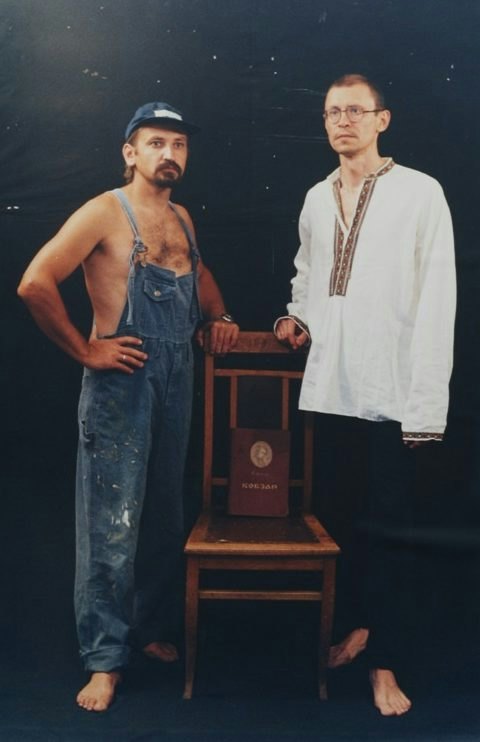
Oleh Tistol and Mykola Matsenko have always been interested in the history of Ukraine — its heroes and antiheroes, all those important dates and facts that made it into school textbooks but were perceived simplistically. Therefore, in the manifestos of their association “Natsprom,” the artists proclaimed a struggle for beautiful stereotypes, and in their works, they spoke about the most ambiguous moments of the past and their interpretation in the present.
Summer 1994 in Crimea, the “battle for the Black Sea Fleet” between Russia and Ukraine was in full swing. In Sevastopol, an international festival was taking place, with events happening at various locations. Among them was the exhibition “Alchemical Capitulation,” organized by the Kyiv Soros Center for Contemporary Art on the military ship “Slavutych.” The deck, holds, cabins — the entire ship was transformed into an exhibition space where the works formed a complex statement about difficult times.
On the opening day of the exhibition, artists Oleh Tistol, Mykola Matsenko, and Oleksandr Kharchenko, with the support of the “Slavutych” crew, recreated da Vinci’s “The Last Supper” in the form of a performance, with sailors playing the roles of Jesus and the apostles. It is believed that the history of the Renaissance era began with da Vinci’s “The Last Supper.” This performance also became iconic.
Struggle for stereotypes
Matsenko and Tistol studied together at an art school in Kyiv, then at the Lviv State Institute of Applied and Decorative Arts. They also collaborated, fulfilling orders for the art combine in the 1980s. Afterward, Tistol lived in Moscow in the famous squat on Furmannyi Lane, participated in exhibitions in Europe, and in 1992 returned to Kyiv and resumed working with Matsenko. Their first joint project happened then within the exhibition “Kosyi Kaponir,” the second — at the exhibition “Space Exploration” in the building of the Kyiv-Mohyla Academy.
The name “Natsprom” appeared much later and meant not only an association. “Natsprom” is an ideological program of two authors based on their artistic interest in national history and culture. Matsenko and Tistol consistently developed these themes both in individual works and collective creativity. The artists formulated their strategy in the text “The Battle of Poltava,” published in the art magazine “Parta.” Later, there were other programmatic essays, but in each, the authors proclaimed a struggle for the beauty of the national stereotype. Thus, they developed a strategy formulated at the end of the 1980s by Tistol and Kostyantyn Reunov — then, in the manifesto “The Willful Edge of National Post-Eclecticism,” the artists proclaimed the end of art.
The pathos of the “Natsprom” manifestos was built around national history, or rather its complex and ambiguous periods and personalities. The authors raised questions about who our historical heroes are, what heroism is in principle, which events shape the Ukrainian national idea, and what shapes it at all. In the 1990s, during the creation of new statehood, these topics were especially in demand.
The programmatic work of the collective is the panel “The Battle of Poltava,” referring to an important event in Ukrainian history. Sweden’s defeat caused serious geopolitical changes in contemporary Europe, redistributing spheres of influence in favor of Moscow and strengthening its authority in the region. In this work, the authors drew attention to themes of political friendship, alliance, and betrayal.
Everyone to the museum
In their works, the artists often referred to stylistic and compositional repetitions, used stencils, which connects “Natsprom” creativity with pop art. For example, the motif of a kiss migrated from Tistol’s work “Reunion” to collective projects. But while in many cultures a kiss is part of traditions related to greetings and farewells, in the works of Tistol and Matsenko it is not friendly at all and symbolizes deceit. This is due to the conviction that no matter how close the cultures of “brotherly” peoples are, the geopolitical conflict between them and the desire to suppress the weaker are inevitable.
One of the most important in “Natsprom” creativity are its “museum” projects. For example, “Atatürk Museum” (together with Oleksandr Kharchenko and Anatoliy Stepanenko) — an installation within the exhibition “Kyiv Art Meeting.” The work was a conditional waiting room — a space with soft armchairs, green houseplants, a coffee table, special spherical lamps designed by Oleksandr Kharchenko. At the entrance were works by Anatoliy Stepanenko, and on one of the walls was a joint work by Tistol and Matsenko, where they depicted riders heading toward the horizon.
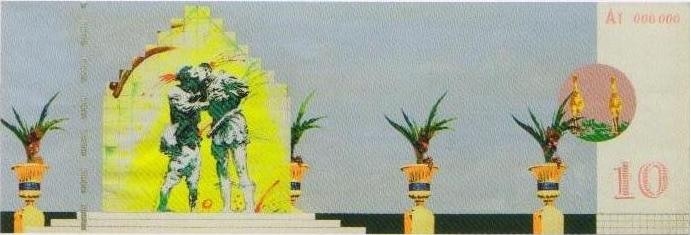
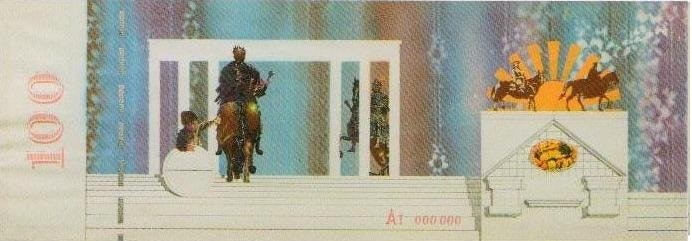
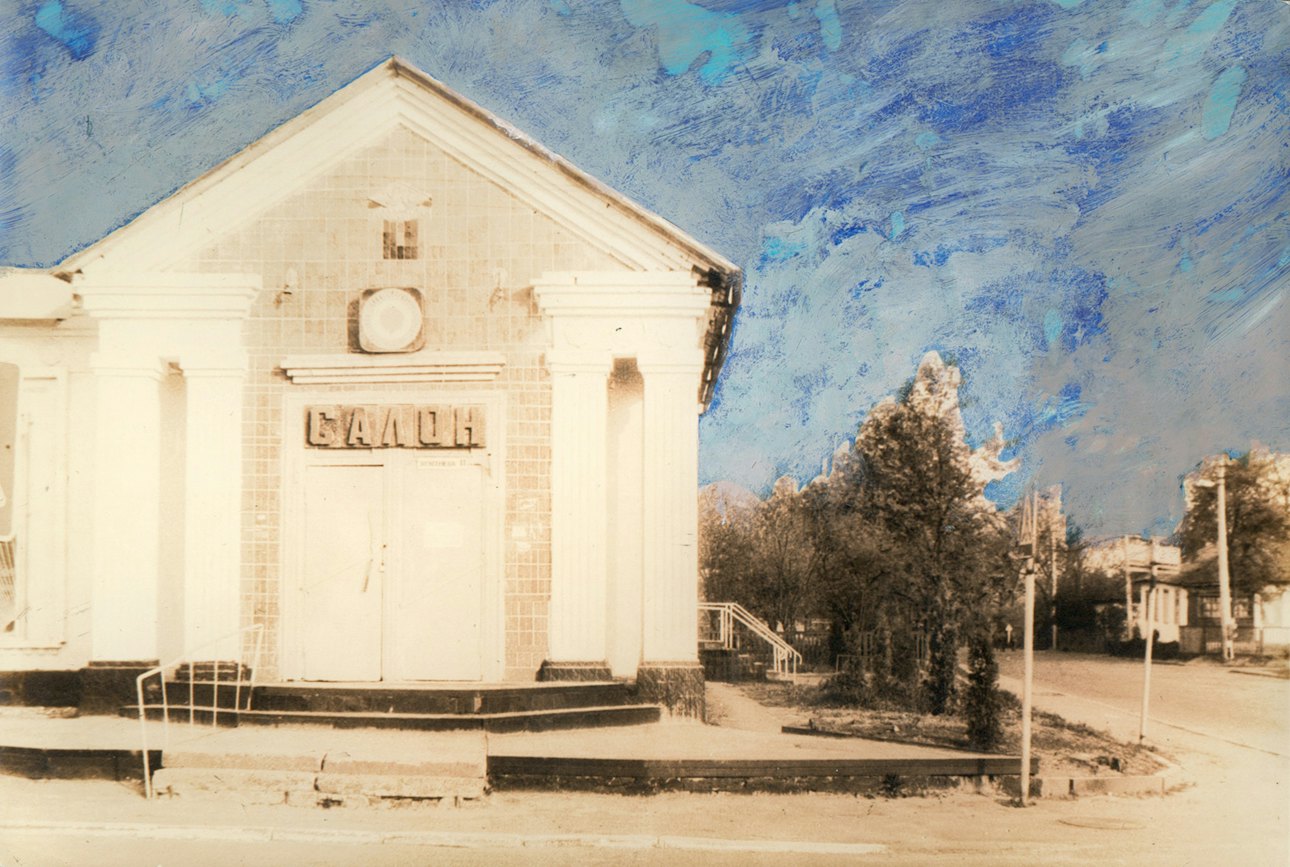
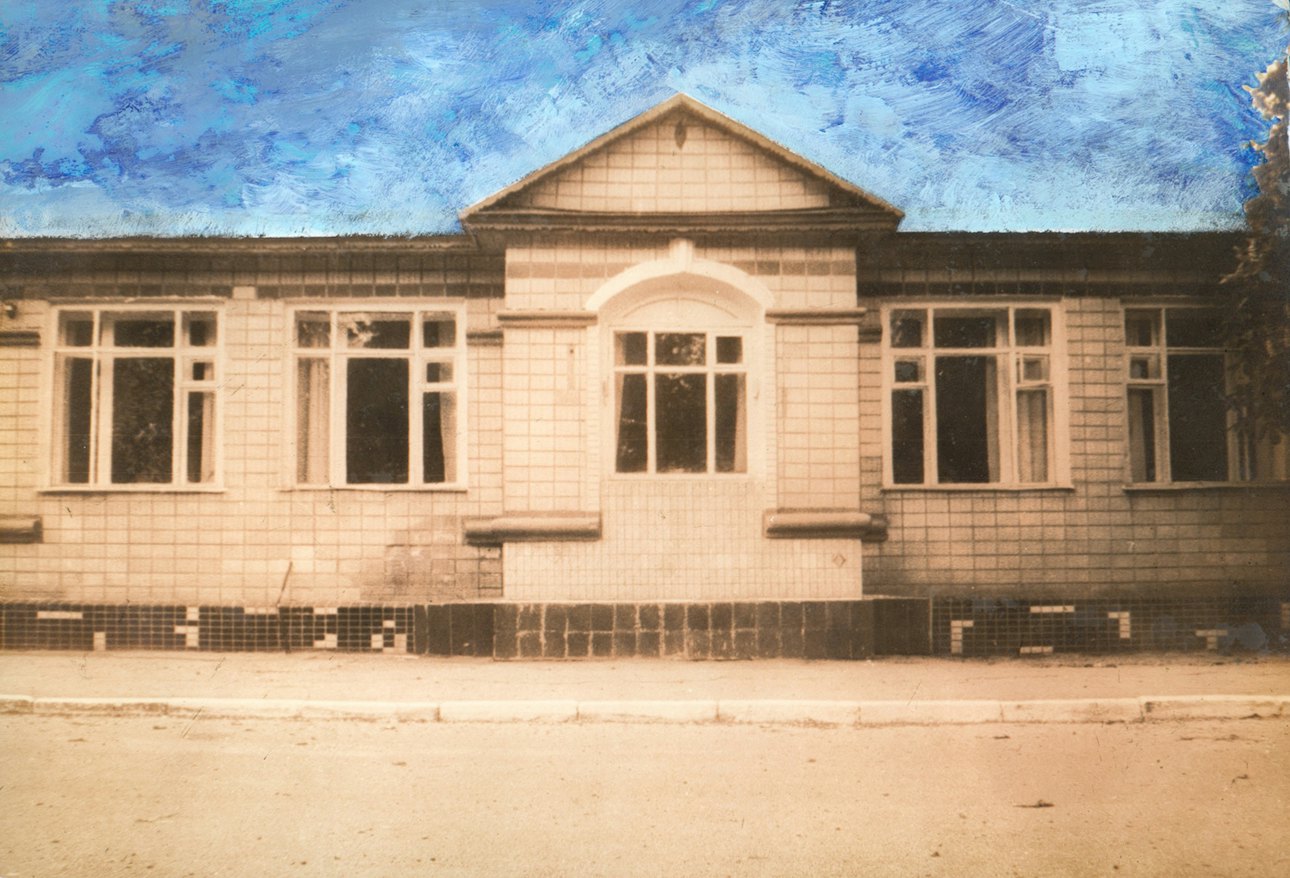
Riders are another important motif in “Natsprom” creativity, symbolizing the search and constant struggle for resources. In this installation, the artists wanted to touch on themes of archetypes and national history, which they continued to do in the “Museum of Architecture” and the “National Museum Project.” In the first work, the authors spoke about Ukrainian architecture, particularly the Baroque period, and cultural heritage in general. The installation consisted of a metal panel depicting a kiss and black-and-white photographs capturing the pediments of buildings in the village of Baryshivka in Kyiv region. This village was founded in the 980s–990s by Prince Volodymyr Monomakh Oster. The artists brought the facades and pediments to the forefront, drawing attention to the fact that this history matters, although it remains unspoken.
They created the “National Museum Project” two years later, in 1998, also addressing the problem of national memory. This time, the artists made several panels with participants of historical events, for example, with the Polish political figure Józef Piłsudski, known for his aggressive policy towards Ukrainians. Another important hero, or rather antihero, in “Natsprom” works is the Russian commander Alexander Suvorov. These panels, like some other works by the artists, were made of paper. The fragility of the material emphasized the fragility of history itself, its susceptibility to deformation and transformation under the pressure of ideology.
History not by the textbook
By referring to the museum format in all these works, the authors wanted to further emphasize the significance of the chosen themes. Referring to important dates and events included in school textbooks, the artists speak about the stereotypical and simplified perception of history as such, bringing its duality and ambiguity to the forefront.
In “Natsprom” installations, there are also altar motifs, which allows one to speak about closeness to the Christian tradition. For Tistol, this comparison is not accidental, as in his work he often refers to folk icons and Ukrainian Baroque.
At the same time, the artists’ works are full of mystifications. Describing them, art critic Halyna Sklyarenko noted grotesque, quasi-carnival elements, and folkloric naivety. Thanks to these techniques and stylistic solutions, the ruin that the artists speak about in their work turns into a mechanism for restoring tradition, understanding one’s past, and cultural heritage.